• Kenya Saturday and Sunday 25/02/2018

    On Saturday afternoon, a hot sunny day, we drove into the Masai Mara Park to engage in the other side of our wildlife experience. For our morning drive John, our Masai guide and driver, Virginia and me, all in our Land Rover had the whole conservancy to ourselves. In the afternoon we expected that the situation would be much different and it was, both from the game on view as well as the number of vehicles sharing the view.

    Entering the park at 3pm we paid US$80 each for a 24 hour pass. Our plan is to go to the park in the afternoon and stay until sunset and then return the following morning at sunrise and stay until our pass runs out in the later afternoon. That way we can maximize our viewing time and then spend time in our conservancy to slow the pace periodically and enjoy the more peaceful side of our wildlife experience. We don’t have a bucket list, we are not trying to tick boxes and we have lots of time to be patient and get the shots we want.

    Because we did not have the time to drive great distances through the park before sunset John, our guide, suggested that we spend the afternoon around a large marsh area which would have lots of elephants and because of the time of year, lots of baby elephants. Additionally there were sure to be lots of birds and I’m particularly interested in seeing and getting some shots of Crowned Cranes, one of my favourites, which would likely be nesting in the area.
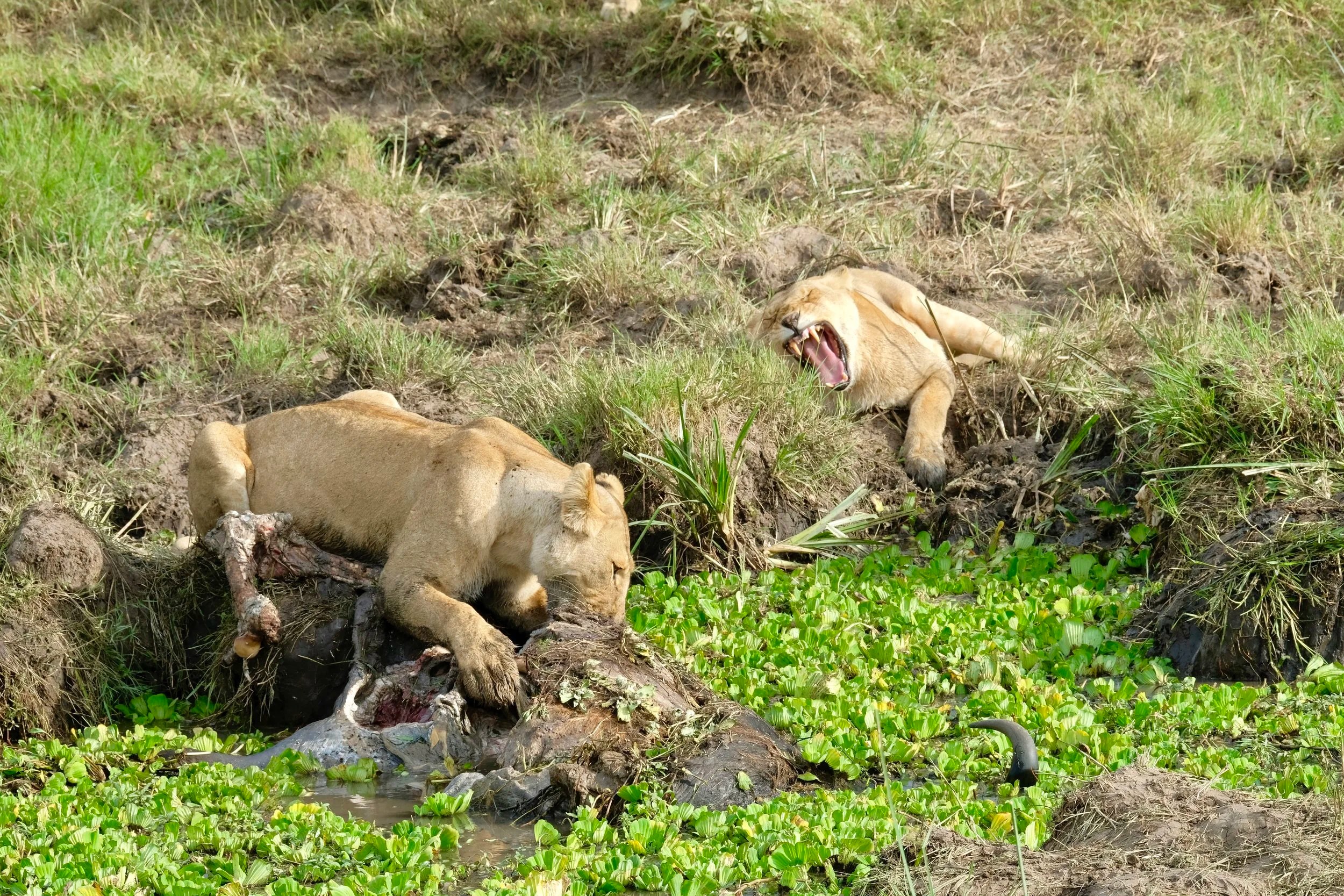
     Lionesses arguing over kill
    Lionesses arguing over kill

    Arriving at the marsh we spotted a group of vehicles clustered around a section of the marsh which had an area of open water. On getting closer we saw a large male lion doing what they do best, dozing in the shade, while 3 lionesses took turns trying to haul a half-eaten buffalo carcass out of the water. They had clearly taken the buffalo down while it was in the water and had eaten as much as they could of the portions that were above the surface but they were determined to haul the rest out onto dry land so that they could finish consuming it. It was most of the hind quarters and a good portion of the underlying half of the body and the weight must have been massive but they were determined to get it  out while gnawing off chunks in the process. Thir power and strength was extraordinary to be able to lift and haul the massive carcass with very little purchase for their claws on the marshy ground. And they were not combining to haul the carcass out of the water but only one lioness at a time was allowed to have access to it. To have killed the beast would have required the combined efforts of all of them, but once killed they ate it individually in their turns hauling it out as they ate, their eating order determined by their seniority and status. The male had already eaten, hence the siesta under the trees to sleep it off and the females were now taking their turns. One of the females decided to eat out of order and the standoff, roaring and battling took at least 1/2 hour to sort out, tense, noisy, close and slightly terrifying.
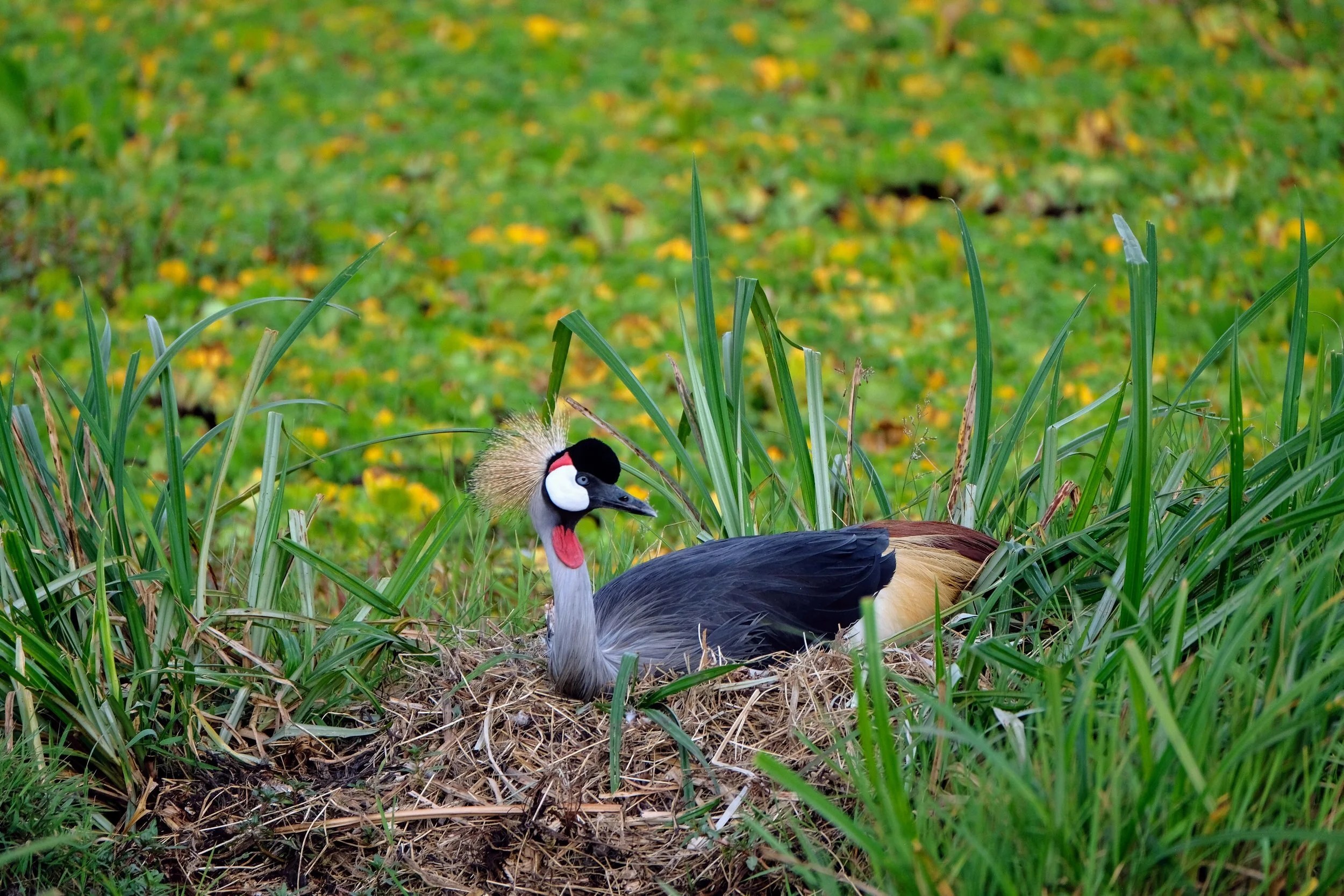
     Crowned Crane on her nest
    Crowned Crane on her nest

    Leaving the lions, we found a nesting Crowned Crane on a little 2 metre square island close to the shore, wonderful to see and we then turned our attention to elephants who were scattered throughout the marshy region in family groups with lots of elephant babes. One group, about 10 metres away from our vehicle, contained a mixed assortment of older males and a couple of mothers with very small kids, only a couple of months old at a guess. The kids, like kids everywhere, were behaving as kids do. One of them a little older than the other was determined to rough house it with the other one. He, pardon the stereotyping but it could only have been a boy, kept butting and pushing the other one and when the younger tired of this and lay down to rest, Dennis the Menace would stand on the other one and force it to get up so the process could start again. Periodically the younger one’s mother would wave her trunk at the transgressor and shoo him away until her back was turned when he would start again. He was like a little high-energy 2 year old, buzzing and bumbling and chasing his way around and butting into anything that got in his way. Tiring of the game he then decided to try and eat the marsh grass as his elders were. He was still nursing but precocious as he was, he was determined to eat the grass like the grownups. Unfortunately it takes practice to learn how to use your trunk and he couldn’t figure out how to grasp the grass and pull it out and then when he did he couldn’t find his mouth and there was grass all over his face and on top of his head. Wonderful to watch!
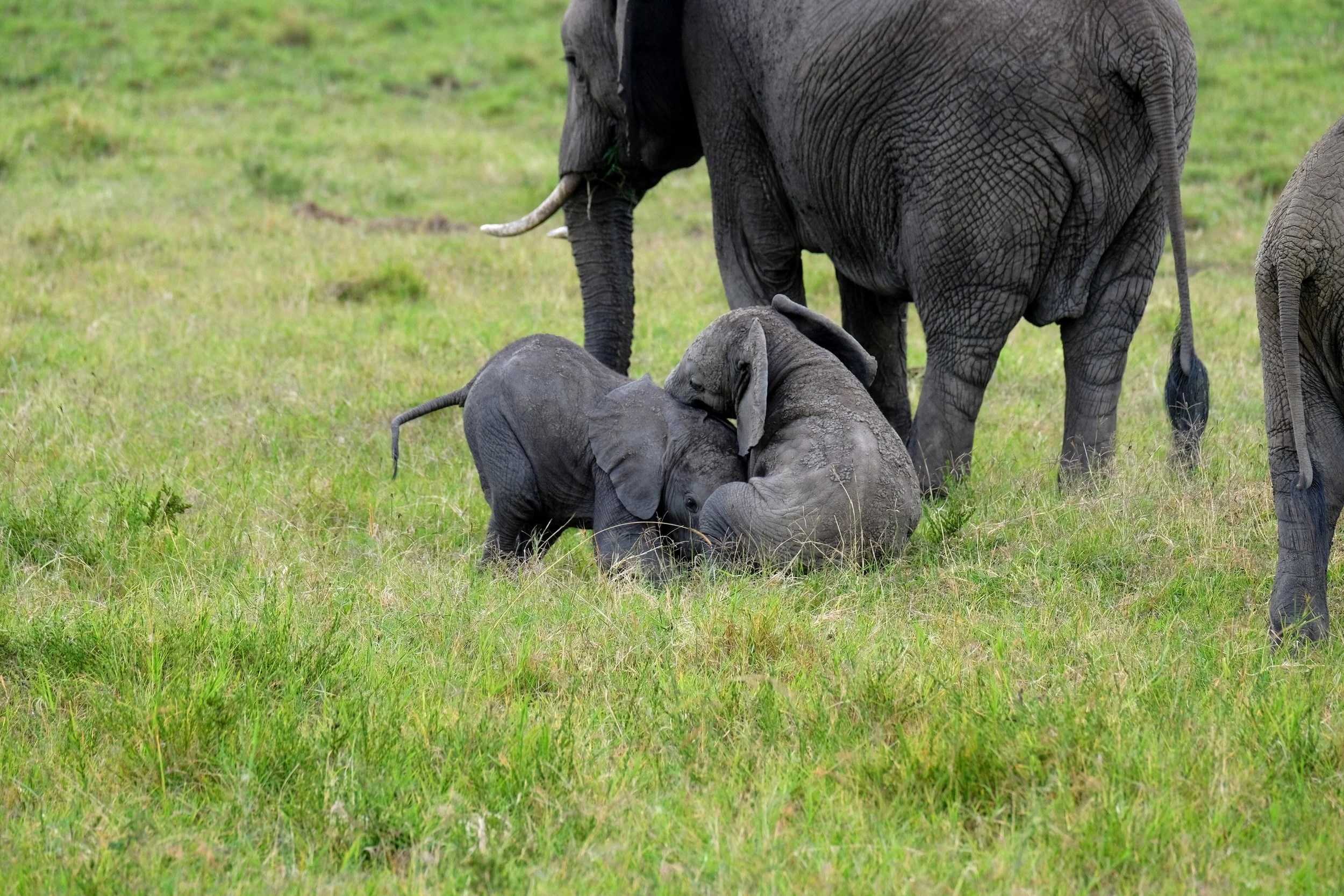
     Dennis the Elephant Menace stirring things up
    Dennis the Elephant Menace stirring things up

    Out of the park and back to Kandili in the dark. 

    Sunday morning off at 6:30 and back to the park by early light. Staying at our camp is an Israeli family, mother, father and their 18 year old daughter whose birthday present was a balloon ride over the Masai Mara which they had taken the previous morning. They were charming and their daughter delightful but as is always the case, we did not have much time to get to know them, ships passing in the night, but we enjoyed our brief acquaintance. They were on their way back to Nairobi driving their own Land Cruiser, and it was arranged by mutual agreement that they would join forces with John and our vehicle for a couple of hours and then leave us for their drive back to Nairobi through the park and on to the city. 

    The day started well, once within the park we came across a lion pride surrounded by a ring of hyenas who were trying to steal the remains of a kill which the senior male was carrying in his mouth to another location, don’t know why but he was. The hyenas were determined to get a share and the rest of the pride trailed along behind. We spent a brief time watching; the light was beautiful, early morning and  golden across the grasslands, and even the hyenas looking handsome in the golden wash, and then we were off to try for a leopard before the Israelis left us. 

    We drove to area where a female leopard and her two cubs  had reportedy been seen to find a Picadilly Circus of cars clustered around a grove of trees; it was a useful reminder of why why we had chosen our conservancy camp. Angling for a spot where we could see, we could just discern through the undergrowth, the female and her two cubs. She was trying to get them to climb a tree whose branches began at ground level so easy for them to begin their climb, but they couldn’t quite master the technique and their balance and they would get 2 or 3 metres up and then tumble back down to the ground. Slow process but she finally had them hidden up in the tree and could safely leave them while she went hunting. Had the undergrowth not been as thick we would have had some glorious pictures. As it was it was great fun watching this all happen and then the female drifted into the belt of trees along the sides of a small watercourse and disappeared. We stayed for a 1/2 hour to see if she came back but she was busy hunting and the cubs were too well hidden to be spotted.

    It was now 9:30 and time for the Israeli family to leave and we accompanied them to their right track which would eventually lead to the road back to Nairobi. Even though we only had a couple of hours together, a lucky morning. 

    On our way again John received a phone call to tell him that there were some BBC film trucks tracking a family of cheetah. That seemed too good to miss so we spent 1/2 hour driving over to where they were to be found. We came across them in a wide sweeping valley surrounded by low ridges on either side of an open vale about a kilometre wide with a stream running along it. There were three camera trucks positioned in an open line the length of the valley, one at each end and one in the middle all positioned well up the sides of the ridges and all pointing their equipment at a small clump of trees next to the stream and about halfway along the valley. We pulled up alongside the vehicle in the middle peopled by the driver and the camera operator, Sophie Darlington one of the UK’s and the world’s best wildlife cinematographers. She has shot many of the BBC’s wildlife series narrated by David Attenborough and was there to follow a collective of 5 cheetahs, brothers all, who hunt together,  a very rare circumstance. Sophie and the BBC team believed that the 5 brothers would come out of the trees at some point and begin their hunt. The valley was filled with zebra, hartebeest and Thompson’s gazelle and the team wanted to be there to capture the hunt if and when the cheetah came out of hiding and went to their work. Sophie was very helpful and knowledgeable having been doing this for over 30 years so we decided to stay with her vehicle and hope that the hunt took place because these would truly be lifetime shots.

    Vey hot and still on the hillside as we watched the grove of trees about 600 metres away. The cheetah would either chase up towards us or along the valley to our front and whatever happened we would be perfectly positioned to watch what would be a remarkable event. Unfortunately the cheetah were not given the BBC script so did not take their cue and enter stage right, hunting. We stayed with the BBC truck for 3 1/2 hours watching the trees but no one emerged and we reluctantly had to leave as we were coming up to the time when our 24 hour pass ran out and we had to leave the park. 
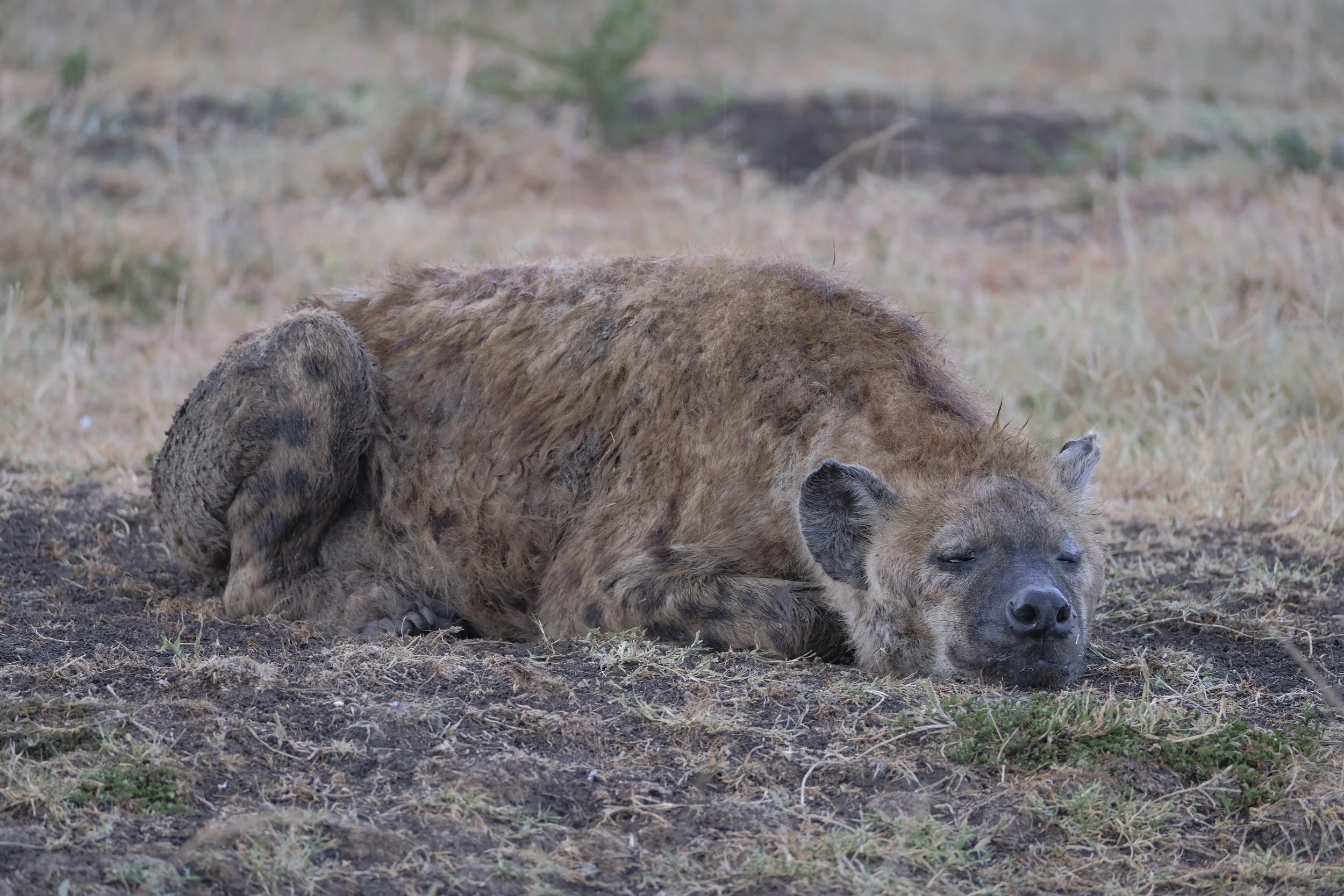
     Unhappy hyena in the rain
    Unhappy hyena in the rain

    Long drive home but along the way managed to stalk a leopard and get some good shots. As we were driving near the belt of trees where we had seen the mother leopard earlier in the day we saw that a troop of zebra had suddenly frozen and had all turned in one direction. We drove the couple of hundred metres to the patch of trees that they were intently watching. We poked the vehicle’s nose into the underbrush but could see nothing but turning off the engine we could hear somewhere in the bushes not very far away a very, very deep rumble and then an occasional bark. We moved over to an open patch where we could see better and then I began to search the brush with my binoculars. There was nothing to be seen deep shadows and undergrowth, and where nothing had been there was suddenly a face and slowly a male leopard moved out of the shadows and dropped down on the ground about 5 or 6 metres away from the vehicle. He continued to growl and bark, clearly calling his mate who must have been the mother of the morning’s cubs, and after looking at us with his deadly green eyes and giving us some wonderful leopard portraits, he picked himself up and drifted back into the undergrowth. This was particularly satisfying as no other cars had picked up the zebra signals and we were the only vehicle on the scene when the leopard emerged. So petty, sigh…..

    Fabulous end to a fabulous day. We will be back in the park tomorrow and we will not be hunting for animals but for the BBC truck, going to be sticking close whenever we can.

  • Kenya Wednesday to Friday Feb 21 – 23

    Arrived on Wednesday evening in Nairobi, airport much improved since our last visit 4 years ago. It was chaotic then and we expected that it would take at least an hour or 90 minutes to get visas, get bags and clear customs but very well organized and smooth and within 30 minutes we were through the formalities and connecting with our driver and car. In the Serena Hotel in Nairobi for 2 nights to catch up on sleep and get rested for our time in the Masai Mara.

    The Serena is one of our favourite hotels anywhere, right in the centre of Nairobi but surrounded by fairly extensive grounds so that it feels very lush and restful and very old Africa even though mad traffic is only metres away. Since we have arranged for a car and driver to drive us to our camp, about a 5 or 6 hour drive, we went for a walk into central Nairobi to buy wine. The hotel insisted that a staff person accompany us even though it was the middle of the day, we were not too concerned but our hotel guide told us that after sunset all the hotel staff take the bus at the stop in front of the hotel, no one willingly walks the downtown streets because of the danger of muggers. Our wine expedition was only possible because we are not flying, our total luggage limit is 15 kilos and my carry-on alone is close to that with cameras and equipment, so we have the luxury of loading the car with things that we normally would not be able to travel with.

    I wrote the above yesterday, Thursday, we are now at our camp after a very long harrowing day driving over unpaved, rocky paths that pass for roads in the Kenyan countryside. Compounding this was the fact that our driver became hopelessly lost and we arrived after a bone-jarring 8 1/2 drive and to add insult to injury, we discovered that the hotel had forgotten to pack the wine in our car and 8 bottles of wine were still sitting in the hotel luggage room. Tears were shed, but after talking with the hotel in Nairobi they have agreed to fly the box of wine at their expense to the local safari airstrip and our camp will send a car to pick it up. We are holding our collective breaths…

    In case you’re wondering, the point of driving rather than flying was not to transport wine but rather to take the opportunity to see the country and the landscape. We have usually flown to the various camps that we have visited and I really wanted to get a sense of the country and a drive seemed the perfect way to do it and in spite of the tooth-rattling driving conditions it was still very worthwhile to see the many changes in topography and vegetation and habitation and I’m pleased that we decided to do it. It was especially interesting and neat to drive across the Great Rift Valley on our way to the camp.

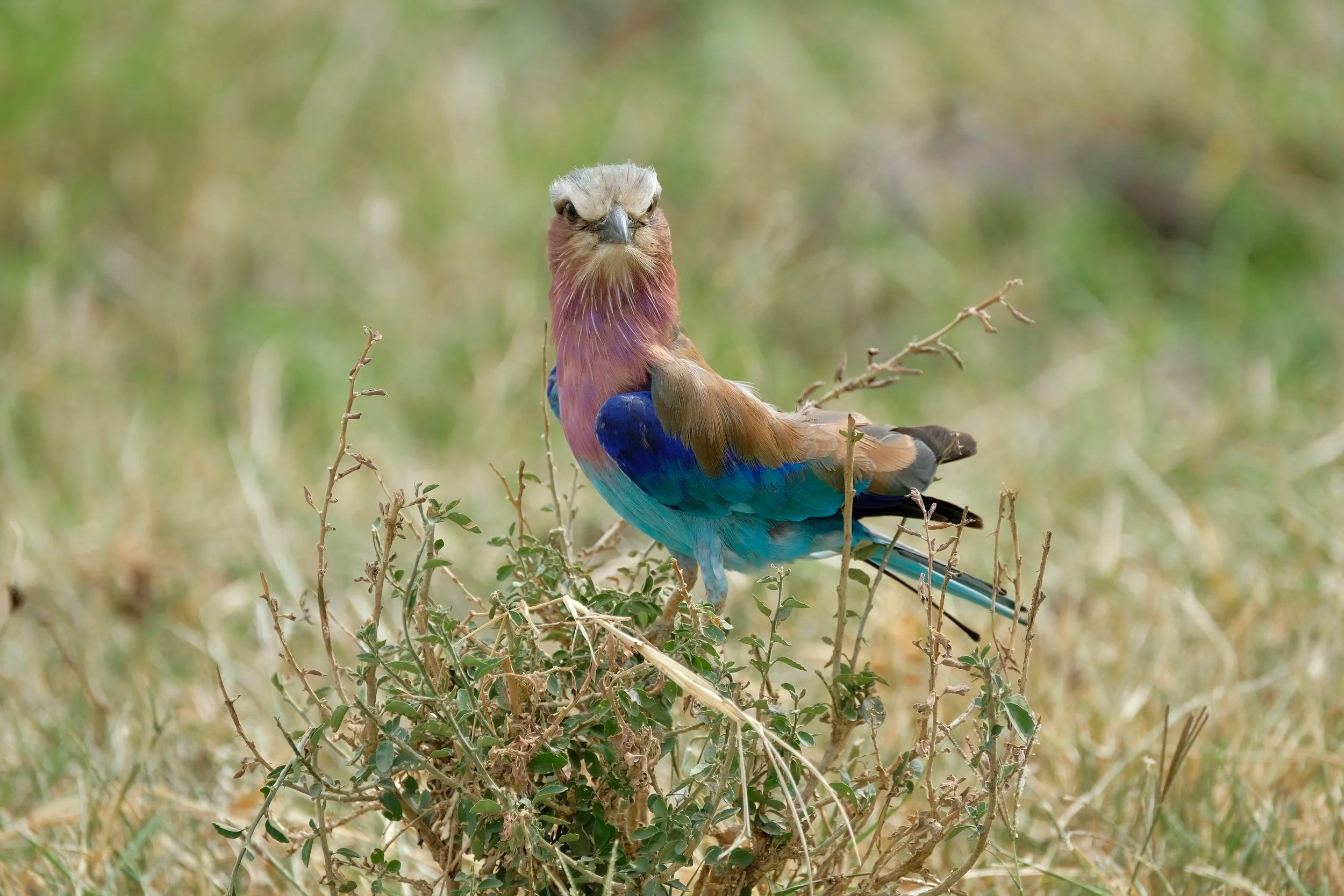
     Lilac Breasted Roller
    Lilac Breasted Roller

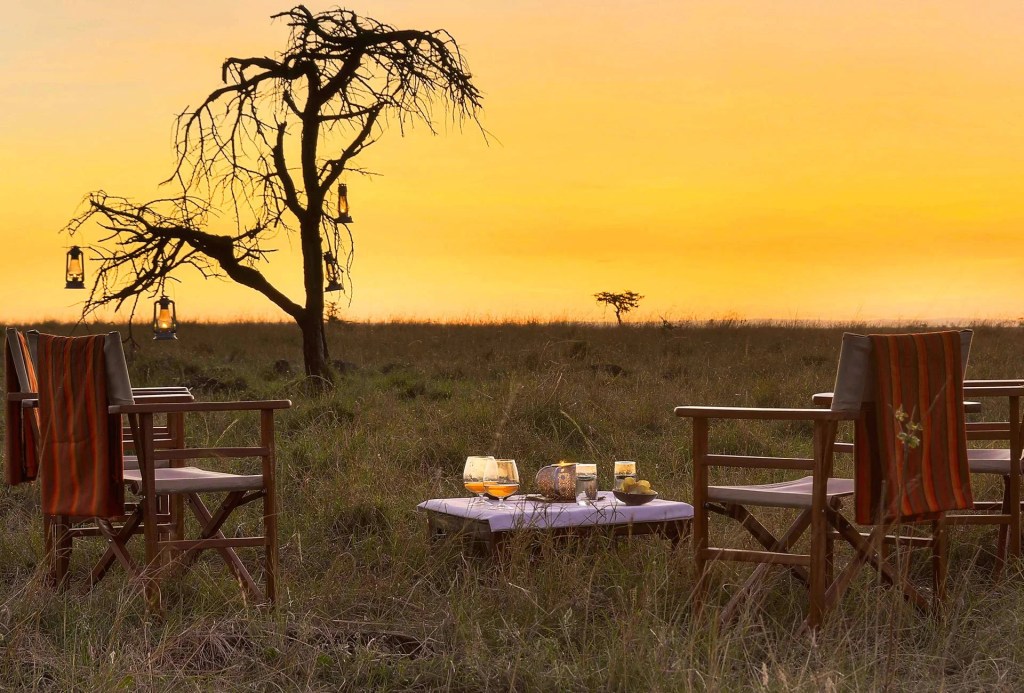
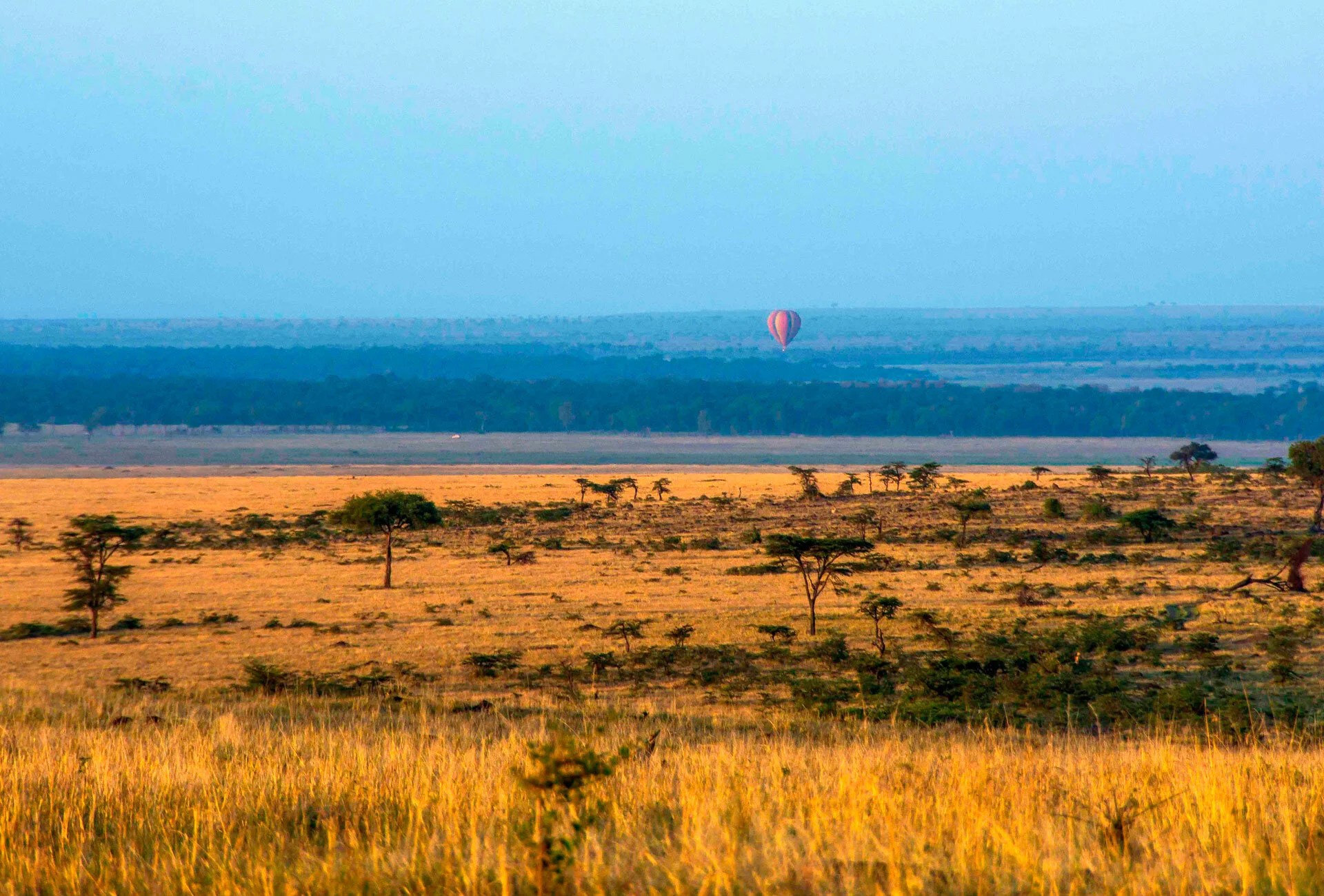
    We went out this morning for our first safari drive, like old times beginning the day in the dark at 5:30 and on the road by 6. We are staying in an eco-camp in a small Conservancy near the Masi Mara National Park. The conservancy is owned by a number of the Masai people and the camp is staffed and run by them. It is near the Masai Mara Park and because it’s is small it does not have the number of animal species more or less resident in the property. However all the lands that are not National Park or a conservancy are used for grazing and the whole region is open country as there are no fences around any properties be they conservancy, private or national park. Because there are no fences animals move through and between our conservancy, other conservancies and the national park as well as over private grazing lands where they are legally allowed to move. Obviously this is grudgingly accepted but not encouraged by farmers and herders so that the animals tend to congregate in conservancies and the national parks where they are protected. High food chain animals, the carnivores, tend to need a fairly extensive range for their activities so that the smaller conservancies do not attract permanent habitation for the big cats for example except when they are moving through to another location and as a result smaller conservancies offer small pleasures, birds and the smaller species that may get overlooked in the range of options in the large national parks.

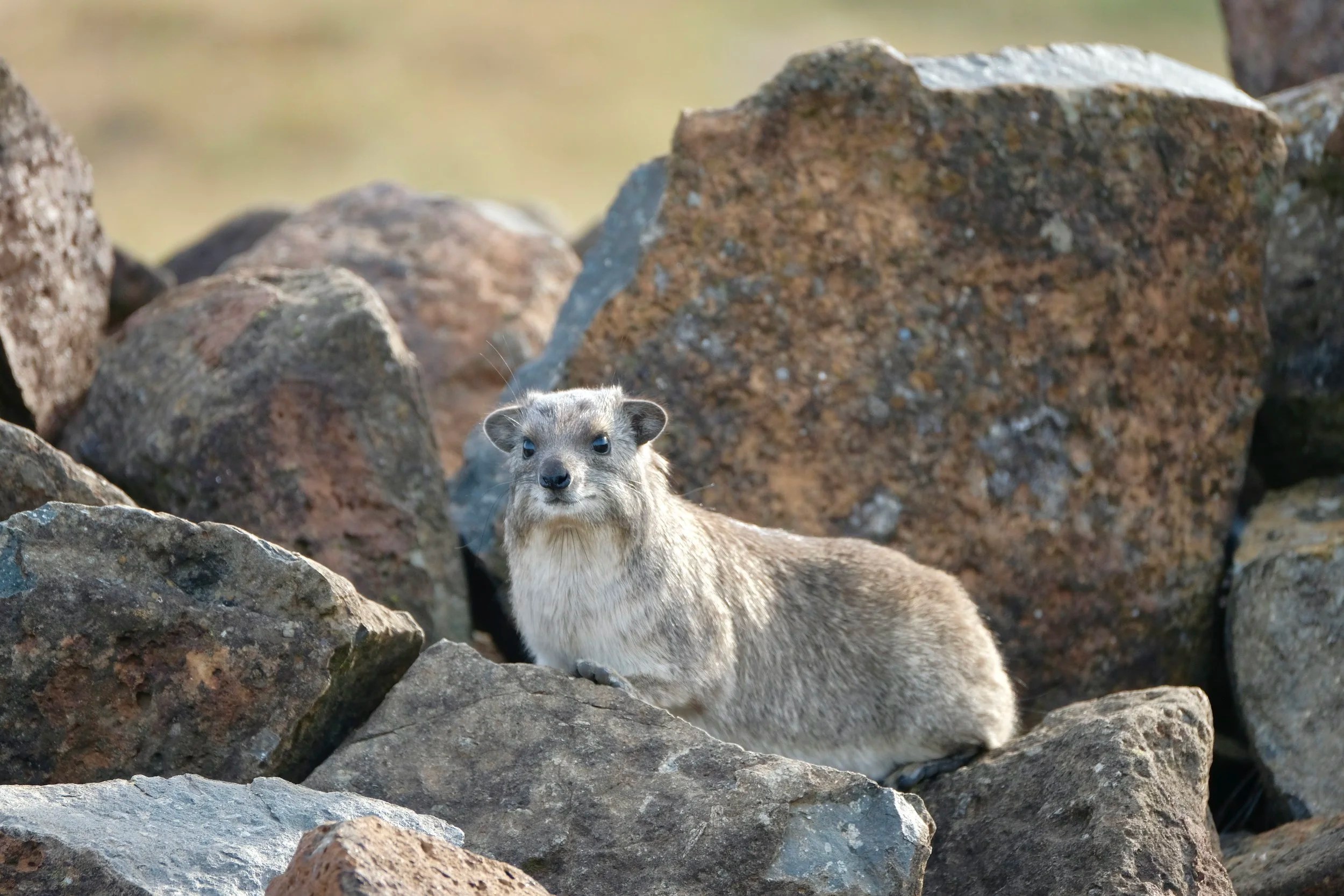
     Rock Hyrax
    Rock Hyrax

    We are about a 25 minute drive from the Masai Mara National Park so that if we want big cats and big mammals we can pay to enter the park and spend the day, the downside being the number of cars that can congregate at a sighting, rush hour!, and if we want smaller pleasures, more personal attention and only one or two other cars, we can spend time in our conservancy. Our camp gives us the luxury of both options and since we will be here for 12 days we wanted the chance to balance our time. Our first morning was an enjoyable prelude, no big cats or elephants but a spectacular sunrise over the savannah and time spent with a couple of species that we had never seen, in particular the Rock Hyrax, a little marmotty creature that thrives in the tumbled rocky cliffs that characterize the property. Fabulous to spend time with and fun to watch.

    This afternoon we will be driving over to the national park to spend the late afternoon.

  • Kenya 2018 18/02/2018

    This is a very long overdue post, my last being from New York in December 2016. The worst of getting behind is the difficulty of beginning afresh, there are always reasons to put it off and the problem compounds.

    2017 was a good year, trips to Bhutan, Thailand, France, Tobago and Bequia but now it’s 2018 and a fresh start.

    We leave for Kenya on Tuesday and are in the final scrambling stages of pack/repack and getting our luggage weight down below 15 kilos since we’ll be on a series of small local flights with pretty restrictive weight allowances. It’s our second visit to Kenya’s Maasai Mara and our 5th trip to Africa in the last 5 or 6 years. On all of our trips, wildlife photography has been one of the key drivers in the choices we have made and the current trip is springing from the same motivation. The difference this time however is our itinerary. Whereas in each of our earlier trips we included a couple of safari camps, 3 or 4 days in each one, this time we will be spending time, 12 days, in only one camp.

    Our experience with the varied camps has always been good but I have always been left with a sense of rush; arrive in a camp, a couple of game drives a day with a 2 or 3 others in the vehicle, and off to the next camp. And as pleasant as our vehicle companions have been, interests and expectations are not necessarily shared so there is a tendency on the part of the guides to try and pack in as much in the time available to make sure that everyone has their needs met and all their boxes ticked.

    This trip is intended to redress the balance. We are staying at Kandili Camp and have our own private vehicle and driver and we’re looking forward to taking things a little more slowly, spending a whole day in one spot if we want and just getting a much better sense of place and patterns. We have chosen this time of the year as the rainy season has not yet started and the grasses should be low which makes for easier viewing and at this time of the year there should be lots of young animals to be seen. On our last visit to the Maasai Mara in 2014, we came across a mother leopard with one surviving cub; our driver and our vehicle companions did spend some time with them but left to our own devices, we would have happily spent the largest part of our time with the two of them and made them a focus of our attention.

    Really looking forward to this trip. Back to packing!

  • New York minute 06/12/16

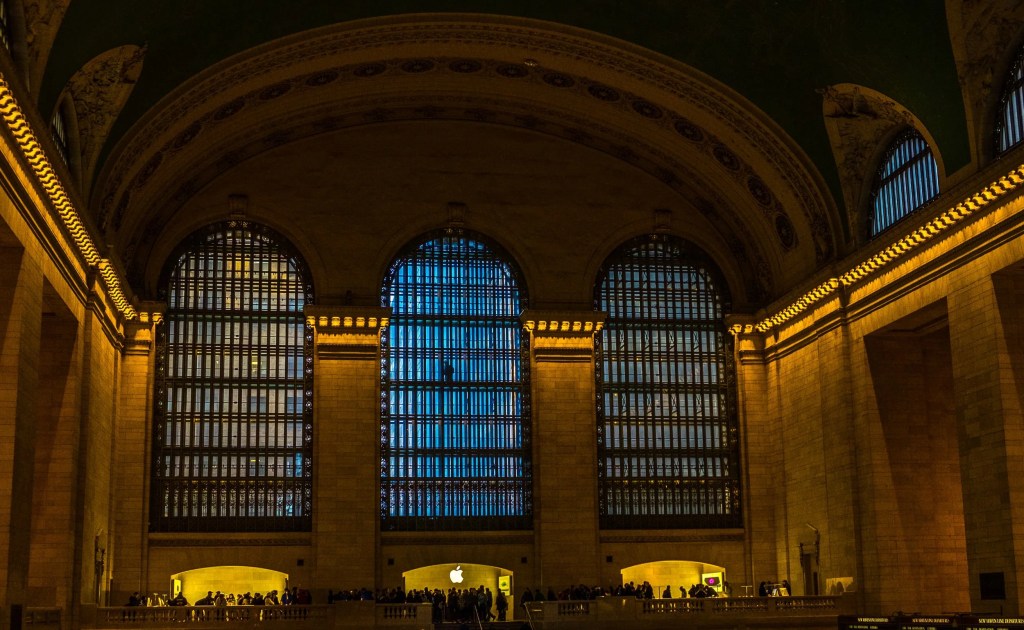
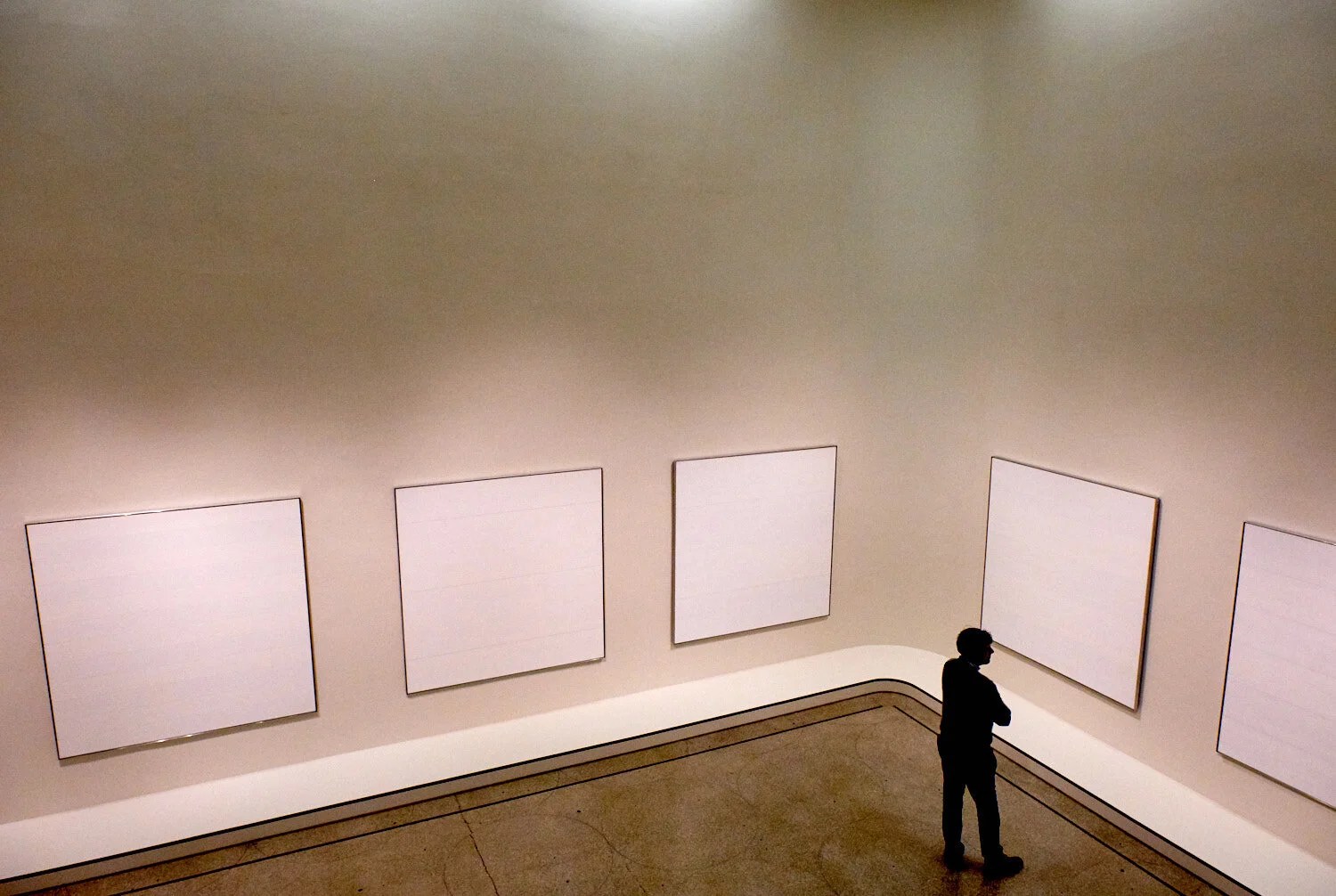
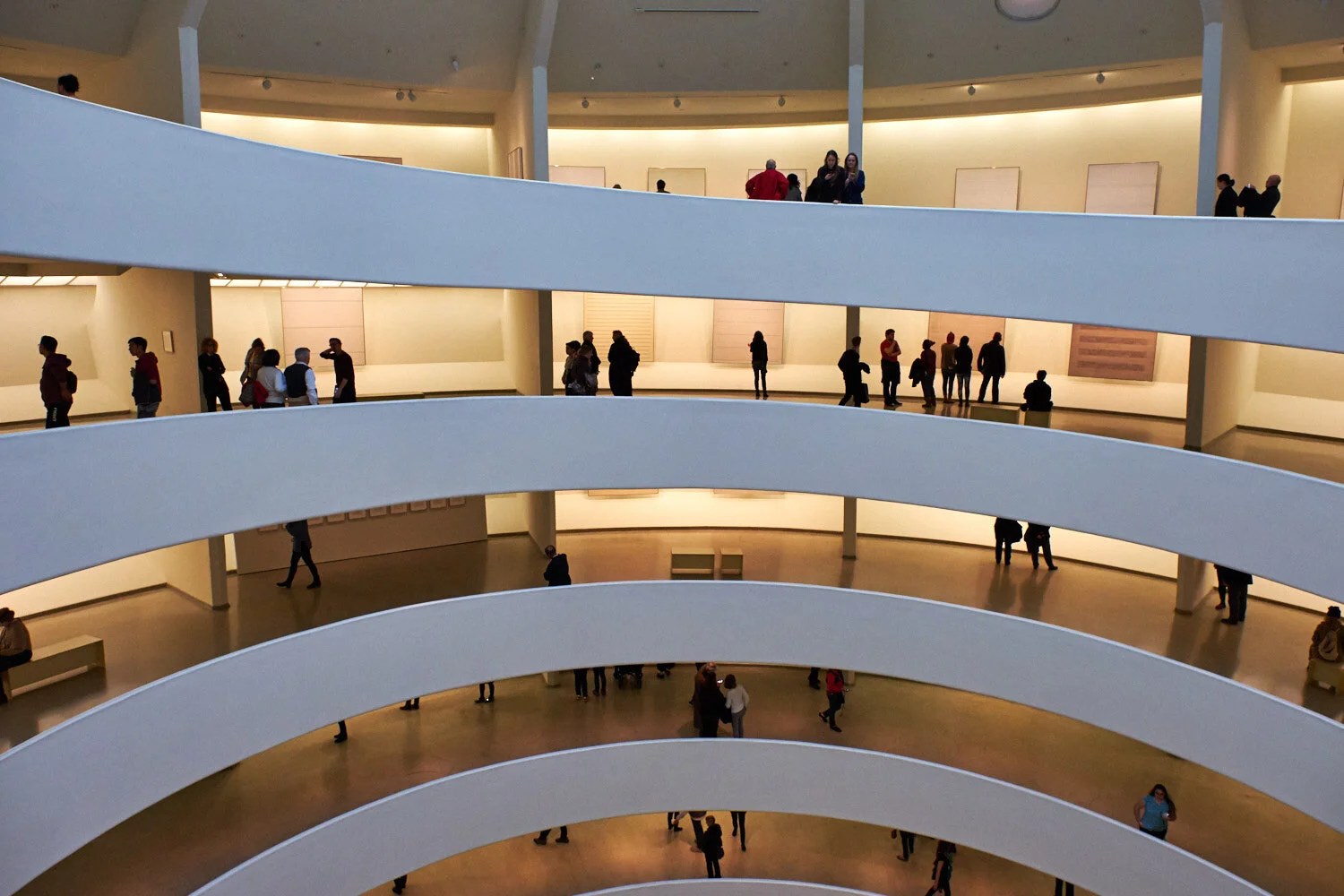
    Just got home from a couple of days in New York, staying with friends David and Jane on the Upper West Side. Fabulous time as always but the crowds on the sidewalks on 5th Ave were claustrophobic-making and they got worse as you neared Trump’s Tower of Babel.


     Agnes Martin show at the Guggenheim
    Agnes Martin show at the Guggenheim

  • Petra and home 21/10/16

    After last night’s walk to the Treasury at Petra by Night, V did not feel confident in her ability to walk the distances required to explore the site properly, about 5k to get to the end of the track which passes through the Siq, past the Treasury and and past a number of tombs and monuments ending at the trail which begins the 800 steps leading up to the top of the Monastery heights. The return to the gate is over the same ground, but uphill in the return direction and in the heat of the day after having hiked around exploring the site. V decided that she would to take a horse-drawn carriage to the end of the trail and then walk back, the carriage meeting us at the Treasury for the last stretch. I reluctantly chose to join her as I was not keen to use the scrawny and over-worked horses and mules that are available for hire but I knew that V would simply not be up to the walk.

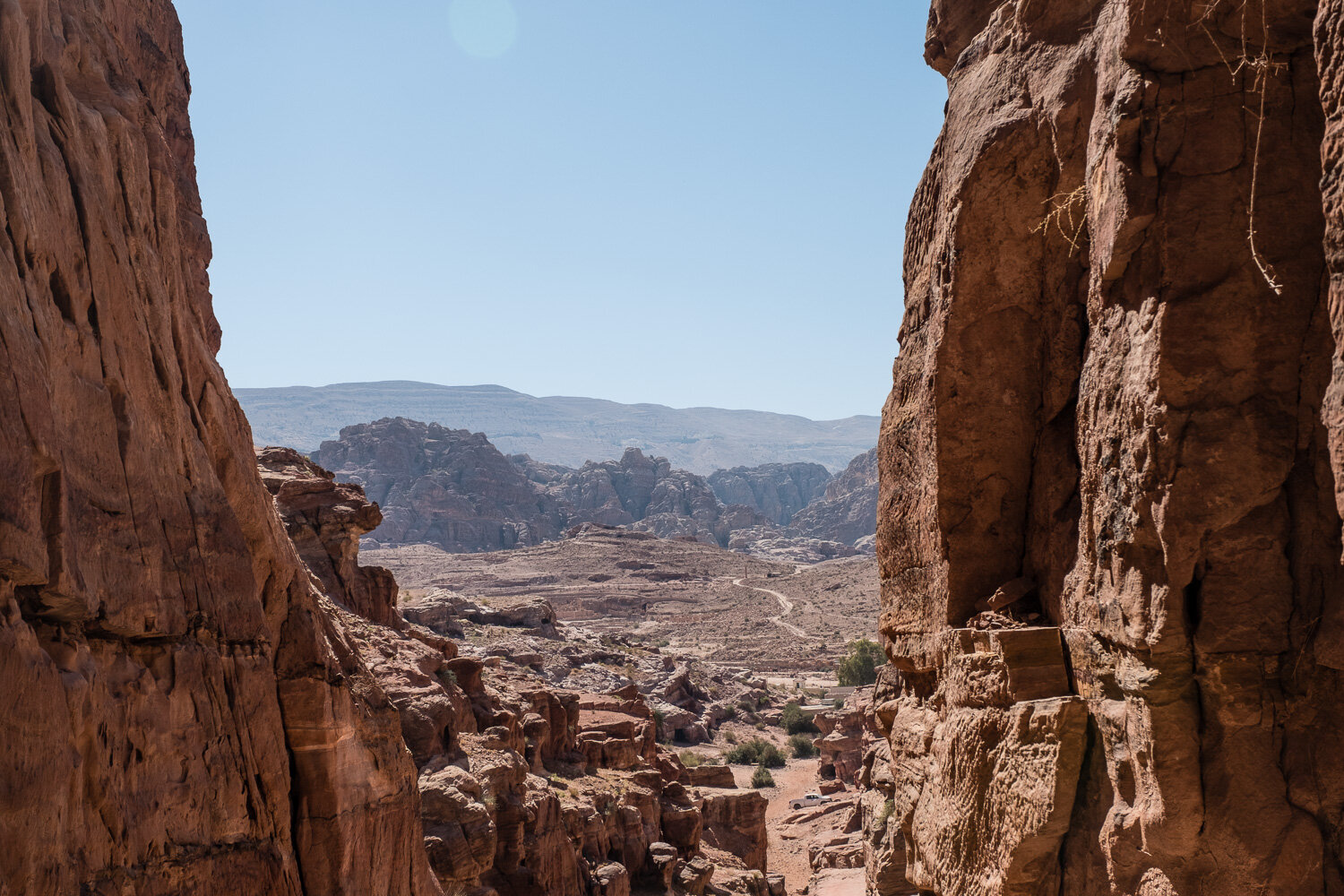
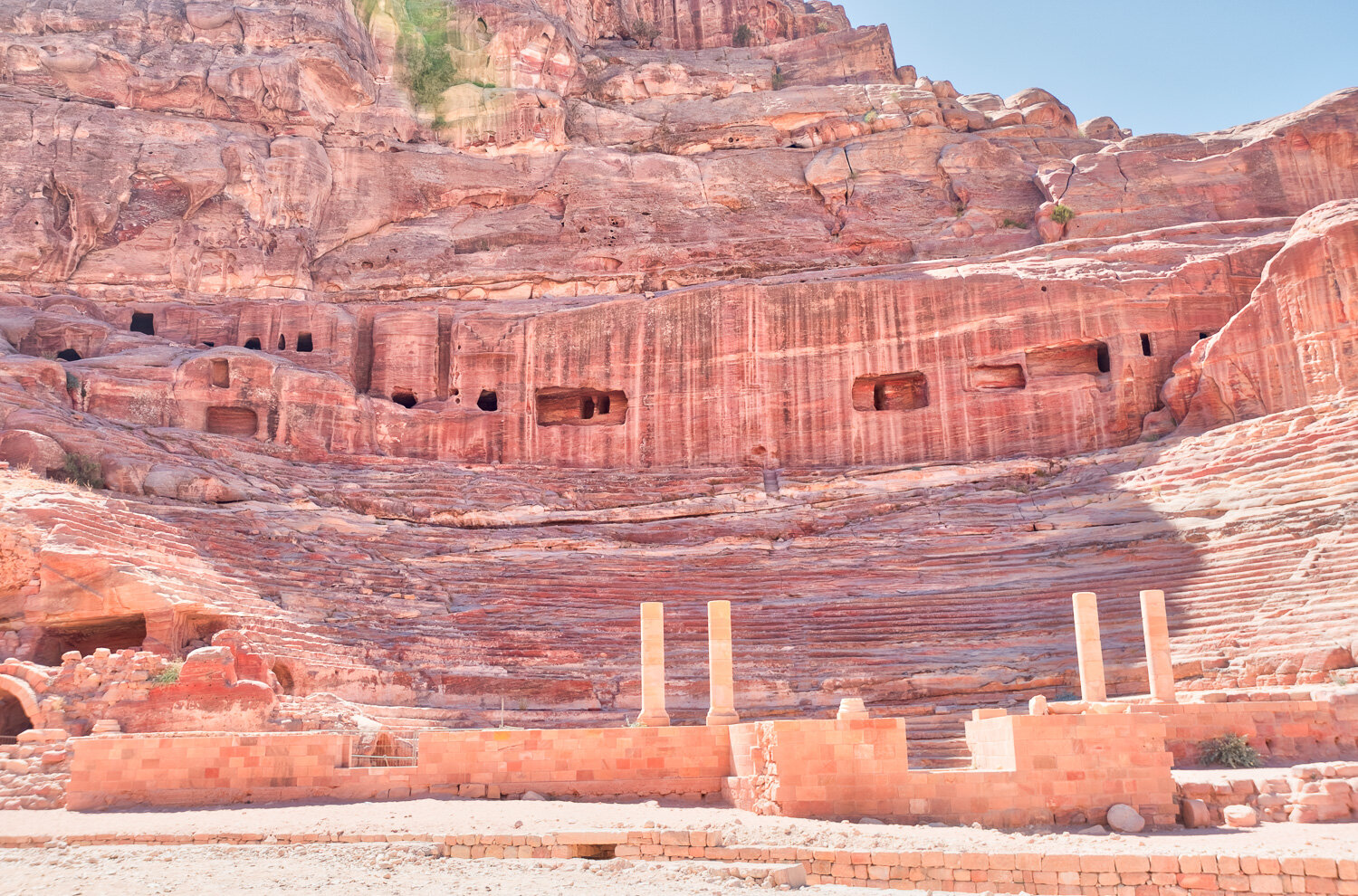
    We were at the gate at about 8:15 and we were dropped at the end of the trail at about 8:45, arranging to meet our carriage at 3pm in front of the Treasury building, giving us 6 hours to explore and to work our way back to meet the carriage. We began the climb to the Monastery and got about halfway up but the climb was proving problematic for V’s knees and the heat was ramping up so we worked our back down to the trail and spent the next 5 hours exploring some of the monuments and tombs before directing our steps to the trail and the Treasury. The site is huge and, if you have not been, stretches over many square kilometres, all of it up and down. I was aware of that before arriving but still had not fully grasped the extent of the city and the amount of time and energy that are required to really explore the site. Even more surprising is the very small area that has been excavated, the largest percent of the area literally untouched with trails leading off through the rough scrub desert and valleys in which it would be very easy to get lost, Diana having done just that when she visited Petra two years ago.

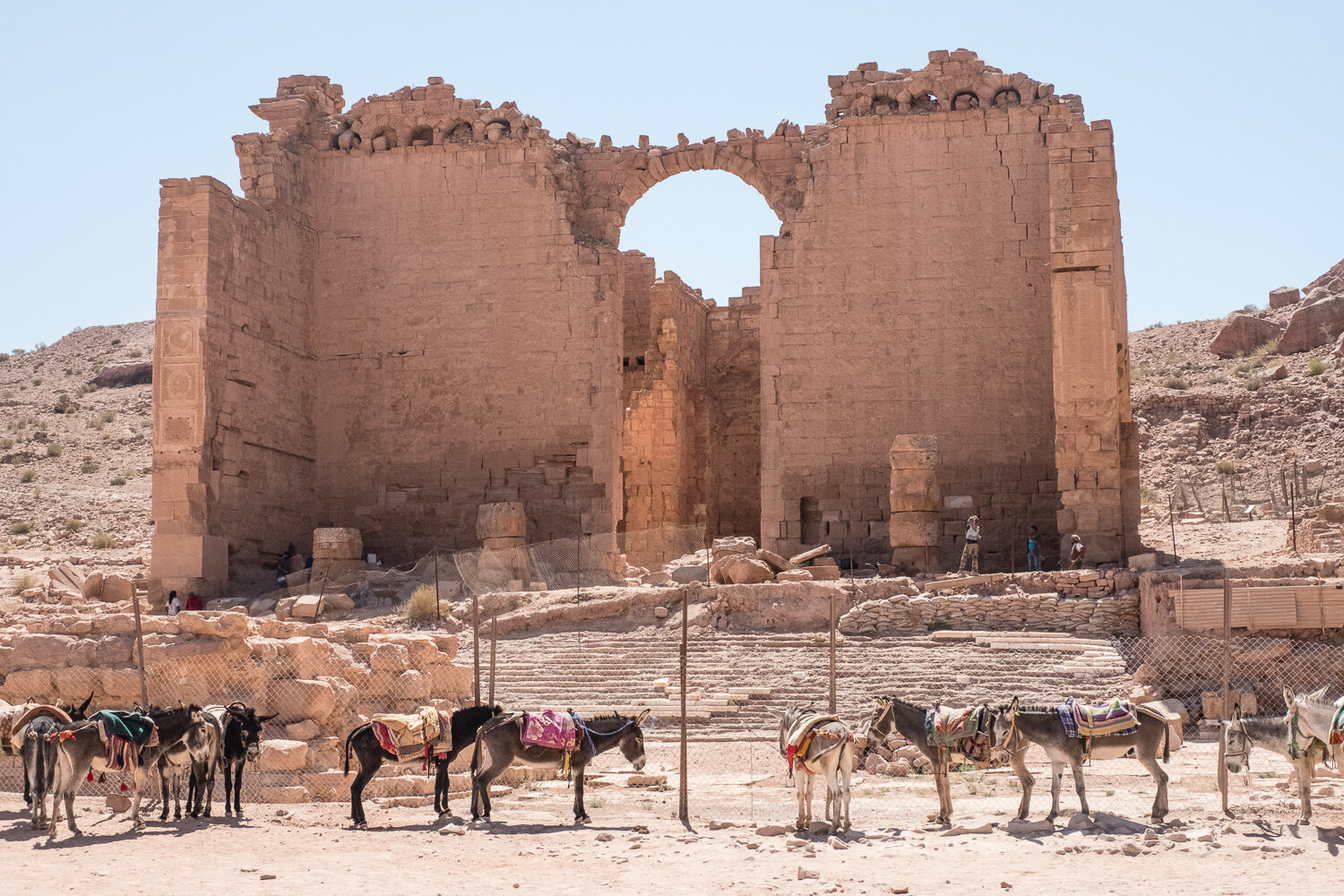
     Petra ruins
    Petra ruins

    Fascinating day but long and hot and surprisingly few visitors on site. We have heard from various sources that tourist visitors to Petra in particular and Jordan in general have dropped by about 75% in the last couple of years since the Syrian crisis broke out and the region is being viewed with increased concern by NA visitors. We were happy to get back to the Guesthouse, a long hot shower and gallons of ice cold water. Dinner at the Movenpick Hotel where the rooftop bar/restaurant was featuring a BBQ night. An ice cold, dry gin martini, the first of the trip to set things right and then a very good meal of various small dishes of the local appetizers and then perfectly grilled lamb chops and a big glass of red wine with the stars glowing overhead and cooling breeze wafting…

     The climb up to the Monastery
    The climb up to the Monastery

    We are going back to Amman a day early, we’re tired after 3 weeks on the road and are looking forward to one completely relaxing day by the Intercontinental pool before we begin the long flights home. Left the Petra Guesthouse about 9am planning to drive over to the Dead Sea and then follow the highway north back to Amman. There are three North- South highways in Jordan, the one we had taken to get to Petra known as the Desert Highway, the most easterly and the most boring; the Kings Highway which is supposed to be the most scenic running through river valleys as it travels north and which has been the pilgrimage road for Muslims coming from Syria, Iraq and beyond and heading for the holy city of Mecca since the 8th century; and the Dead Sea highway which runs right beside the sea but is not recommended as the first 100k up until it reaches the Dead Sea is very dangerous as it runs through a number of mountain passes between Petra and the Dead Sea. The optimum route is to take the Kings Highway scenic route and then cross over to the Dead Sea Highway when it reaches the southern edge of the sea and then follow it north and then on to Amman.
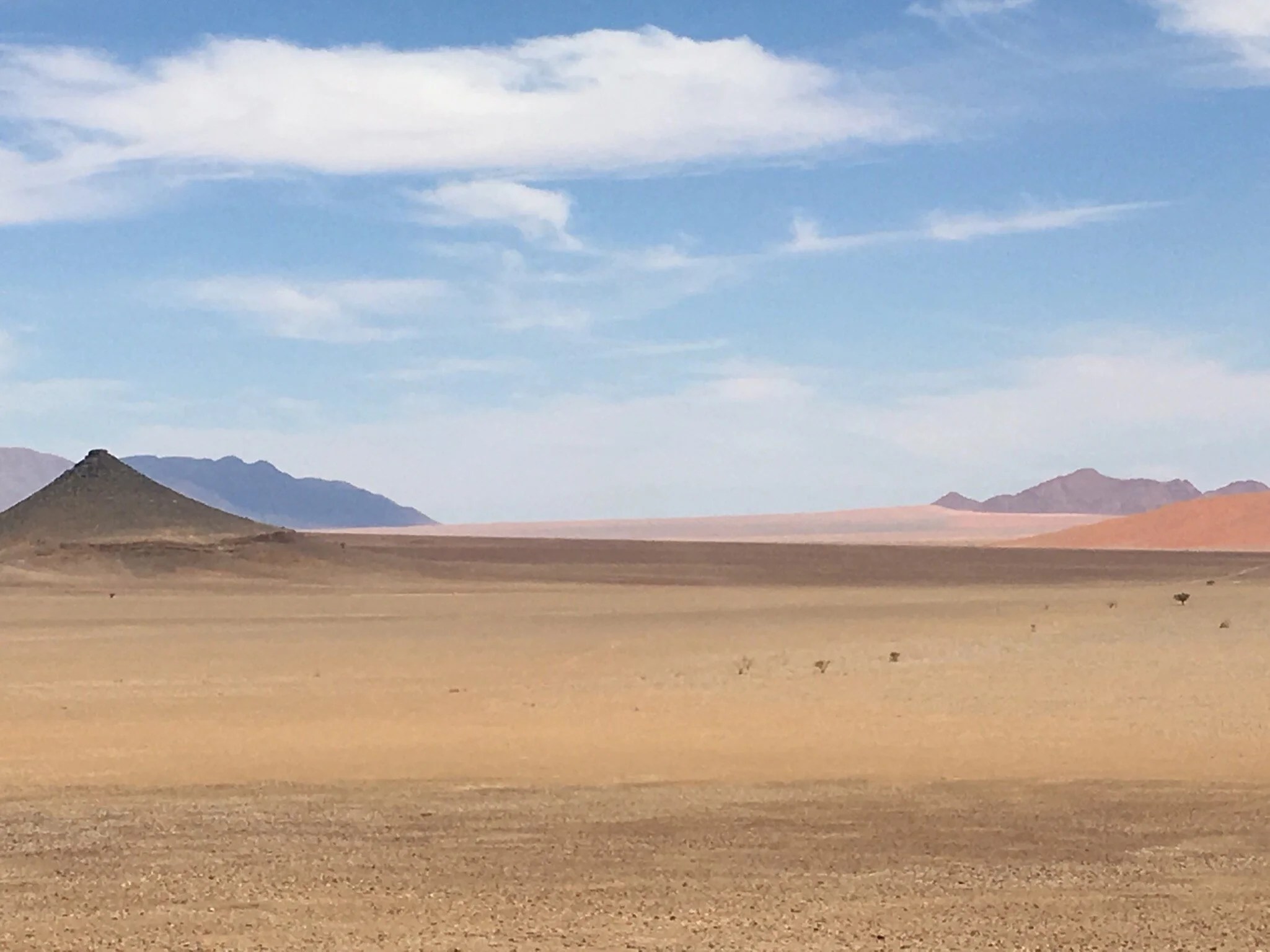
     Petra
    Petra
     Petra
    Petra

    I had my usual Charlie Brown moment with the gps as like Charlie who has infinite faith that Lucy will not move the football when he prepares to kick it and she unfailingly does, so I trustingly entered our destination in the gps trusting that it would take us to the Kings Highway and on to the Dead Sea. And as usual the gps moved the football and the route so after about 10 kilometres and strangely no other cars on the road in either direction, the road began to climb, steeply. We still hadn’t twigged and so began a very hairy hour, the road under construction and shades of Namibia, a rough narrow gravel track with no guardrails, which climbed by switchbacks up, over and down only to repeat the performance and climb up and over the next set of mountain ridges. Each blind corner was frightening, the road too narrow for two vehicles, no way to see around the corner and a straight drop down on the outer side. Fortunately there were no construction vehicles or people doing any work on the roads, it was Friday a fact that only dawned on me as I wrote this, and no cars coming in the opposite direction. The drive was stunningly beautiful and slightly terrifying, happy to have done it but glad that we didn’t do it on a normal workday with traffic on the road.
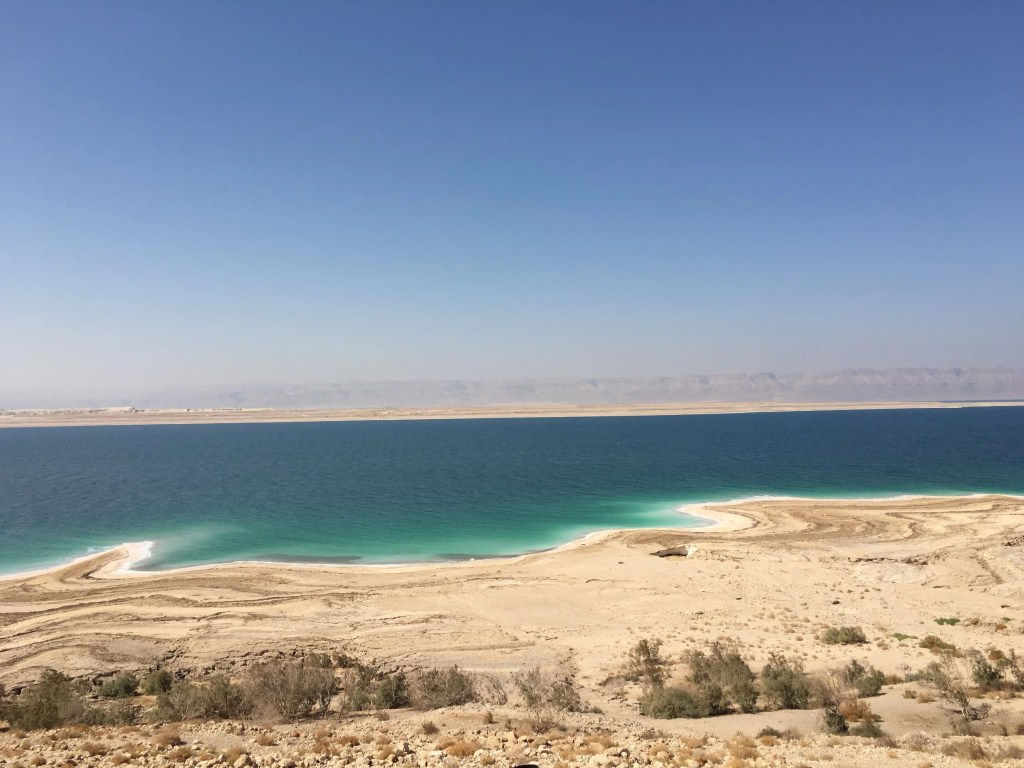
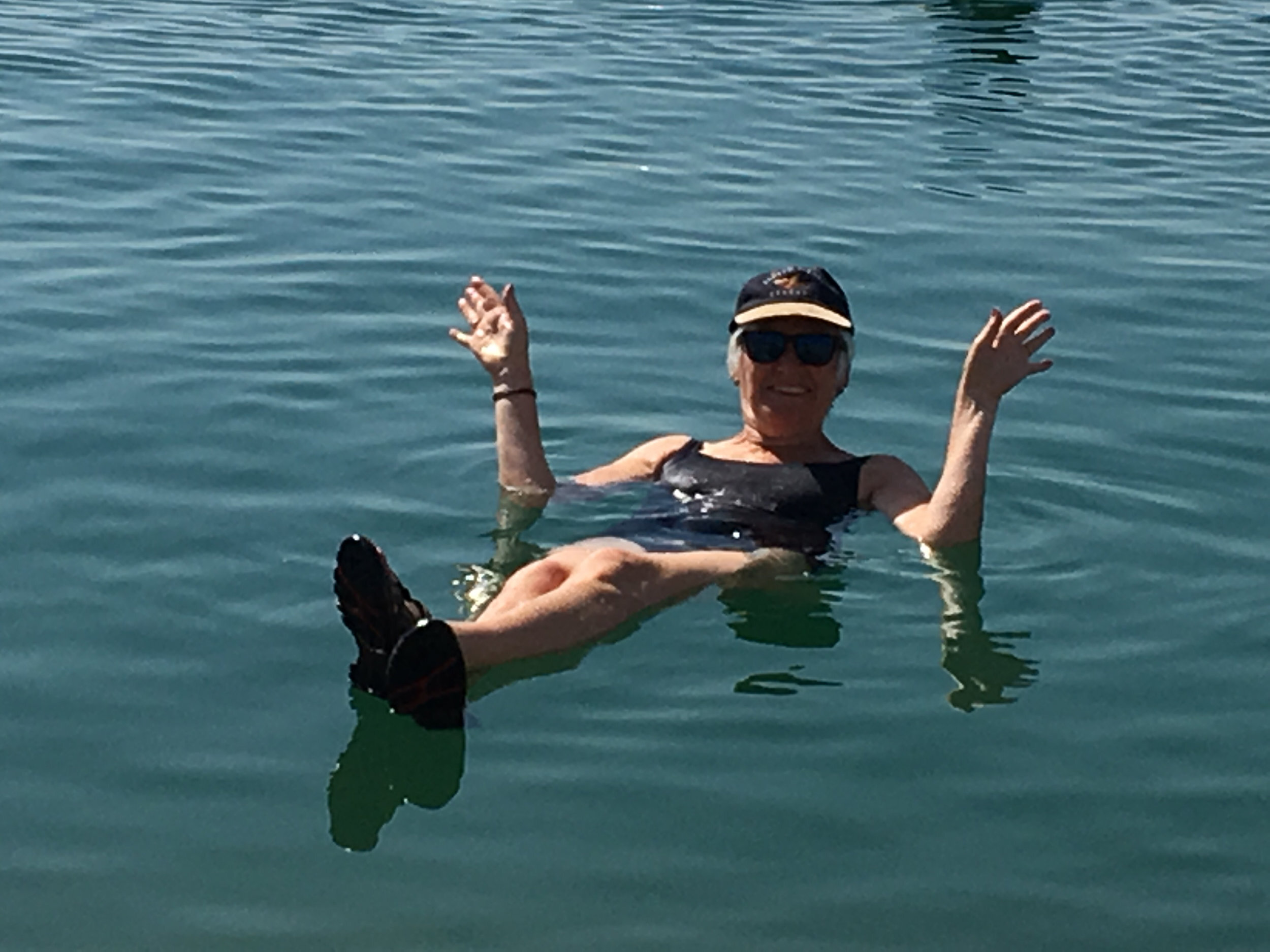
    Reached the Dead Sea and taken aback by its size and the deep blue of the water. We gather that the water level is dropping about a metre a year, so much water is being taken out of it on the Israeli and Jordan side and industrially processed for a variety of chemicals, that at the current rate of loss it is expected to be dry by 2040. Yet for all that it is huge, at the southern end stretching north as far as the eye can see, and the colour a deep rich blue while across the water the West Bank rises up mountainous and misty. We were heading for the Movenpick Resort, right at the northern end of the water, to go for a swim. Arrived after an hour’s drive, parked our car and filled a bag with bathing suits etc and paid 52JD each, about $104 each, to use the resort’s facilities. It is a very large property, a lavish main building and then reflecting the degree to which the water has receded, a series of levels reached by wide stone steps and downward descending paths, each level slightly newer as if only recently accessible by walking and not by swimming. The top-most level contained a huge swimming pool laid out in connected lagoons, surrounded by trees and some of the shallower lagoons beached with sand for children to swim and play. The bar, restaurant and changing rooms were on this level and so we changed and began the long, many-stepped descent to the sea. Foolishly I had not brought sandals with me but had shoved my driving shoes in my bag and had brought the bag with me to take to the beach. The day was sun-baked, it was about 2pm, and many of the flights of steps were built of black stone so the clichéed phrase about frying an egg on the pavement could easily have been updated to include a side of bacon and baking a loaf of bread as well, I dashed from shady spot to shady spot but the stone steps were too hot even to sit and put on my shoes.  The beach level finally and painfully reached, I left my bag on a beach lounger and we headed for the water across the baking stony gravel, V had sensibly worn sandals and showed no pity, and into water that was only slightly cooler than the beach. For those of you who have experienced it you’ll agree that it is a difficult sensation to describe, it is literally impossible to assume any other position than floating, on your back by choice as floating on your front would push your face into the water, extremely painful for your eyes, not to speak of the dire consequences if you swallowed water. I tried really hard to push my legs down to stand on the bottom but just could not do it, they were forced back up to float on the surface, so the process of standing up in shallow water and getting up and out of the water requires a very undignified series of poses. The water too feels almost oily and touching the wet handrail, built from the water’s edge up the beach to assist swimmers to exit, your hands slipped easily on its surface with the lubricated sense of being covered in baby oil.

    Under the waterside shower to wash off the sea water and then hopping over the hot sand to my lounger, I finally manged to sit and put on my shoes and the world was once again pleasant and free of discomfort. After a swim by V in the upper level pool, back to our car and the drive to the Amman airport where we dropped the car and taxied back to the Intercontinental for our last couple of nights.

    Last day passed in a pleasant flurry, bought a rug in an antique market, sat by the pool and read and then a final feast at Fakhr El-din. Flight to Dubai, overnight in the Emirates hotel and then the 14 hour long-haul to Toronto. On balance a fabulous trip and I’ll try and put down our learnings and reflections after we have a chance to digest our experiences.


  • Into Jordan                18/10/16

    In the evening, after yesterday’s post, we went out to dinner at Fakhr-El Din, a Lebanese restaurant that had been recommended to us before we left on our trip and then was subsequently recommended by Bashar at the Intercontinental. V had called the hotel from Toronto pre-trip and had had the concierge make a reservation and we were glad that she did, very busy. As an aside we have been trying valiantly to approximate the pronunciation of arabic names and places and I was very pleased at how well I succeeded in telling the taxi attendant where we wanted to go even though mustering the throaty guttural required to pronounce the restaurant’s name made me fell as if I was calling him a very robust anglo-saxon epithet.

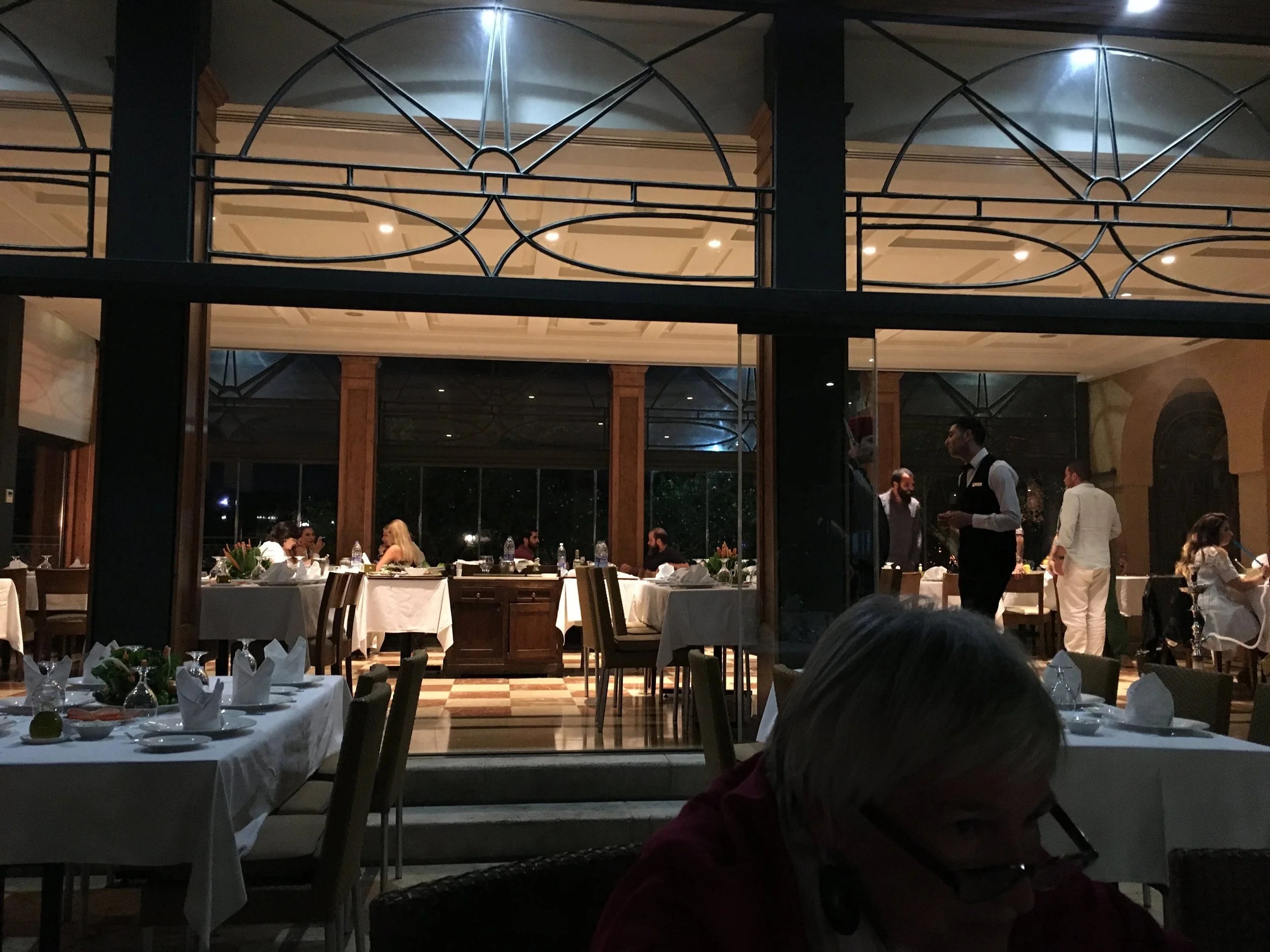
    The restaurant was wonderful, very elegant and in the home of a former Prime Minister of Jordan, with indoor dining rooms and an outdoor candle-lit garden where we sat. We arrived at 7:30 and by 8:30 it was packed with locals seeing and being seen. Amman culture appears to be very secular and the tables were filled with larger groups of mixed gender as well as smaller tables of 3 or 4, in some cases all men in others all women, and in others mixed. The table immediately beside ours was made up of a woman with whom we chatted briefly and who turned out to be Egyptian but now living in the US and two local men who were her hosts for the evening and who spoke no english. We have been struggling to find an appropriate drink to have with dinner as the wine is for the most part imported and expensive and beer which while very good, does not appeal for accompanying a meal. Our table neighbour then introduced us to the drink that her table as well as many others was drinking, arak also known in Turkey as raki, in Greece as ouzo and in France as pastis, a semi-sweet licorice-flavouered liquor that turns milky white when mixed with water. Our neighbours sent over to us two glasses and as soon as we tasted it we knew we had come home! Under our neighbour’s tutelage we learned the appropriate ratio of water to specify and the way we should ask for it to be prepared, mixed 2 parts water to one part arak in a small glass with a handful of fresh mint leaves and ice. I immediately ordered a quarter bottle, it is quite strong, and consulted with our waiter about the right bottle to order as there were a variety on offer and it seemed to be as important a decision as the right bottle of wine to order with dinner. Our waiter took charge of it when it came, mixed it properly and made sure our glasses were kept filled throughout the evening with fresh mint leaves and cold refreshing arak.

     Fakhr El-din
    Fakhr El-din

    Feeling like we belonged we began to look around and it was a fascinating place to people watch. Everyone engaged, lots of talking, no one sitting on their hands waiting to be entertained and yet pleasantly quiet. Most tables had hookahs bubbling away and the smell of the hookahs and the quiet hum of conversation was very relaxing. Conversations were held at a reasonable level, men and women both extremely well-dressed and no one shouting or raising their voices. We had our dinner, a variety of small dishes of very good food and our main course The Fakhr El-din Raw Platter, to quote “a specially made platter of different fresh raw lamb cuts with spices and seasonings”. It really was very good but there was enough raw lamb for a party and we were only two however we drank arak and drifted through the meal. Nibbling our way through dinner, sipping our arak and watching people took up the evening and we finally left at about 11:30 after a thoroughly wonderful evening. In fact we enjoyed it so well that as we were leaving I made a reservation for Saturday night, our last in Amman as we leave for Toronto on Sunday.

    A quick aside, our dinner last night was very good but as I realized later quite expensive and this brings me to the difference between Namibia and Jordan. In Namibia you divide and in Jordan you multiply to get the Cdn$ equivalent. The arithmetic operation has a huge psychological impact on the way you think about costs, at least for me. In Namibia when confronted with a price tag you divide by ten and even if it’s expensive it feels much less so when compared to the initial sticker shock; in Jordan on the other hand you multiply by two and while things look quite affordable, when the bill arrives and you multiply by two it can lead to occasional moments requiring a sharp intake of breath.

    A hotel car picked us up this morning and took us to the airport where we picked up the car that we’ll be driving down to Petra and back to Amman. Why at the airport and not in Amman? Daughter Diana traveled in Jordan two years ago, renting a car and driving herself and she was very clear that it would be much better if we didn’t attempt to drive ourselves in the city and after a couple of days here I can understand why. Driving here, as it is in many places in the world, is a creative enterprise, one carried out with individual flair. Road markings are suggestions merely and roundabouts are scrums, not for the faint of heart and yet it is surprisingly calm. Little honking and evidence of road rage, unlike our situation here at home. There does not appear to be a cultural requirement that every move made or decision taken on the road is fully invested with personal significance; people cut you off, you cut people off but no one raises fingers or behaves as if these things are a direct attack on their person. As hair-raising as some moments were in Amman traffic, I know that 30 minutes in rush hour traffic in Toronto is hugely more stressful as everyone behaves as if everything was meant, and being taken, very personally.

    The road to Petra on the Desert Highway was about a 4 hour drive and very dull and boring driving it was, although periodically enlivened by unmarked speed bumps across the highway. In many instances these are preceded on the highway by rows of small metal bumps that warn of the upcoming speed bumps but in many cases there are no warnings so V, whose eyes are much better than mine was lookout and we dropped from 100kph to 40kph in mere metres when she spotted one. It does keep an otherwise boring ride interesting.

     Petra by Night
    Petra by Night

    Michael at the Intercontinental has arranged for us to stay in the Petra Guesthouse. When he heard that we had a reservation at the Movenpick Hotel he suggested that we stay at the Guesthouse which is run by the Intercontinental but since it is owned by the government, cannot be branded with the hotel’s name. There were no rooms available but he called the hotel’s manager and arranged a very nice suite for us and since the guesthouse is right next to the gate into Petra and since it is about 1/3 the price of the Movenpick, we were very much looking forward to getting there.

    Checked in and had a not very pleasant dinner at the Guesthouse, the hotel may be managed by the Intercontinental but the restaurant needs work. However, we’ll eat at the Movenpick tomorrow night and have the best of both worlds.

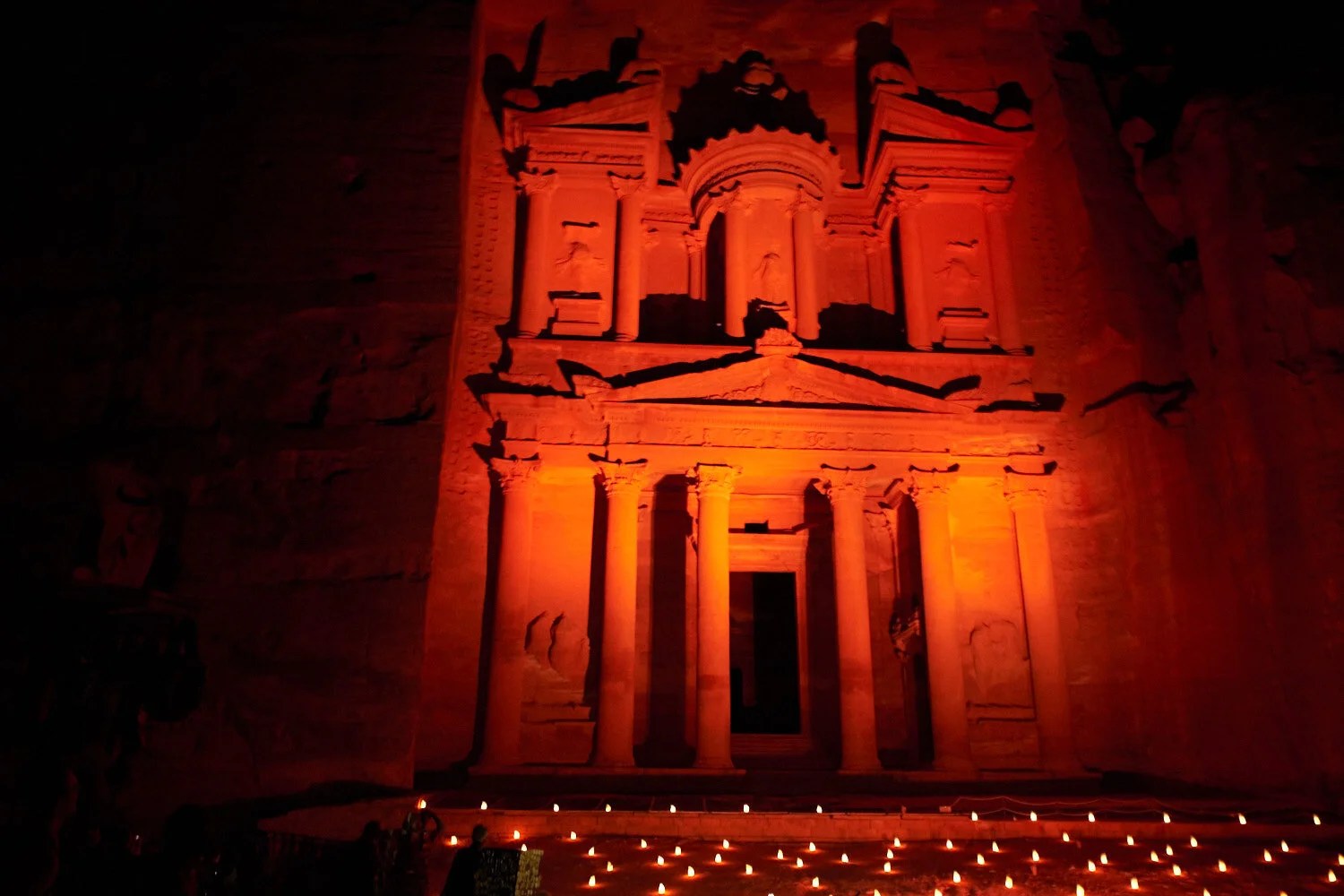
    Early dinner and then off to Petra by Night, an event that takes place twice a week and one that allows you to enter the Petra grounds at night and then with candles in brown paper bags every 5 metres or so to mark the path, walk to the Treasury building to watch a concert under the stars. The Treasury building is the iconic building that everyone immediately identifies with Petra and we were very much looking forward to the evening and to our first sight of Petra. It was a long stony walk in the dark, about 2k, and further than I think we had expected but I’m glad that we did it since it gives us much better information that will help us plan our day’s trek in the ruins tomorrow. Concert was was very nice but the best part, as you would expect was the Treasury building lit by hundreds of candles while a flute and a stringed instrument played haunting arabic melodies.

  • Into Jordan 17/10/16

    Windhoek like Swakopmund was modern, bustling and clean. We had skirted it when we arrived and drove from the airport to Africats, our first stop in Namibia, the road to which passed through the outskirts of Windhoek. At that time we had the strong impression of its German cultural heritage, many of the older brick building being designed in a recognizably germanic colonial style. On our arrival today, the centre of the city strengthened this impression with graceful old neighbourhoods filled with colonial homes and a thoroughly modern CBD with stainless steel and glass skyscrapers.

    Our hotel for the night, the Olive Exclusive Guesthouse, so named not to confuse it with a rival property next door, the Olive Grove Guesthouse, was charming and need I say, not exactly exclusive as it accepted us, scruffy, dusty and the worse for wear after 2 weeks on the road. Very, very large and modern suite and a wonderful restaurant on the property, our only regret was that we were there for only one night. Dinner in the restaurant, a long hot shower, a good nights sleep and off to the airport next morning for our flight to Amman, via Jo’burg and Dubai.

    We were met at the airport in Jo’burg by Susie and Rich Prangley of African Avenue. Susie has been planner and advisor on of all of our various african adventures and in fact has also planned the african segment of the trip currently being taken by Brian and Sylvie, neighbours in Toronto, who we were very pleased to introduce to Susie on hearing that they were trying to figure out their plans. Susie and Rich have become very good friends and on our first visit to South Africa they invited us to stay with them at their home in White River near Kruger. Since then they have created two beautiful little ones, Rosie and Zach who we were very keen to meet. Since we did not have time to get to White River on this trip, we arrived in Jo’burg at 4pm and our flight to Dubai was at 10:30pm, they came down Jo’burg, picked us up and drove us to Rich’s mother’s house where had dinner with their family. A really pleasant afternoon and evening, spoiled only by the fact that we had so little time and had to rush off after dinner back to the airport.

    Overnight to Dubai on Emirates in Business, Air Canada has so much to learn! Long layover in Dubai and then a 3 hour flight to Amman, getting us in late afternoon. Our hotel is the Intercontinental and after 2 weeks in Namibia we had almost forgotten what spoiled can feel like. I’m a great fan of Intercontinental Hotels and this one was no exception. Next morning, coming down to the Concierge desk on the elevator after breakfast on the Club floor, we struck up a conversation with a man on the elevator who after hearing that we were figuring out what to do with our day, introduced himself as the Director of Intercontinental hotels in the region and the GM of our hotel. He is Swiss, a charming and very knowledgeable man who as it turned out is also a photographer in his spare time, and was very keen to help us plan our time in Jordan. He first made a call to find the head concierge, a crossed-keys concierge named Bashar, who we discovered was the first crossed-key concierge in Jordan, and put us in his hands. Bashar has been enormously helpful and even more important, warm, friendly and caring. He has taken us under his wing and smoothed our path as we have planned and changed plans and has made all aspects our itinerary work. Cannot say enough good things about Michael the GM and Bashar, if you are ever in Amman, don’t stay anywhere else! And a reminder to all to chat with everyone you come across when traveling, you never know where it may lead.

     Jerash
    Jerash

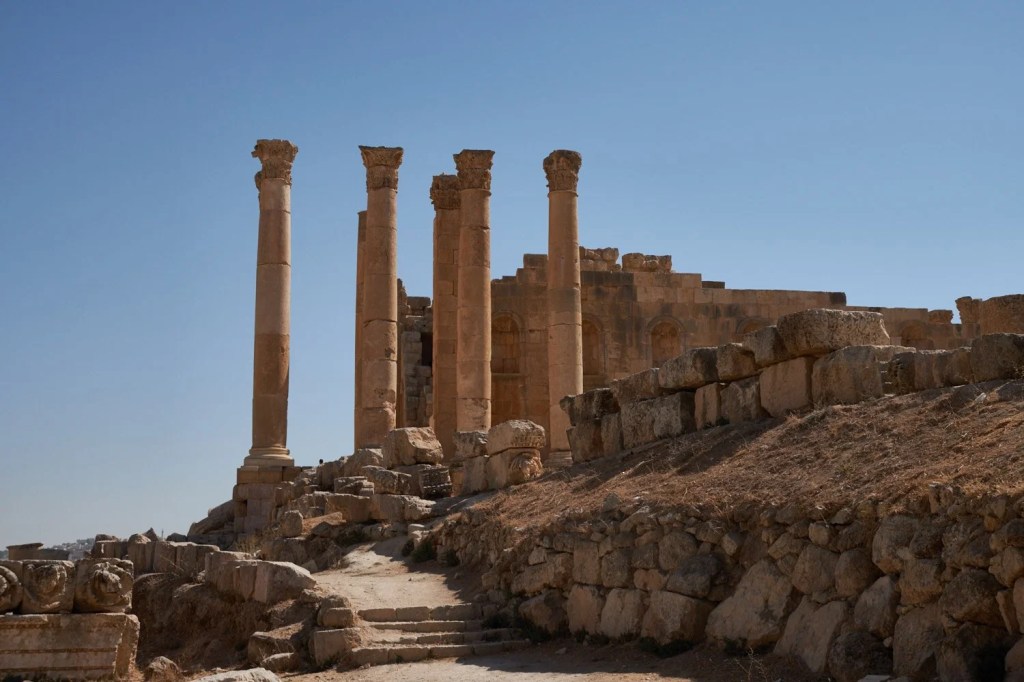
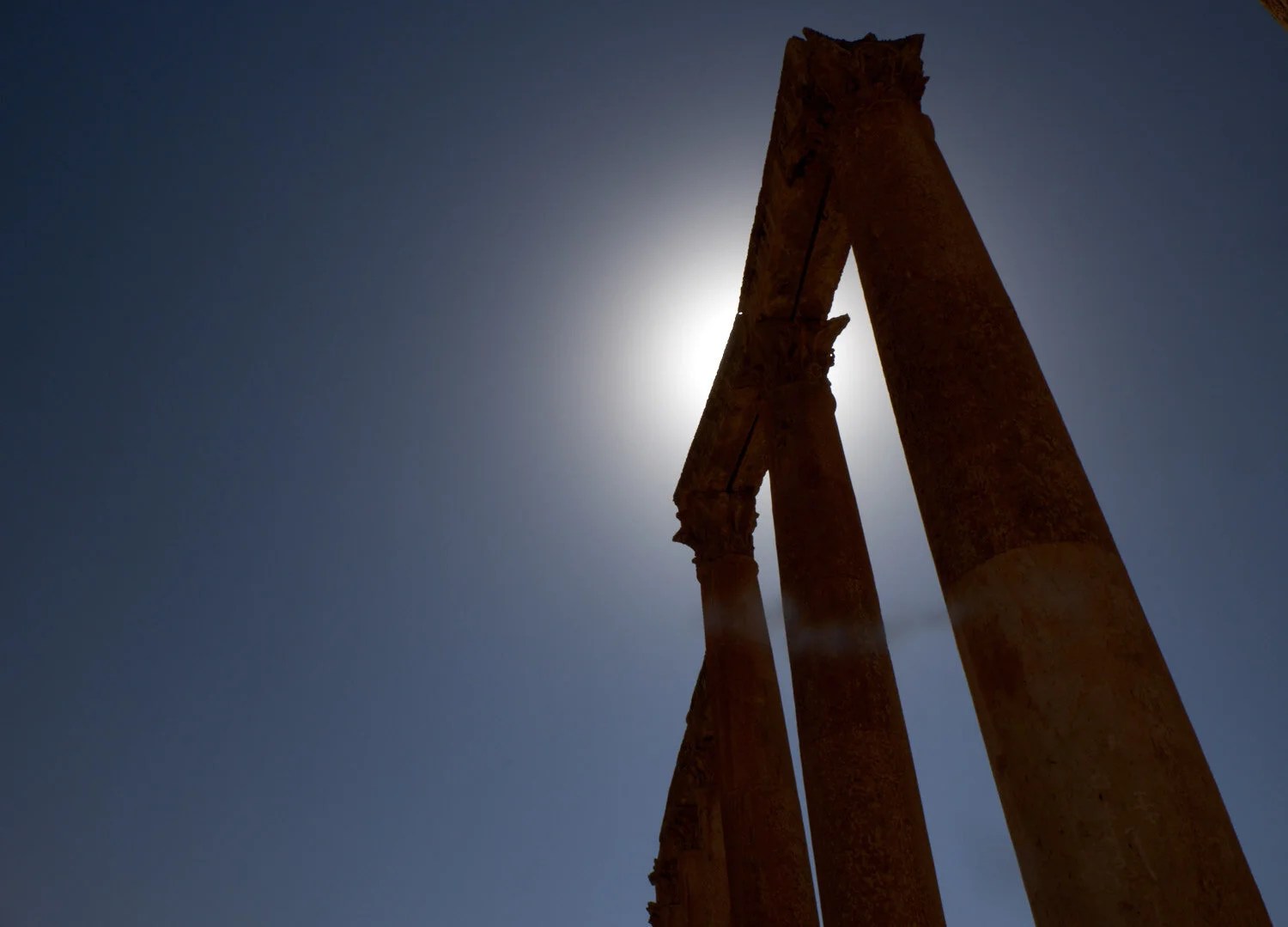
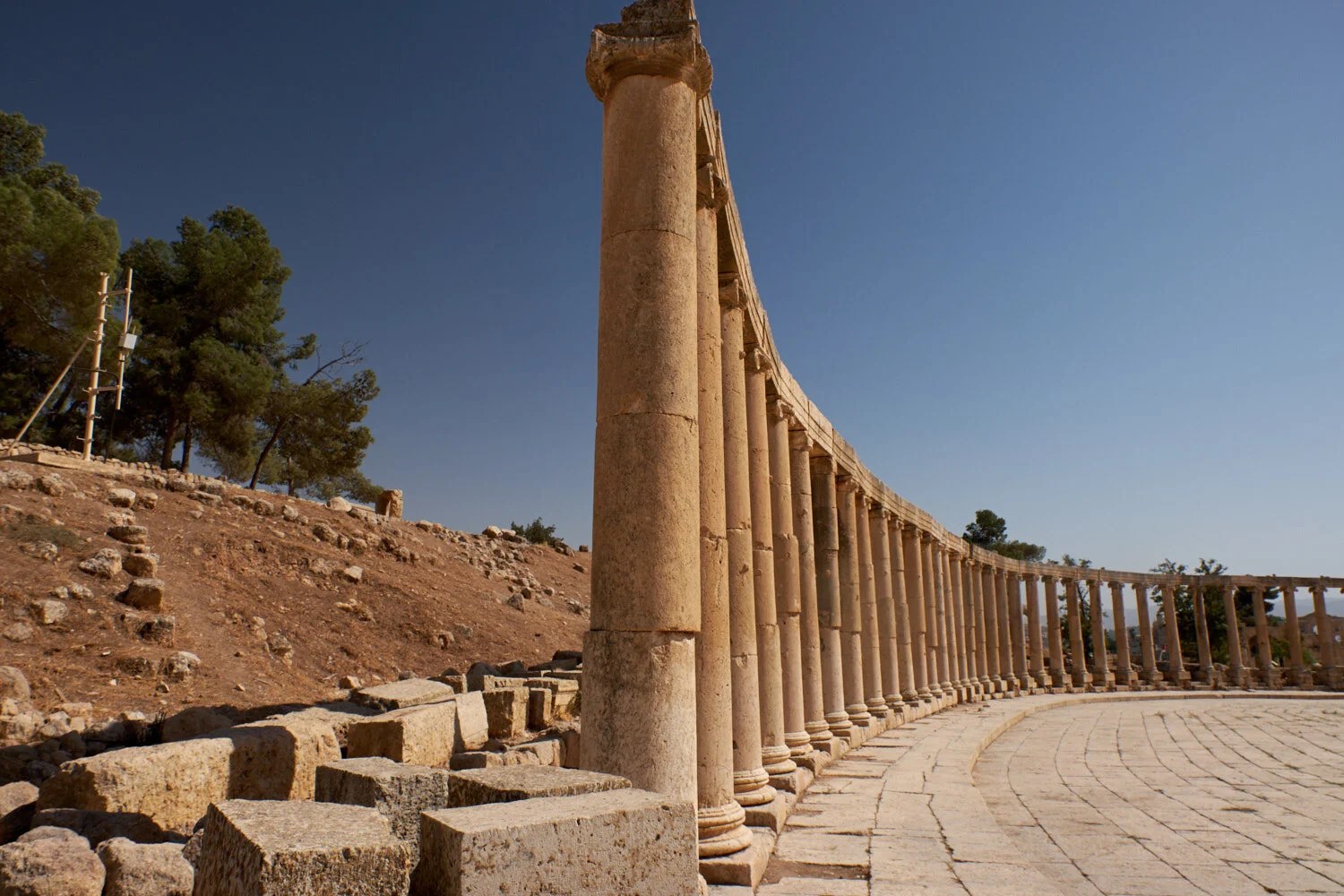
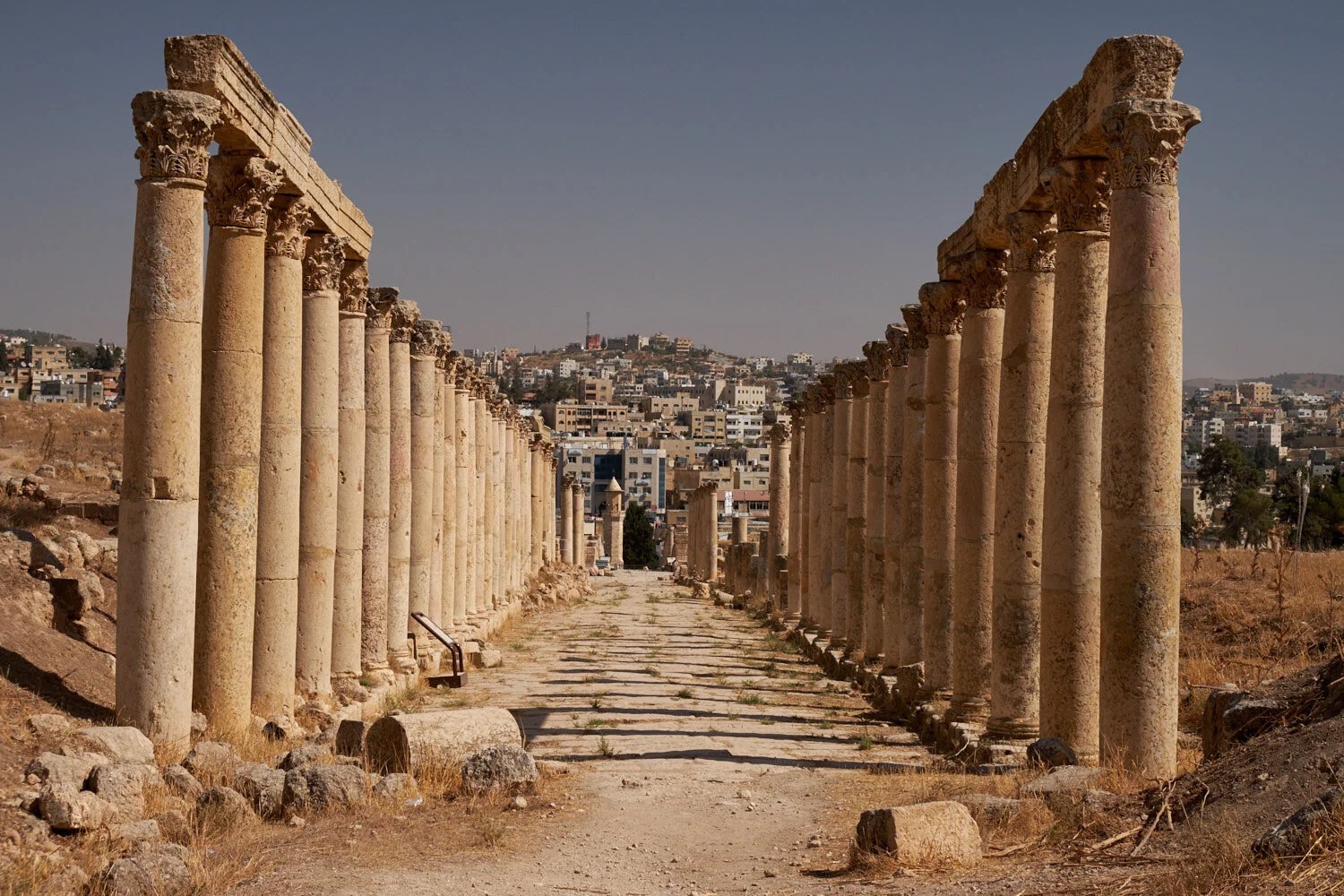
    Bashar sorted a car and driver for us today to drive to the ruins at Jerash about 45 minutes out of Amman. Jerash is the site of the ruins of the Greco-Roman city of Gerasa, also referred to as Antioch. Ancient Greek inscriptions from the city as well as literary sources support that the city was founded by Alexander the Great or his general Perdiccas, who settled retired Macedonian soldiers there (γῆρας – gēras means “old age” in Ancient Greek). This took place during the spring of 331 BC, when Alexander left Egypt, crossed Syria and then went to Mesopotamia. Jerash is sometimes misleadingly referred to as the “Pompeii of the Middle East”, referring to its size, extent of excavation and level of preservation however Jerash was never destroyed and buried by a single cataclysmic event, such as a volcanic eruption although it was largely destroyed in an earthquake in 790AD. Jerash is considered one of the most important and best preserved Roman cities in the Near East.

     Jerash
    Jerash

    We spent a fascinating afternoon wandering the site but in the end beaten by the sun which at that time of the day is relentless and there is little or no shade to be found on the site.

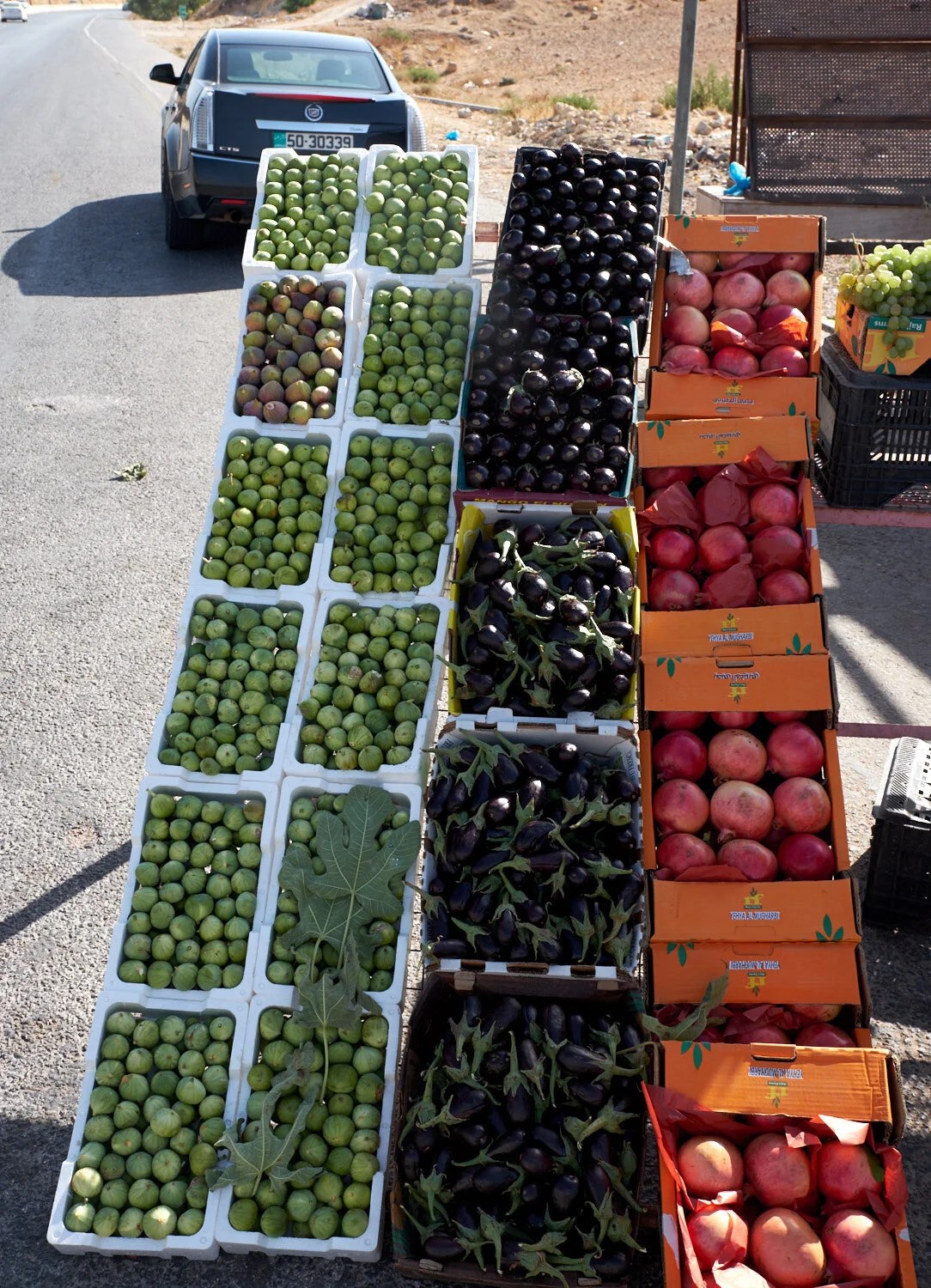
    We had noticed on the drive from Amman as we got out into the countryside, cars and trucks pulled over on the edges of the highway displaying boxes and trays of fruits and vegetables, bright and shiny and stacked for sale. We were very taken by this and our driver told us that the region of Jerash is a very rich and fertile valley where much of the country’s produce is grown, dry dusty appearances notwithstanding. He scouted along the sides of the road on our return and suddenly pulled over to the side of the highway at the site of one of these fruit sellers, opened the door and got out. No one in Jordan ever appears to close their car doors, so there we were on the side of a 3 lane highway, cars speeding by at 100+k , our car doors wide while our driver began the most heated, loud and frantic negotiation for a tray of fresh figs, some bunches of grapes and a couple of pomegranates while we looked on. At the end of the very intense discussion the driver and the fruit seller shook hands, broke out in loud laughs and appeared to have thoroughly enjoyed themselves, honour having been satisfied on both sides. The driver then presented the fruits to us and refused any payment.

     Jerash
    Jerash

    This is but one example of the graciousness that we experienced from the Jordanians with whom we have been in contact. They have been unfailingly charming, helpful, warm and friendly. We weren’t sure what to expect prior to our arrival but our experiences have been nothing but positive and these small touches make an enormous difference when you are navigating your way through a new culture.

    Tomorrow, on our way to Petra.


  • Out of Namibia 14/10/16

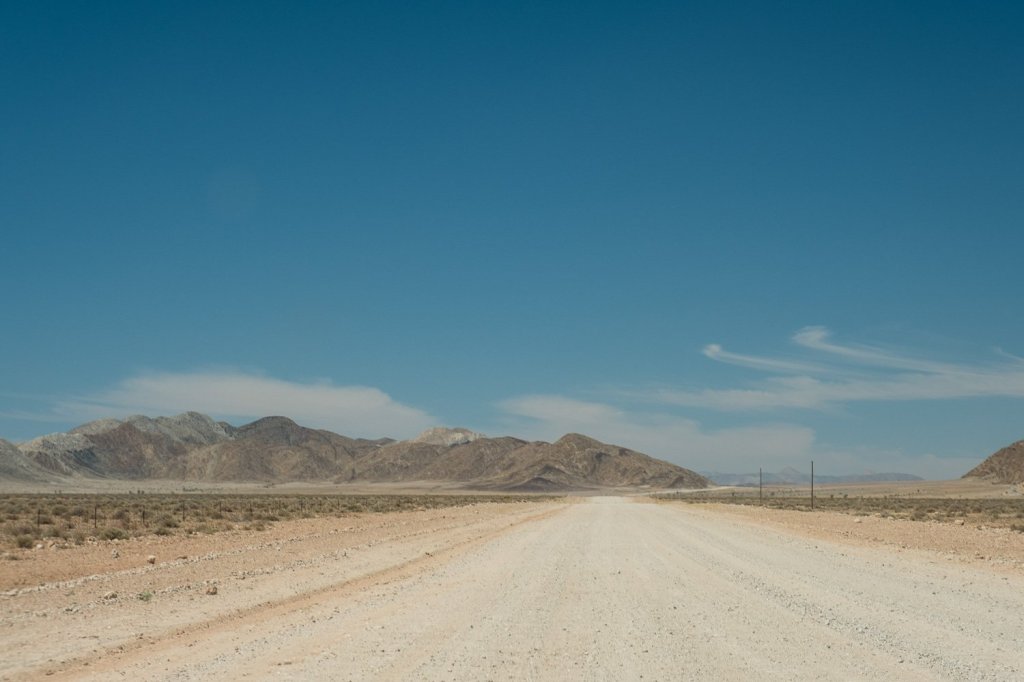
    In my last post we were heading from Swakopmund to Sossusvlei after a surprising and interesting three days exploring the coast. As usual, a 6 hour drive over gravel roads but before leaving I made sure that we had our route set in my portable gps linked by bluetooth to my iphone and the Tracks4africa app. Road construction and detours out of Swakop so our usual three way discussion ensued, V with her paper map, the gps with its inflexible and naggingly annoying one-track mind and me with the steering wheel and a very short attention span. Finally got ourselves sorted and on the right road south to the &Beyond Sossusvlei Desert Lodge.

    Not a particularly memorable drive, gravel road and desert so with a brief stop for lunch in Solataire (sic), we pushed on, arriving in mid-afternoon. The lodge, like all &Beyond properties a stunner, on a rocky rise overlooking miles of flat desert to hills and very large dunes rising in the distance.  There are 12 individual self-contained stone units scattered over the ridge, each with its own deck looking out over the infinite desert views, somewhat reminiscent of Doro Nawas, but there the resemblance ended. Instead of desultory service and a rundown air, the rooms and the lodge were spotless and sparkling, service was pleasant and attentive, rooms luxurious and food some of the best we have had. Only drawback is the 1 hour drive from the lodge to the gates of the Sossusvlei Reserve and a further 1/2 drive from the gates to the beginning of the Sossuusvlei dunes.

     Sundowners at Sossusvlei Desert Lodge
    Sundowners at Sossusvlei Desert Lodge

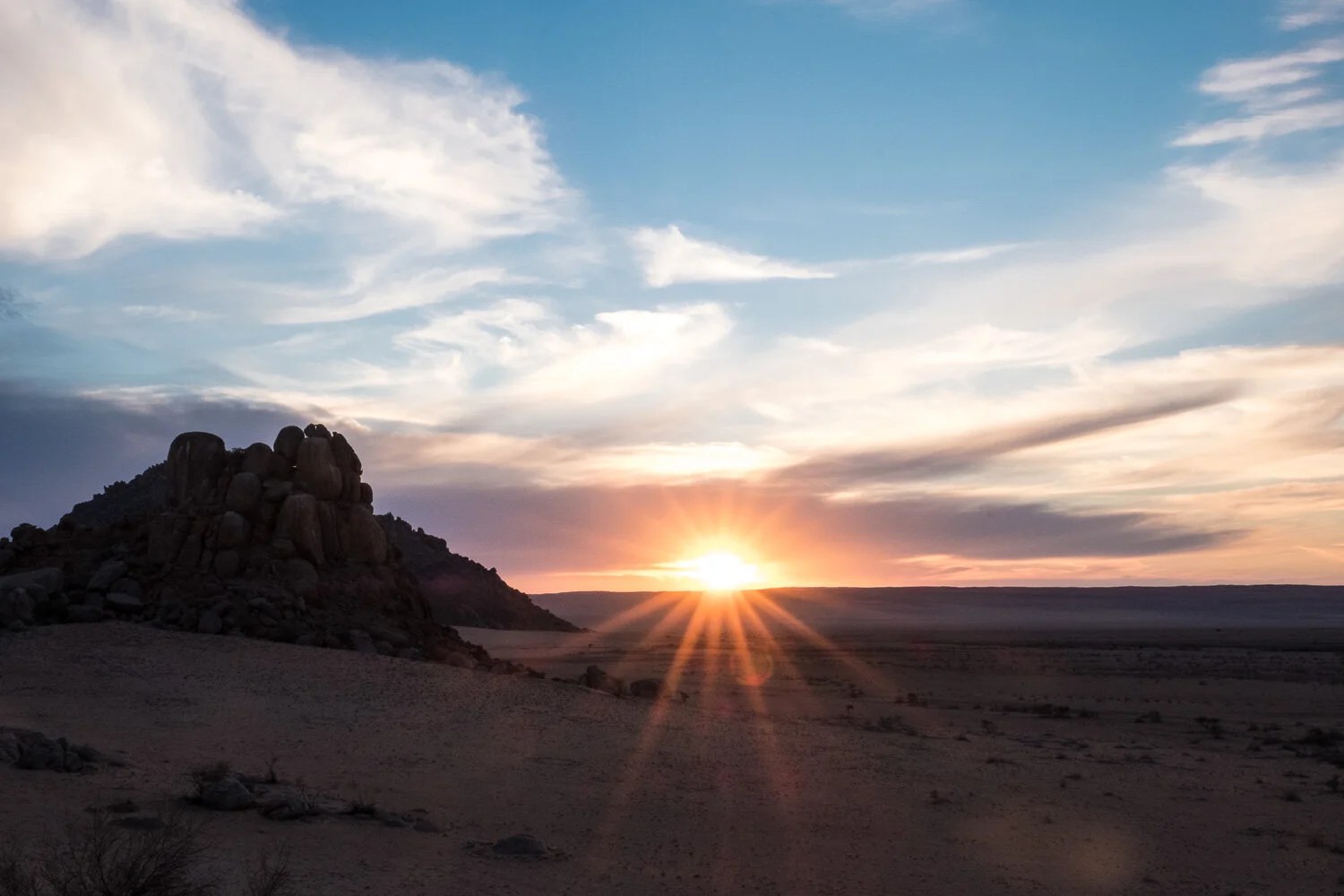
    Out in the evening for a drive across the desert and sundowners on a hill looking across desert and dunes and then back for a wonderfully well-prepared dinner under the stars.

    The lodge has its own separate observatory with a very large and sophisticated telescope and a resident astronomer/astrophotographer available for show and tell demonstrations in the evenings. No light pollution here so the Milky Way is bright and almost tangible, the Southern Cross glowingly apparent and Venus and Mars huge and shiny, hanging above the horizon. We were too tired after the day’s driving but planned to take advantage of the astro-facilities the following evening. Even more pressingly we were due for a 5:00am wake up call for a balloon ride over the dunes that we had arranged before we left Canada. Call came on time but with less than good news, there was too much wind to launch the balloon so no ride available that day. However our guide was ready and would take us in a Land Rover to the Sossusvlei Dunes and would be ready to leave at 6 so that we would be first in the gates when they opened at 7.

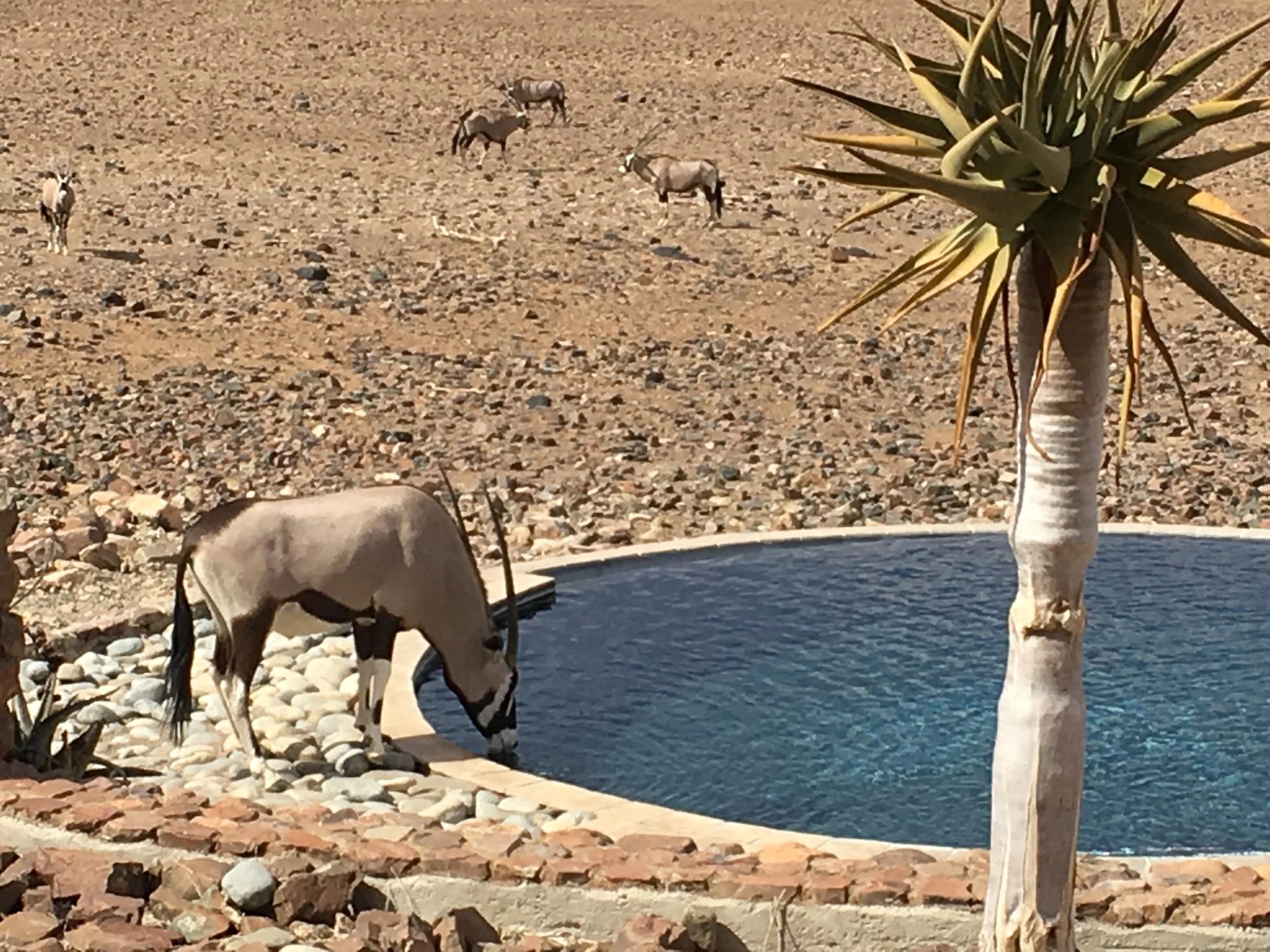
     Oryx at the Lodge swimming pool
    Oryx at the Lodge swimming pool

    Sorry to miss the balloon ride but not heart-broken; i had felt cranky and achy before going to bed and when our 5am call came I awoke with the early stages of a full-on cough and cold, headachy with a very sore throat. Lots of coffee and then a long drive from the lodge reaching the dunes about 8am, dunes red and imposing, a couple of hundred metres high and glowing in the early sunlight. We drove on a paved road, what a treat!, that traverses the dunes stopping periodically to shoot and working our way to what was for me one of the goals of the trip, Deadvlei. 

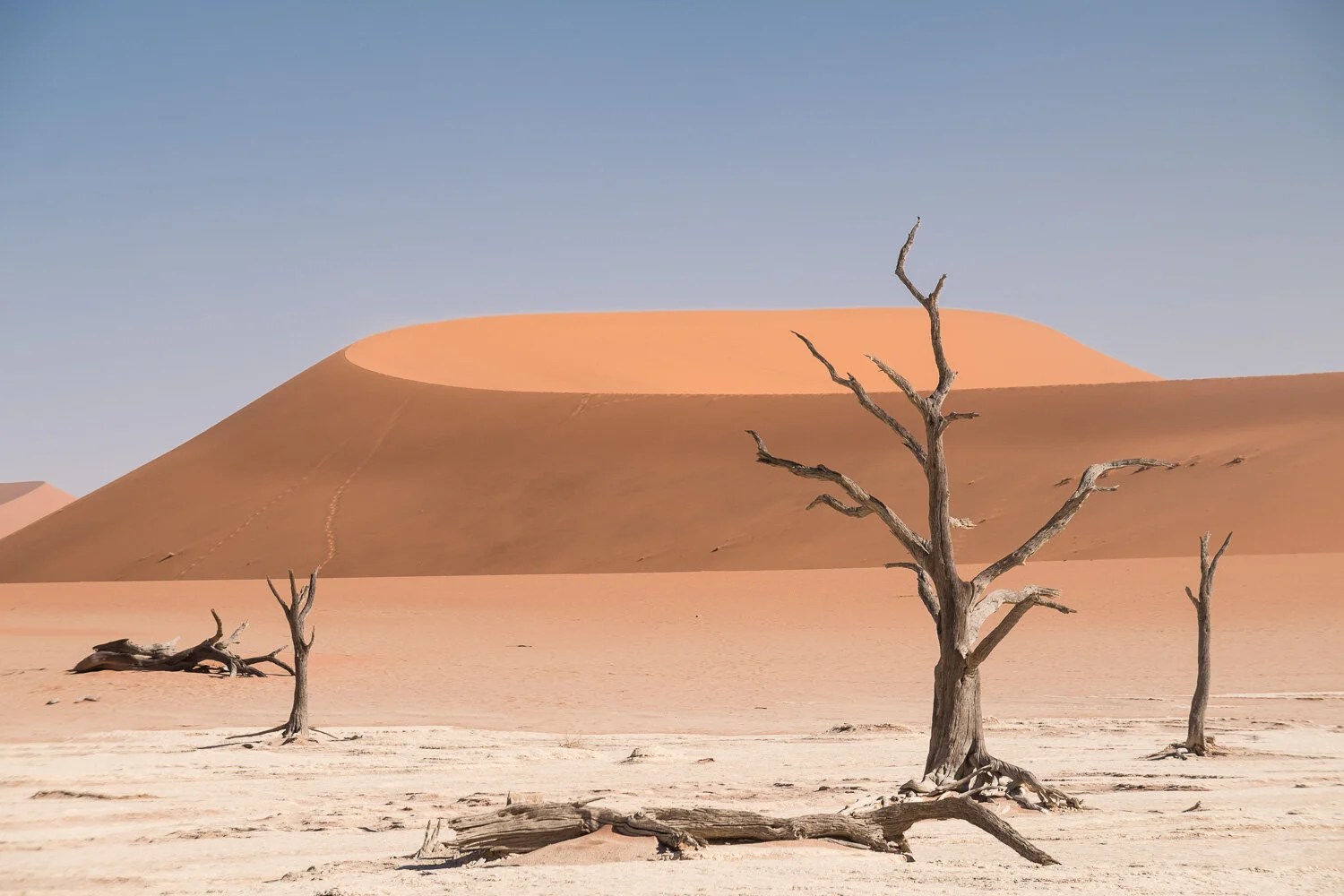
    Deadvlei is dry pan, formerly a very large pond a couple of hectares in size but now hard, baked dry, rock-like earth punctuated with scattered dry skeletons of trees and sitting in a bowl surrounded by very high dunes. The walk in to Deadvlei is 1.1k wading through powdery sand, the sand very light and dry and very tiring to plow through, think very hot, deep powder snow and no snowshoes. Well worth the walk however and I’m hopeful of some good shots

     Deadvlei
    Deadvlei

    Back to our 4×4 for a picnic breakfast under the trees at a waterhole and then back to the lodge for a shower. At this point feeling pretty grim so decided I’d lay low for the day, doze and try and shake off the cold. V planned to go out with the guide later in the day but I was happy to veg and hope for a better day tomorrow. Received the news from our balloon people that because we were not able to go up today, we need to be put on a wait list for the following day’s flight, the balloon being full and our only hope, a cancellation. Long slow day, achy and as ever with these things, events seeming to occur at a padded distance. On V’s return went along for dinner but not much appetite and couldn’t manage the observatory and star program, too bad really as V went and thoroughly enjoyed it. Had told the lodge that if there were no cancellations for the balloon ride not to wake us so we had a lie in until 8 and the world looked much better.

    Tough decision to be made to be made today. Tomorrow we leave for Windhoek and then on to Jo’burg and then Jordan. We were told that there was room for us on the balloon tomorrow morning but I had had the lodge look into organizing a helicopter ride to see if we could get some sunrise shots over the dunes. We knew we would be able to get a ride on the balloon but we didn’t know if the winds would keep it on the ground; however the deciding factor was that even if the balloon flew there was no guarantee that it would fly over areas where it would be interesting to photograph. With that in mind we decided to cancel the balloon and commit to the helicopter. Significantly more expensive but we knew we would go independent of winds and we would go where we wanted and not where the wind took us, so up at 5:15am for our ride.

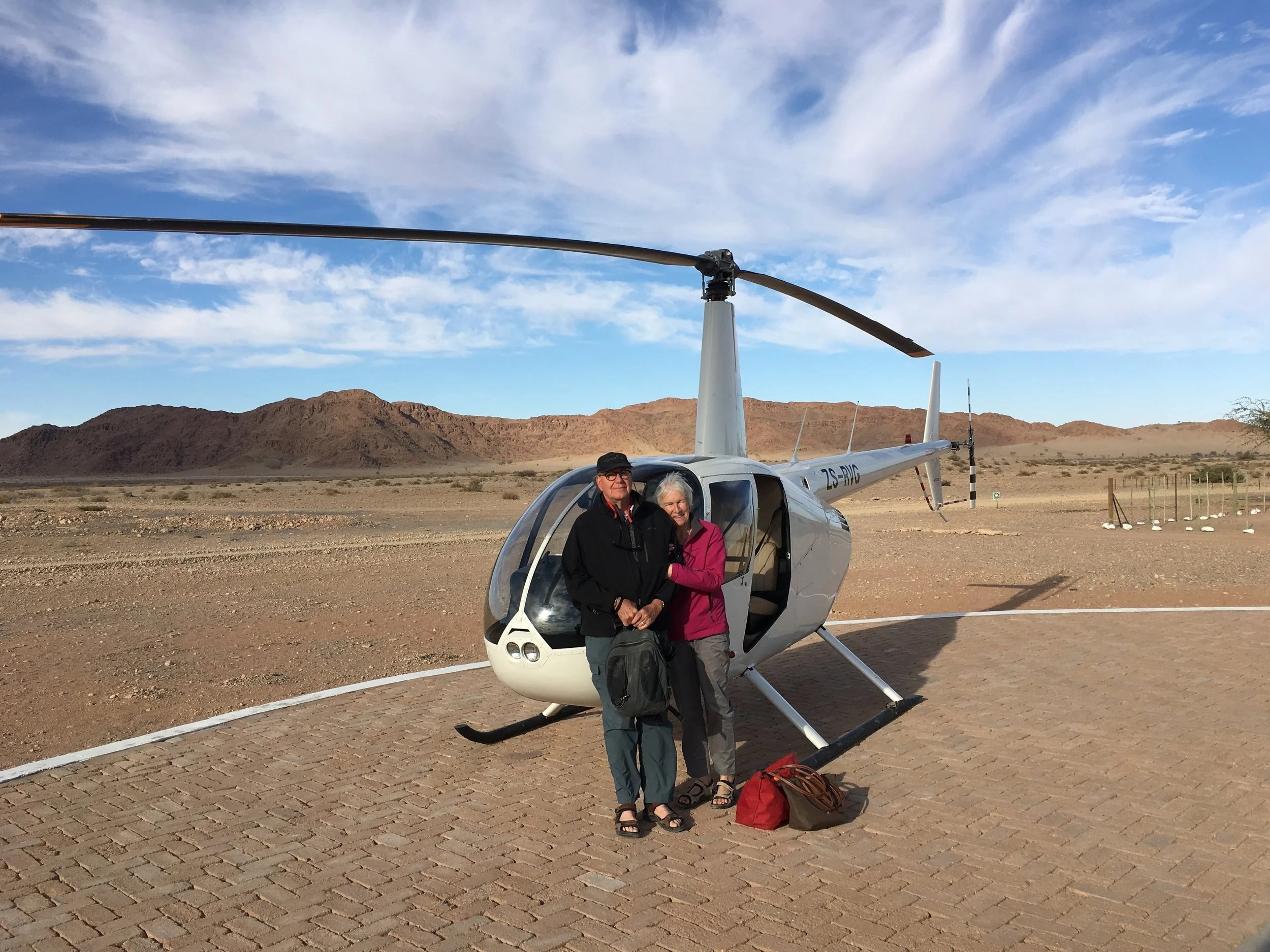
    Packed, paid the bill and loaded our vehicle the night before and on the road by 6. The lodge had packed a box breakfast for us and we stowed that for post helicopter and plowed through the darkness to our takeoff point near the gate to the Dunes Reserve. Met our pilot who put us and our cameras in the open back of a pickup truck and bounced our dusty way a couple of kilometres to the pad and met our helicopter, a little 4 seater slightly larger than the pickup. V selected the front seat next to the pilot and I had the back two seats for me and camera equipment. The pilot asked if I’d like him to remove the doors and I jumped at the chance so my cameras and I had to be properly secured as there was now nothing between me and the ground except several hundred metres of air. I had paid for an hour’s flying time so we had a fabulous flight out over the dunes as far as Deadvlei and worked our way cross country and back to the launch pad. Fabulous views and wonderful shooting opportunities but cold and very, very windy. In fact we made the right call as the balloon was unable to lift off today, the winds being much too strong.

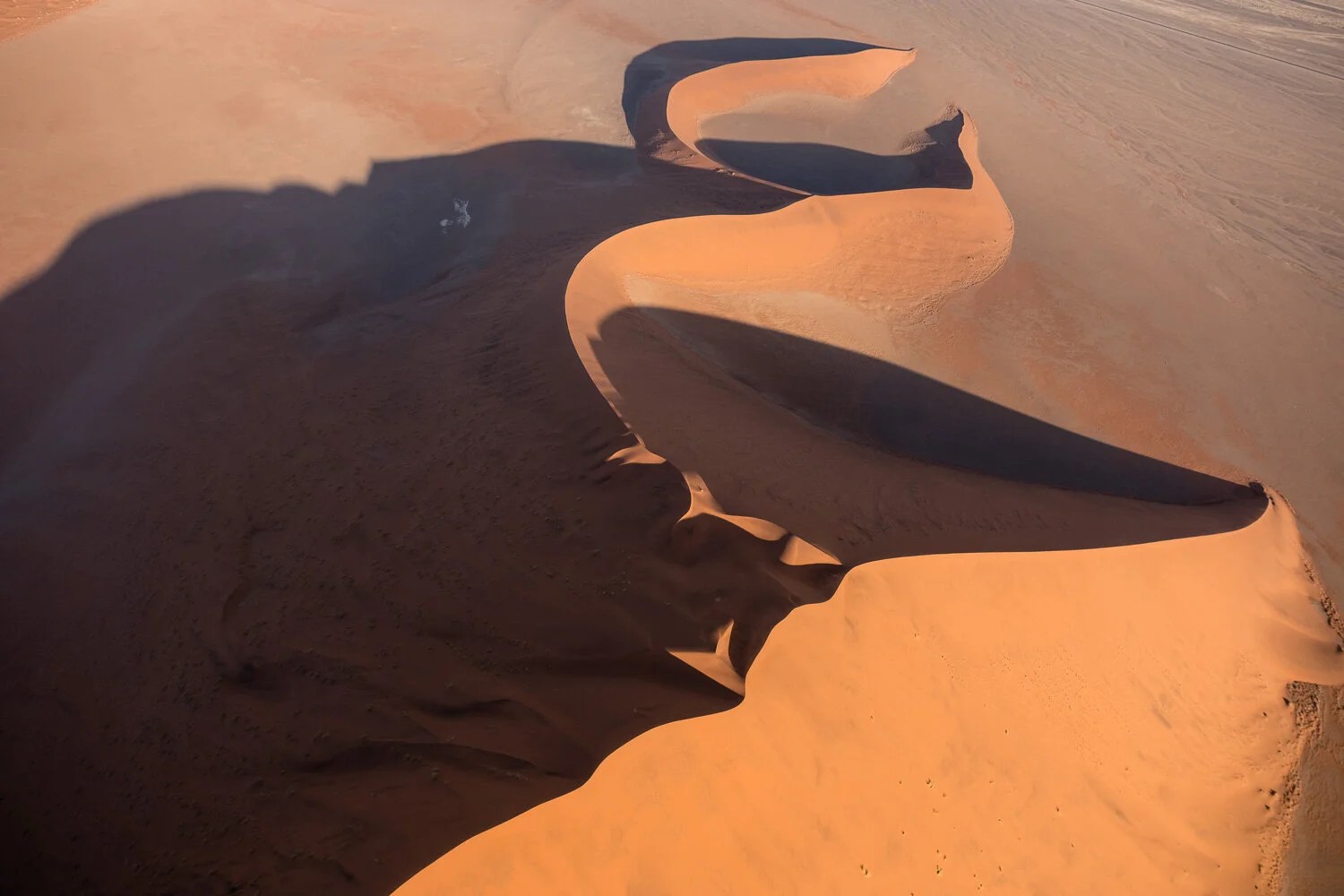
     Dunes from the helicopter
    Dunes from the helicopter

    Once on the ground, found a quiet spot, ate our boxed breakfast and made ready for the drive to Windhoek.

  • Out of Namibia 08/10/16

    In my last post I talked about our 9 hour drive to Damaraland. Because we got our roads so wrong before the Tracks4Africa gps app came to the rescue, we drove to the Doro Nawas camp from the opposite direction than the one expected to be taken by visitors which meant that there were no signs for the camp on the sides off the road, we keep looking for them but never saw any, which given the overlong drive worried us considerably. One of the benefits of our wrong-way drive however was that it took us through parts of the country not usually traveled by visitors and over a mountain pass that was stunning, hairy driving but fabulous views. Our guide when we finally arrived couldn’t believe that we made managed the drive in our vehicle, clearly a drive that is not normally taken by tourists.

    Damaraland the region, and Doro Nawas our lodge, in neither case had any really compelling connections for us. Doro Nawas is reached by 4 or 5 kilometres of gravel road branching off the main gravel highway to a very rocky and wind-swept hill rising out of the dusty desert and about 40 or 50 metres high. The main lodge was perched on top and the various individual stone chalets scattered around the hillside. The 5k drive to reach it was unquestionably the worst piece of track that we have driven  in our entire trip. It was bone-shaking, teeth-rattlingly bad and while the gravel roads and highways are pretty pretty grim in places, corrugations really shaking the car, you can usually find an optimum speed that is not so slow that the car is is slowly being shaken into piles of bolts nor so fast that the bumps are minimized but the car is unsafe, slewing about on the gravel, but a happy and tolerable balance between the two. In the case of the Doro Nawas road there was no optimum manageable speed and we feared for the safety of the car as we pounded along it. Not a good introduction to the lodge, which is a Wilderness Camp, a brand for a number of camps throughout Southern Africa which like the &Beyond Camps is a guarantee of a high level of service and accommodation. Someone was not watching the store in the case of Doro Nawas and given the cost of the camp it was surprising that no attention was paid to the first impression that a camp creates, the road to the site. It quickly became clear that the road to the camp was not the only problem faced by the camp, the service was forgetful and unpleasant and the food less than compelling. Added to a fiercely windswept location with dust blown into every crack and crevice in cars, clothes and bags, it was not a case of gradually losing its charm, for me it had none to start with. The camp very much needs a strong hand on the tiller to pull it back into shape and provide some leadership. Example, each time we ordered anything we were asked for our room number. We had drinks at the bar, we had some laundry done and we ordered various things to be charged to our room and yet when we checked out our bill showed no charges. We had to painstakingly go though our charges so that they could enter them on our account and charge us. A quick way to run the business into the ground, enough said.

    Unfortunate because Damaraland was the homeland of the San people, more usually know as Kalahari/Namib Desert Bushmen. If anyone can remember the 1980’s movie, “The Gods Must Be Crazy”, then you will remember that its central character was a San coming to terms with 20th century technology. We did spend an afternoon climbing over rocks to find San rock drawings, stunning images of animals chipped and etched into flat rock surfaces with only chunks of quartz as tools, the whole region is strewn with chunks of quartz of various sizes.

    Once again first-world complaints about the service in the lodge while the whole of the vast, dusty, windswept, desert region, scorching by day and freezing by night provided complete and rich lives for the San people, nomads who owned nothing, had little in the way of technology, who had no permanent dwellings, but who could find food, water, shelter and artistic creativity in conditions that would kill any of us in days. 

    Sorry to leave the San but happy to leave Doro Nawas we loaded our car for the drive to Swakopmund, a port and fishing city on the Skeleton Coast of Namibia. 

    Swakopmund surprised us. We had expected a provincial backwater, a slightly rundown and forgotten town on the edge of the world but instead found a surprisingly wealthy and sophisticated area with good restaurants and very expensive homes, 1,000,000 + Euros, the Muskoka for Windhoek, the capital city, as well as a wintering location for many Europeans.

    Our home for 3 nights was the Desert Breeze Lodge, a quirky and eccentric set of individual stone units scattered around a very modernist designed property on the edge of huge rolling dunes, hundreds of metres high, on the edge of town, we really like it. In Swakopmund The restaurants were packed, reservations always needed and the food and wines unfailingly good. Because Namibia in general and Swakopmund in particular was settled by and was until recent times a German colony, the German influence is still very strong and many restaurant menus in the city and in the smallest restaurants in the smallest country villages, regularly included sauerkraut and schnitzel. Beer was very good however.

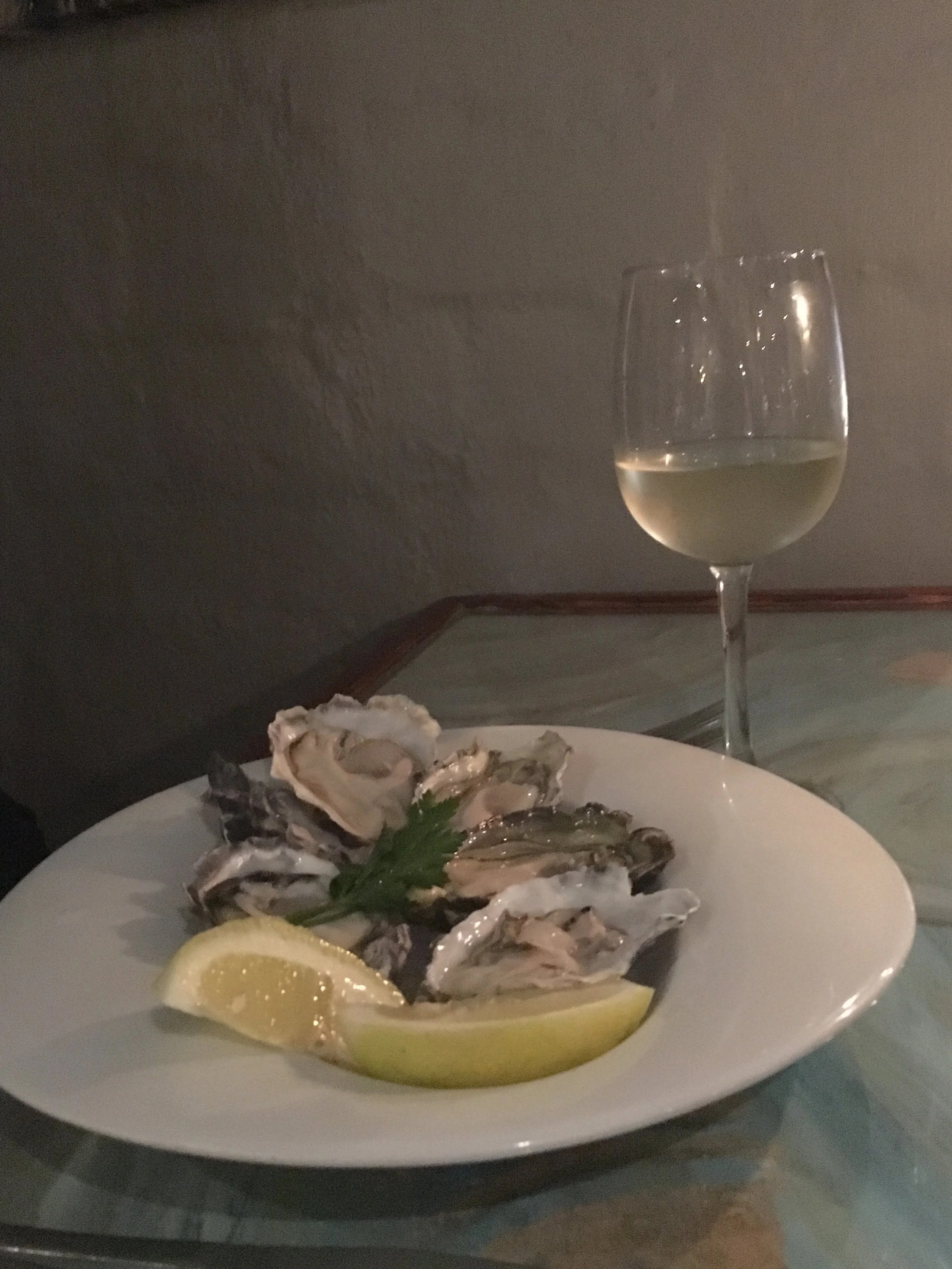
     Oyster at The Tug
    Oyster at The Tug

    For me there is a remaining myster about the town, the lack of lights in house windows. On our first evening as we drove across the city from our lodging to get to The Tug restaurant for dinner, I could not get over the feeling that we were in a Steven King novel. It was dark night at 7pm and yet as we drove there were very few cars on the roads and there was not a spark of light in any of the houses, hundreds of them, that we drove past. The city felt deserted, empty and very disconcerting.  I expected that, in keeping with the houses, the restaurant would be empty and we would be the only diners, and yet when we entered it was packed, noisy and full of life. This stark contrast remained throughout our stay and I can only imagine that it is standard for homes to cover all windows with blackout curtains but why? Certainly it cannot be the case that after dark everyone operates in the dark, yet these are the only two conclusions that could explain the darkened city and the eerie feeling of emptiness. Each house is secured with electric wire fences, many of these are not large walled properties but ordinary one-family homes sitting side by side in residential neighbourhoods, but for reasons that continue to mystify me, they are all closed, shuttered and dark.

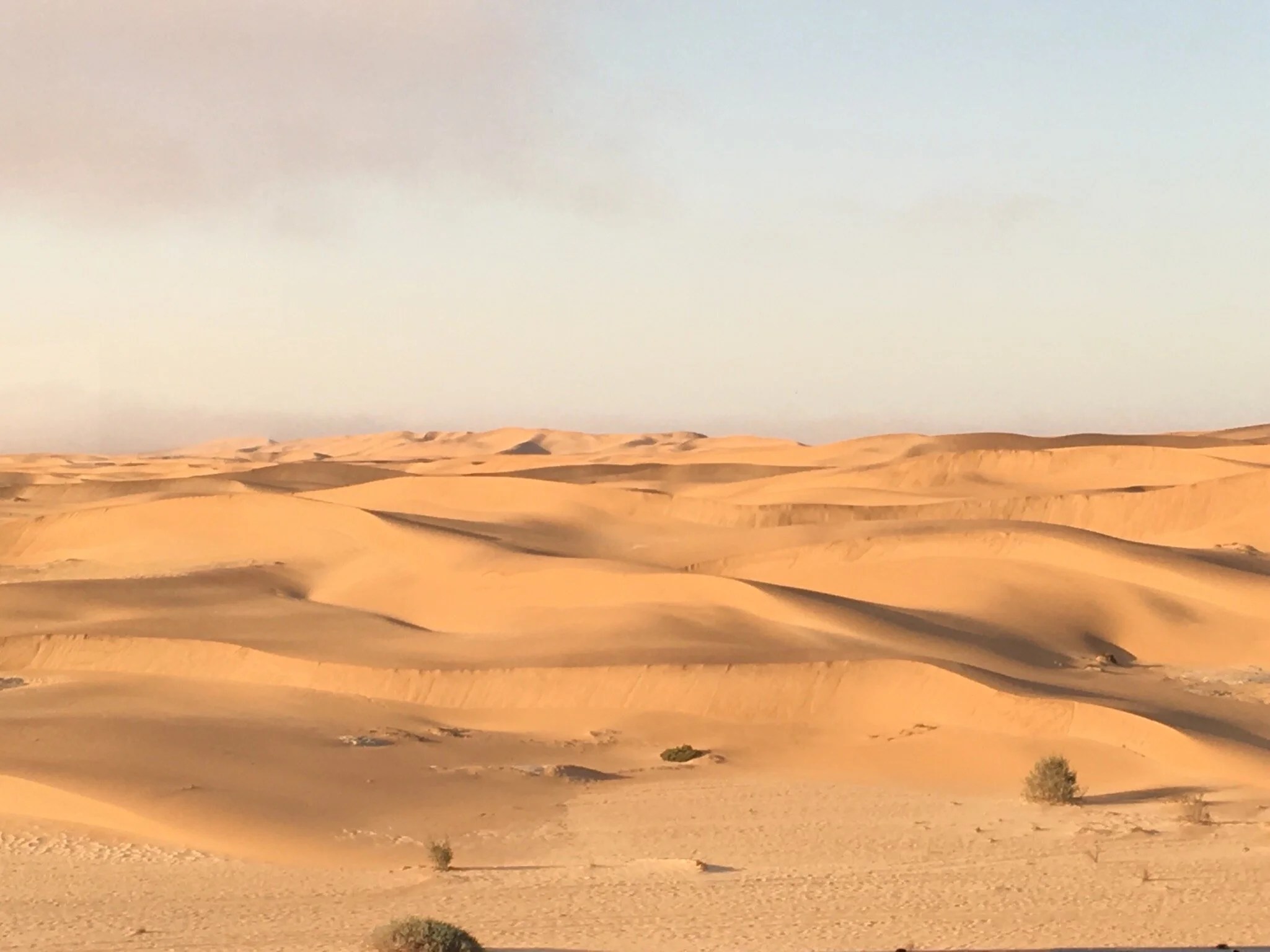
     Dunes in Swakopmund from our hotel window
    Dunes in Swakopmund from our hotel window

    Susie, our trip planner from African Avenue and now a very good friend, had arranged a morning on a boat in Walvis Bay, about 40k south of Swakopmund and an afternoon exploring the dunes in Sandwich Harbour, south of Walvis Bay. We were picked up at 7:30 and headed down to Walvis to board our boat. The day was cool and the sky was heavily overcast, we had not seen blue sky since we crossed the hills edging the coast and the forecast was for fog and heavy clouds to continue for the duration of our stay. An aside, there is a strong cold current running up the western side of Africa from Antarctica, the Benguela Current, which is very rich in plankton and makes the region home to large quantities of fish as well as to various species of whale. It also produces dense fogs and overcasts as the cold air over the current hits the hot air from the desert which parellels the shore. You would imagine that the area, because of the fog and heavy clouds would be very wet and yet it an extremely dry region with less than 4mm of rain a year. In any event, we boarded our boat and headed out in the bay to see what we could find, and of course, hoping for whales. What we did see, at closer quarters, was a large number of oil rigs and tankers moored out in the approaches to bay. We had noticed them the previous afternoon but could not recall if there was oil in Namibia, and even if so, certainly not in the quantity to require 7 rigs in close proximity, just offshore, along with 15 or 20 tankers moored in rows near them. Our captain told us that they were Angolan, the country directly to the north of Namibia, and were moored off Walvis Bay to be serviced and mothballed, oil prices too low to make them economically viable, until the rise in the price of oil was sufficiently high to sail them back to Angola and put them back into production. The empty and seemingly abandoned ships were very much in keeping with my earlier experiences of Swakopmund at night.

    Our morning on the water was a fun, did see whales, managed to get some shots, as well as porpoises swimming alongside and in front of our boat, effortlessly matching the speed of our two 175hp engines and then a without warning, shooting ahead of the boat to lose us in seconds. We completed our morning by eating quantities of oysters which are raised commercially in the bay and which we had enjoyed with our dinner the previous evening. They were plump, cold and of a very good size but not brassy and metallic like our West Coast oysters but sweet, creamy and briny and more akin to the East Coast oysters which we love.

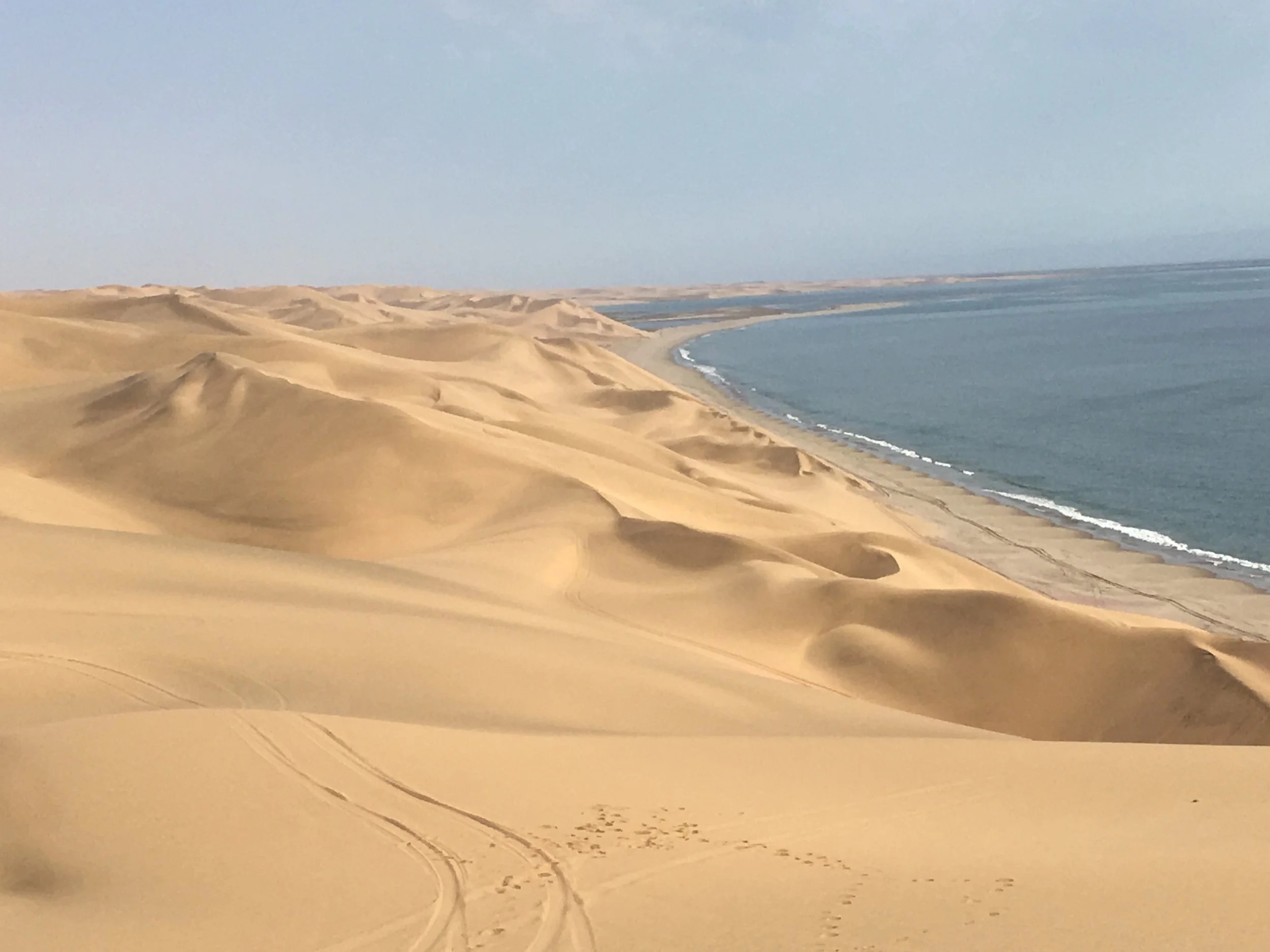
    One of the highlights of our trip was our afternoon exploration of the sand dunes that stretch from the sea in some places or as much as a couple of kilometres away from the sea in others, the area on which Swakopmund is built being one of these, and extend for 30 or 40 kilometres inland. Just south of Walvis Bay is Sandwich Harbour, an area where the dunes begin at the high water mark and extend for long distances inland. You should not think of these dunes as waves of sand 10 or 20 metres high but as mountains of sand 400 or 500 metres high, whose sand waves run parallel to the shore, each wave being separated from the one behind it further inland by valleys of sand hundreds of metres deep that must be climbed to get to the summit of the next sand wave.

     Sandwich Harbour from a dune summit
    Sandwich Harbour from a dune summit
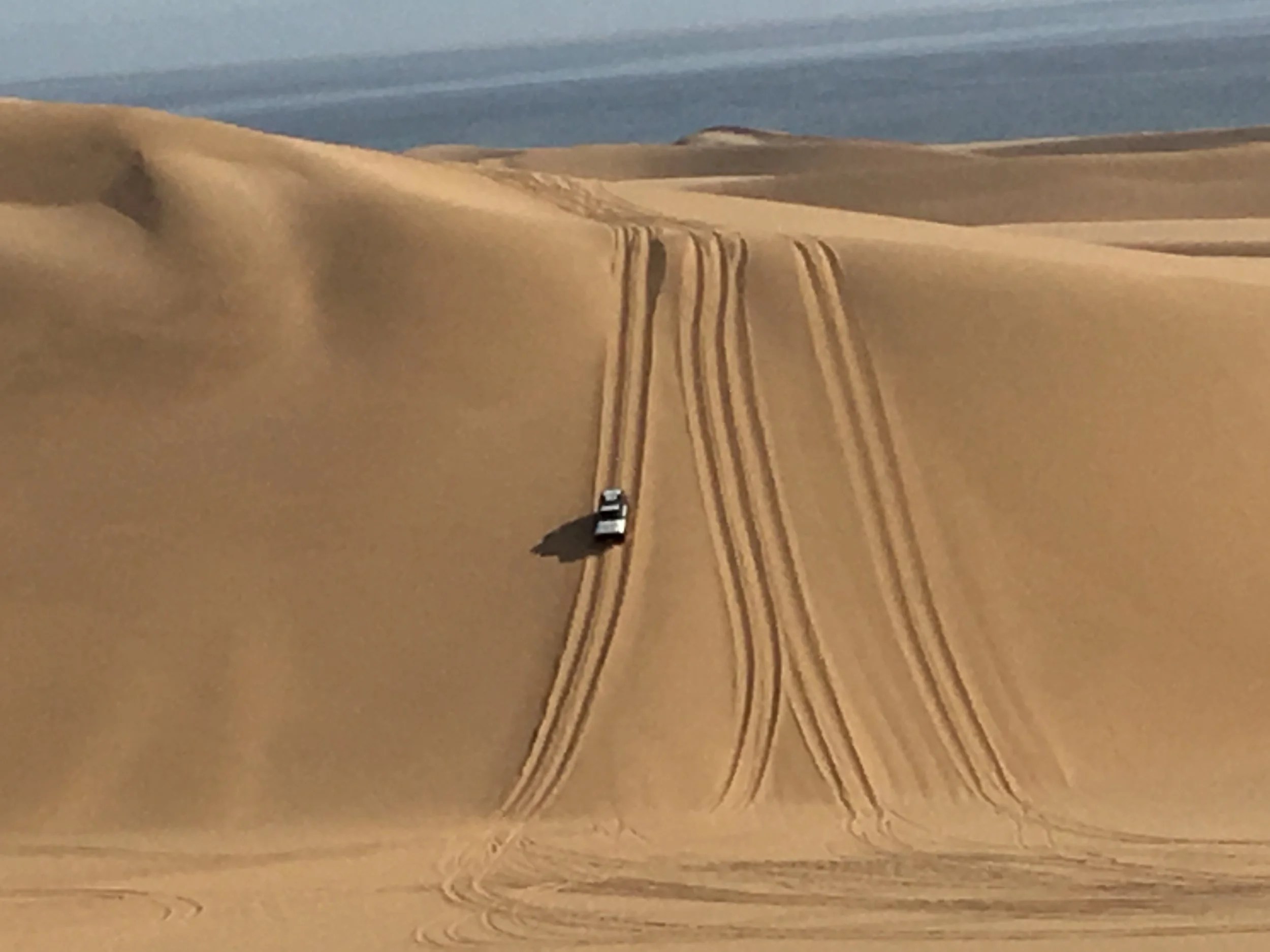
     Down into a dune valley
    Down into a dune valley

     We spent about 5 hours in our 4×4 driven by our guide, not the kind of driving that can be done by someone not very experienced in navigating and safely traversing the vast expanse of sand seas. While the sand waves are the predominant feature there were occasional flatter portions of land with some scrub bushes and plants, particularly the !Nara plant which was the most important plant of the San as well as of many of the local peoples. The ! preceding the name indicates that it said with an initial click, a feature of many of the local languages which are filled with a variety of spoken clicks. Nara or Acanthosicyos horridus is an unusual melon that occurs only in Namibia. The nara plant is leafless, the modified stems and spines serve as the photosynthetic “organs” of the plant and the edible seeds are known locally as butterpips. The fruit serves as an essential food source and medicine for many people and animals from February to April and August to September. Because the plant is spiny many small animals shelter within its branches and the locals claim that any animal whose diet includes the plant is free from ticks and parasites. In these shrubby areas we saw oryx and some small jackals as well as ground squirrels and a very tiny gecko, completely transparent that lives in the sand with huge eyes without lids that the gecko must clean with his tongue. A really fascinating area. 

    During our drive the fog disappated, the overcast lifted and we were treated a brilliant blue sky and hot sunshine. Back to our home in Swakopmund and a very good dinner at a rest​aurant before we left for our last stop in Namibia, Soussosvlei and then on to Jordan and Petra.

    More to come when next I can rely on my wifi connection.​

  • Namibia – More days
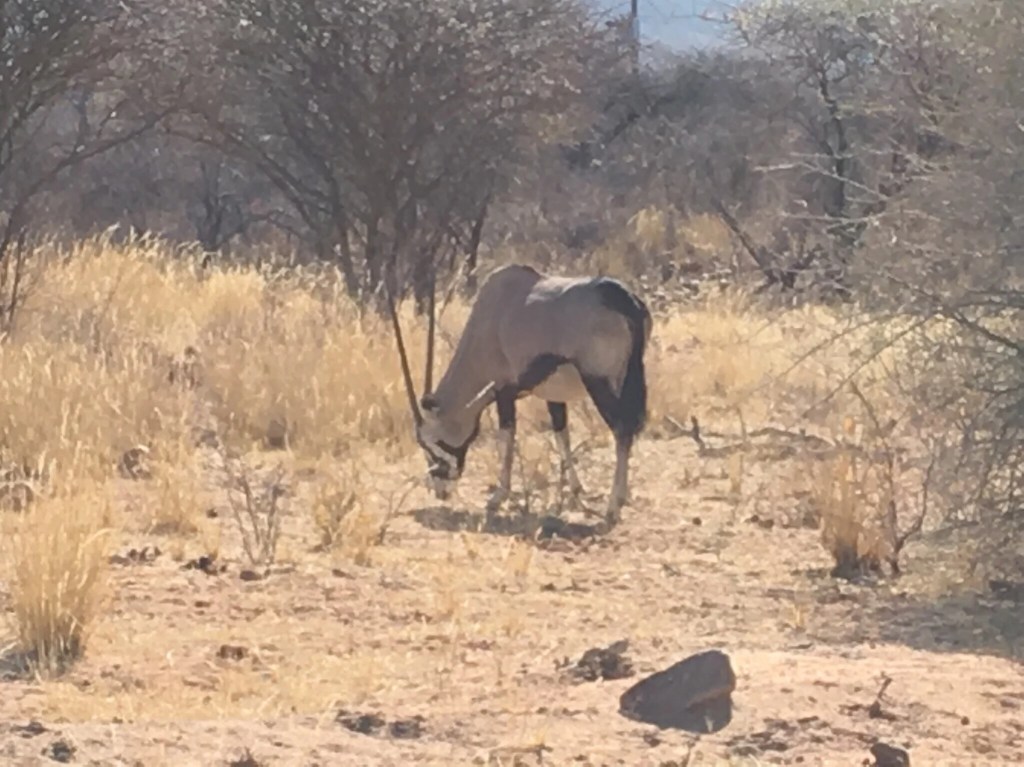
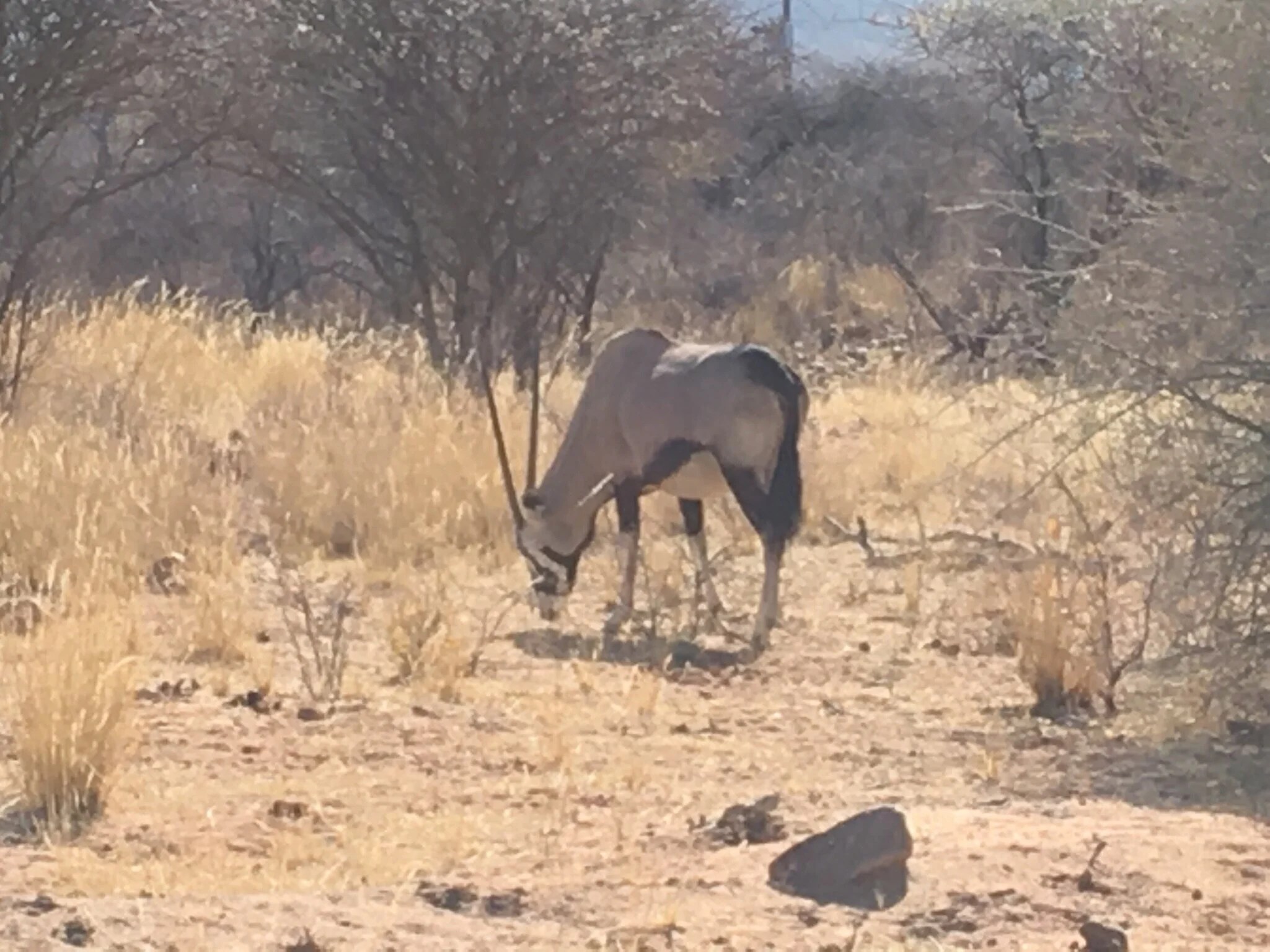
     Oryx Etosha
    Oryx Etosha

    Mashura Outpost Lodge was wonderful but the highlight was our game drive through Etosha National Park. A quick diversion, Namibia seems to be composed of at least two very different geological structures, sometimes butting up against the other so that you can move very quickly in the space of a couple of hundred metres from a red sandstone region with red desert sand and hills to a white limestone area whose rocks and boulders are white and whose sand is as soft, fine and white as talcum powder. Our first couple of days in Okinjima was in sandstone countryside with red and yellow sands and termite mounds. As we drove to Mushara, about half of whose 5 hour drive was over corrugated and dusty gravel roads the country changed to limestone and that remained as the prevailing geology of Mushara and the Etosha park.

    There are no paved roads in Etosha, as a consequence the roads are covered with the fine talcum dust of the limestone which forms dense plumes of choking dust that billow behind a car and makes driving perilous since following vehicles can’t see the car ahead and when passed by cars coming in the opposite direction you can see the lead car but you have no way of knowing if there are others following behind lost in the dust clouds. It goes without saying that car windows have to be kept closed as breathing is difficult in the dust, but there is one remarkable feature of the dust that seems very out of place in the heat of Etosha. As the dust billows up all the trees and bushes on the sides of the roads are permanently coated in a thick white coating that remains until the rainy season and looks absolutely like hoar frost. So as you drive the whole landscape appears to be deep in frost while the outside thermometer in the car reads 39C.

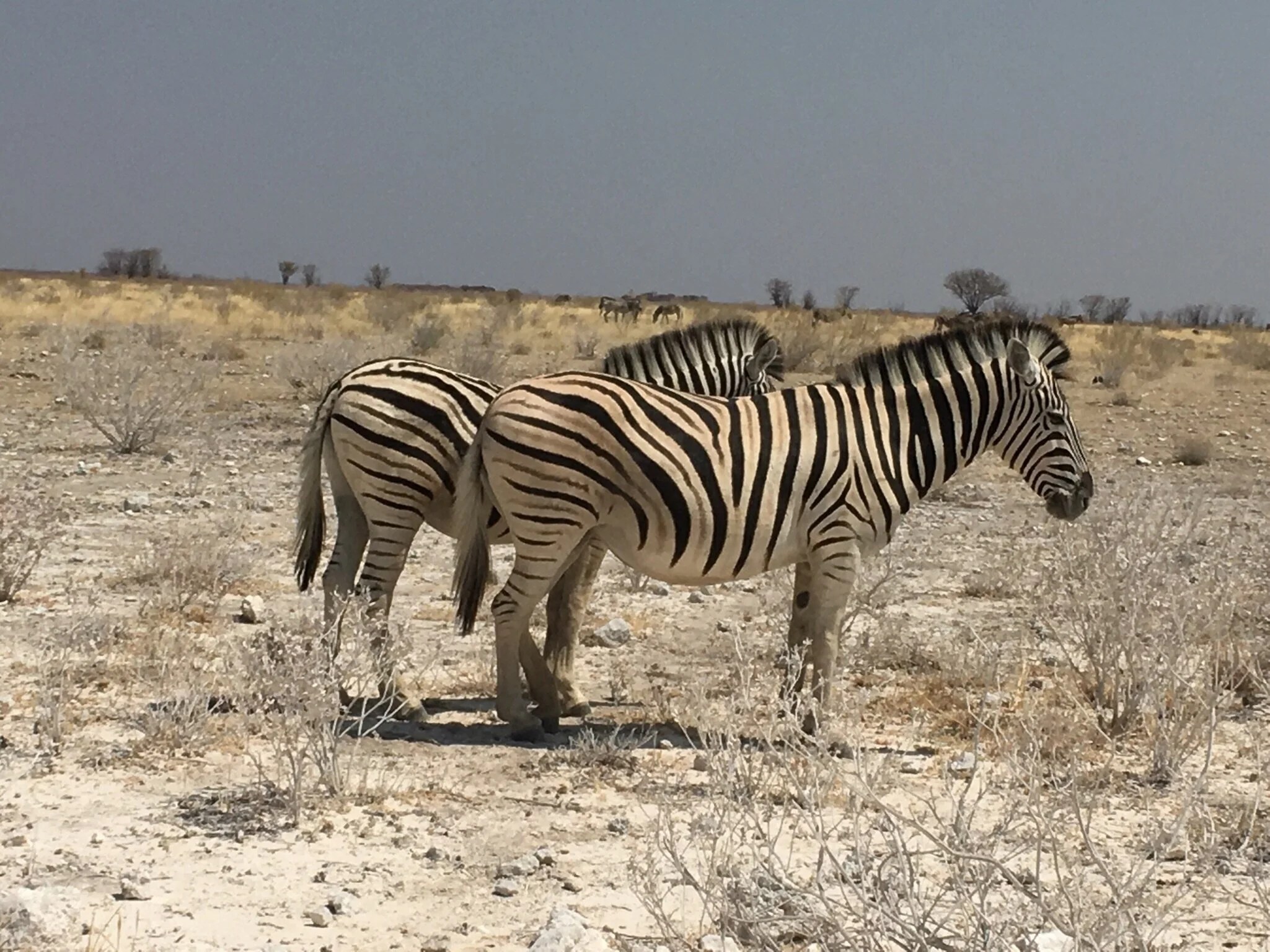
     Because it’s the dry season the water holes, some artificial and some natural springs, are the only source of water for the animals in the park. There are water holes scattered throughout the 23,000 square kilometres of parkland and many of them are within reach or sight of the roads that run throughout Etosha. They are are a remarkable way of seeing animal hierarchies in operation and as there is a great diversity of animals in the park, predators, all the big cats represented as well as hyenas and prey in large numbers from giraffes, warthogs and zebra through many varieties of antelope. We have never seen so many different species of animal in large numbers as we did on this trip all of them scattered throughout the landscape around the water holes while the top of the pecking order, the elephants drink and wallow while everyone else waits. Then the lions drink, lie down, relax and watch everyone else suffer in the heat until the lions get bored with being the neighbourhood bullies and leave and then everyone else gets their turn. We, as everyone else does, heeded the signs not to leave your car.

    Left Mashura and spent the day driving through the park from waterhole to waterhole and seeing all the masses of animals waiting to drink and watching them playing out the dramas that varied from hole to hole depending on the makeup of the animal populations present. We took about 7 hours crossing the park and then on to Ongava Lodge, one of the higher-end lodges of this trip. Very nice place, very nice accommodations and restaurant but we were there for only one night as a convenient departure point near the park gates on the other side of the park from Masdhura as we launched off to Doro Nawas Lodge in Damaraland. One very interesting feature of Ongava was a water hole maintained by the Lodge with a concealed passage about 100 metres long to a hide next to the water hole where it was possible to watch animals at the water from a distance of about 10 or 15 metres. The Lodge and its restaurant are at the top of a treeless and very rocky hill and the restaurant’s dining veranda overlooks the water hole which is lit at night. We did not have time to use the blind, left early next morning for a very long day’s drive to Doro Nawas Lodge, but as we ate our dinner watched three rhinos at the water hole who then left to make room for a couple of young male lions; theatre in the round.

     Left early the next morning and about an hour into our drive paved roads ran out and in a service station on the edge of the gravel we lowered our tire pressure on all tires to 2.2 and filled up. Properly inflated tires on corrugated gravel are a recipe for flat tires and we won’t re-inflate them until the last stretch near Windhoek when we once again hit paved roads. Somehow or other lost our map reading skills deserted us and what was booked as a 5 to 6 hour drive  ended up taking 9 hours and were only saved by my little Bad Elf portable gps and an app on the iPhone that I had bought before the trip called Tracks4Africa. Our gps in the car had no record of our destination in its database and our map had it in entirely the wrong place about 75K away from its actual location. However Tracks4Africa rode to the rescue, had its location in its database and in a cloud of dust in the setting sun, we arrived after a very long, dusty and very bumpy day of driving.

    More to come in the next chapter.