• Blue Clipper Q&A

    Overdue following up on my last posting, but the first 10 days back were consumed with preparation for and attendance at a full-day Board Meeting, my other life, as well as a host of long-neglected and overdue tasks that needed attention.

    As I return to day-to-day reality I have finally started reading newspapers again, retreat over, but I have no sense that I actually missed anything, all too predictable. However, on a more cheerful note, in my last post I promised that I’d answer some the questions that I’ve received about the ship and the voyage so,

    1. Can you tell me about your fellow sailors?

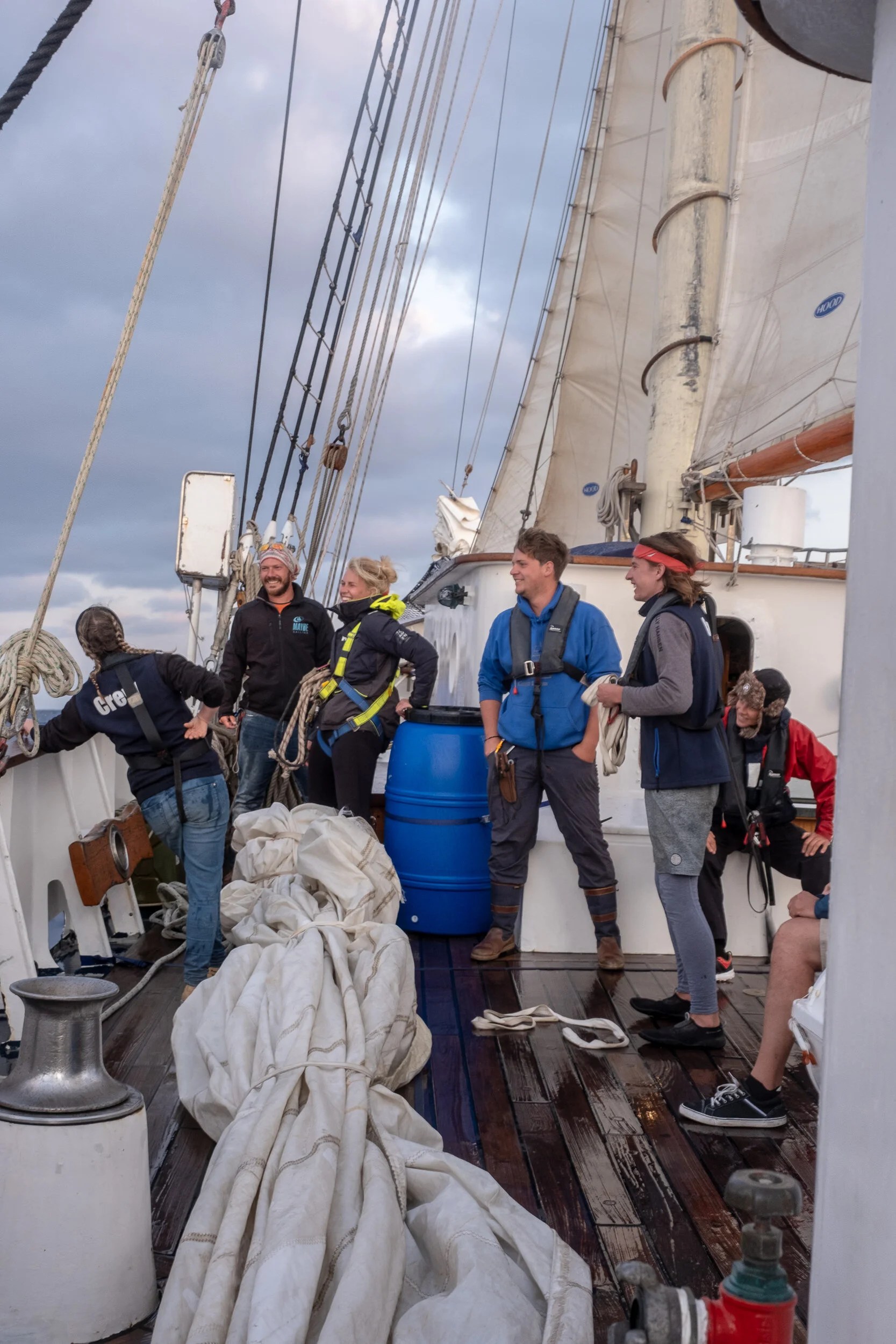
    Interesting question as there were three distinct groups on the voyage, 8 permanent crew including Captain Chris, 10 trainees and the 6 of us voyage crew. The permanent crew, and permanent only in the sense that they were attached to the ship and on its payroll, but not with respect to their tenure, since they sign on for a voyage and may be replaced at the start of the next voyage. Blue Clipper is a UK owned vessel and all the crew were from the UK, interestingly, virtually all were from Yorkshire and Scotland. They were, for the most part, young men and women who have chosen the sea as their career and all were, without exception, well-educated, cheerful and enormously helpful.

    The 10 trainees were even younger than the permanent crew and were much more international, 1 Canadian young man from the Okanagan who was the youngest person aboard at 18 and since I was the oldest, we two Canadians bracketed the age spectrum from 18 to 75. In addition, one young American woman, a Norwegian girl, a young man from Spain and the rest from various places in the UK. Their shared characteristic was that they were all on a gap year or had just graduated from university and all were taking the trip for the adventure and to explore whether they wanted to work in a marine industry. They were also the most fun and all seemed to be having a great time, undaunted, even during our first 8 days sailing in rough weather when, berthing in the forepeak, they claimed that they spent half their sleeping time flying through the air when the ship pitched and the other half scrambling for hand and footholds to stay in their bunks on the rolls.
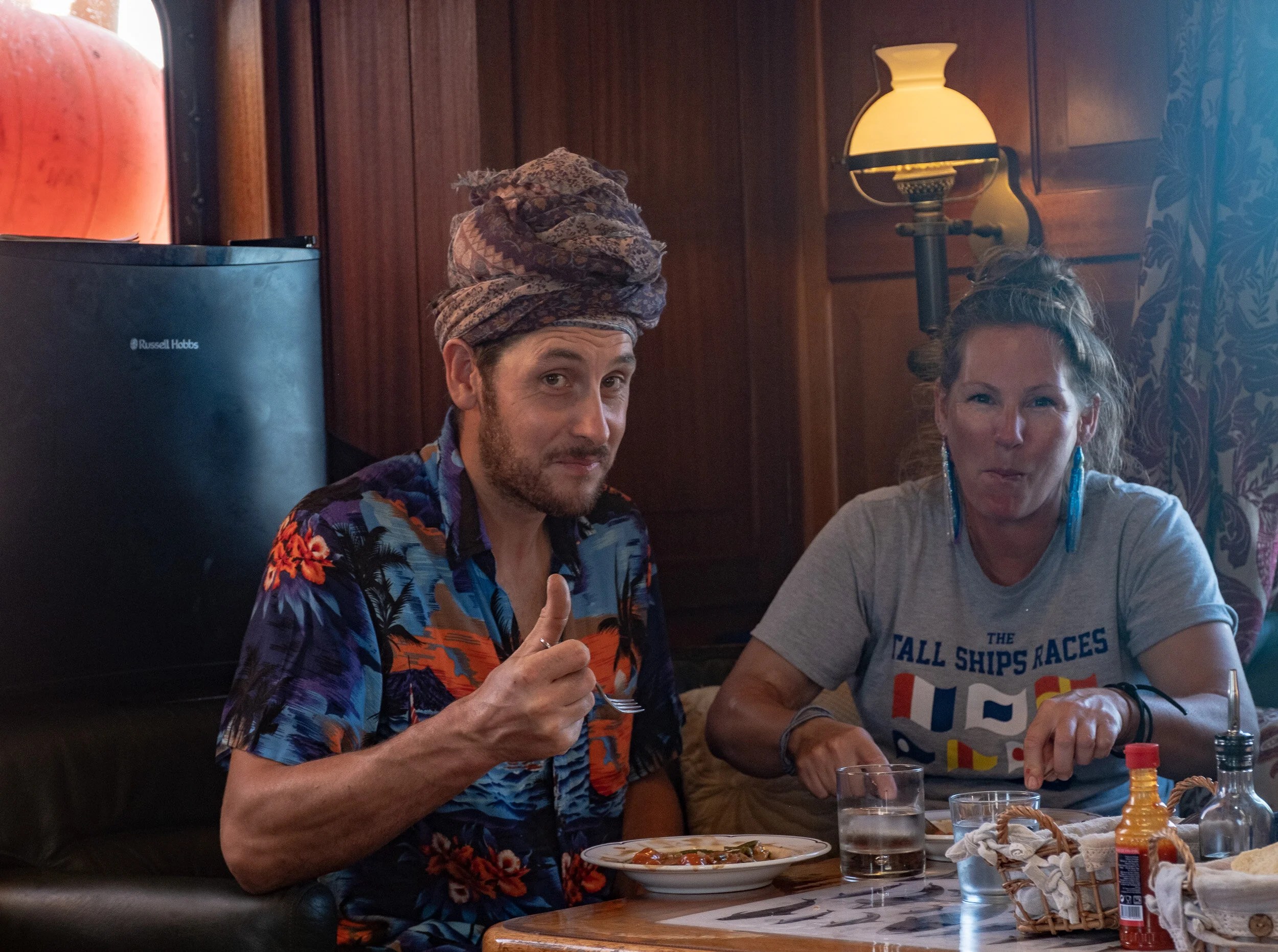
     Dressing up for Easter
    Dressing up for Easter

    The final group was the voyage crew, me, an Australian man from Melbourne, on the trip of a lifetime, a German engineer who now lives in the US, a married couple from the UK and an English academic living in Scotland, who plays the Celtic harp and did so daily, claiming the distinction of being the first person since St Brendan to have sailed across the Atlantic to the accompaniment of harp music. Everyone on board was good company, interesting to talk to and good-humoured in spite of the occasional rebellions of the body in the rougher conditions.

    2. What was the food like, no grocery stores in mid-ocean?

    As you would expect, heavily reliant on rice, couscous and pasta and the vegetable kingdom’s longer lasting members, root veggies and cabbage as well as eggs and chicken which lasted quite well in the fridge, powered by a generator which ran for virtually the whole passage. Breakfast was oatmeal and fresh bread baked every day by Ruth, our chef, who I believe was the bravest member of our crew. Why, you ask? Ruth and her partner Jennie who looked after hospitality and food service, made the decision to sign on for the trip to try it out and see if they enjoyed it enough to make a career in sea-going hospitality. They were both charming young Scottish women but neither Ruth who had worked in a number of higher-end restaurants in London nor Jennie had ever sailed before. Additionally, the galley was in a deckhouse separate from the saloon where we dined and to reach it from the galley required a walk along the deck and up a couple of steps to a higher level of deck where the saloon was located. During the first part of the voyage when the winds were high and the seas were running, Ruth was up at 5am to make bread and prepare meals for 24 people while the ship was rolling 20 or 25 degrees and she was fighting her own battle with seasickness. She would gamely run to the leeward rail, be sick over the side and then run back to the galley to finish preparing meals, while large soup pots whose contents of very hot soup or stew splashed and tilted with every roll of the ship. This she did 3 times a day during the whole of that rough patch and we never missed a meal. And even when the meal was ready to serve the difficulties continued, as these large hot pots had to be carried from the galley along the deck to the saloon. Amazingly, even during the worst of the rolling and pitching, every pot arrived safely in spite of the fact that during the journey from the galley to the saloon there was no opportunity to reach out a hand to help keep balance as both hands were occupied with a very hot pot!
    3. What are the stars like when you’re sailing at night?

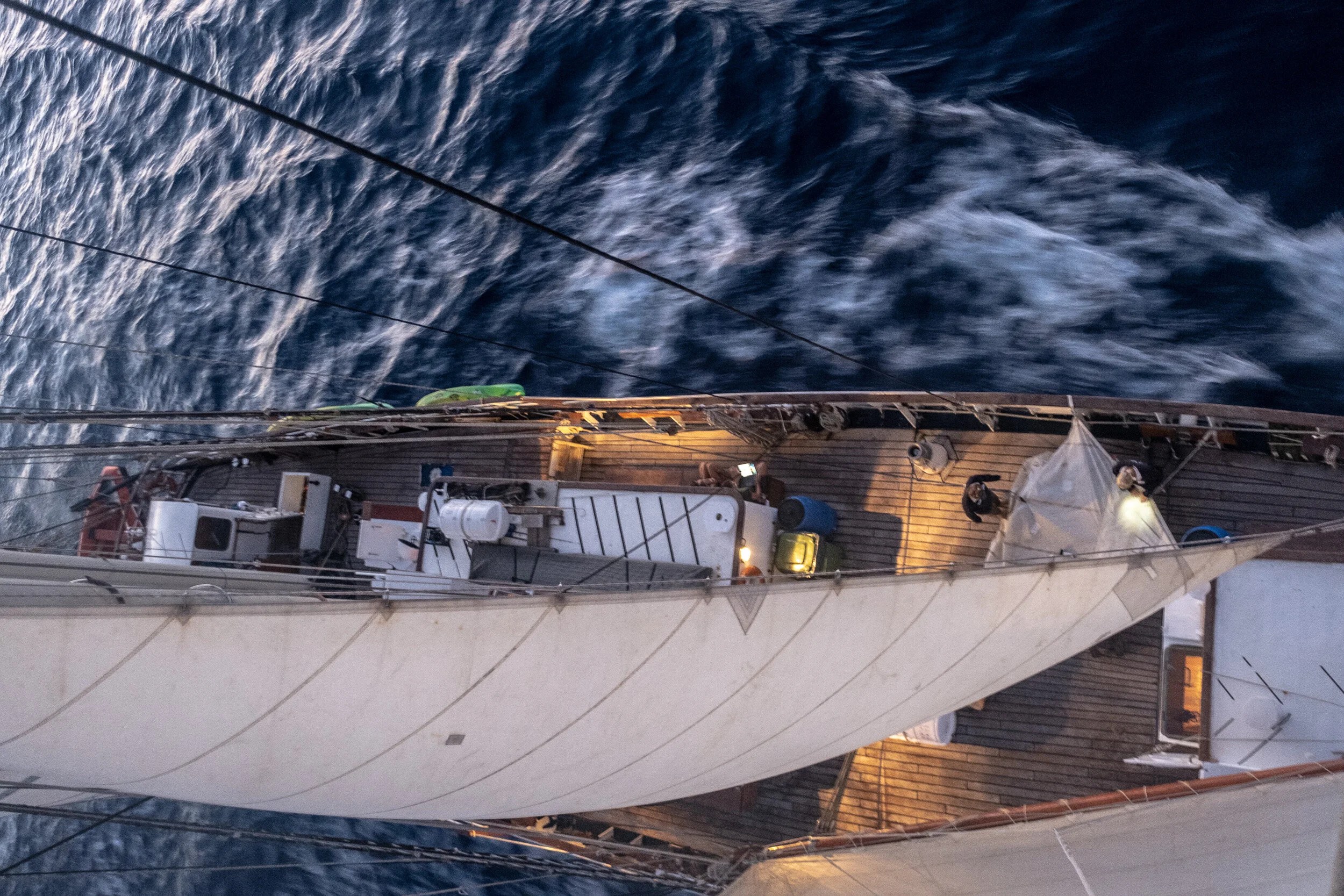
    They are, as you would imagine, awe-inspiring…when you can look at them! On my first passage on Tecla last fall, the weather was overcast and rainy for most of our time aboard, and we did not ever have a clear sky to see the stars, so on this trip I had great expectations of a brilliantly lit night sky and lying on deck and just looking up at the candles in the sky. Initially, because of the weather this was not possible, but when the weather improved and the sky cleared I had great hopes. I had not reckoned with the motion of the ship however, so it was a real surprise when I looked up and saw the stars swinging in great irregular circles in the sky as the ship rolled. Even in the quieter weather, there are still swells and waves, small though they might be, so the ship is never still but moves from side to side and up and down and as it does, so do the stars. You do feel as if you are stationary and the heavens are swinging from side to side around your head. I never quite got past it but I’m sure with practice you would have both your sea and your sky legs.
    4. How about raising the sails, no winches?

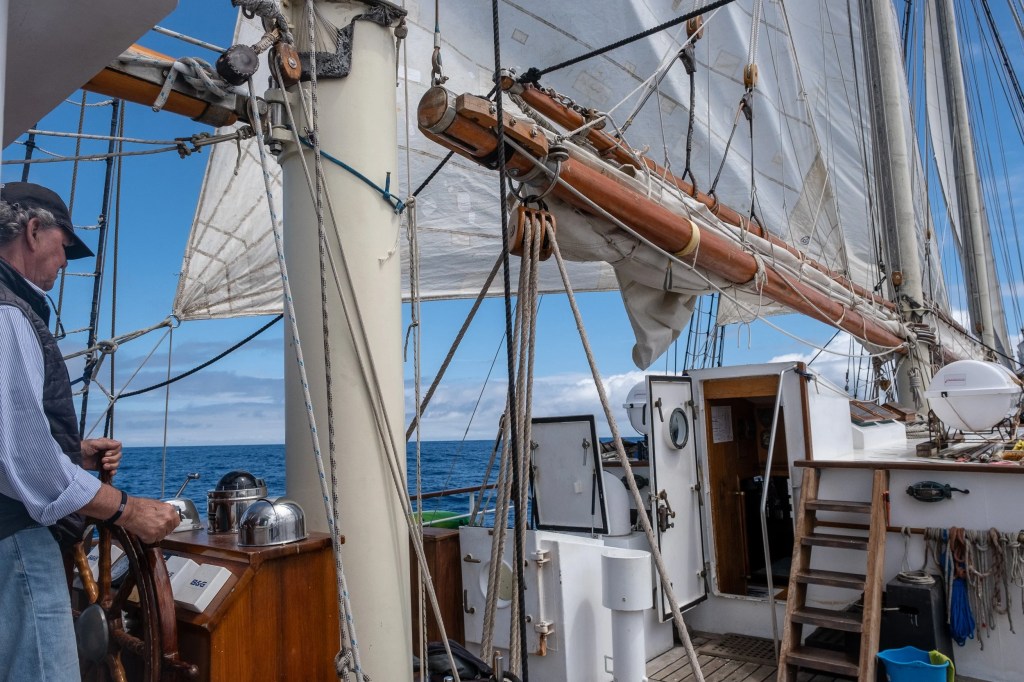
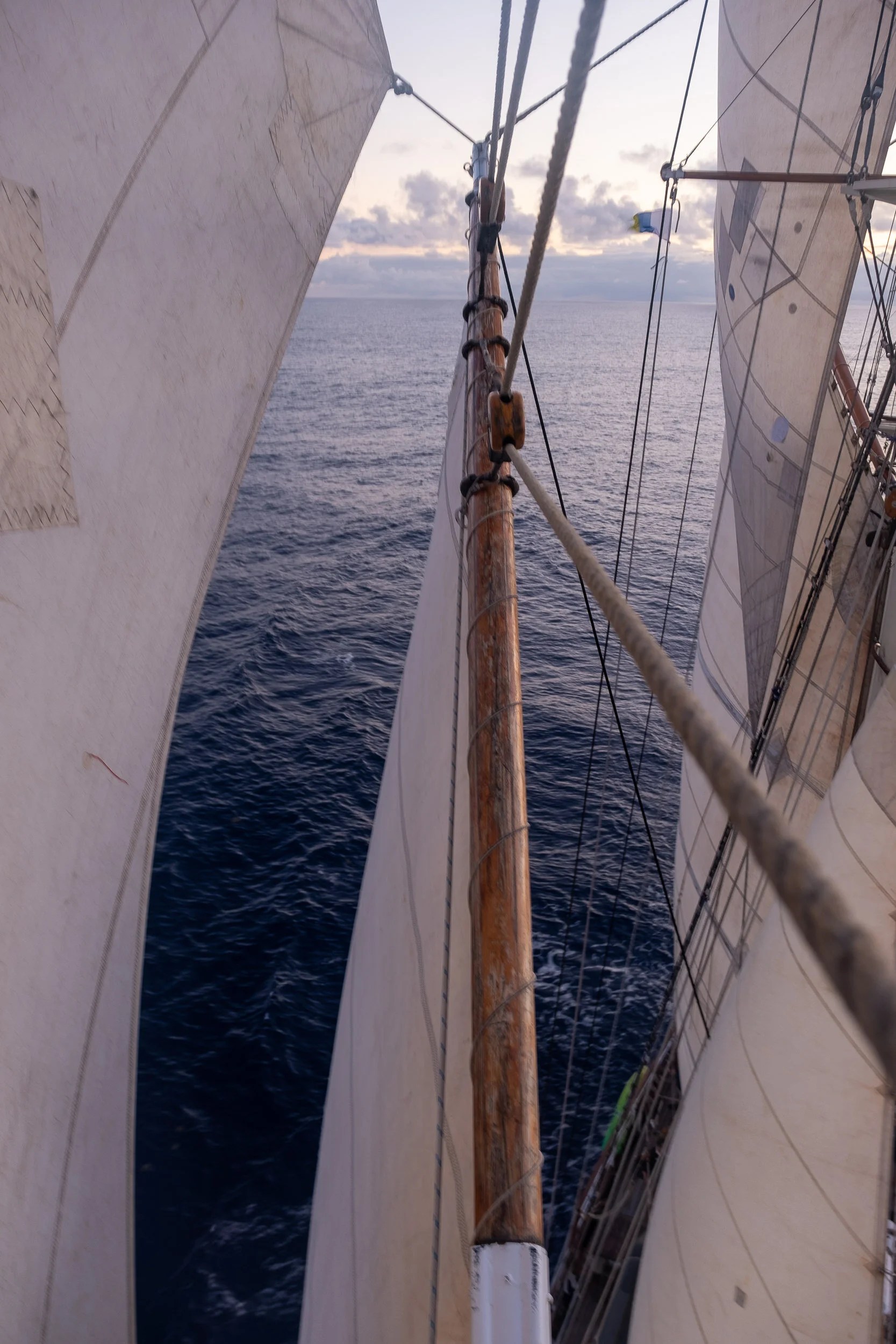
    Nope, gaff-rigged tall ship and to qualify as a tall ship it needs to maintain a traditional rig, so blocks and lines on the masts and all the sails need to be raised by hand. As an aside, because it was a training ship, the trainee crew had a morning lecture on various technical aspects of sailing, sail handling and navigation. We, the voyage crew had a lecture at 1600 on similar topics. I loved this, since I had really wanted to learn more about navigation on the voyage, but we covered a variety of topics. As an example here are the 27 steps that are required to raise a sail on Blue Clipper. We worked our way through the steps in our lecture and then were given the 27 steps in jumbled order, our assignment for the next day was to put them in the proper sequence. Take a look and see what you think, all in the correct order?

    • 1. Sail Ties off

    • 2. Sheet eased

    • 3. Boom topped Up

    • 4. Leeward Running Backstay cast off

    • 5. Windward Running Backstay set

    • 6. Throat Downhaul cast off

    • 7. Ease leeward Lazy-jack & trice forward

    • 8. Reefing Line free to run

    • 9. Topsail Sheet free to run

    • 10. Throat and Peak Halyards ready to haul, Capsized on deck

    • 11. Throat and Peak Purchases ready to haul

    • 12. Trim Gaff Vangs

    • 13. Throat and Peak Halyards haul away, Gaff horizontal

    • 14. Throat Halyard, haul to “Well” and make fast

    • 15. Peak Halyard, haul to “Well” and make fast

    • 16. Throat Purchase, haul to “Well” and make fast

    • 17. Peak Purchase, haul to “Well” and make fast

    • 18. Top Down

    • 19. Set Course

    • 20. Trim Sheet to course

    • 21. Make fast Throat Downhaul

    • 22. Trim Lazy-jacks

    • 23. Trim Vangs to sail setting

    • 24. Trim Reefing Line

    • 25. Trim Topsail Sheet

    • 26. Set up Boom Preventer

    • 27. Tidy Lines

    5. What were the safety procedures like and how seriously were they taken?

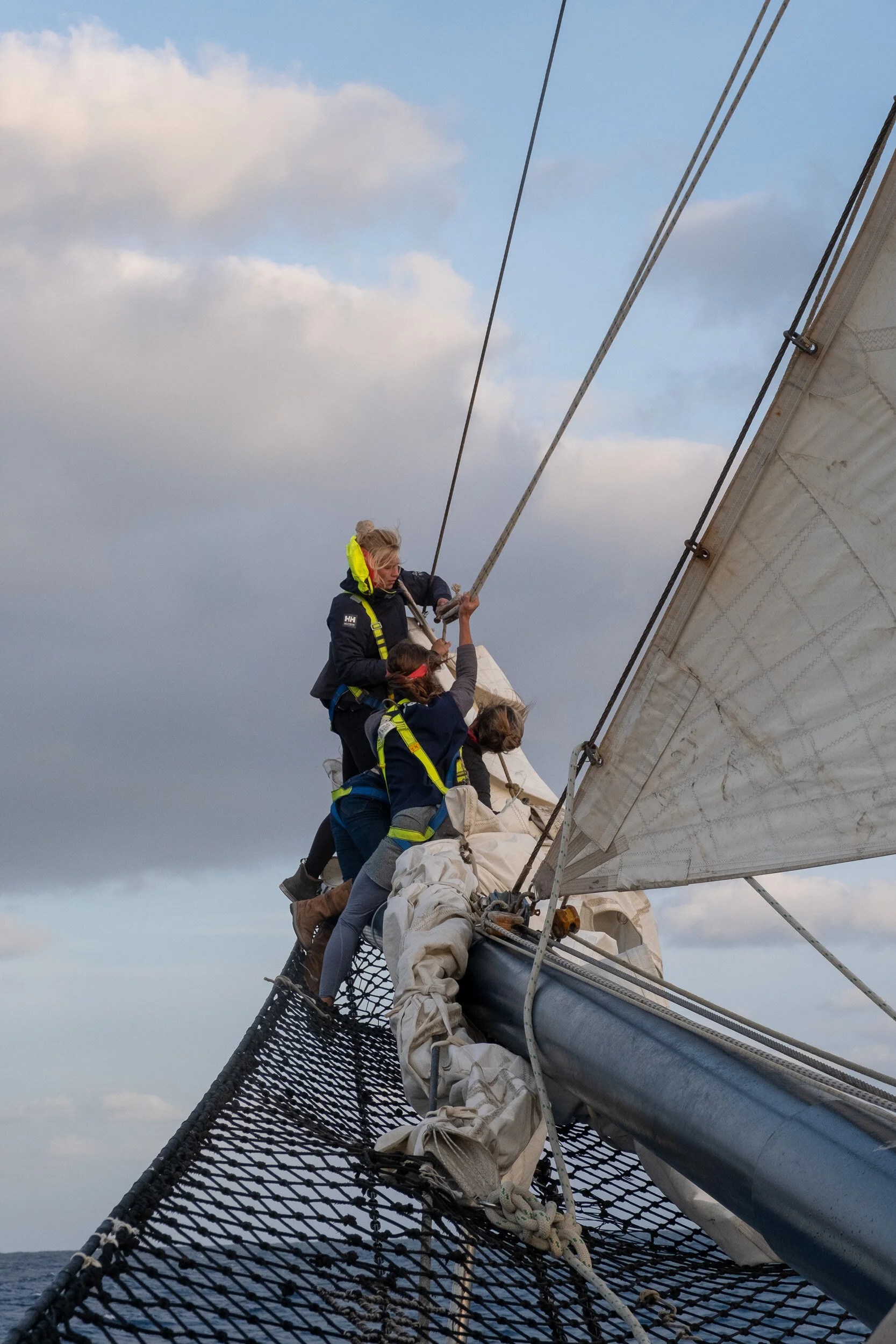
    My trip on Tecla was very different compared to Blue Clipper with respect to the way safety procedures were handled. Tecla certainly took things seriously, but were much more relaxed than Blue Clipper on board which there were pretty rigourous safety procedures that were adopted depending on conditions. For example, no one was allowed on deck after dark without a life jacket being worn, and if the seas were running a notice would be posted in the saloon requiring life jackets for all crew while on deck. Additionally, when the seas were really running in our Force 7/8 winds in the first 8 days or so, then it was strongly suggested that if moving about on deck, then safety lines needed to be clipped on. Certainly when climbing the mast or going out on the bowsprit, safety lines were required and when on the helm in rough seas the helmsman was required to clip on. In fact, life raft drills and fire drills in full firefighting kit were carried out on a couple of occasions and in one instance a female crew member jumped surreptitiously overboard and a full man overboard drill was carried out, which included a crew member being lowered in after her, raising her on a sling to the deck, strapping her into a body brace and carrying her into the saloon for treatment. We were instructed on which side of the ship to jump from in the event of fire, the windward, and which side to jump from if the boat was sinking, the leeward, think abut it. Chris and the crew took safety extremely seriously, and it really did give me a sense that if anything went wrong, everyone knew what to do and would do the right thing quickly.
    6. Did you enjoy the trip?

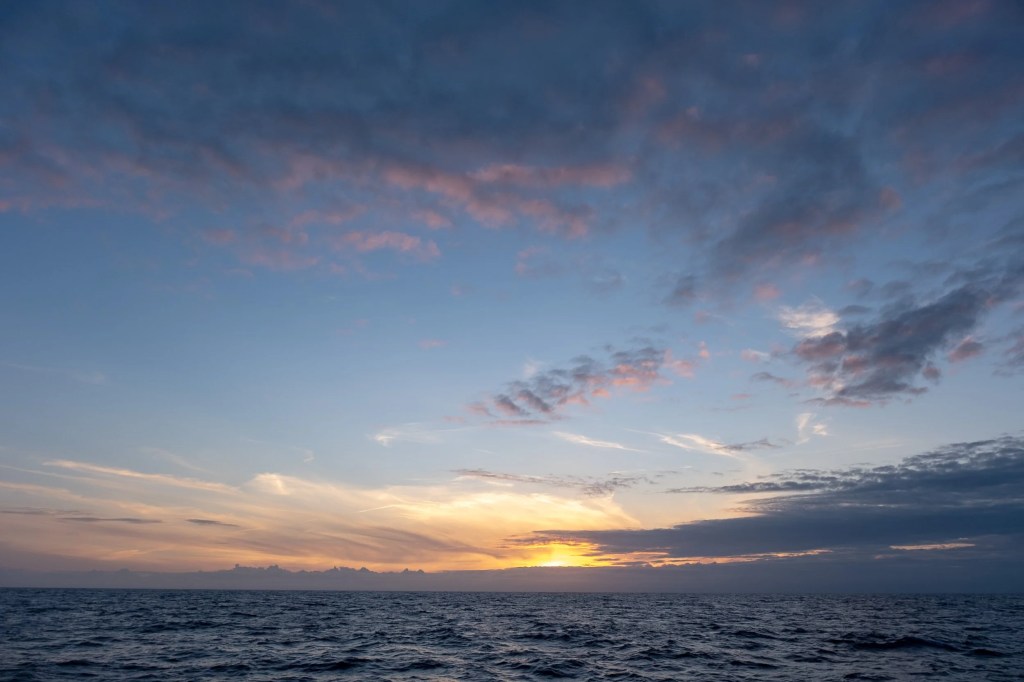
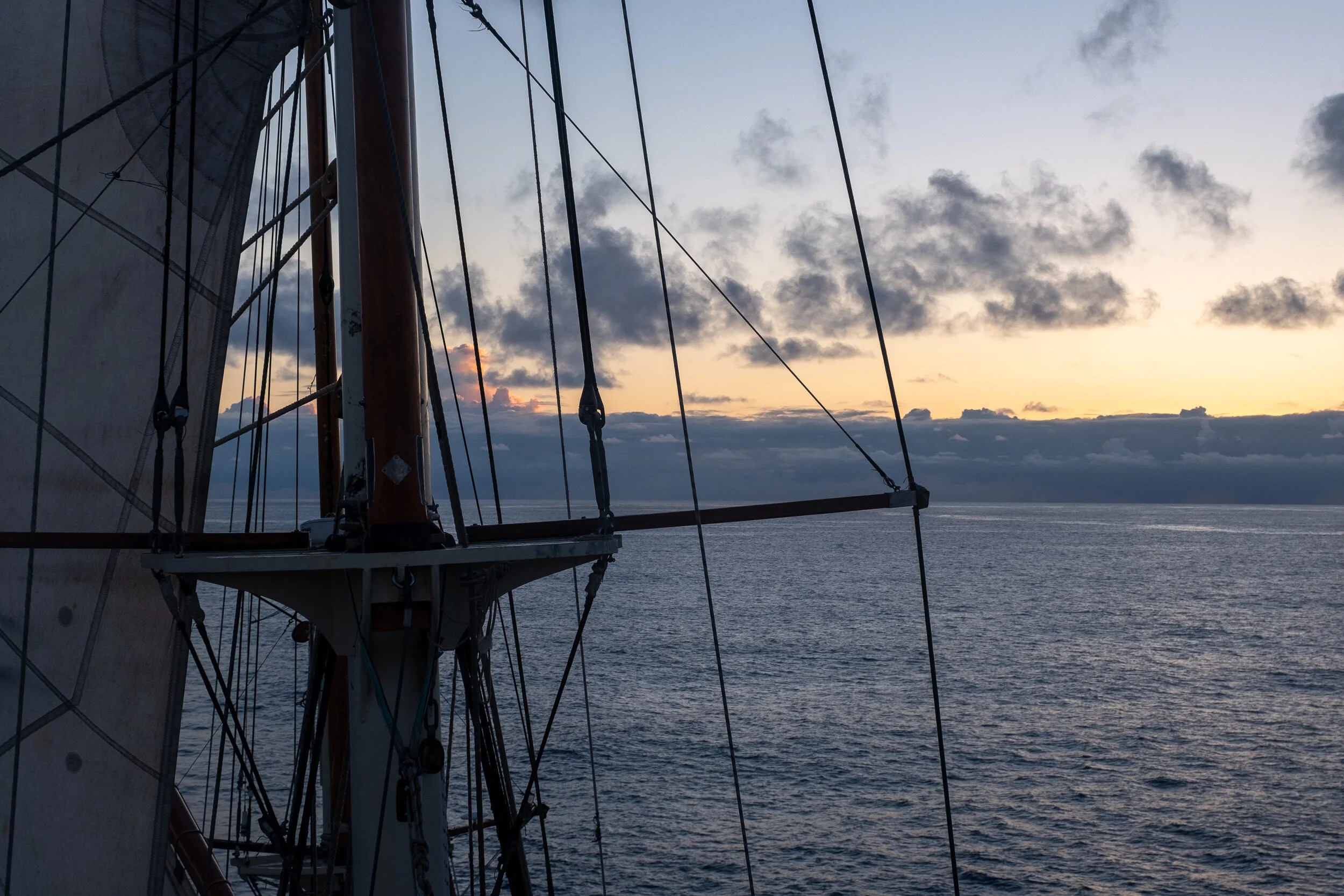
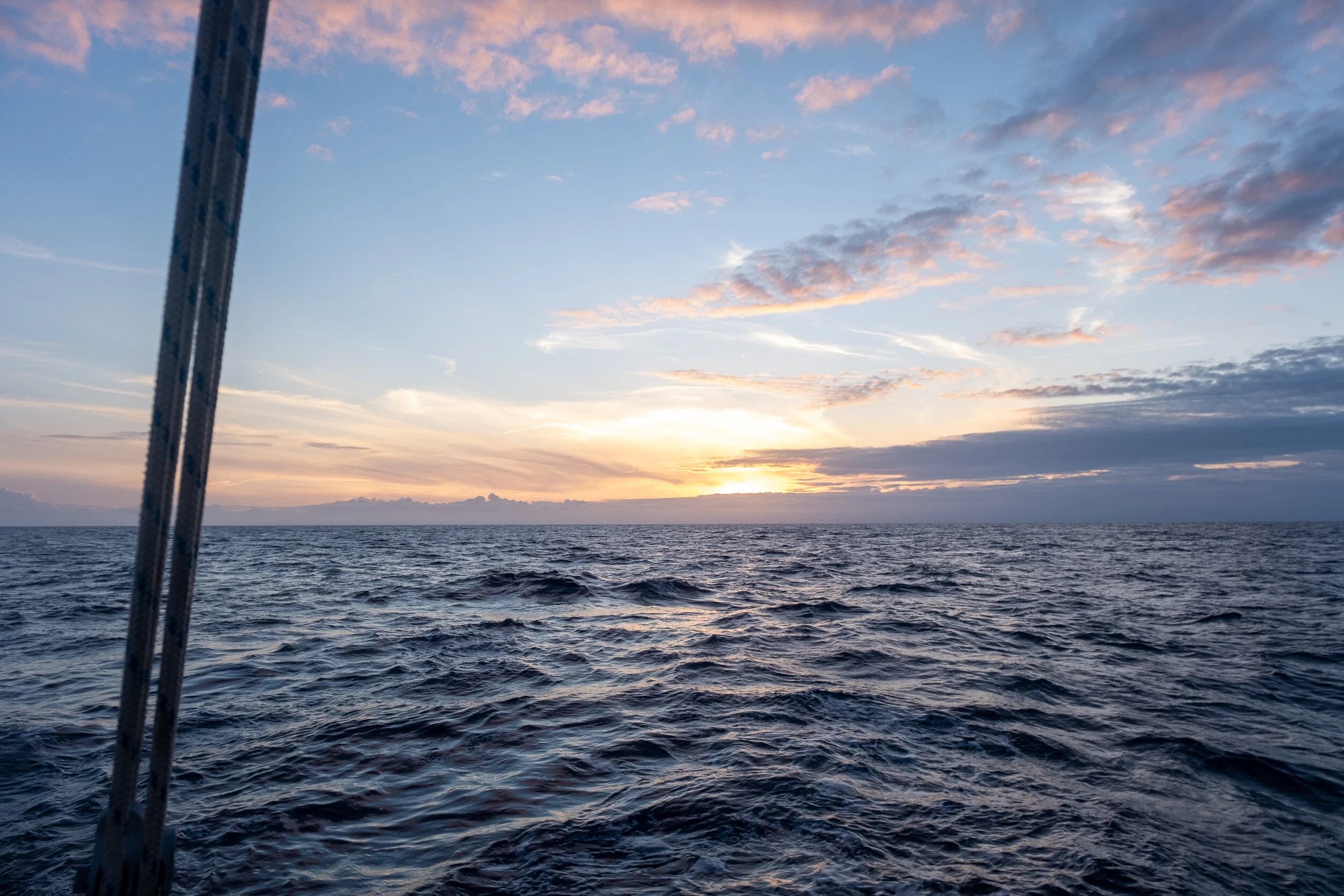
    Enjoy is not a word that I think I would use in this context, but maybe better, were there highs as well as the lows. And yes, there were some pretty amazing highs. Climbing the mast at sunset and looking around the vast sweep of the ocean, with the sinking sun tinting the sea and the sails crimson; helming the ship into the harbour at the end of 18 days sailing and seeing V waiting at the dock; seeing flying fish soaring across the waves; being able to helm the ship and keep her on course in the conditions that we sailed through in the first half of the passage; watching dolphins gamboling along the side of the ship; but my biggest thrill and high was simply to have done it. I still get a little bubble of pride when I think about having helped sail the Atlantic in a sailing ship. The lows I have documented, praying for a quick deliverance during the first day and night in the rough seas but this too passed and there was a real high when I was able to get my sea legs and concentrate on the pleasures of the trip.

    7. Would I do it again?

    Absolutely!
  • Reflections and random thoughts…

    V has raised a number questions about the voyage and the ship and I have received other questions from readers and friends; I plan to do a post in the next couple of days to try and answer as many of these as I can. In the meantime I thought I’d jot down some of the interesting incidents/experiences of the last couple of weeks.

    • Flying fish really do fly or at least glide. I’m sure everyone already knows this but it was truly facinating and amazing to see them actually do it. Because of their size, about 12-14 inches long, and the height at which they travel, only about a metre above the water, I would imagine that anyone on a larger vessel, eg cruise ship, would not normally be able to see them. However they are readily viewable on a sailing ship and they were frequently to be seen. Without warning a silvery little torpedo with spiny-ribbed, translucent fins stuck out at right angles like wings would suddenly pop out of the sea next to the ship and then glide for 40 or 50 metres, aloft for 5 or 10 seconds, and then dive back into the sea. Seemingly it is their way of escaping predators and while we saw them regularly throughout the voyage, unsurprisingly they seemed to be most active when we were being followed by dolphins. Unfortunately none of them ever landed on deck where they would have made someone, me, a great breakfast. I emphasize my interest in them for breakfast because I discovered that no one on the ship believed them to be edible. As a Bajan for whom flying fish is one of the national dishes, I was even more surprised to learn in Bermuda when I asked some of the locals about their availability that they use it only as a bait fish and would not believe me that anyone would ever eat one. Bermuda may have a lot of things going for it but…

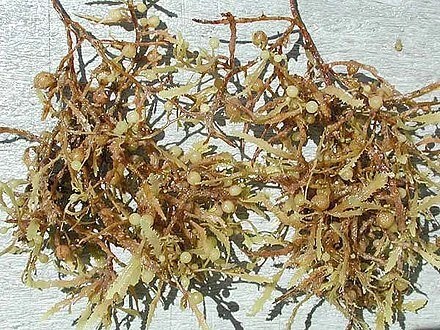
    • I have read all my life about the Sargasso Sea so it was an interesting bonus, had not thought about it when planning the trip, to actually sail through portions of it. I don’t believe that we ever sailed through the most concentrated parts of it but for the first week or so of our voyage we saw significant amounts of a bright yellow-orange plant floating just under the surface, either in small patches or occasionally in large mats covering a couple of hundred square metres. They were particularly colourful when in larger mats because under a bright blue sky, the sea was an intense, rich indigo and the mats of rich yellow looked as if the seascape had been designed by Ikea. Apparently the larger mats have very rich micro ecosystems with a variety of small crabs and crustaceans that are indigineous to the sargassum weed.

     Sargassum seaweed
    Sargassum seaweed
    • There were a number of nights when we passed through areas of the sea that were particularly rich in phosphorescent micro-organisms so that waves would be filled with twinkling lights and waves that broke on the deck would, in the words of one of the crew “make the deck look like a disco dance floor”. There was one phenomenon that I never saw but others did; because the ship was very modern, built in the 1990’s, it had a number of design features that would not have been found on earlier generations of boats. One of these was the portholes that were designed to be just above the waterline so that the swells would rise and fall covering the portholes, in fact for the whole of the first week when we were on the port tack, my cabin being on the starboard side meant that my porthole was submerged for virtually that whole time and my view, like a submarine, was underwater. It was during this time that others on the starboard side saw the water bright with phosphorescence through their portholes, like looking at underwater fireworks. I presumably slept right through it!

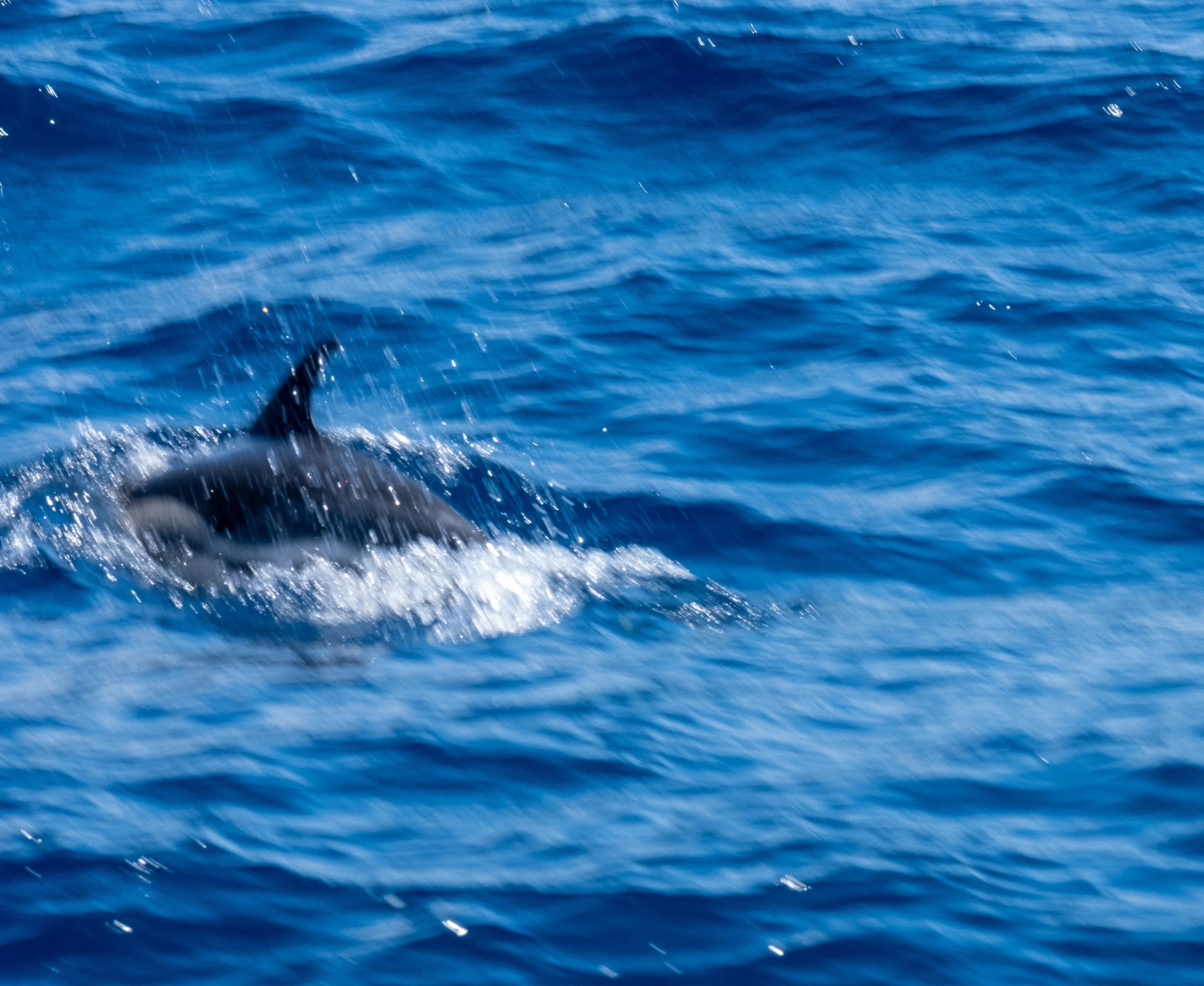
     Never managed to capture a dolphin!
    Never managed to capture a dolphin!
    • One unexpected physical issue that I had not anticipated arose during our rough sailing in the first 7 or 8 days. Those of you who read my journal during my Camino walk through Portugal and Spain a couple of years ago may recall that as a result of the downhill portions of our daily walks the pressure on the front of my shoes was so great that the nail on the big toe of my right foot became black and I subsequently lost it. I resorted to cutting out the left front portion of my right shoe so that I could continue on my walk, I nearly had to do the same thing on the sail. When at the helm, with the seas and swells running as high as they were, the hip was rolling pretty vigourously and as a swell passed under the ship from the port side, the ship would lift and then roll severely over to starboard. You couldn’t use the helm to aid in balancing as that would incline the wheel to turn and so turn the ship so it was a matter of digging in your right foot and trying to use your right leg as a brace to keep your balance. Over the course of many hours on the helm during that period my right toe now looks Camino-worthy. Plus ça change…

    • Unfortunately did not see any whales which was on of my hopes and as this is the middle of the whale migration season, expected that we would see some. We did see dolphins however and they were a joy to watch, frisking like marine dogs chasing a car, could almost imagine that there tongues were lolling as they swam after us.

    • One of the crew is a marine scientist who has been traveling on Blue Clipper for many months to complete a study of micro-plastics in the ocean. She put out a fine-meshed drag net daily on a timed routine to filter the water we were sailing through and to retain any micro-plastics too large to pass through the mesh. The samples that she is capturing are sealed in containers and logged as to location and will be analysed later in her lab. The sad news is that every drag retained significant quantities and that has been the case throughout her voyages. These micro-plastics are tiny, each grain barely visible, and are taken up by the micro-organisms and plankton that are at the base of the food chain. Consequently they now are part of the living tissue of all marine animals and obviously are concentrated in the creatures at the top, including us. Chilling!

     Some of my crew mates, relaxed moment
    Some of my crew mates, relaxed moment

    • Off the ship and back from 3 weeks away from the information flood. I have been noticing recently, last couple of years, that I’m less and less interested in the mass of daily news and information. Function of age or a result of stepping away from it and realizing that nothing was actually missed during my times away? Don’t know but 18 days out of contact is hugely refreshing. When I began this trip I was unsure if it would work for me, my first sailing trip last fall had stops in the Faroes, the Shetlands and the Orkneys and I wasn’t sure if a long run with no stops to break it up would be difficult to manage. V said that I should think of it as a retreat and she was right. There is a sense of that, constrained space, closed community, lots of time for reflection, hard work and a disciplined, structured setting. Interesting sidelight, on our last night at sea, Emma, our First Mate, put together a series of questions and placed them in a cup. We each drew one in turn and then had to answer it for everybody to hear. There were lots of easy and fun question, “What was your favourite meal?”, “What was your most interesting moment?”. In keeping with the theme of retreats, it was fated of course that my question was “What did you learn about yourself?” Still trying to answer it, but certainly part of the answer includes the need for stepping back. All the papers and magazines have been saved since I left for catching up but still haven’t opened a paper since we returned, it will be interesting to see how long that lasts.

    Next, the Azores and V’ s Q&A. Stay tuned!

  • Arriving in the Azores!

    When last heard from, we were approaching the Azores but unsure, with wind and weather, when we would arrive. The seas had been relatively calm and the winds, while helpful, were somewhat low so that it did not appear as if we would get to Porta Delga in the Azores until sometime on Saturday, 3 days later than our scheduled arrival. I called V on my satellite phone to let her know and promised to get back in touch if there was a change.

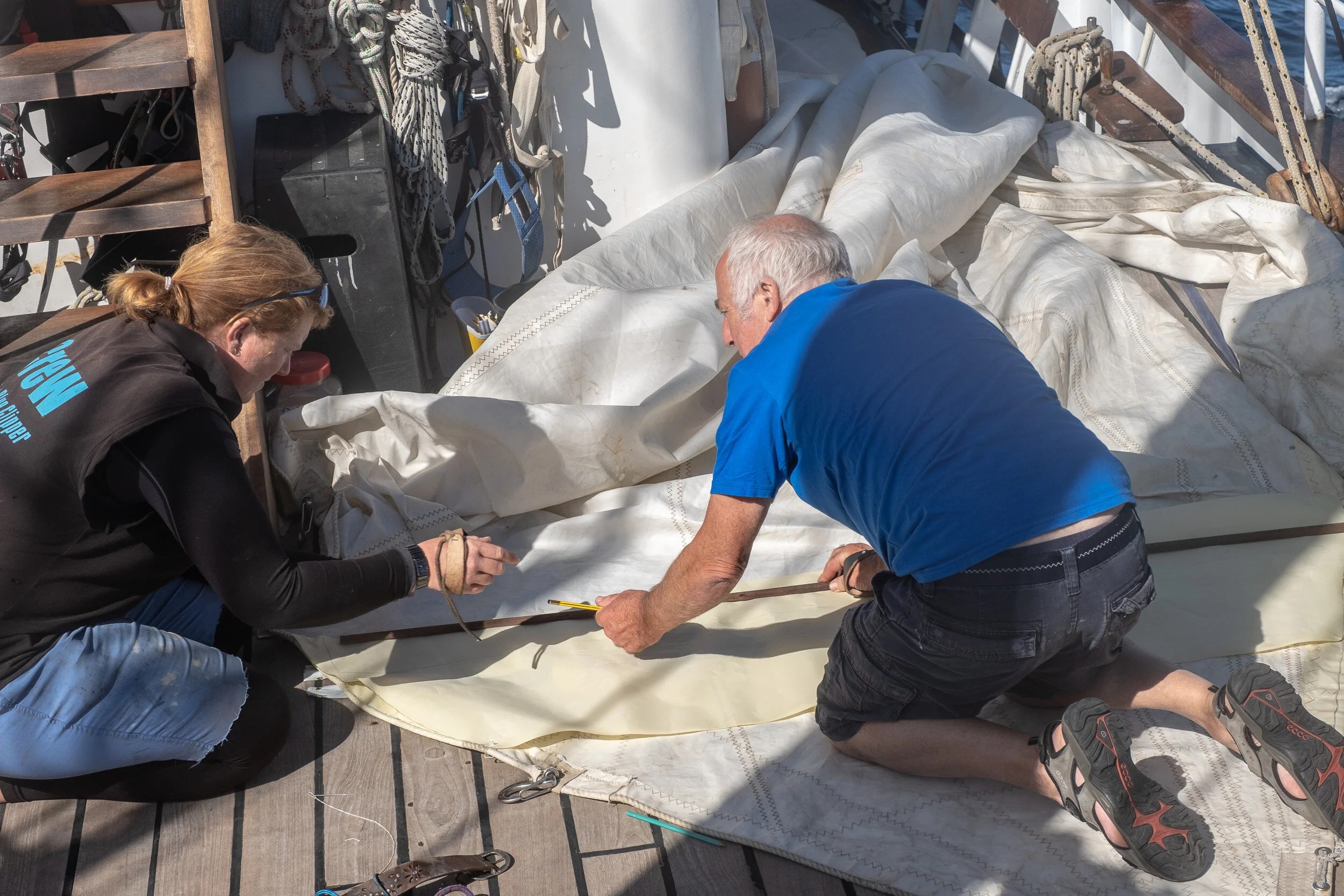
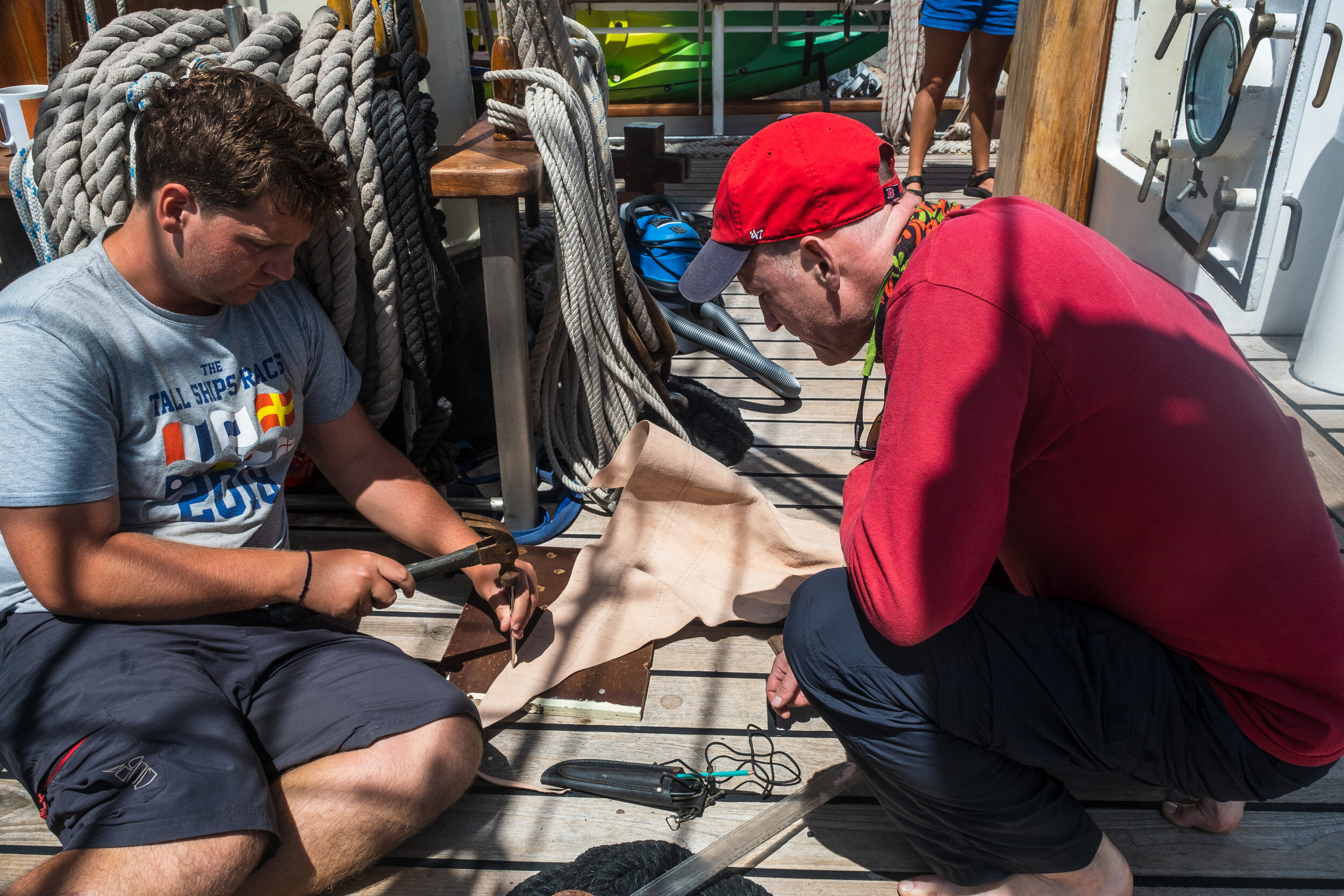
     Sail repair at sea
    Sail repair at sea

    Later that Wednesday afternoon, 16 days out of Bermuda, the winds picked up, the swells grew, and while it was nothing like our first week at sea, nonetheless it was not comfortable sailing and once more we were rolling with considerable vigour. On the plus side we were able to add a couple of knots to our speed which moved our likely arrival time forward.

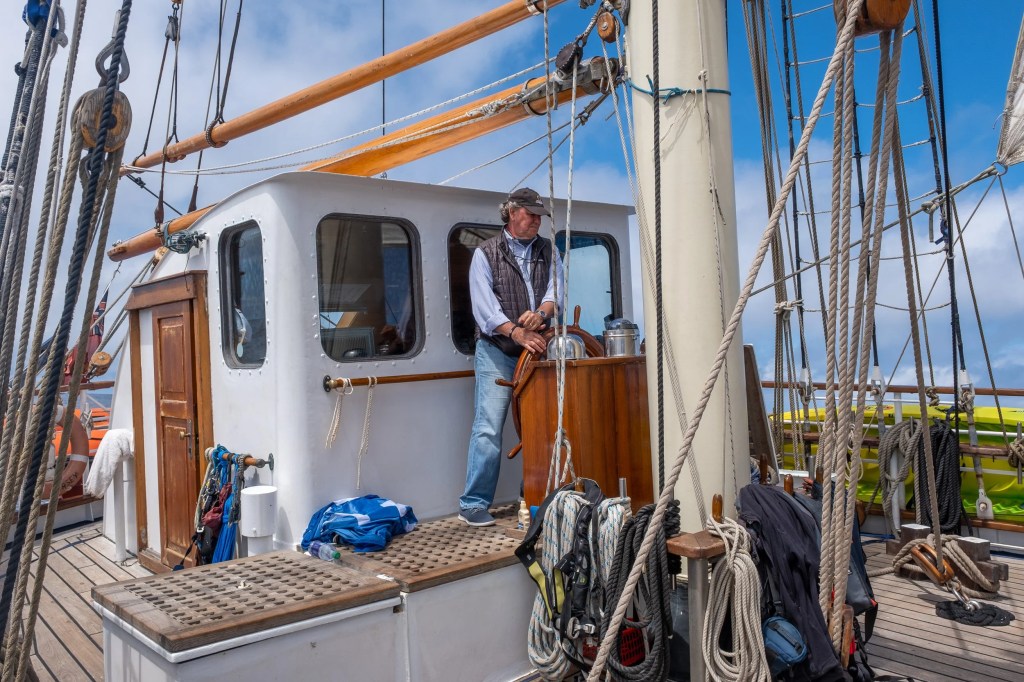
    On Friday morning, 18 days out, we made landfall at 1030 and since our watch was on duty from noon until 1600 I knew that we would arrive sometime during our watch. As we came on watch, lots of crew looking over the side to see how close we were getting and activity increased as the ship was made ready for arrival. Then came one of the highlight moments of the trip for me. I had been on the helm for about an hour and a half as we drew closer to the harbour. The wind was shifty and still blowing with some force as we approached the harbour mouth and I expected to turn the wheel over to one of the permanent crew to land the ship. I was very surprised when Chris, our captain, joined me at the wheel and told me to steer her in.

     Sail repair at sea - Captain Chris & Grace
    Sail repair at sea – Captain Chris & Grace

    Slightly terrifying! I had felt very confident of my ability to handle the helm and to keep the ship on a bearing but this was the first time that I was steering it like a moving vehicle surrounded by things to crash into. This was not the open sea with some forgiveness to make adjustments to keep the ship on a heading with little attention being directly paid to where the bow was pointing instead this was all about where the bow was pointing and no attention needed to be paid to the compass bearing! Because of the size of the vessel it takes time for changes in the helm to be reflected in the ship’s course, it therefore called for a very rapid mental readjustment to very new sailing conditions with no margin for error! As we got closer to our mooring, the moment for professional hands had arrived and I was very happy to surrender the helm to Chris, but as nervous-making as it was, still a moment for my internal highlight reel and a great way to end the voyage.

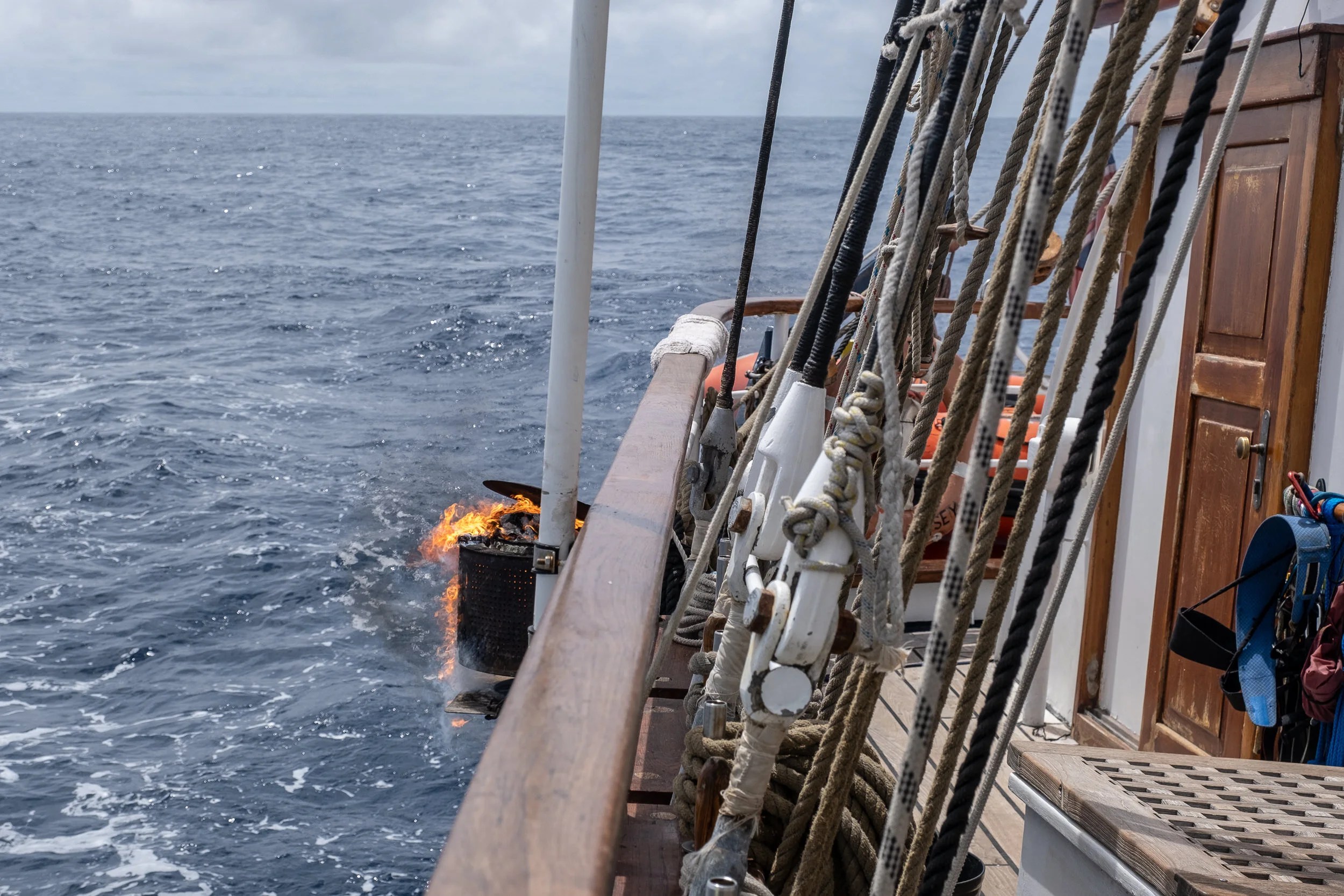
     Burning garbage at sea
    Burning garbage at sea

    A little sidenote for good friends Chuck & Eileen, as we passed the harbour mouth and entered the harbour, I was very surprised to see that one of the moored ships past which we sailed was the Boreal, a little cruise vessel that the four of us, C&E and V & I had taken on an Arctic cruise north of 80º from Svalbard to Greenland and Iceland, it felt somehow fitting.

    V had been watching the ship sail in, not knowing that I was on the helm, and by the time that we were tied up and tidying up the lines, she had found our mooring and was waiting to come aboard. As a measure of how weary I was feeling, while everyone had earlier assembled their belongings and were packed and ready to depart on arrival, it had not even occurred to me to pack and get ready to leave, so as V sat in the saloon and chatted with my crew mates I hurried to my cabin and with no thought of order or organization I simply stuffed all my belongings in any bag where I could find room. Nota bene: things take twice as much room when packed this way as compared to folding them and so with bags so stuffed that I could not close them and with sleeves and legs and socks dangling from every opening I stepped off Blue Clipper for the last time and headed for a rare steak, much red wine and a very long hot shower.

    Next post, Reflections and Summing Up, stay tuned!

  • At sea – Week 2

    Week 2 was considerably easier than week 1. During the first week we had reduced sail as the winds increased, removing the top sails, taking down the outer jib which was putting an immense strain on the masts and rigging and reefing the main and fore sails. Even so we were sometimes making 8-9 knots and in the first 4 days we covered 650 nautical miles. Had the winds continued and had they been pushing us in the right direction we could have made the crossing in 12 days instead of the 18 days that it eventually took.

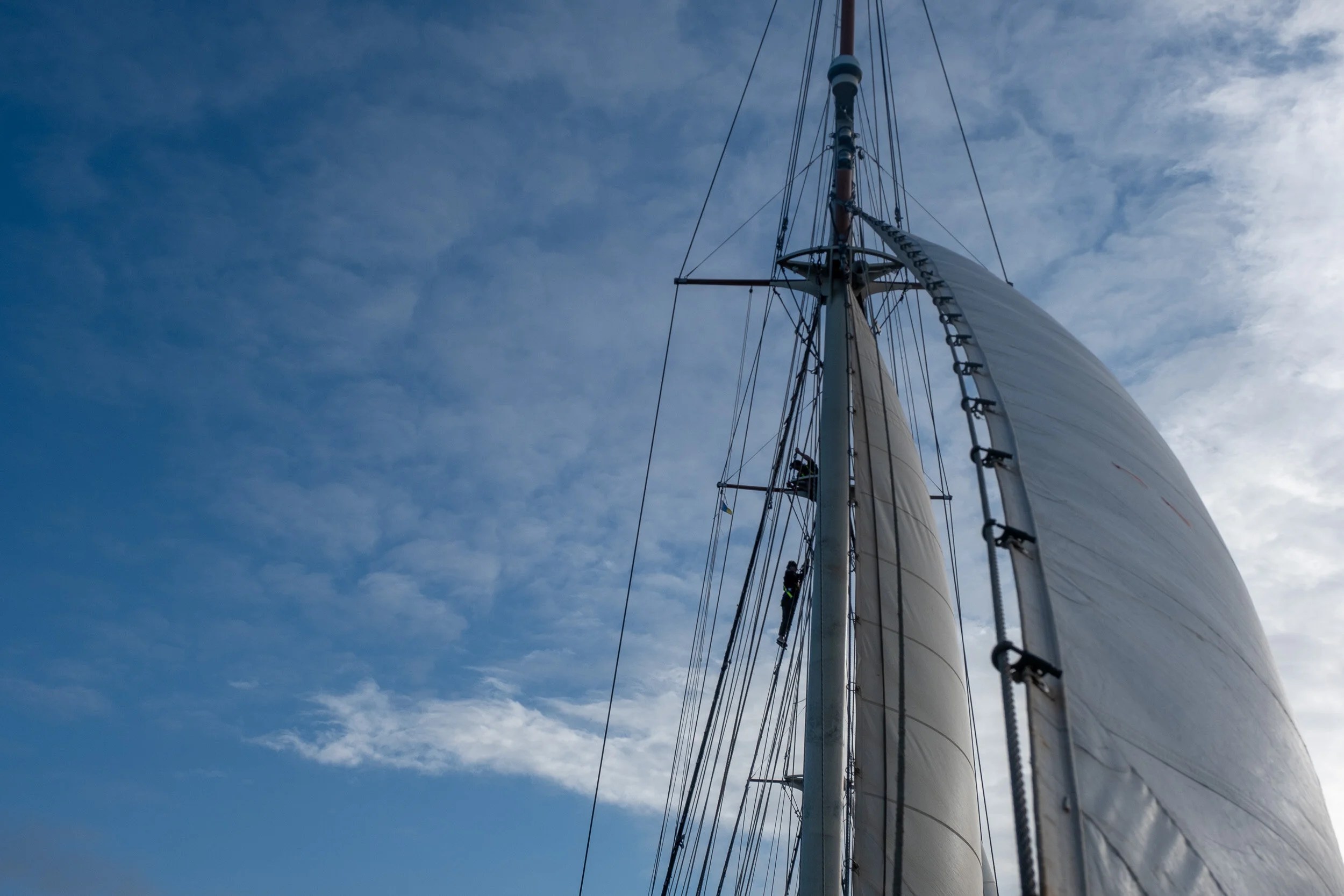
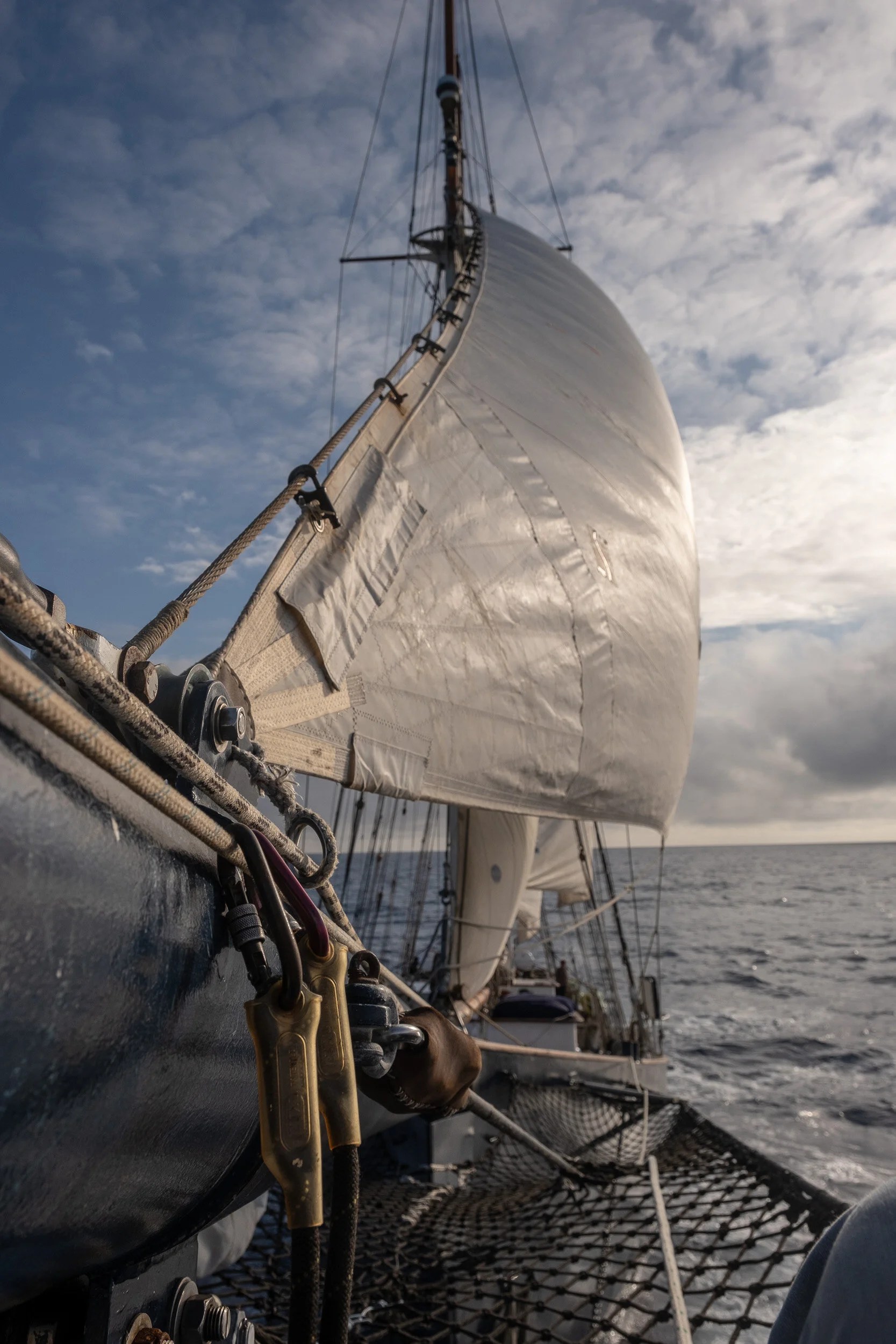
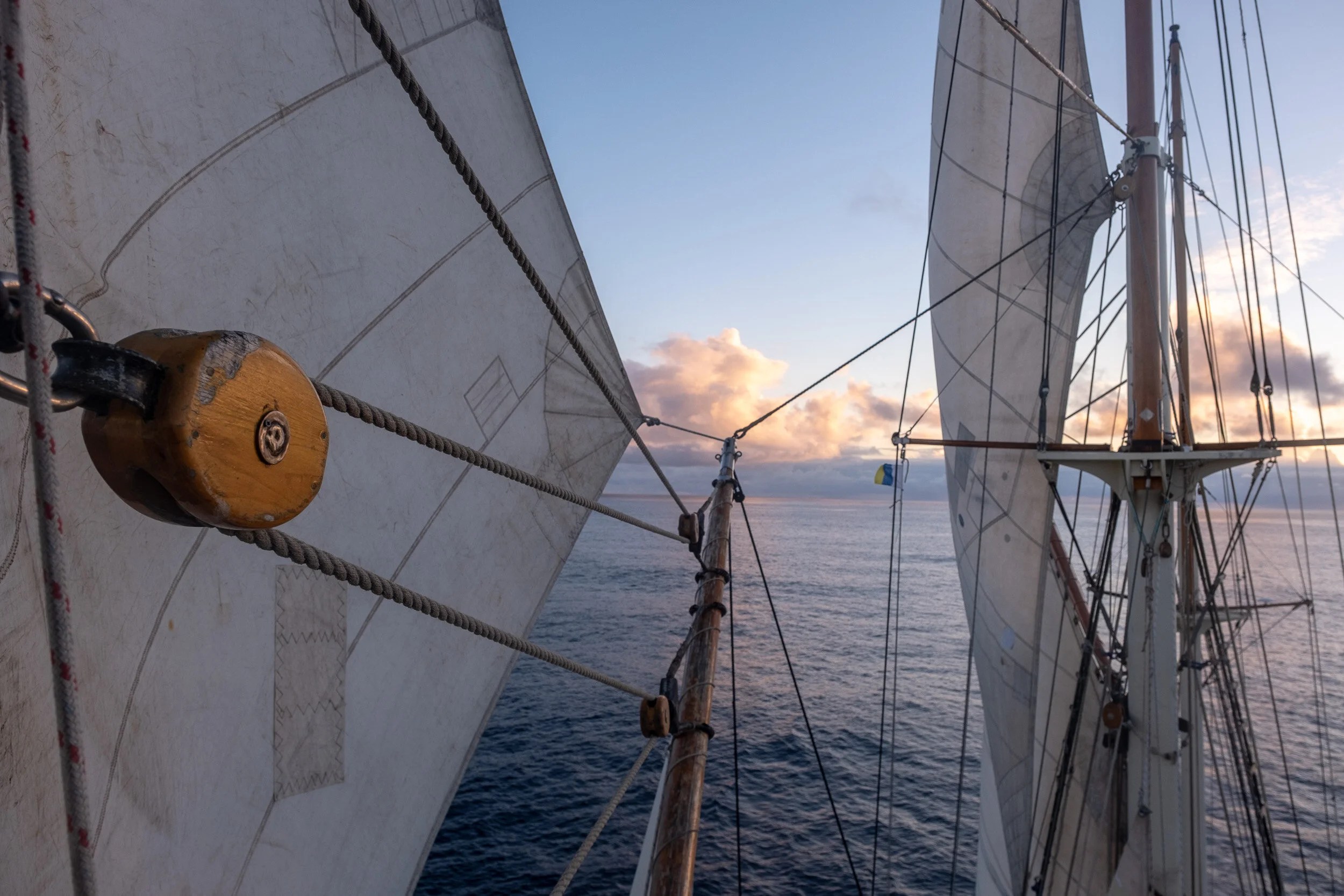
     From the bowsprit looking back to the inner jib and watching someone climbing the mast
    From the bowsprit looking back to the inner jib and watching someone climbing the mast

    After our first week of sailing the winds dropped significantly over the course of one night and with the diminished winds the seas flattened and the swells reduced to a metre or two, infinitely easier to live with. To put that in perspective, when sitting in the saloon for meals and looking through the saloon’s windows, the horizon sinks as the boat rolls so that you see nothing but sky at the bottom of the roll and then the horizon line rushes up past the tops of the windows and you are looking at nothing but sea on the peak of the roll. This happens rhythmically and predictably, the only difference between this and more violent weather is the speed, violence and irregularity of the motion that we experienced in the first week.

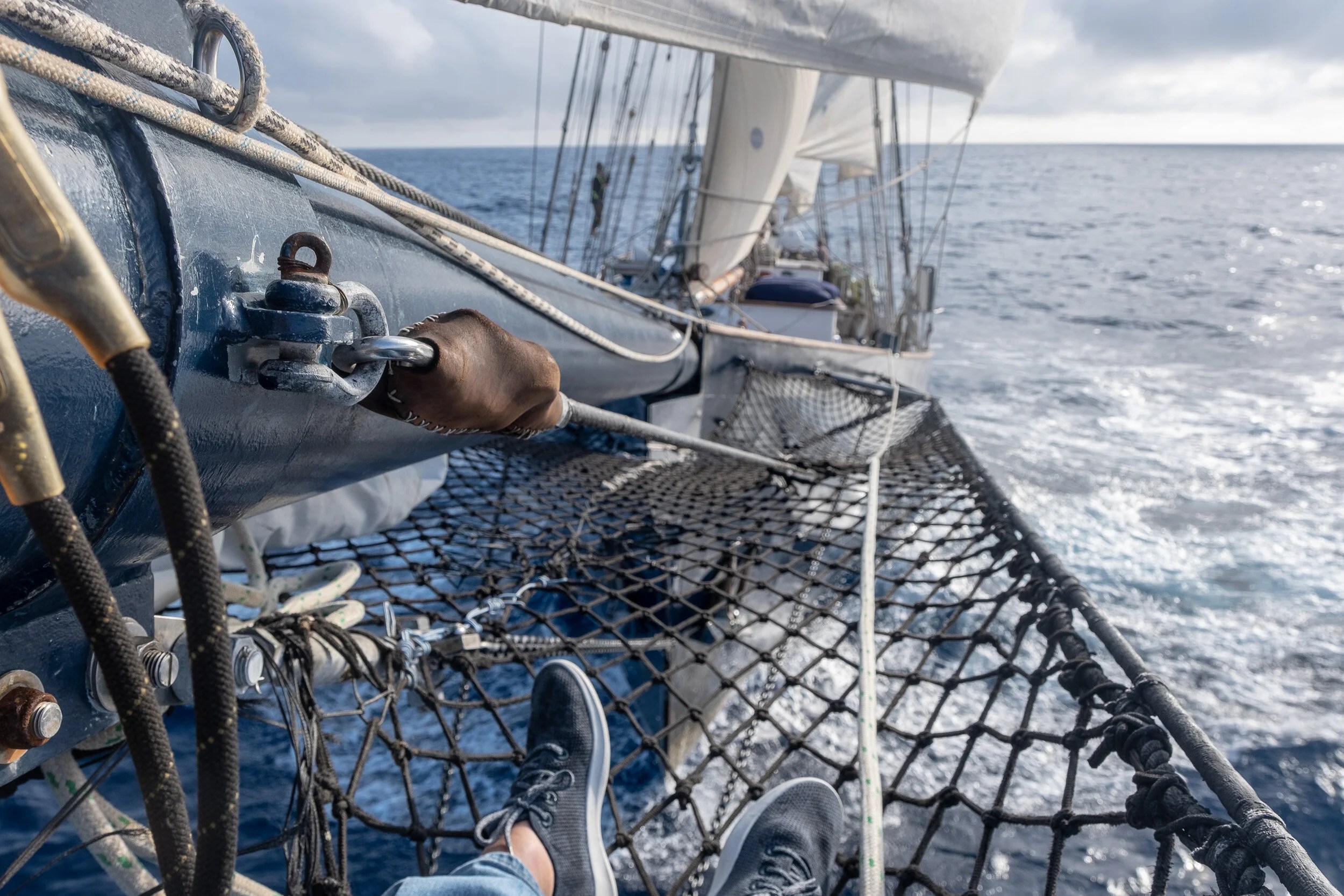
     From the end of the bowsprit, no dolphins, just Allbirds!
    From the end of the bowsprit, no dolphins, just Allbirds!

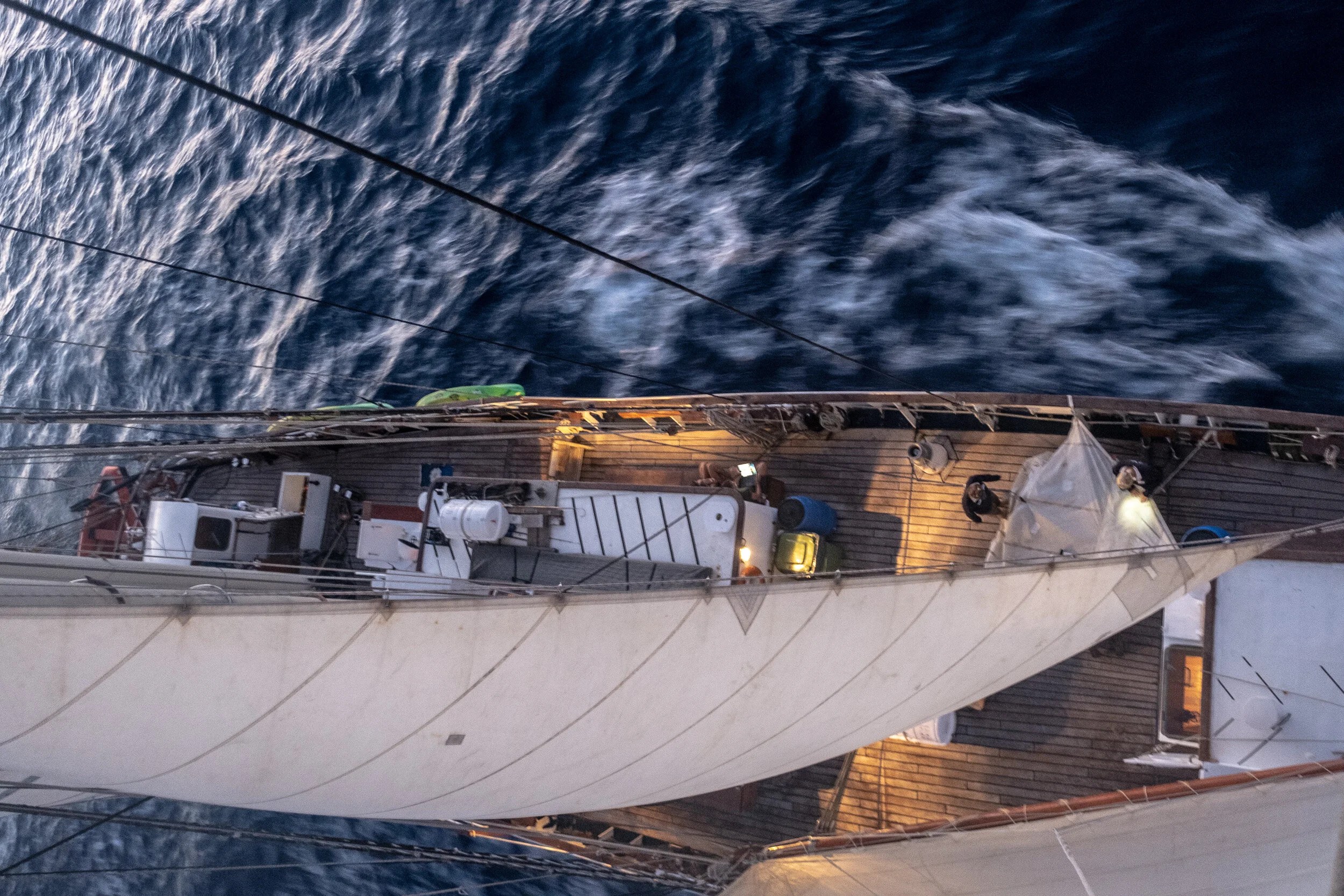
    With smoother seas life was once again fun and we had enough wind to keep the ship traveling at around 6 knots. One of the things that we had practiced while moored in Bermuda was climbing out to the end of the bowsprit and I was very keen to do this while under sail as well as climbing a mast to get some shots down to the deck from above.

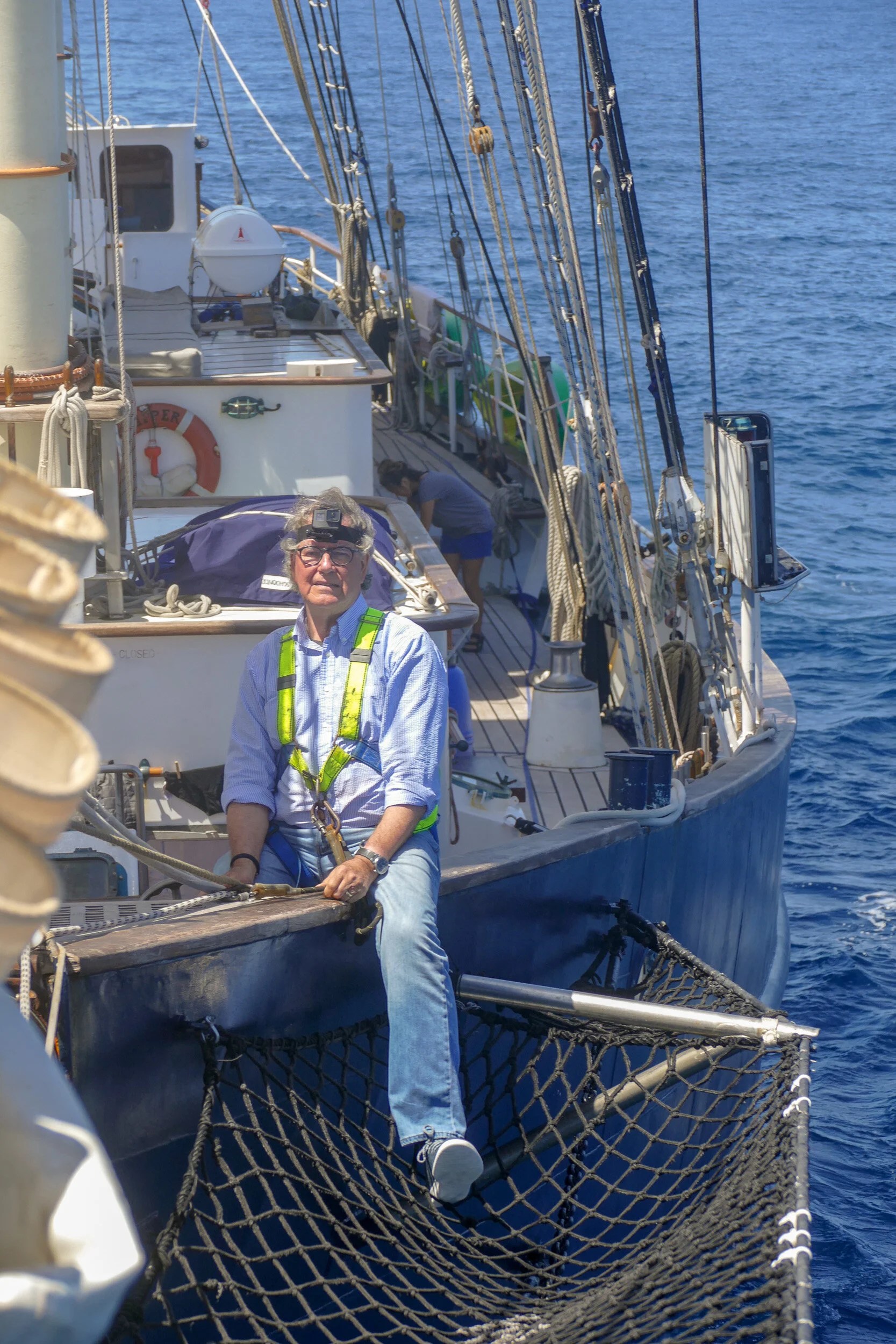
    Climbing out on the bowsprit was a fairly easy activity as long as the ship was sailing smoothly without significant seas to deal with. Once the sailing got rougher however life out on the bowsprit got very wet as the ship would rise on a swell, the end of the bowsprit rising to point at the sky and then swooping rapidly down at the bottom of the swell to raise cascades of water from the bow wave. We had periodically been escorted by troupes of dolphins swimming easily along the sides of the ship and then racing ahead to leap out the water and pace the ship in the bow wave. My hope was to try and catch dolphins at play from the end of the bowsprit and get what I knew would be some very good shots with the camera. Tried a couple of times sitting on the netting under the bowsprit and waiting for dolphins to appear. Alas, never happened. Their appearance was unpredictable and the amount of time they spent was short, 3 or 4 minutes at most, which did not allow enough time to harness up and get to the end of bowsprit to shoot them so unfortunately will have to wait until another time. Best solution would be to mount a camera in a semi-permanent spot on the bowsprit and have it video the bow in a continuous 15 minute loop so that only the last 15 minutes of time is available for download which would leave enough time to shoot the dolphins and then retrieve the camera before the footage was overwritten. Future project!

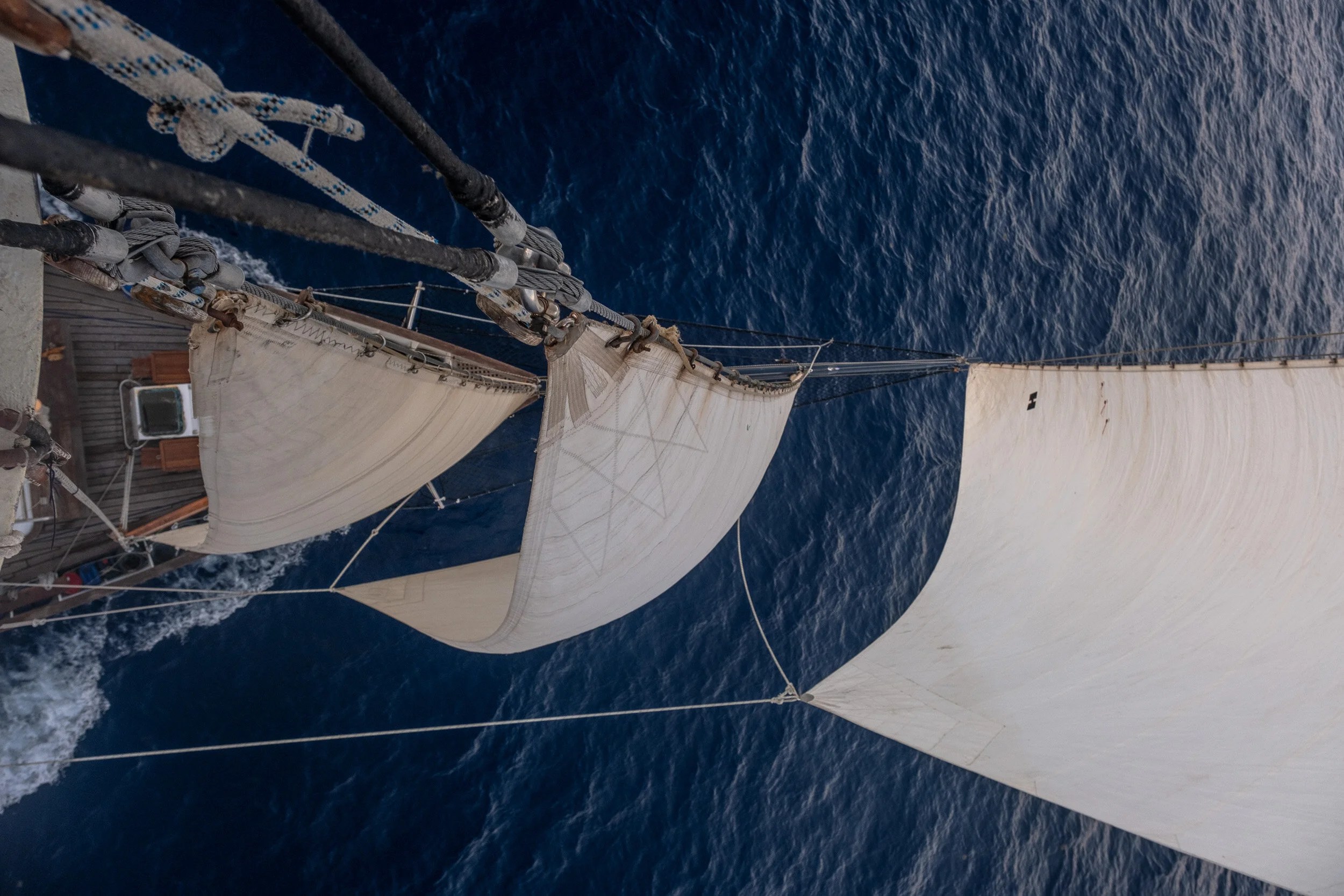
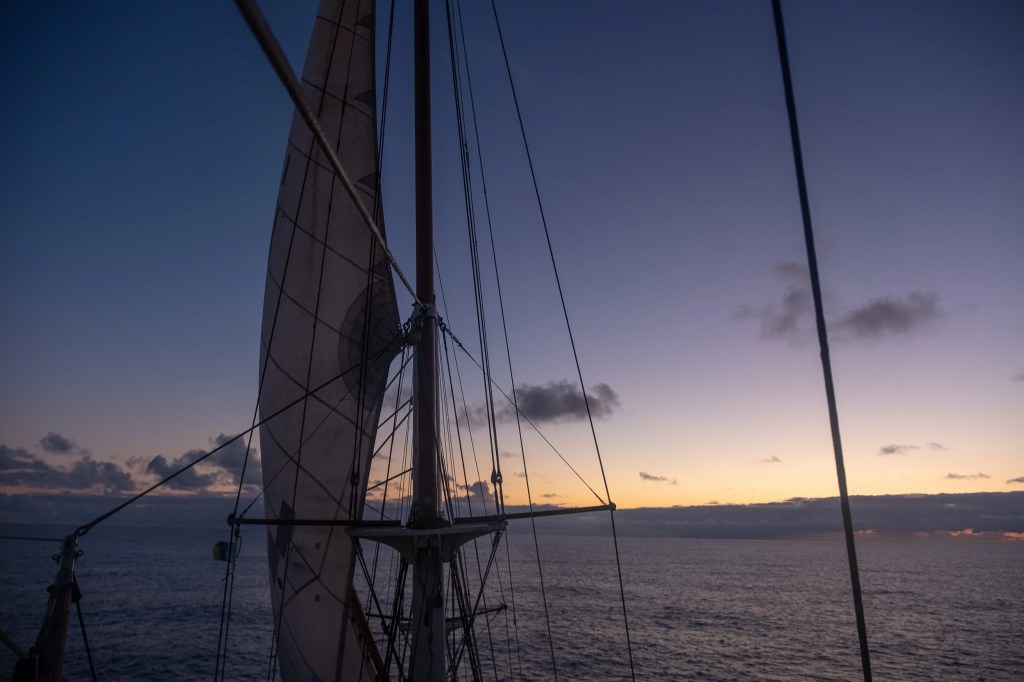
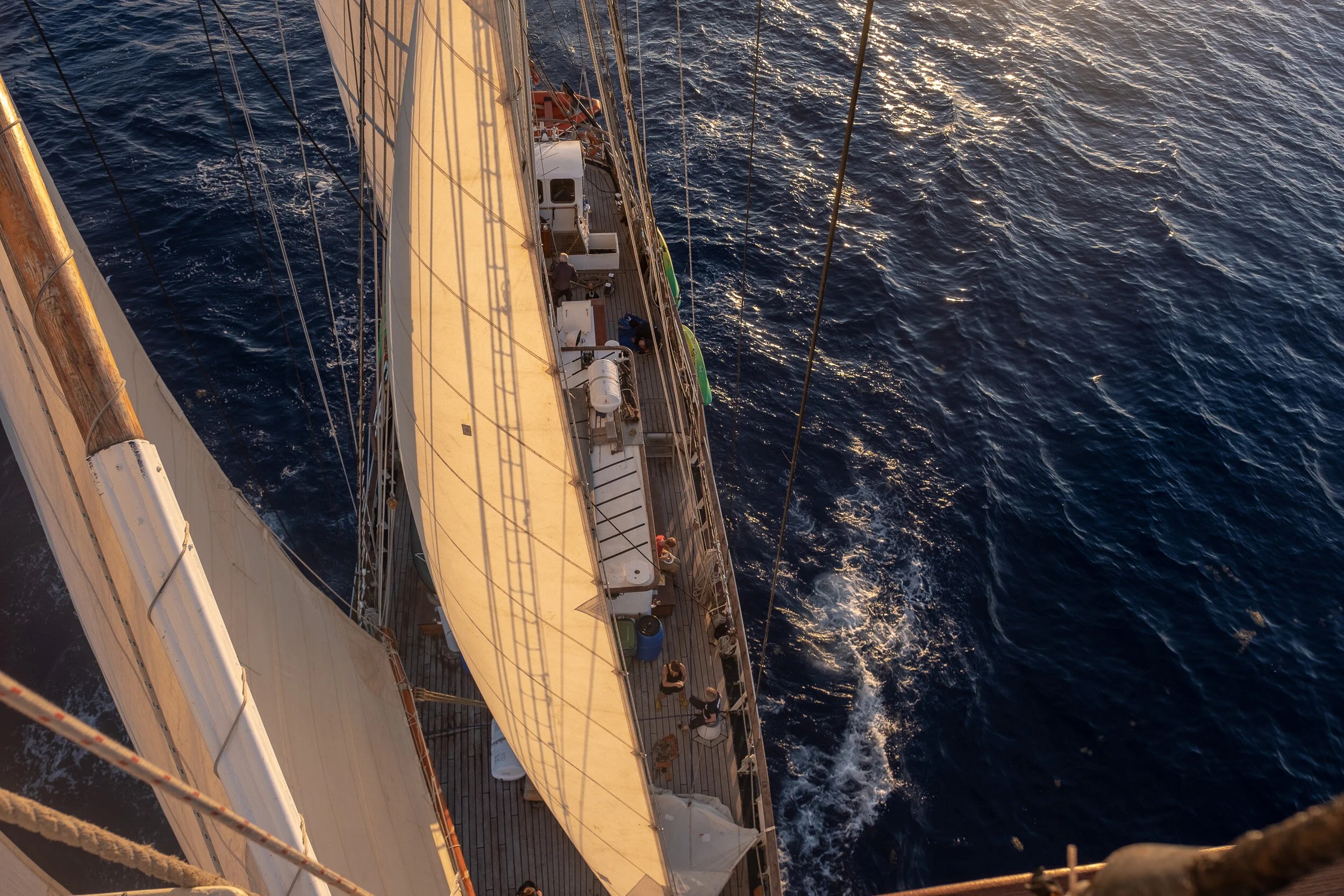
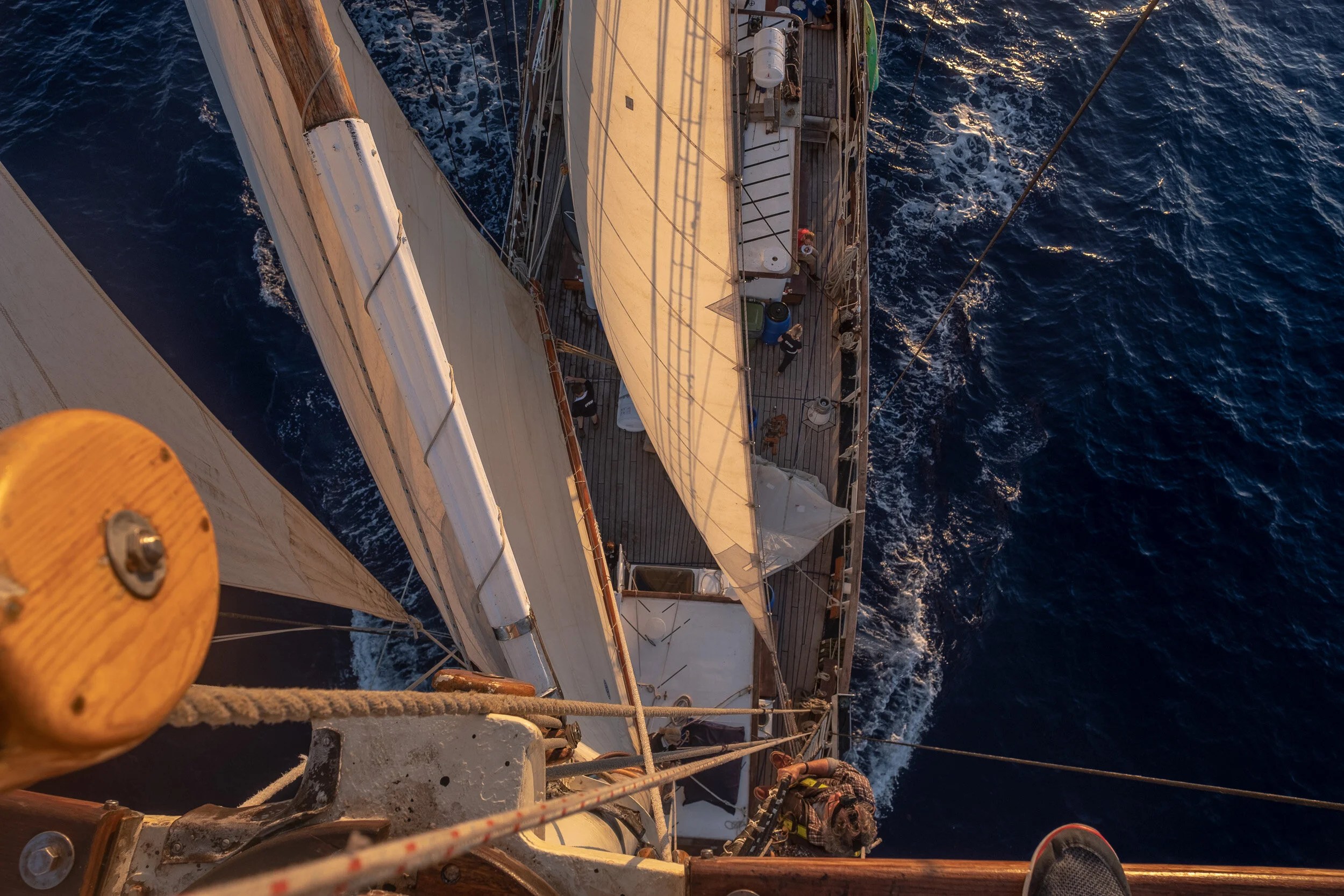
    Climbing the mast was also on my agenda. I waited for a reasonably calm evening, wanted to get the sunset, and then clipped on the lifeline and climbed the ratlines of the foremast.

    As we drew towards the end of our second week, the intensity of the speculation grew with respect to our arrival date. I’m fortunate in that V is flying in to meet the ship and then we have booked a couple of hotels and a car as we intend to spend 8 or 9 days exploring the island of San Miguel, the largest of the Azores and our arrival port. If we’re a day or two late, it will be dull for V to spend time on her own but she at least will be able to get around and enjoy the area. The others who are leaving the ship in the Azores, a couple of crew as well as a couple of Voyage Crew as we are known, have flights booked that assumed that we would arrive late on May 1 or early on the 2nd. After our 13th day at sea, our projected arrival date, obviously dependent on wind and weather, was likely to be somewhere between the 3rd and the 5th of May. At this point, sat phones came into play as those affected by the late arrival date began trying to make flight and itinerary changes.

    Stay tuned for the next chapter….!

     Climbing out on the bowsprit
    Climbing out on the bowsprit
  • At sea – Week 1

    At Sea – Week 1

    When last heard from, we were just on the point of leaving Bermuda’s St George’s Harbour at 15:30 on Tuesday April 16, with pilot aboard and followed by the pilot boat. Pilot escorted us from our dockside mooring to the opening of the narrow passage that opens out to the Atlantic and then having hopped aboard the pilot boat that had pulled up alongside, left us to the open sea.

     Leaving Bermuda
    Leaving Bermuda

    Every scrap of sail that she could carry was then raised, the inner and outer jib, the staysail, and the fore, main and mizzen sails. Winds were from the NW at about 10-12 knots gusting to 15 and we were making about 6-7 knots through the water and on a SE course. Not the best heading for the Azores, we needed to be pointing NE, but had to work with what the winds gave us.

    I’m not usually suceptible to sea sickness but I knew I was in trouble from the off. We had swells that were about 3-4 metres in height running parallel to the boat coming on to our port side and as we rose to meet them we were rolling pretty severely. Added to that was the slight pitch from our 6 knot forward advance as we met the seas. My first watch was due to start at 1800 and at 1730 our watch was told that we had 1/2 hour for dinner before the start of our watch. I stepped down into the saloon where we take our meals and I saw from the blackboard that the night’s menu was a pea and mint risotto. That did it for me. I just kept walking through the saloon and down the companionway stairs to my cabin, covered in a cold, clammy sweat and I knew that the time had come to pray for a quick death, painful or painless couldn’t have mattered less, so long as it was quick.

    Swallowed a Kwells anti-nausea pill as well as a couple of Advil PM’s, fell into my bunk and consigned myself to my fate. Fortunately, thanks to the Advil PM’s, fairly quickly fell asleep but with the less than comforting thought running through my mind that no matter what I did or said or how badly I felt, there was no getting off the boat for the next 15 or 16 days.

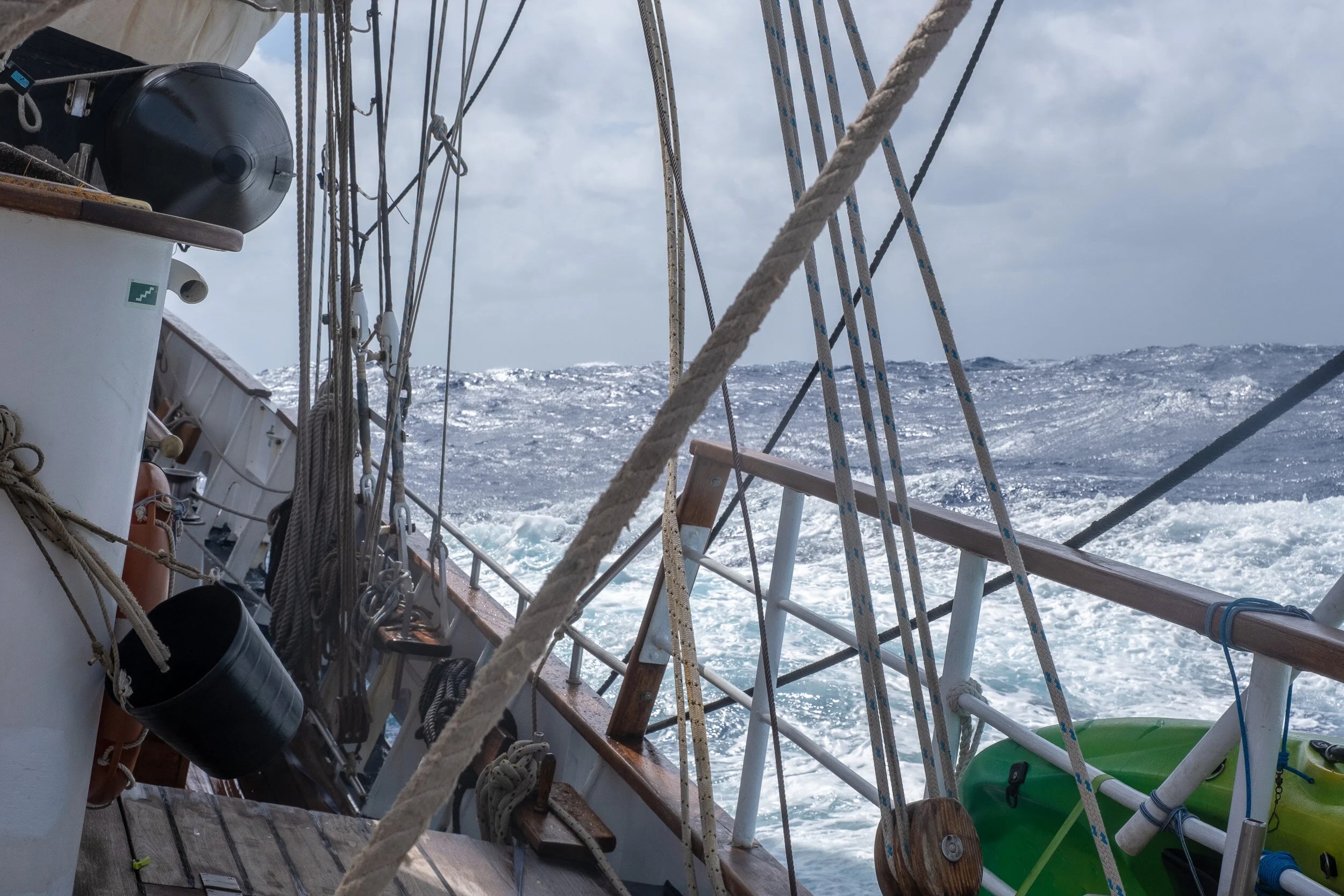
    Awoke next morning feeling significantly better, at least in comparison to the previous night, but by no means at the top of my form. Winds had come up considerably in the night and our first full day at sea was a template for the next 7 or 8 days. Over that period winds varied from Force 6 to Force 8 and the seas were running at 3 or 4 metres with periodic swells as high as 8 metres which I have to tell you is pretty exciting as you watch the wall of water approach the ship. We were sailing through a high pressure cell so the sun was shining brilliantly, the sky was blue and relatively clear of clouds and the colour of the sea was a deep, limpid indigo, Venetian glass brought to life. If it weren’t for the 8 meters swells that were trying to sink us, it would have been perfect!

     Taking in the outer jib
    Taking in the outer jib

    Sea legs came in a day or so but it I continue to take a prophylactic Kwells in the morning and the evening just in case.

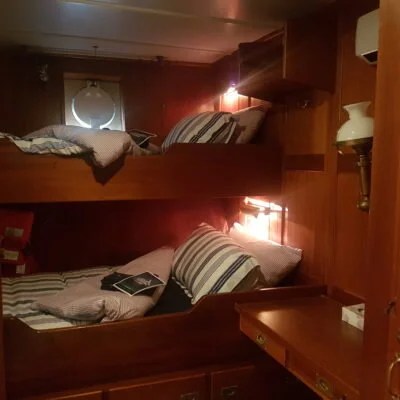
    During virtually all of this time we have been unchangingly on the port tack which has been just fine for me but less than perfect for half the boat’s crew. My cabin and bunk are on the starboard side, which because it’s on the leeward side on the port tack, means that the ship’s heel rolls me downhill tightly into the side of the ship while I’m in my bunk. The half of the crew on the port side are on the high side of the heel and so need to wedge themselves into their bunks with pillows and lay boards so as not to be rolled out of their bunks onto the cabin floor.

    Unlike Tecla on last fall’s sail from Iceland, our watch rotation includes 2 dog watches which makes for a fairer watch schedule but does make it very difficult to get into a routine. What is a dog watch you ask. There are 3 watch teams rotating 4 hours on watch and 8 hours off. Without a dog watch system, you stay on one assigned watch timetable, so if you’re on the 4 o’clock to 8 o’clock watch then you’re permanently on watch during those time periods, AM and PM. Not much fun to have get up every day at 4AM for your watch.

     Seas returning to normal
    Seas returning to normal

    With a dog watch, the normal 4 hour watch period between 4PM and 8PM is broken into two short 2 hour dog watches which forces time assignments to move every day, giving everyone a turn at different times. So, without a dog watch, if I’m on the noon to 4 watch I know that my next watch will start at midnight ’till 4AM. However with a dog watch, when my watch finishes at 4PM, the next watch goes from 4PM to 6PM, the 2’nd watch group goes from 6PM to 8PM and then we’re on watch again at 8PM ’till midnight. In this way every watch group rotates time assignments around the clock, fairer but harder to get into a comfortable sleeping routine.

    Highlights? Low moments?

    Highlight – Easter Sunday, Ruth our chef hardboiled 24 eggs and we had an egg decorating contest in the dining saloon. Great fun and some very creative efforts but trying to draw on an egg when you’re bouncing all over the ocean in a Force 8 is a challenge that must be experienced!

     Worst is over!
    Worst is over!

    Highlight – Helming the ship in a Force 8 with 6 – 8 metre seas coming at the ship sideways from the port side with the sun shining in a bright blue sky. The ship is making 9 to 10 knots, the tops are being blown off the waves, the air is filled with white foam and you watch as a wall of water approaches the port side. The ship rises sideways along the swell and as it reaches the top of the swell and meets the full force of the wind, is heeled over with the starboard rail underwater. As exciting as this is, what follows next is quite eerie. As the ship slides down the far side of the swell, you look for the next swell which is approaching like a moving wall a couple of hundred metres away but the space between the ship and the next swell is flat and calm without a ripple. The wind is howling in the rigging but the trough is quiet and calm water like a bright blue billiard table, peace in the midst of turmoil and then the next swell lifts the boat.

    Low moment – We flew like the wind for the first 6 or 7 days but sadly, while our required direction of travel to reach the Azores is NE, the winds which were speeding us along were not allowing us to make any northing. Wondered if we’d ever make the Azores as we were forced to sail SE and while the forecast kept promising more favourable winds, they weren’t arriving and we kept adding Southerly miles to our route which need to be made up. If anyone followed the GPS track of the ship’s route on the website I know that it must have appeared as if we were sailing away from our destination! We had approximately 2,000 nautical miles to make to the Azores but our initial heading meant that we were adding miles to that total.

    Low moment – Continual rolling and heeling made every activity fraught and tricky. Moving about was perilous and needed to be planned, grab a life line and wait for the roll, take a couple of steps and then wait and repeat. Lifebelts were permanently required while on deck and for any activity that required both hands, we tied on to lifelines. The sound of the wind in the rigging and of the ship banging into the seas was ever present and a permanent backdrop to any conversation.

    Meals are a challenge for both galley food prep and for the hungry sailors, nothing is ever level nor is the heel consistent as the ship is rolling continuously so that one hand is required to keep the plate’s contents in the dish balanced at a manageable level and to prevent the plate being pitched to the floor, wearing lunch not unheard of.

    The passage up from Cuba to Bermuda was apparently very easy, not much wind and what wind there was was contrary so that the ship motored up rather than sailed but the seas were calm and flat and the sailing was very comfortable. I don’t think anyone was prepared for the conditions that we met as soon as we left Bermuda and certainly no one expected them to last as long as they did.

    This post is being written retrospectively as it was impossible to keep the laptop from being tossed from one side of the cabin to the other so I know that we survived the first week but at the time it felt as if we were on an endless, repeating loop.

    Stay tuned, things get better!

  • Last day in port!

    This is perforce a brief post, as we will be leaving the dock shortly. Water pump has not yet arrived but seemingly it’s on the island, and as I understand it, we will leave as soon as it’s delivered and make the repairs while underway. At the moment the fuel tanker is alongside and filling the bunkers so within the next couple of hours we will be off.

    Yesterday was a make and mend day, cleaning up and making ready for sea. I posted the blog, wandered into town for lunch, and took it relatively easy. Not much to report, everyone is impatient to be off and we still have about 2,000 nautical miles to cover to get to the Azores so every day in port is cutting into our scheduled arrival date, but with favourable winds we should be ok.

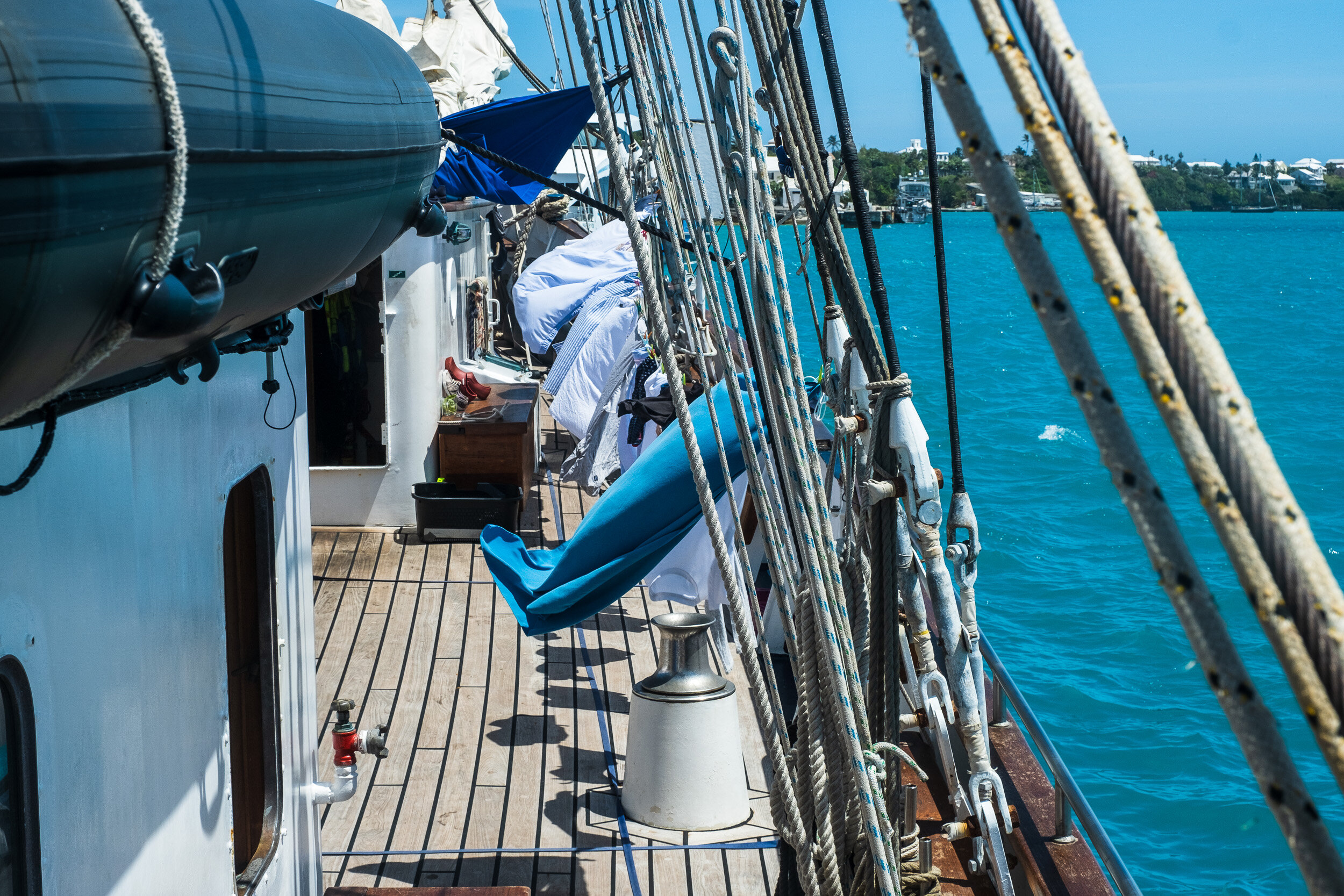
     Make and mend
    Make and mend

    Low pressure cell moved through last night and the winds have moved into the west, which should be in our favour, but it did bring rain. I had taken advantage of our delay to get a last load of laundry done and hung out to dry in the rigging but rain arrived early this morning and soaked it all so hope there will be enough time this morning to get the worst of the wet out before we leave. Sun shining now so with luck…

    I wont have access to internet after we leave so posts will not be possible but I have a satellite tracker so you can check progress on the blog. There is a button in the sidebar which if clicked will take you to a gps map with the ship’s track and position.

    See you on the other side….

    Stay tuned!

     Last day for laundry!
    Last day for laundry!
  • In Bermuda, Sunday

    Sunday morning, beautiful day, high cloudless blue sky. Wind is brisk and while it has been out of the North for many days, in our teeth if we were sailing to the Azores, it has now swung around from the South, an ideal day and wind for the start of our passage. Unfortunately we are still tied up in Bermuda, awaiting the parts that are being flown in, and can only look at the weather and hope that it stays.

    An easy day, everyone on their day off and many have headed to various parts of the island to explore. I’m enjoying the leisure and have chosen to write the blog, walk around the town and precincts and lie on deck reading my book while the landscape is still level and not bouncing around the horizon.

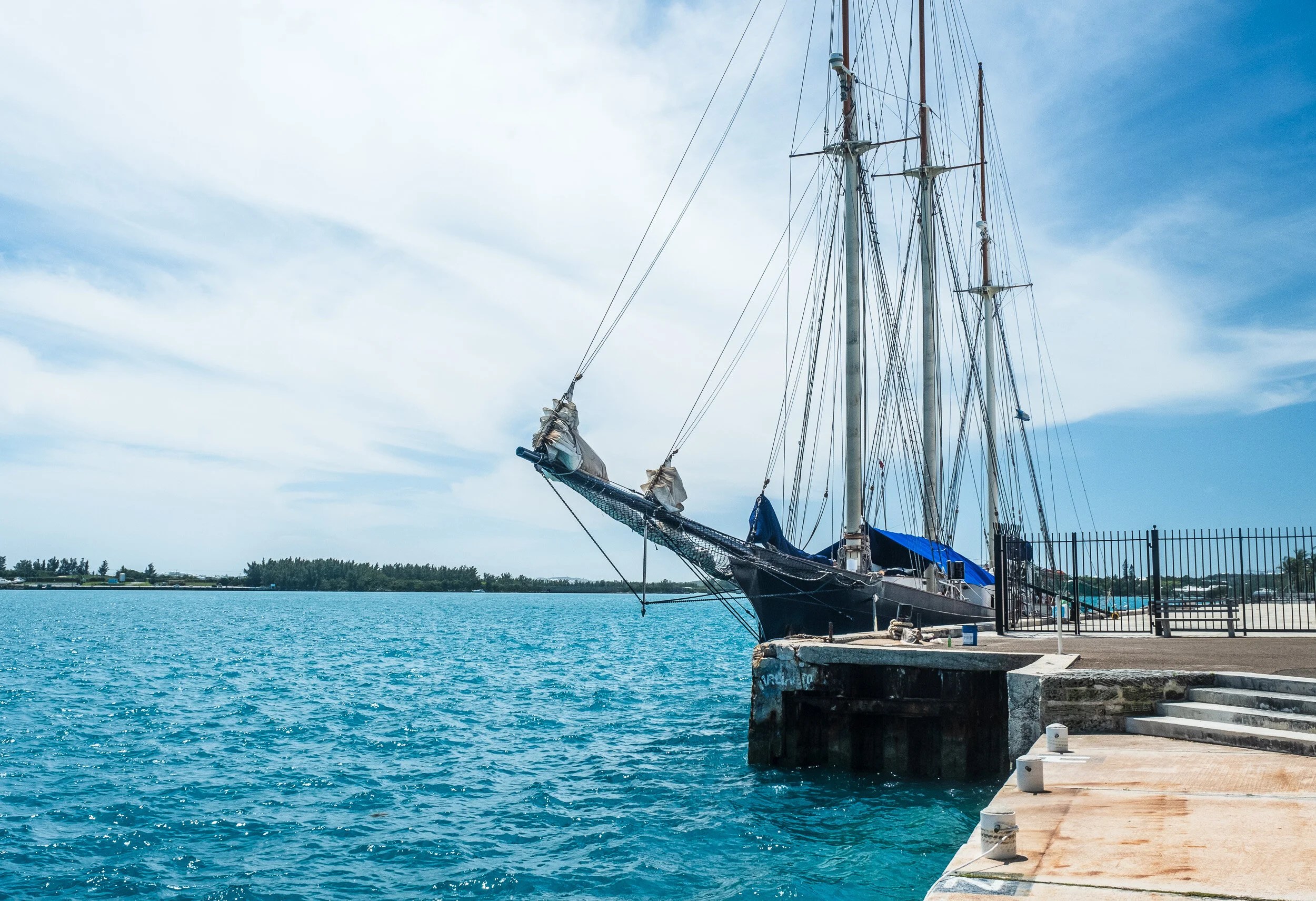
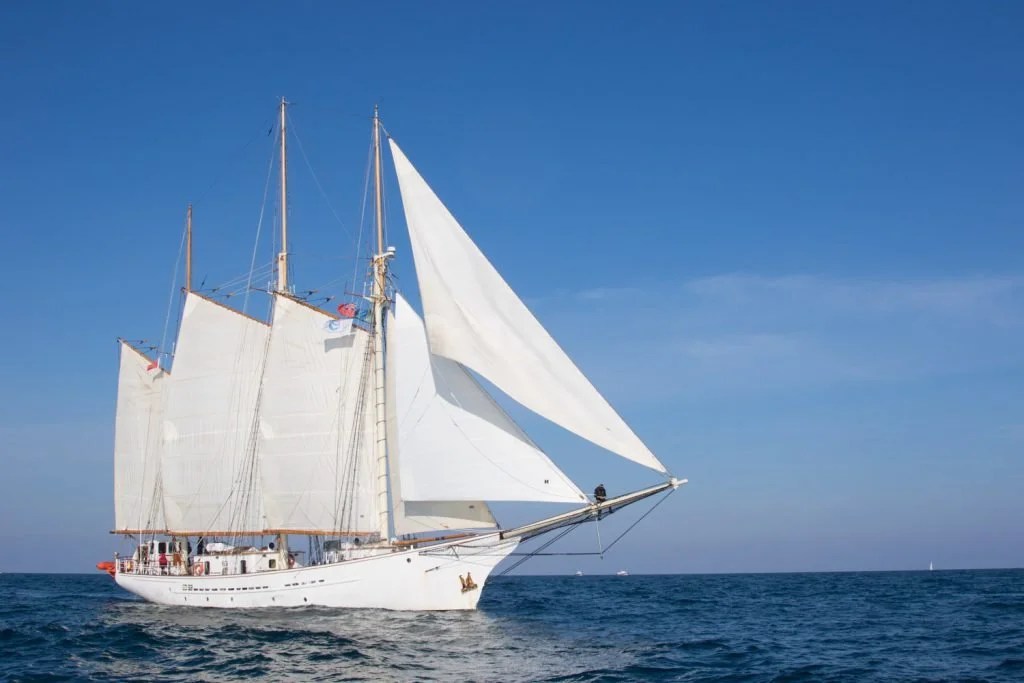
     Blue Clipper at dock
    Blue Clipper at dock

    Unlike Tecla who had a permanent crew of 3 including the captain plus a cook and a guest crew of 10, Blue Clipper is awash with crew. There are 6 of us guest crew, plus a group of 10 Trainees who have been aboard since St Maarten and working towards various certifications, and 8 permanent crew, for a total of 24, a full house for meals. I’m sure this will be hugely easier on everyone with lots more hands to spread the load but we are still on watches and and while there will be 5 or 6 people per watch, there are 3 masts with gaff rigged sails to manage instead of 2 as on Tecla so I expect we will still be kept hopping. Crew, as you would expect, is very young and I’m by some distance, the old man of group.

    Last night after dinner, a number of the young ones wanted to watch a movie and since my ipad has a phone card I’m on a fast phone network and can stream Netflix with no hiccoughs. Everyone wanted to watch Adrift so a day before our departure for an ocean crossing we watched, irony of ironies, the travails of a sailboat in the throes of trying to survive a storm and dismasting at sea. They all seemed to love it but a bunch of young blue-sea sailors are not going to let movie makers errors go unpunished!

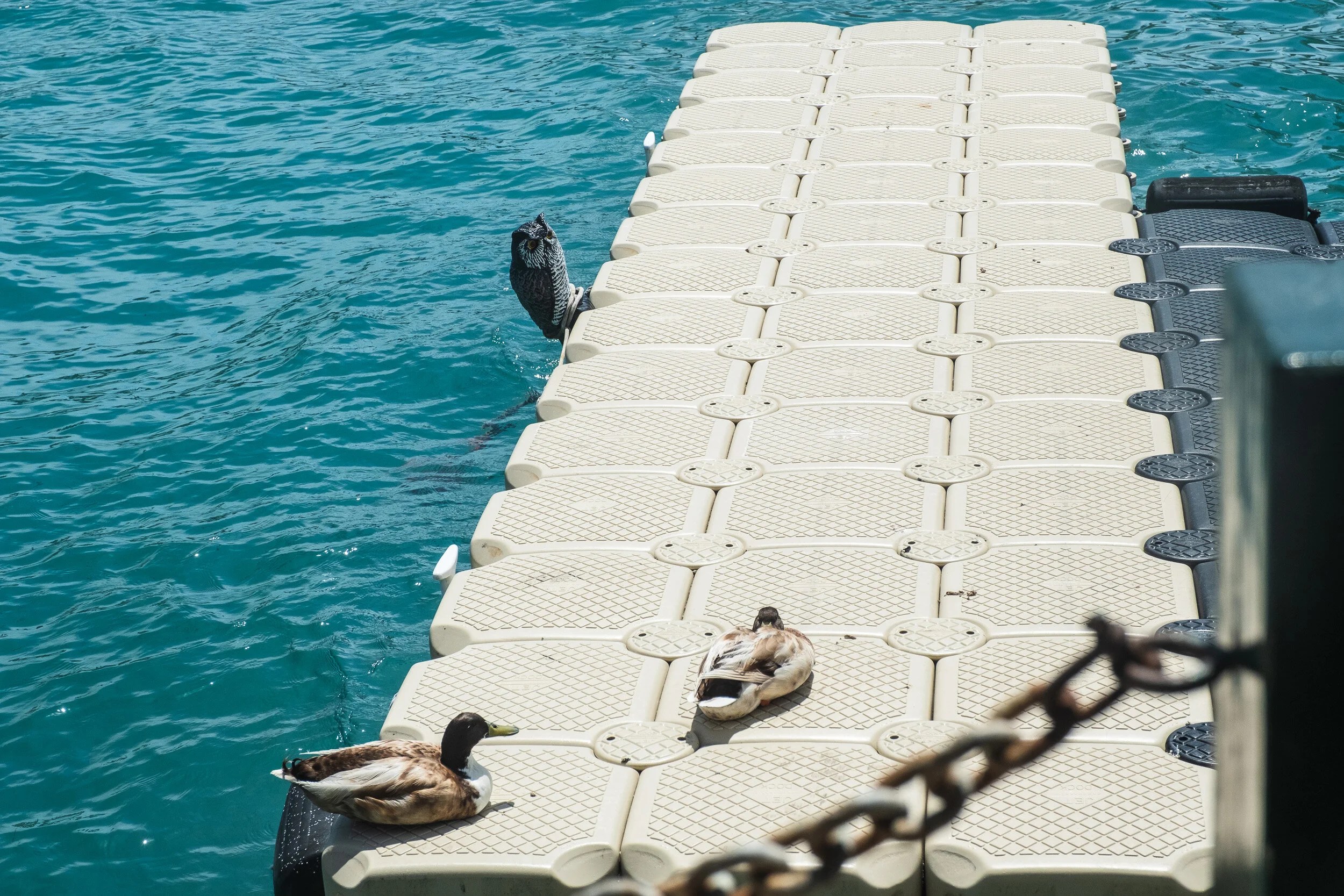
     Salt water Mallards unfazed by an owl efigy, probably have never seen one in life!
    Salt water Mallards unfazed by an owl efigy, probably have never seen one in life!

    Tomorrow is, with any luck, our last day at the dock and if the long-awaited parts arrive on time, we should be good to go on Tuesday morning.

    Stay tuned!

  • In Bermuda

    Joined the ship yesterday. I knew I was in for trouble at the airport in Toronto when, after I had cleared security and was going to call V, I realized I couldn’t find my phone. Mad scramble through carryons before I hit the Pause button and tried to remember where I had seen it last, hoping that it was at security screening where I might still have a chance of recovering it. Unfortunately couldn’t remember having seen it since checking emails in the back of the airport limo. Fired up my iPad and checked Find my Phone and I could see that it was located at an address about 10k away from the airport so clearly still in the backseat of the limo.

    Sad really since I had planned to use my iphone to video the interesting moments of the trip with my phone. Had done lots of research before the trip as more and more movies and really interesting video projects are being created entirely on iphones and had bought a Moondog anamorphic lens and a little Shure mike with a lightning connector for the iphone, as well as an iphone Steadycam rig to shoot with, now all this equipment is simply excess weight and space in my luggage. Not a good start to the trip.

    The desk staff at the Air Canada Lounge were very helpful and let me use their phone to call V. Fortunately the limo driver had called to let me know that he was on his way before he picked me up, so I asked V to call the last number calling to the house phone and she reached the driver who found the phone when he checked. So a small win. V retrieved the phone yesterday and had a wonderful experience with the driver’s family, a Pakistani family who have been in Canada for 6 years and whose only daughter had just graduated from, I think Waterloo, with an undergrad degree in Psych. She is interested in getting into HR so she and V got along very well and the family were welcoming, gracious and charming. The phone was wrapped in tissue paper and presented to V in a gift bag accompanied by a large box of chocolates, he is now my limo driver for life!

    When I arrived in St George my first task was to find a cheap, pay-as-you-go phone so that I at least had some voice communication while we are still in reach of a signal. Ended up taking a taxi into Hamilton at the cost of $40US each way and picked up a basic Android phone from Digicel which is unlocked so that I can use it in Bermuda and then pop in an Azores sim card at the other end, not elegant but a working solution.

     Our skipper Chris
    Our skipper Chris

    It was well that I did that as when I arrived on the boat on Saturday, Chris the skipper told me that they had a broken water pump and some minor engine hiccoughs and as parts needed to be flown in, we are now leaving on Tuesday rather than Sunday morning. They had limped into port in Bermuda a day late and were needing to get the boat back into proper working order before we could depart. Not necessarily a hardship as I now have communication, the boat is comfortable and now have a couple of days to explore.

    With a start like this it’s either going to be a fabulous passage or there is one more bump still to come, I’m counting on the former.

    Lat night the boat’s crew was invited to spend the evening at a local sailing club about a 10 minute walk along the waterfront and so we spent the evening drinking Dark and Stormys and chatting to the locals, great fun. I left at about 10 and crashed but I think that a number of the crew closed the bar so I’m expecting a rough breakfast tomorrow morning.

    Stay tuned, more to come.

  • Bermuda to the Azores!

    It’s been a while!

    The last time I posted I had just arrived in Ullapool, Scotland after sailing from Iceland via the Faroes, the Shetlands and the Orkneys. I had planned to journal our photo expedition through Skye and the Western Highlands but the days were too full and there never seemed to be enough time. I heard from a number of you who were unhappy that the blog just stopped so abruptly. Aplogies, I’ve given myself a stern talking to and will try to do better next time.

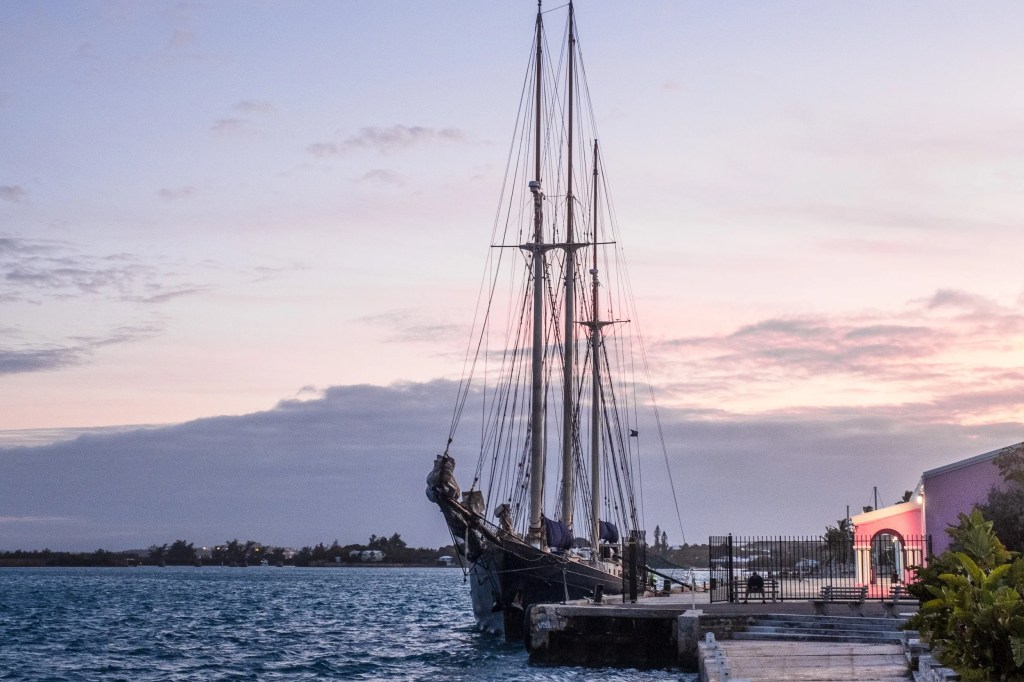
    And what better time to start than now… at the moment I’m in Bermuda at the St George’s Club where I stayed last night and am looking down to the foot of the hill, on the top of which the Club is located, where I can see my next sailing ship, the Blue Clipper, waiting for me to board.

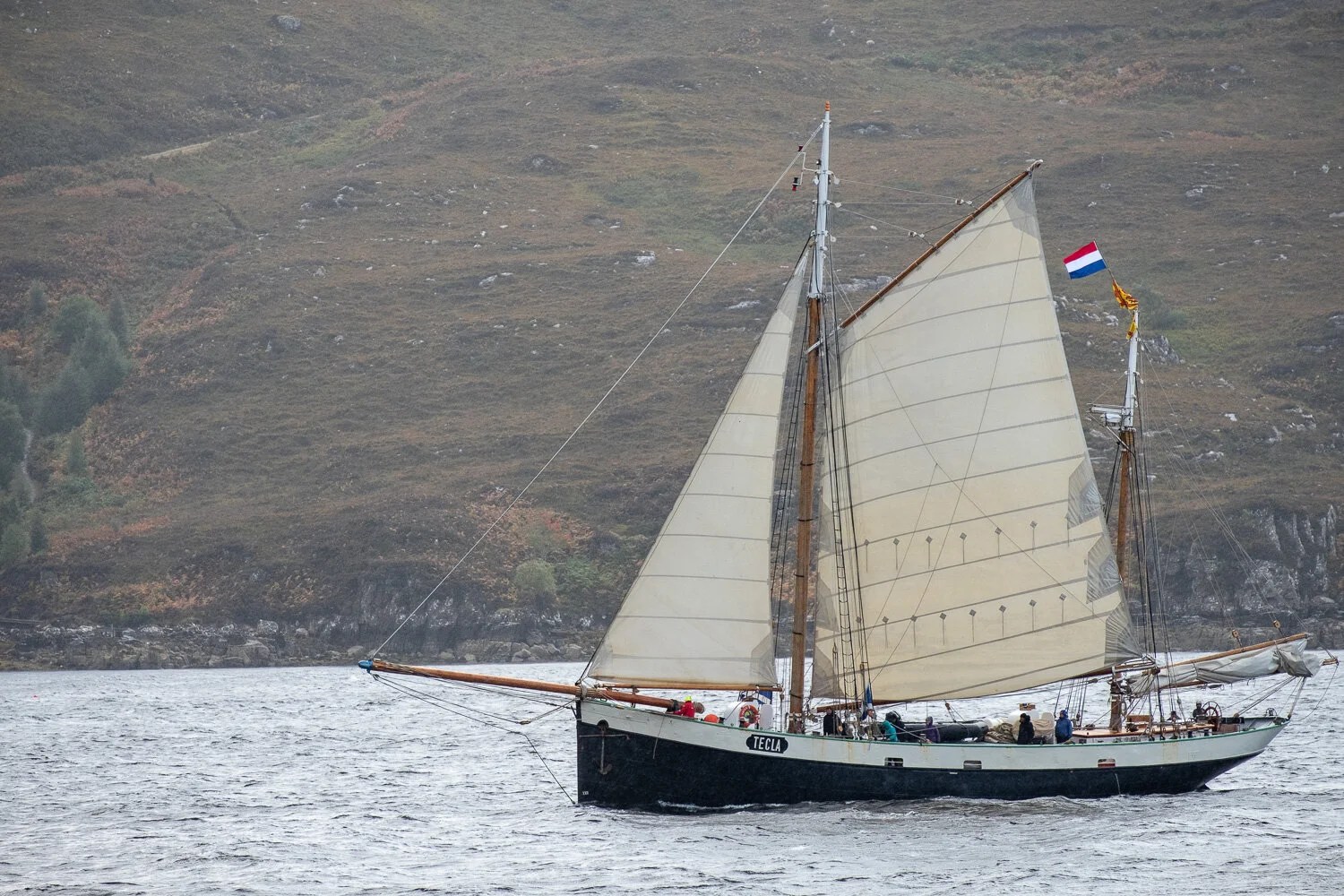
    She’s a beautiful 3 masted schooner, gaff rigged like Tecla, but slightly larger, much newer and enormously more comfortable. As much as I enjoyed sailing in Tecla it did feel like experiencing first-hand Twenty Years Before the Mast. When I hit dry land my first sense was that I wouldn’t care to do anything like that again, and yet, and yet….

    Let me step back a moment, one of my reasons for taking the passage with Tecla was that I wanted to sail with them this summer as they make an attempt at traversing the North-West Passage. I have just celebrated my 75th birthday and sailing the Passage seemed like an challenging way for me to celebrate the event. So my Iceland-Scotland sail was as much as anything a shakedown cruise for me to see if I would be able to handle it. Because of the unpredictability of weather and ice, it’s 50/50 whether they will be able to successfully complete the Arctic Passage or if they’ll have to return the way they came, but at the very least its about 2 months of hard sailing. If I learned anything from my 3 weeks aboard Tecla it was that my ageing and raging body would have been hard-pressed to stand up to requirements and so I reluctantly put that on my ToDo list for my next life.

    My reluctance to do another blue water sail rapidly ebbed and by January the itch to do another sail could not be scratched and so I started to look around to see what I could find. My ideal was an Arctic/Greenland sail, or an Antarctic sail around Cape Horn or all else failing, to do a trans-Atlantic crossing. Couldn’t find anything that worked for either of the first two, timing and availability not working for me but did find Blue Clipper who is on her way back to the UK after wintering in the Caribbean. I could have chosen to go all the way to Liverpool with her but decided to stop when she reaches the Azores, about a three week sail, where V will meet me and we will spend 10 days exploring and photographing the Azores.

    Should be a very different sail than was the case with Tecla, no stops along the way to break up the trip, no access to internet to post the blog and culturally different, Blue Clipper being a British ship and crew whereas Tecla was a Dutch ship with crew to match.

    So here we go again! I board in a couple of hours and will post the blog as long as I have access to a signal and then will catch up on the other side.

    Stay tuned!

  • Out of the Orkneys, Into Ullapool, Sept. 23

    If you remember from my last post we were in Kirkwall, Orkneys for two nights to wait out a gale. Weather intermittent sun and rain but the wind blew hard from the south for the entire time and since we were on the northern side of our dock we were being blown away from our mooring, well that we had doubled our mooring lines.

     Rousay, view from 5500 year old tomb, across a ruined highland clearances home to the passage whose current wouldn’t allow us to traverse it
    Rousay, view from 5500 year old tomb, across a ruined highland clearances home to the passage whose current wouldn’t allow us to traverse it

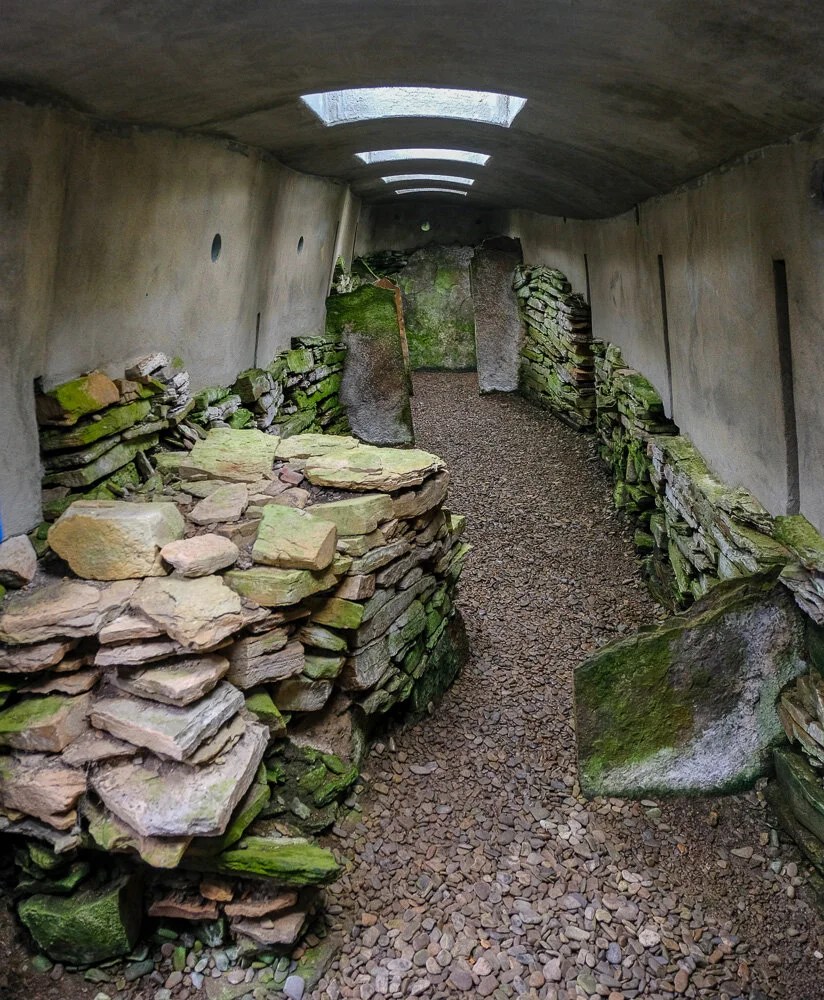
    One advantage of being moored for two days was the opportunity to find the town’s laundromat and clean up a 2 week accumulation, bliss. We were hoping to sail to Stromness to our south which would prepare us for a straight southerly run into Ullapool but the winds coming so hard from the south, we could only clear the harbour by sailing north so after lunch on Thursday we raised sails and headed north for Rousay, a small Orkneys island nicknamed the Egypt of northern Europe. Struggled to make sense of the nickname, flights of imagination attempting to connect windswept, sheep-filled islands with pyramids and desert sand but just couldn’t make it work. I was to discover that the reference arose from the discovery of neoolithic tombs which were built by early inhabitants over 5500 years ago and which, in fact, pre-date the pyramids. I’m anticipating however.

     Inside a 5500 year old burial chamber, covered to protect what remains.
    Inside a 5500 year old burial chamber, covered to protect what remains.

    Really pleasant and easy downwind sail to Rousay, an island of about 200 inhabitants virtually all involved in sheep and cattle raising. Sheep and cattle are raised for meat, not dairy and until recently the wool from the sheep, who are sheared for the summer, was burned since the low price of wool did not make it worthwhile to take to market, shameful waste. However, the islanders recently discovered that they could market the fleece as home insulation and the wool is now a useful addition to the local economy.

    Rousay was subject to highland clearances in the mid-nineteenth century and the island hills are littered with roofless, derelict stone cottages, the only remnants of the hundreds of people who were thrown off the land to make room for raising sheep for the benefit of the island’s landlord.

    The island, small as it is at 18 sq miles, also has evidence from every stage in the history of Northern Europe, with a Neolithic settlement, Bronze Age burial mounds, Iron Age crannogs (man-made islands), brochs (defensive stone towers), Viking boat burials and medieval churches. One of the pictures in my last post pictured a ruined manor farm with a large stone tower which I supposed was an outbuilding associated with the farm. Couldn’t have been more wrong, it was a very well-preserved example of a broch which was at least 2000 years old!

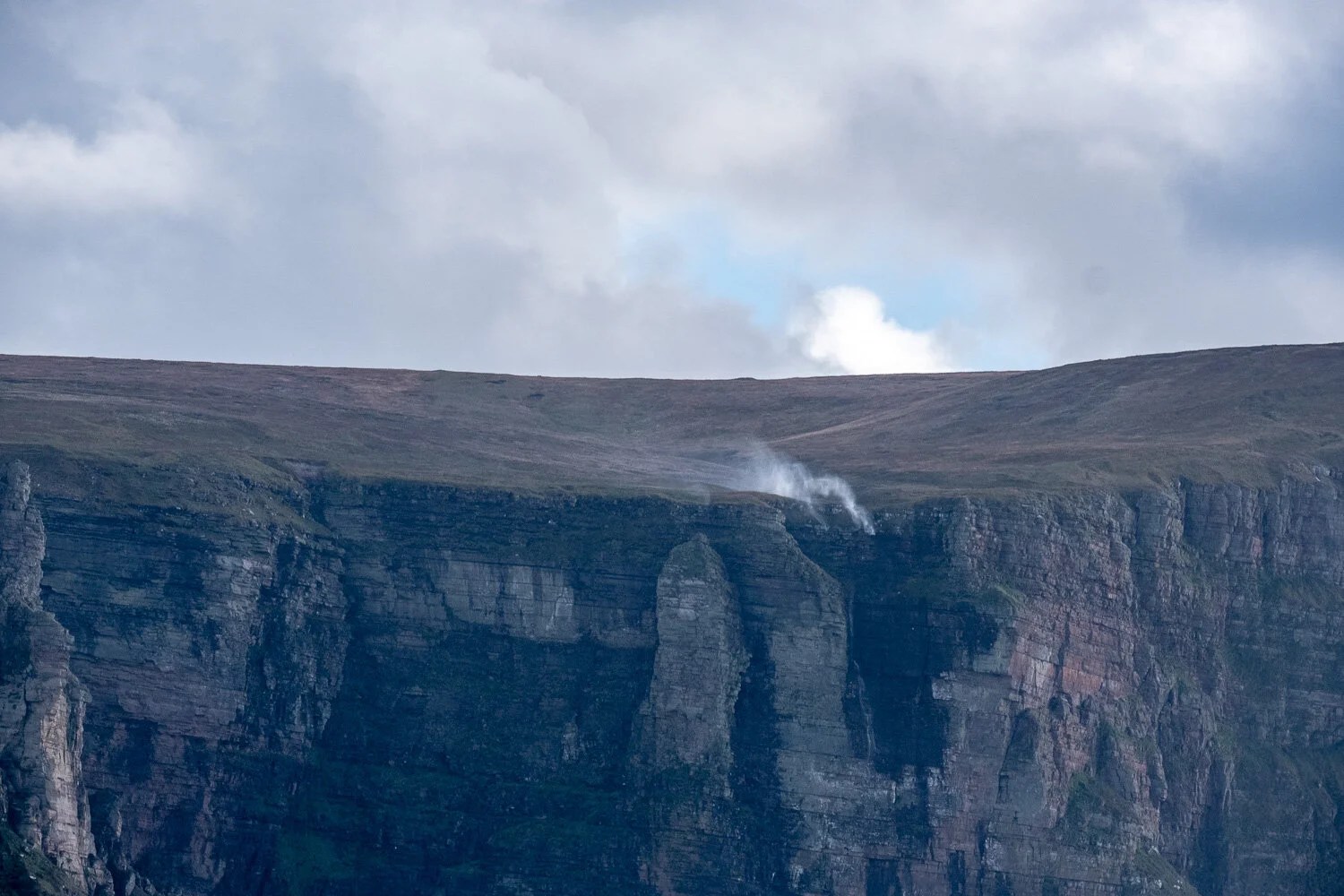
     White smoky patch is not smoke but a waterfall, which with Force 8 gale winds is being blown in reverse back up the waterfall
    White smoky patch is not smoke but a waterfall, which with Force 8 gale winds is being blown in reverse back up the waterfall

    Off in mid-morning on Friday for an easy 20 mile motor sail to Stromness, the winds still being against us. We had planned to sail through a passage between two islands to our south and so through to Stromness. However we had not reckoned with the strength of the currents that run between the islands. The Shetlands and the Orkneys are hard areas to sail, currents and tide have an enormous effect on sailboats and planning a course of sail must take these into account. In our case they made what was to have been a 3 or 4 hour sail into a marathon. We spent the first hour of our journey trying to make headway against the current and were barely moving forward, we then turned tail and put the ship in the opposite direction. In order to work our way to Stromness we then needed to make a giant circle out to sea and creep our way against the wind but more importantly, not against the current. As a result we arrived in Stromness at 10pm after an 11 hour sail rather than the the 4 hour ride that we had expected.

    We were now down to our final two days of sailing before arrival at our final destination of Ullapool. And we really did save the best for the last! Winds were forecast to be Force 7 gusting to Force 8 from the south with high seas and when we cleared the Stromness harbour on Saturday, motor sailing under staysail and mizzen, we hit the full force of winds and waves. We were motoring into the teeth of the wind and waves and standing on deck, in itself a task unless securely attached to a piece of the ship, waves would rise up taller than you were standing on deck and you needed to look up to see the wave’s top, which was being blown to spume by the force of the wind, and the bow pointing up in the air, would then come crashing down into the valley between waves, shipping seas over the decks. Virtually everyone found a spot to roost on deck, wild as it was, since below decks it was punishing. No handholds and trying to walk along the companionway to the galley or standing in your cabin was asking to be slammed from one wall to another. Your choices were to be on deck and soaked wet and cold but able to see the waves coming and prepare for them, or to climb into your bunk and wedge yourself in by your arms and legs but have no way to anticipate the next roll and heave of the ship. This went on until after midnight, when the wind abated and the seas flattened and the ship began to ride much more easily.

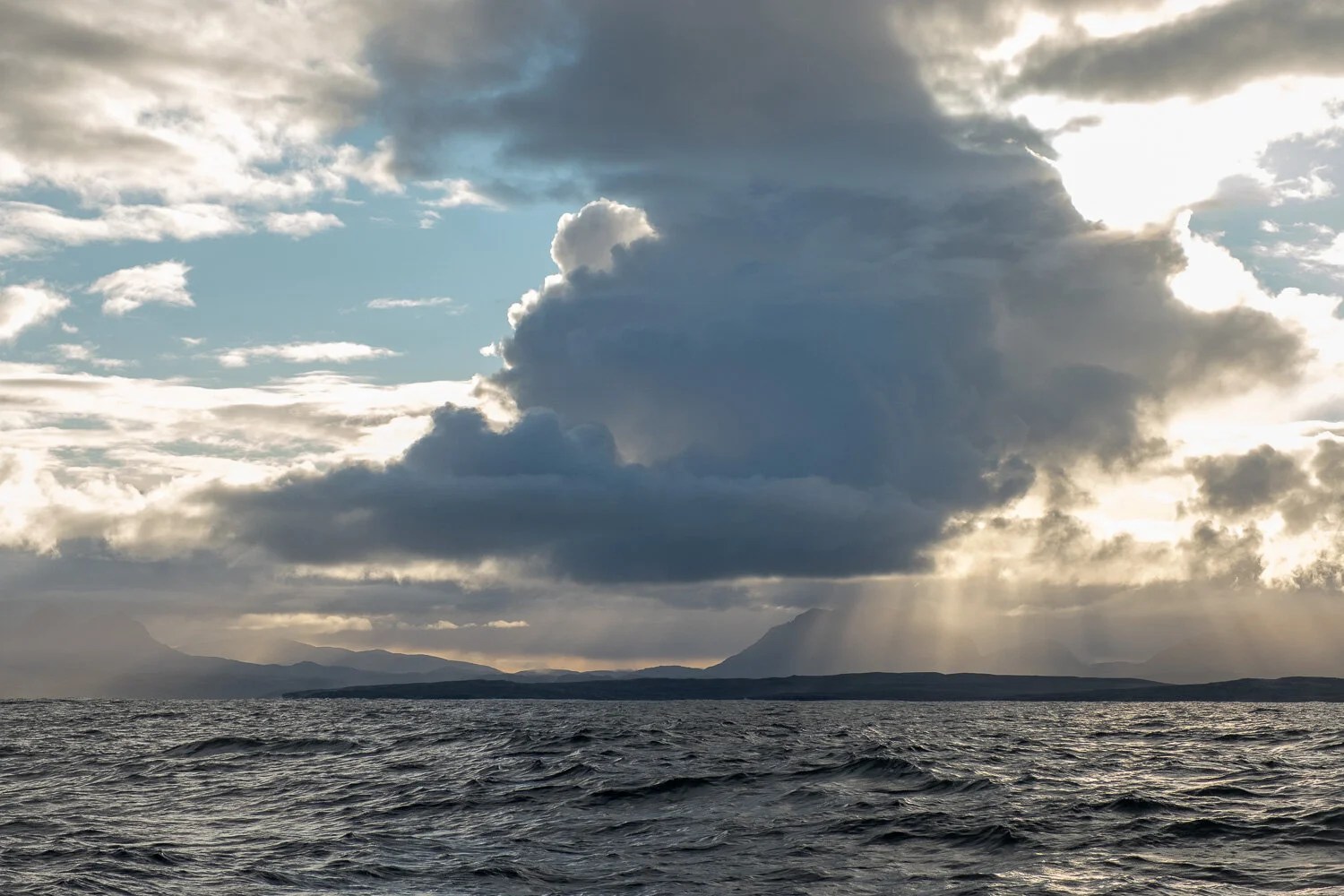
     Dawn coming up like thunder on our way into Ullapool
    Dawn coming up like thunder on our way into Ullapool

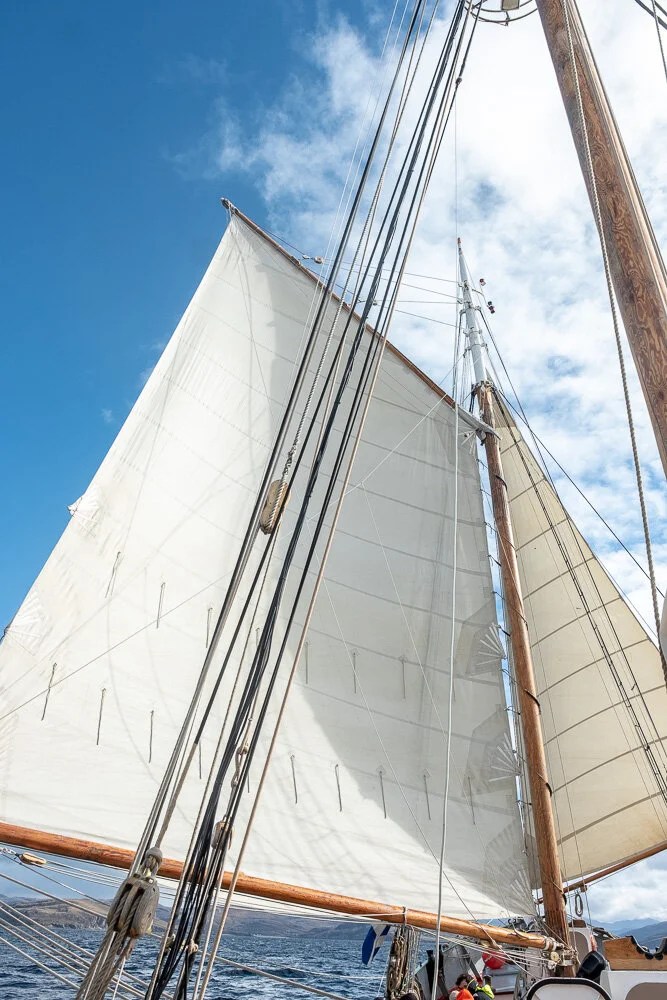
    Dawn brought a clearing sky and the wind moving around out of the west. We had a glorious sail into Ullapool under our staysail and main butterflied wing on wing with our wake creaming behind us. V had positioned herself on the lighthouse at the harbour mouth and I got a text from her as we cleared an island near the harbours mouth that she could see the ship just coming in to view. Another magic moment of the many on the trip.

    Arrived at about 3 in the afternoon, brought down sails, coiled lines and cleared the decks for the last time, a little sad but great to think about hot showers and still beds.

     Butterflied staysail and main, into our final lap
    Butterflied staysail and main, into our final lap

    Gijs invited V to join us for our final dinner on the ship so off with her to the hotel to shave for the first time in 3 weeks, a very long hot shower and as a mixed blessing, a return to the wider world of Doug Ford, Trump and all the other matters that we have been away from for the last 3 weeks. However, one thing that I’ve been looking forward to is seeing V. We’ve been together for 25 years and this three week period is the longest that we have been separated. She was waiting on the dock as the ship pulled in and couldn’t have been happier to see her there. So, together again we’re going to spend the next two weeks on a photo expedition to Skye and the highlands. Looking forward to good restaurants, easy traveling and warm beds. Feel they are richly deserved!

    Stay tuned!

     V’s shot of us clearing the harbour mouth in Ullapool
    V’s shot of us clearing the harbour mouth in Ullapool