Since my last post written from Futaleufu, R and I have begun to get much further along Route 7, the Carretera, in all its wet and misty glory. That description may be about to change however, and we will all be glad of the change but more about that later in the post.
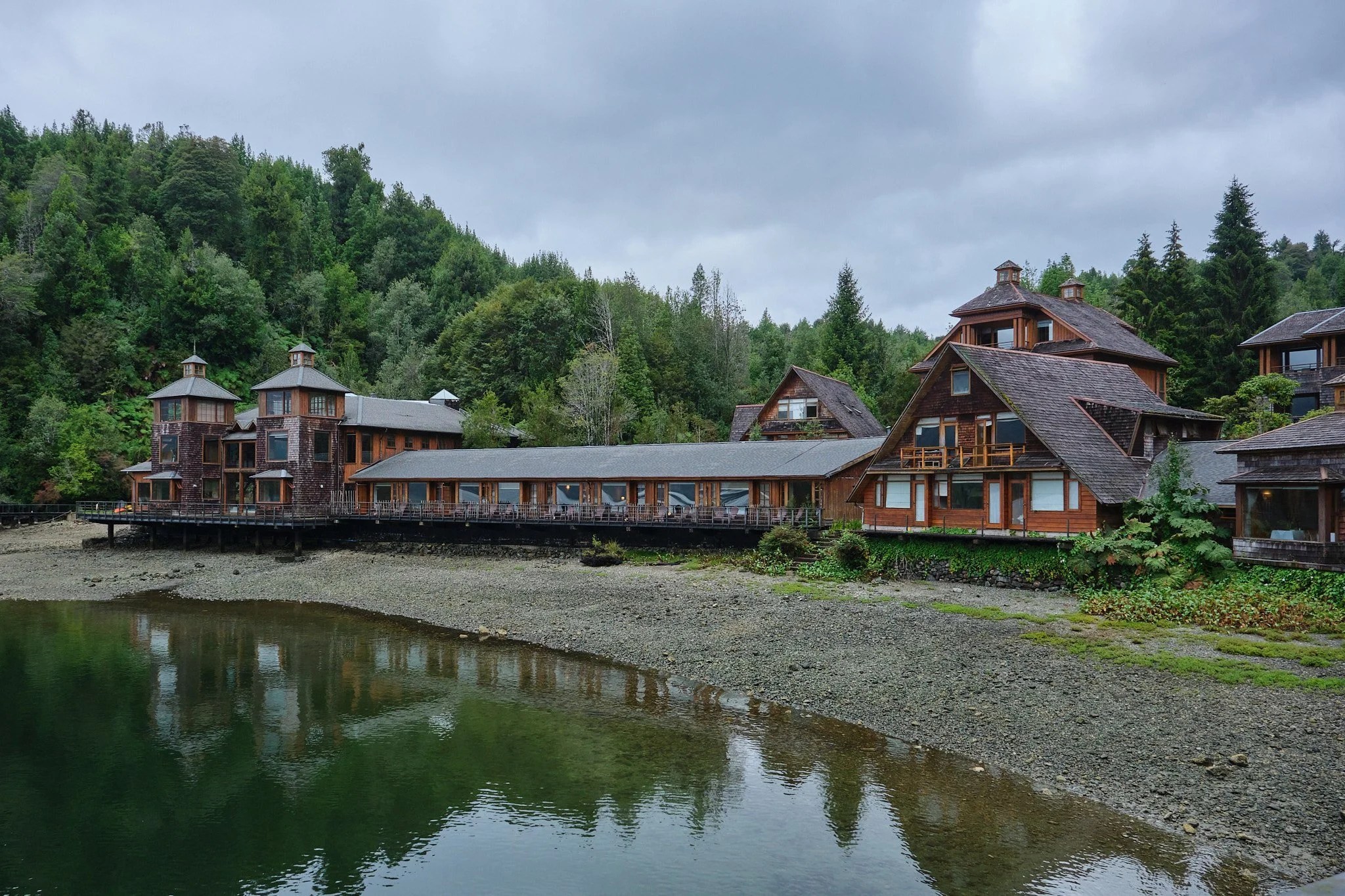
For now, our progress to date…We left Futaleufu on Saturday morning March 11 and drove south and west back over the oceanside range of mountains to reach the location of our just-completed two night’s stay, Puyuhuapi Lodge, an eco lodge and spa on a little island in a fjord not too distant from the Pacific. As soon as we crossed back over to the western side of the mountains our road hugged the ocean and we were once again surrounded by clouds and rain. In fairness, the clouds occasionally parted and we had a brief respite from the rain but for the most part the tops of the mountains were shrouded in mist and cloud. We arrived in mid-afternoon at the private dock where the Puyuhuapi launch picks up its passengers for the 15 minute crossing to the island where the lodge is located.
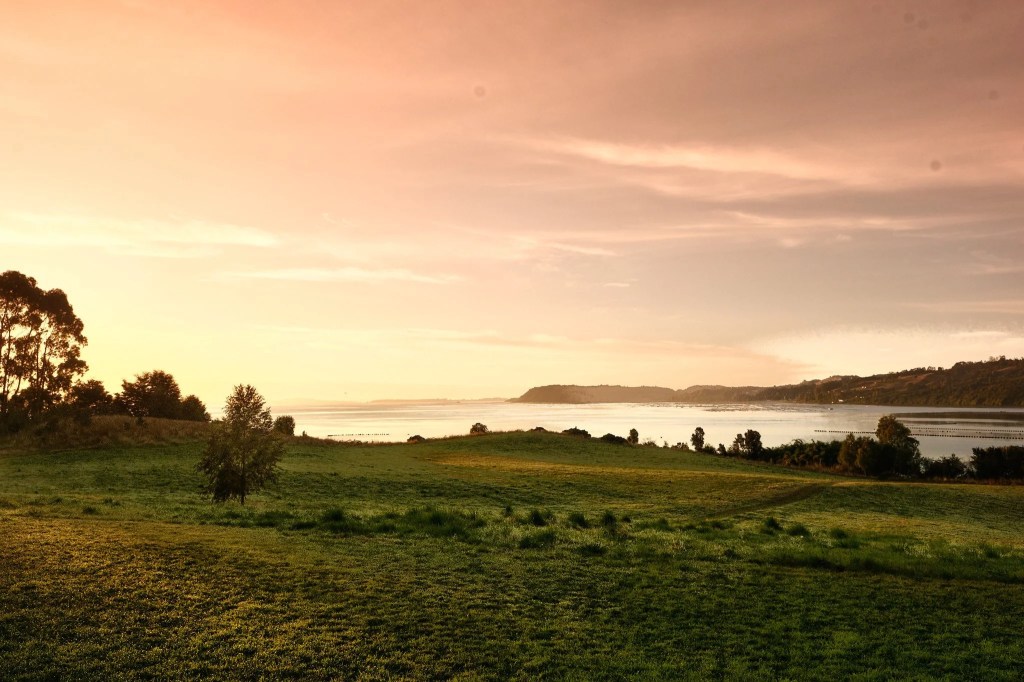
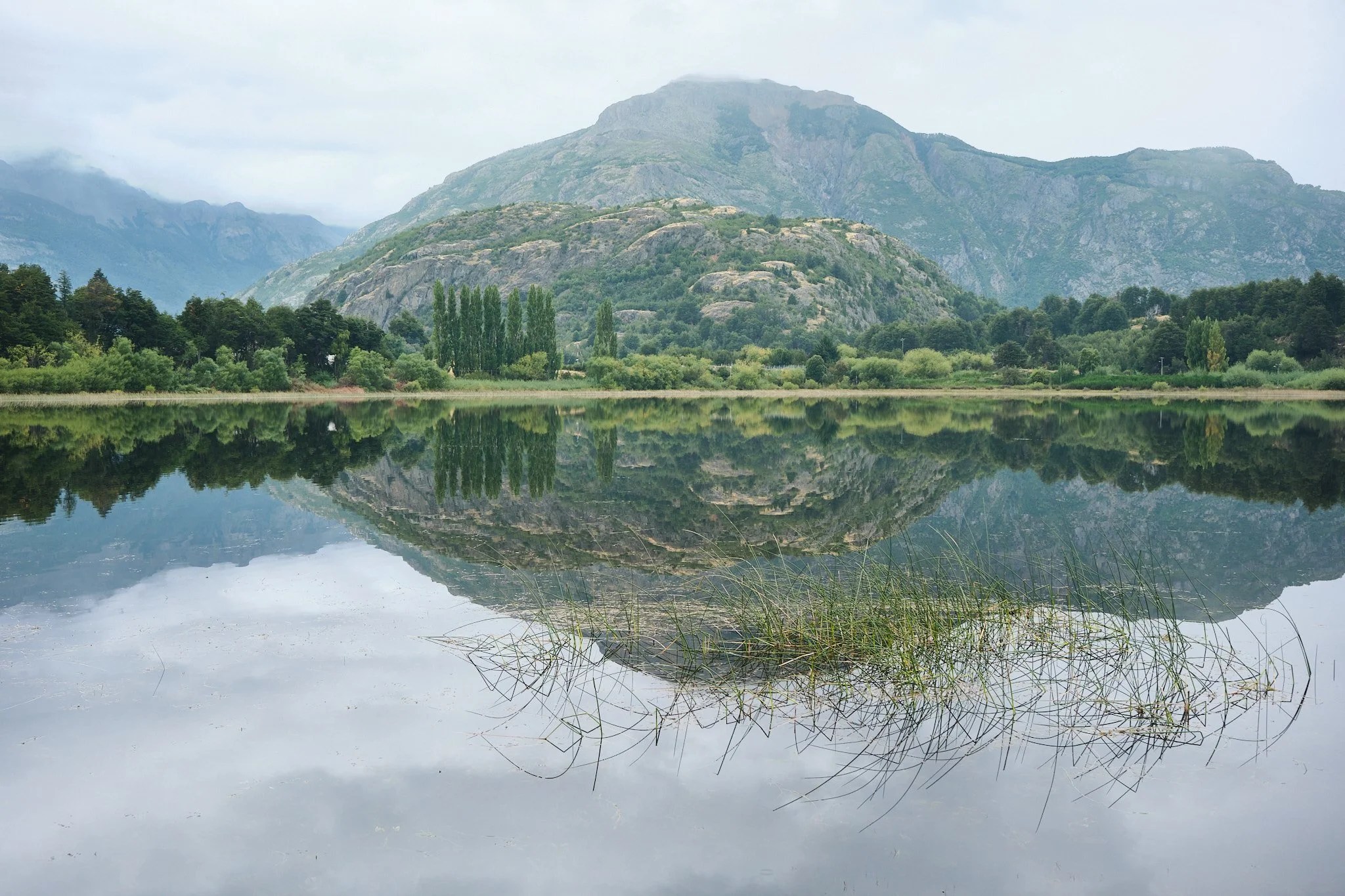
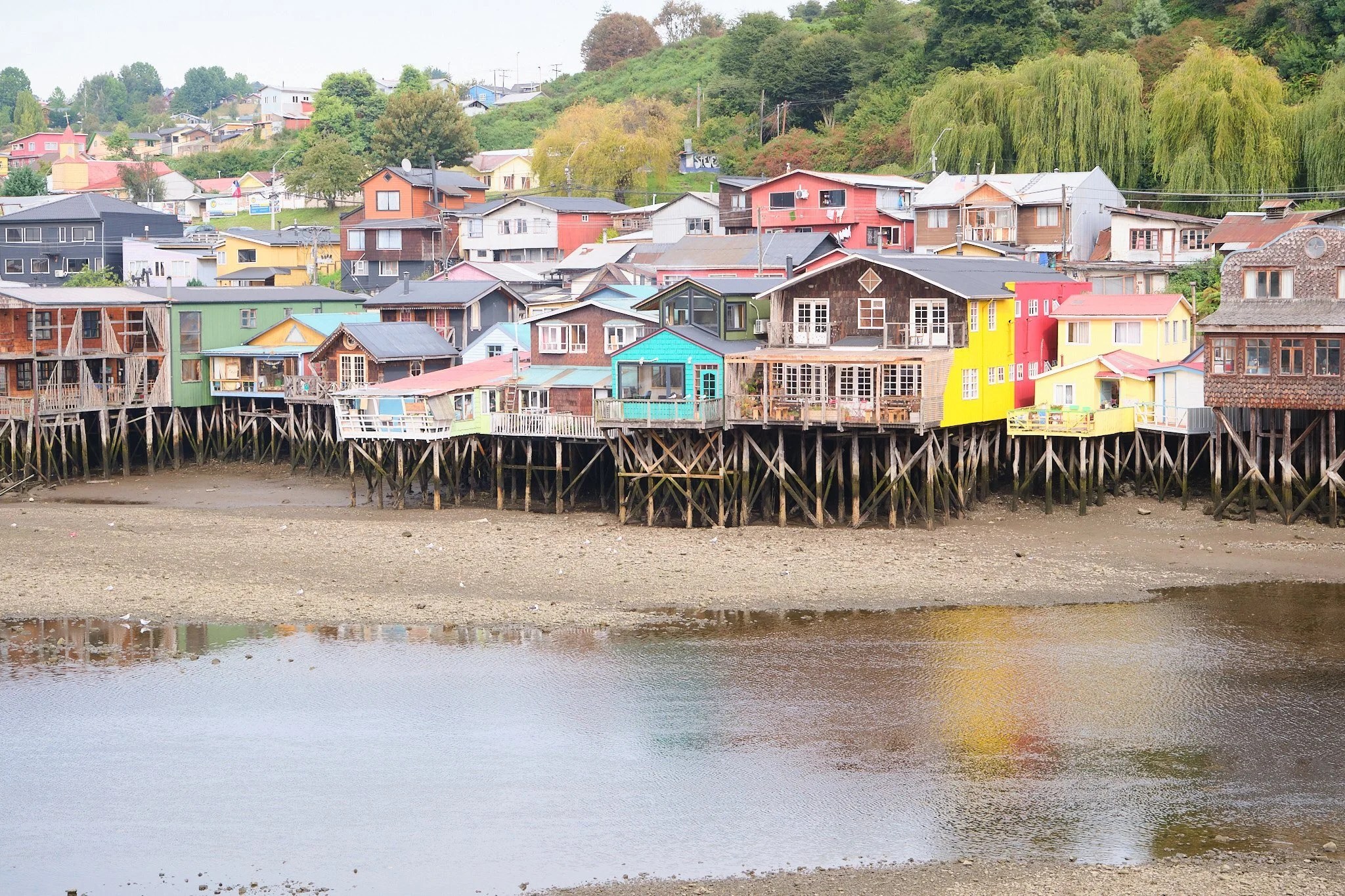
Puyhuapi Lodge at low tide
Puyhuapi it is an eco lodge and spa which means there is a great emphasis placed on physical and mental well-being. There are thermal hot springs to soak in, a sauna, a variety of massages and treatments and a vast array of pummeling and pounding from which, needless to say, we both abstained. In a further nod to moderation the food was not particularly compelling or enticing so the danger of overeating was avoided. Very thoughtful of the chef but I would have been happier with at least a minimum of flavour and creativity. The wines however were, as they have been for the entire trip, interesting and more than made up for the lacklustre menu.
Because we were large distances from any local communities and we were surrounded by mountains there was no link to the outside and no cell or internet service. There was however one desktop computer which is shared by all the guests, a satellite link I suppose, but guests were requested to limit their use of the machine.
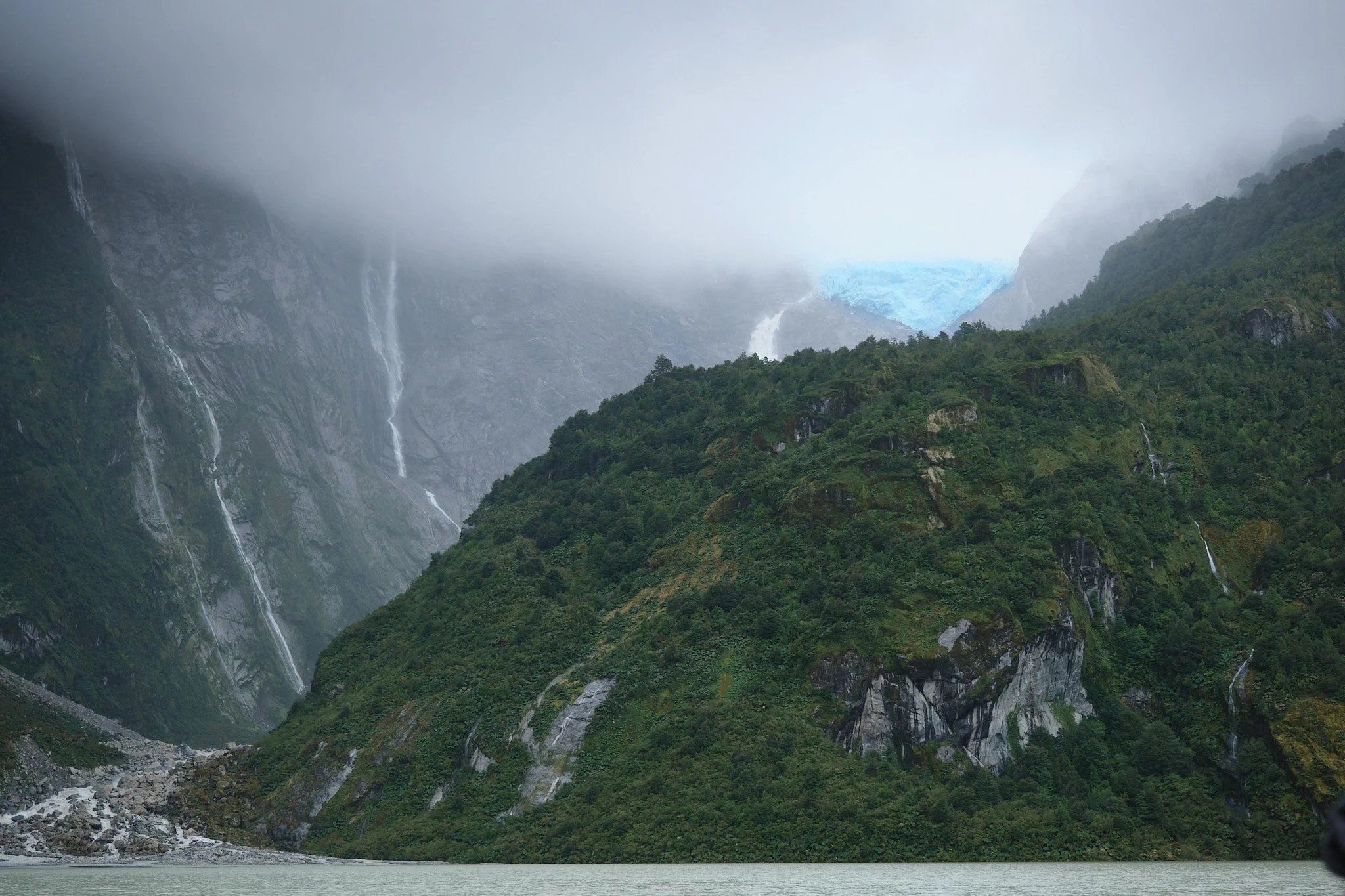
Hanging glacier
On Sunday we took the lodge’s launch back to the mainland at noon and were met by Hans, our driver/guide, who drove us to Queulat National Park. In the park is a large lake in a cavity of the surrounding mountains fed by a hanging glacier and which is a fabulous sight if the clouds are not covering it. We hiked about 600 metres along a forest track wet, rock-strewn, slippery and muddy from the rain and over a suspension bridge above the raging waters of the river which flows from the lake. The lake itself when reached was about half a metre above its normal height and it was very clear that the recent rains had caused all the waterways in the region to be in spate.
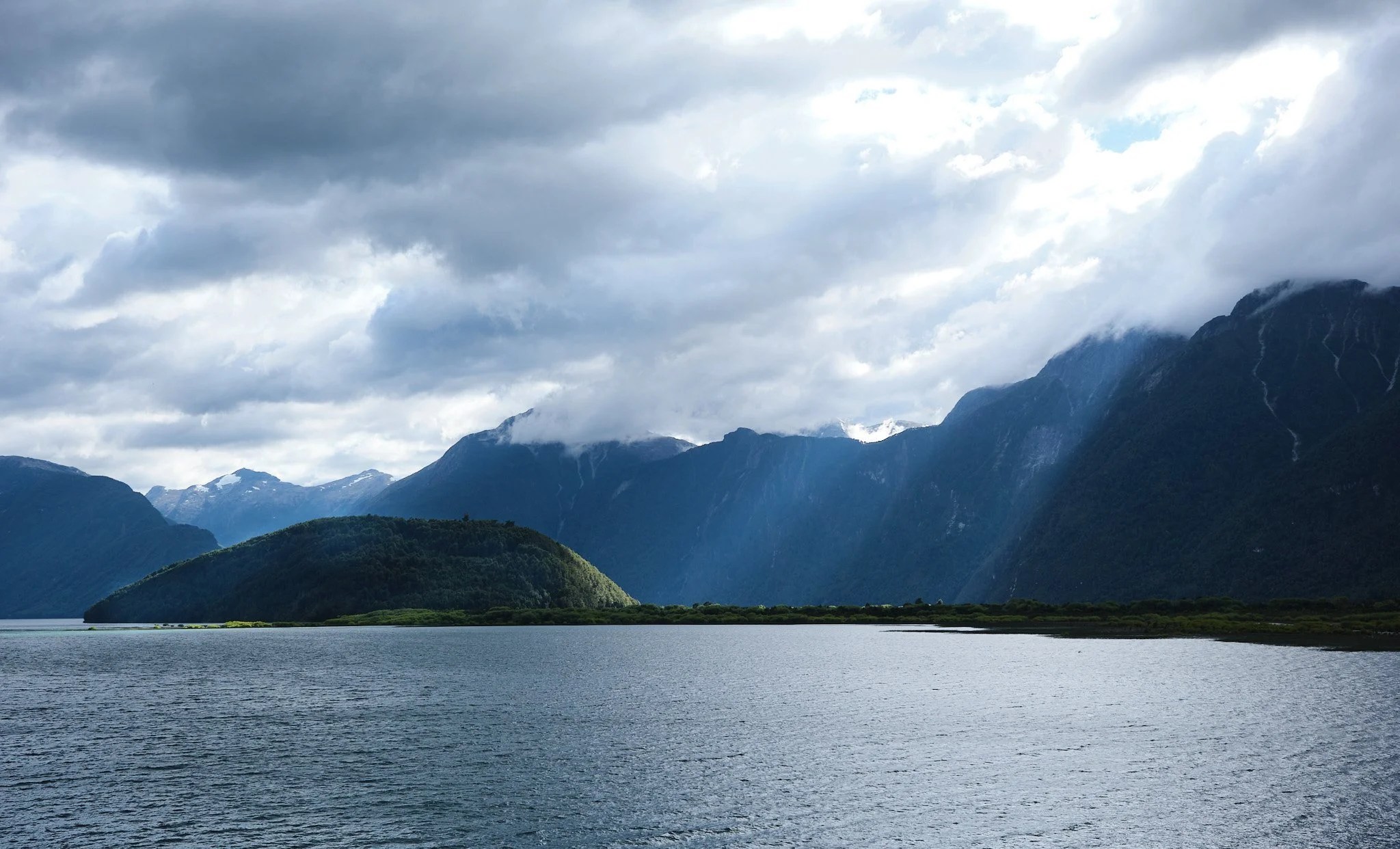
On the other side of the mountain range
At the trailhead where it met the lake was a small dock where we rented a zodiac which crossed the lake right over to the sheer rock wall of the mountain at its edge. Above us, in a cleft at the peak of the mountain was the edge of the glacier from which vast torrents of water were cascading down the face of the mountain fed both by the recent rains and the summer melting of the ice. A staggering sight particularily as the clouds surrounding the glacier opened up as we arrived and we had a fabulous view. By the time we were halfway back across the lake on our return the cloud window had closed and the glacier was no longer visisble.
We stumbled back to our car for the return to the lodge and our last dinner before departing this morning for Coihaique about 4 hours drive over unpaved roads. While it seems that we have covered a lot of ground we still have about 900Km to go. Today’s drive will take us eastward over two mountain ranges which means that we will have two ranges between us and the ocean so the weather should improve markedly. We are also now entering the southern Andes and the peaks from here will be much higher and more of the look that we all associate with Patagonia, high snow-covered mountains and, fingers crossed, sunshine and blue skies.
This note will be brief, I’m writing it in a hurry as we have just arrived in Futaleufu for our second night on the road. and the power is out here at the moment. I’m on my laptop until my battery dies and I hope to get this out in time. After we leave early tomorrow our next couple of nights will be spent in an eco camp where there is no cell or internet capability so after today we will be temporarily off the grid.
When last heard from R and I were getting ready for our departure from Chiloé and on to mainland Chile . The start of our actual Carretera adventure begins on the mainland on Route 7 , the single highway that runs north south and whose length makes up the Carretera Austral.
Our ferry ride, a four hour passage from Chiloé to the mainland, was due to depart at 8am Thursday morning. We were awake by 5am and on the road by 5:30 to get to the ferry by 7am to be in good time for loading our car on the ferry. We arrived at the appointed hour only to see precisely nothing happening and the gate on to the ferry dock firmly shut. Seemingly there was a mechanical problem but we were told not to worry, the ferry would leave by 8:30. When the ferry dock opened it was 9:30 but there was no rush to make up lost time. Things continued to move at a leisurely pace until 11am when we finally departed. Smooth sea and an easy crossing made up for the delay and we arrived at the top of Route 7 to begin our real Carretera adventure at 3:30pm.
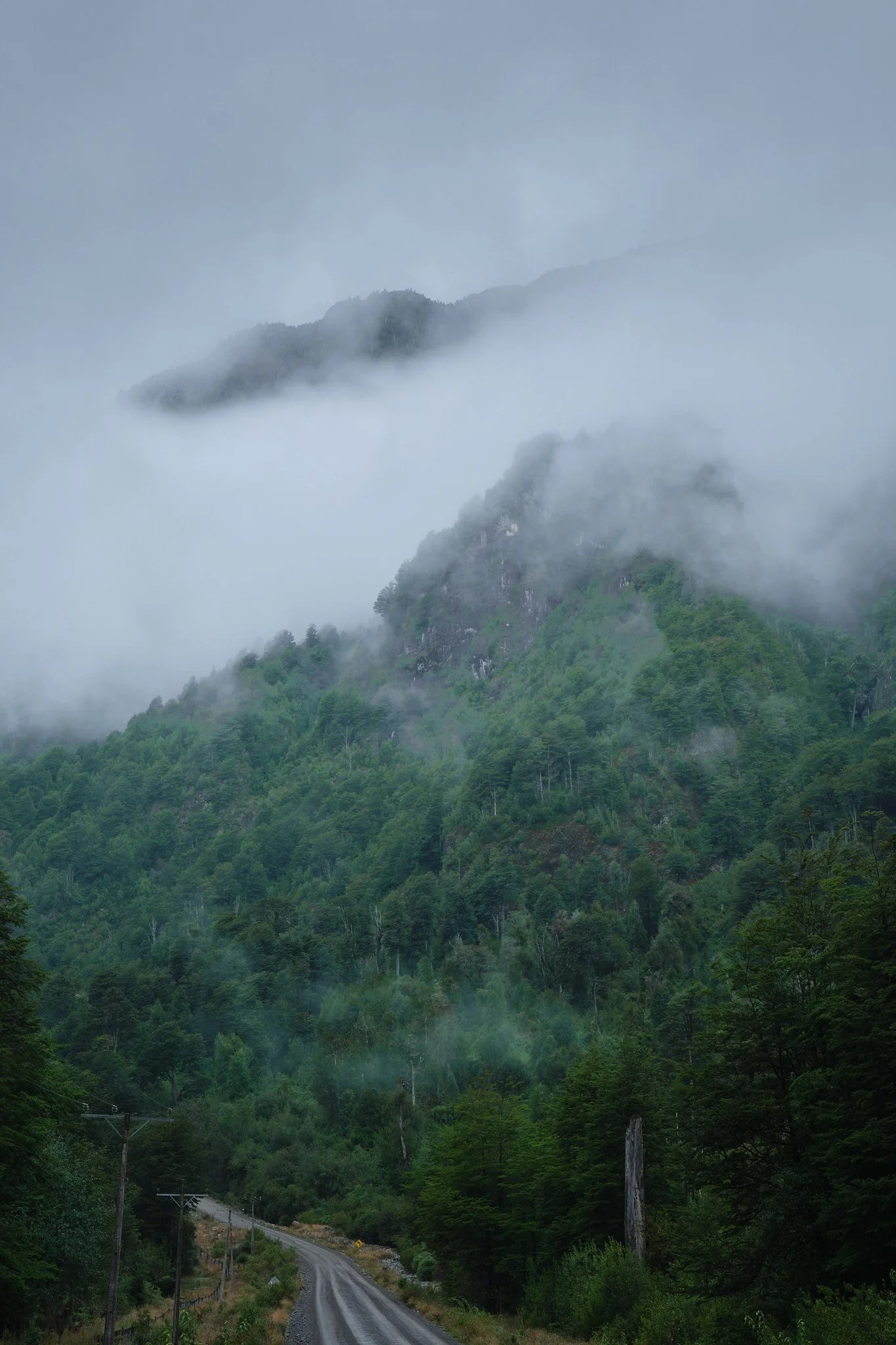
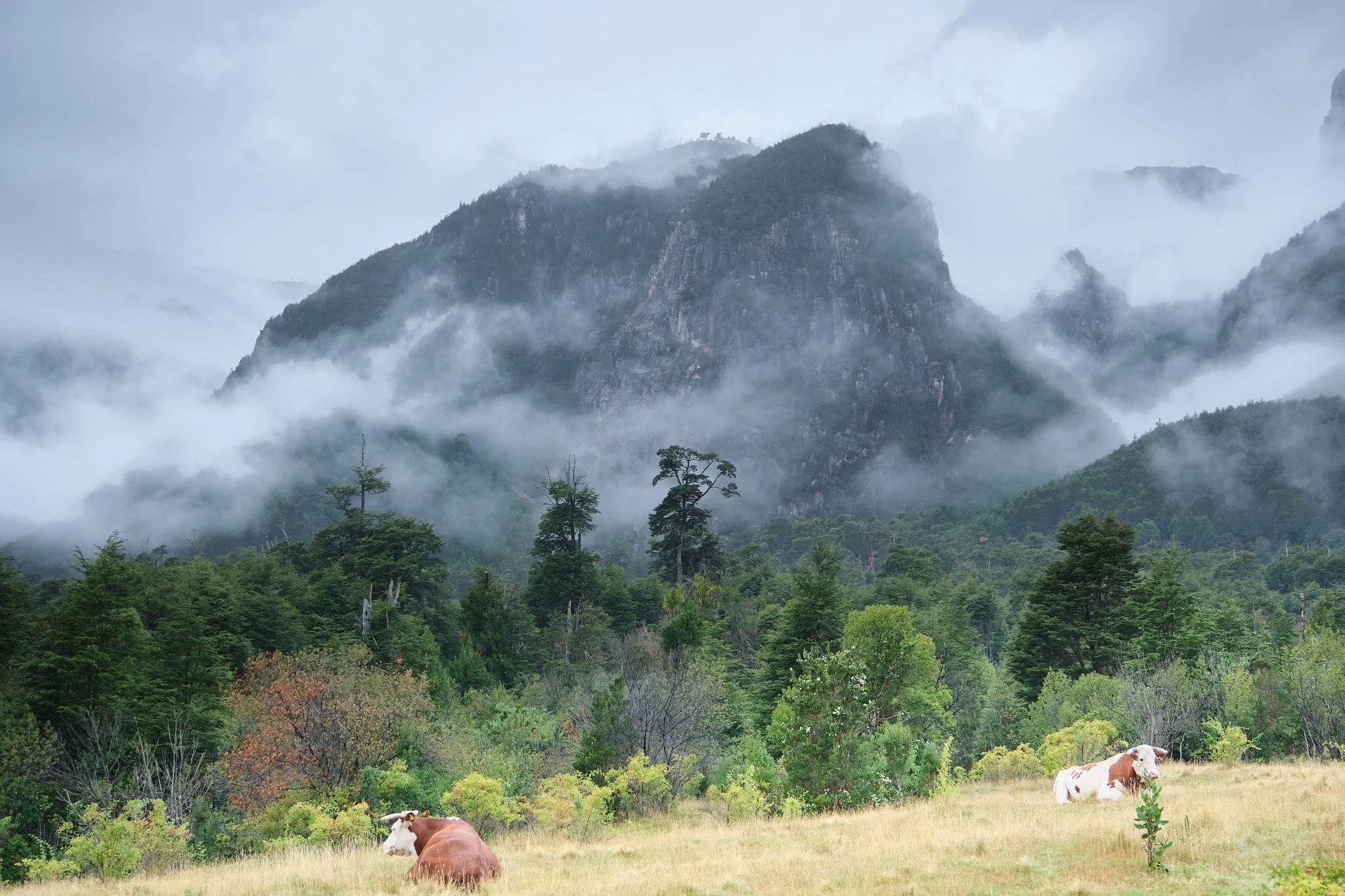
The rain which has marked the previous couple of days in Chiloé followed us to the mainland and all along our drive. The rain itself was not hugely problematic but the rain clouds and fog were very close to the ground and ever-present so that while we knew we were surrounded by the Andes we had to take that on faith since it was impossible to see them.
Andes, fog and rain but beautiful
Our first night was spent on Lake Yelcho, about a 2 hour drive from the ferry and we were very pleased to arrive at our lodging, a fishing camp on the lake. The setting would have been spectacular if visible, snow-capped peaks surrounding a very large lake which attracts fisher people from around the world. All lost to us, but the lodge itself was wonderful. Rustic furnishings and varnished pine interiors, it would have been easy to imagine that we were in Muskoka. Aside from ourselves the guests were Dutch, German and Spanish and again aside from us, very intent on their rods and hooks and stories.
Pleasant enough dinner, I’m being very generous, but as ever the wine and company were good and I slept for a solid 8 hours. Setting dinner aside, a very good night.
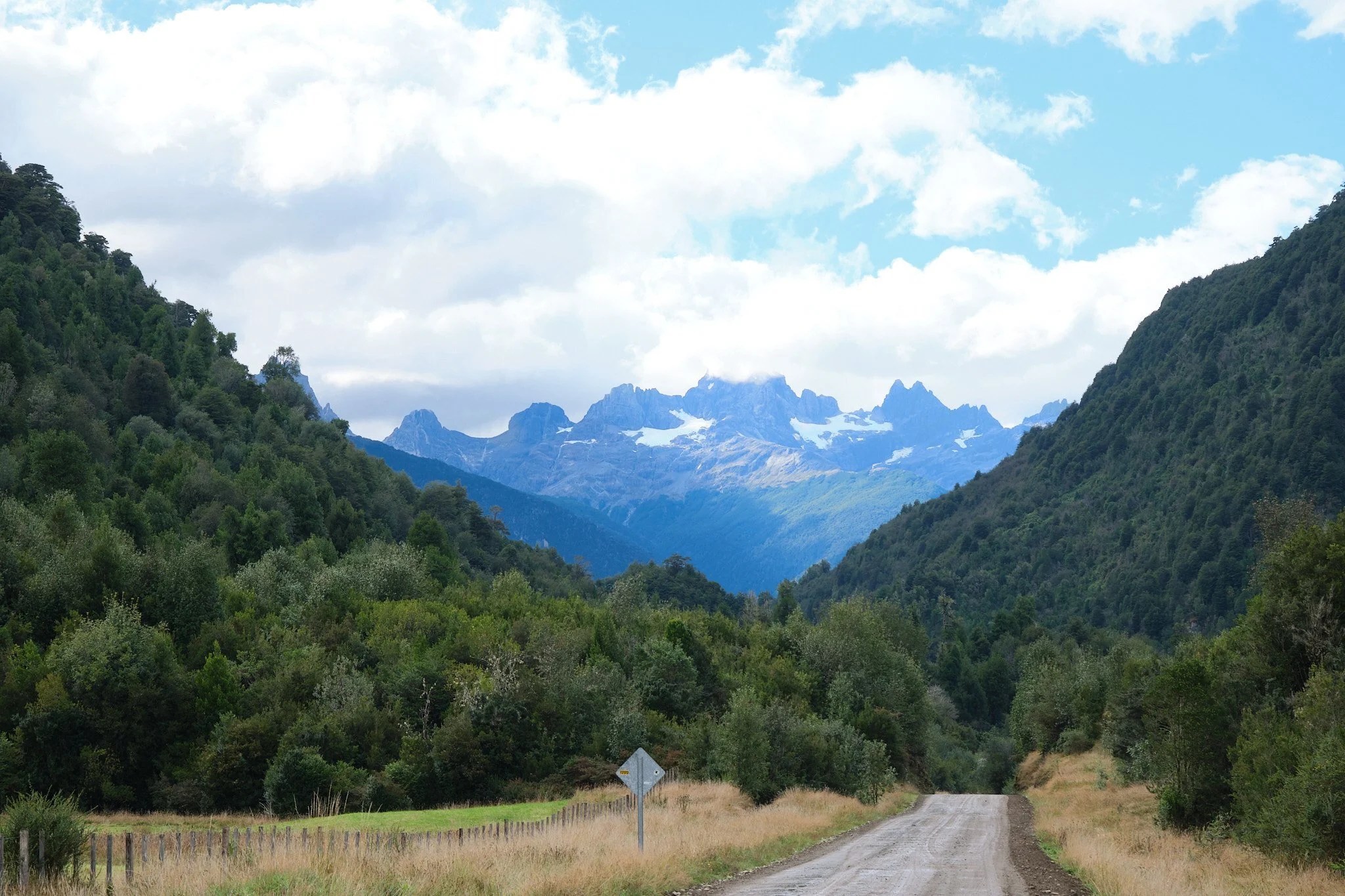
The highway crossed a pass in the Andes today and the highway now continues on the east of the ocean-hugging Andes range. The Andes consists of 3 or 4 parallel rows of north-south mountains and the western-most range runs too close to the ocean to allow the highway to continue on that side. We are now east of the ocean-side range and as a result our weather should improve. Once we crossed the pass the clouds began to lift and the rain slowed but still not bright and sunny. However we live in hope.
Tomorrow in Puyuhuapi Lodge and fingers crossed for better weather.
More to come once we’re back on the grid!
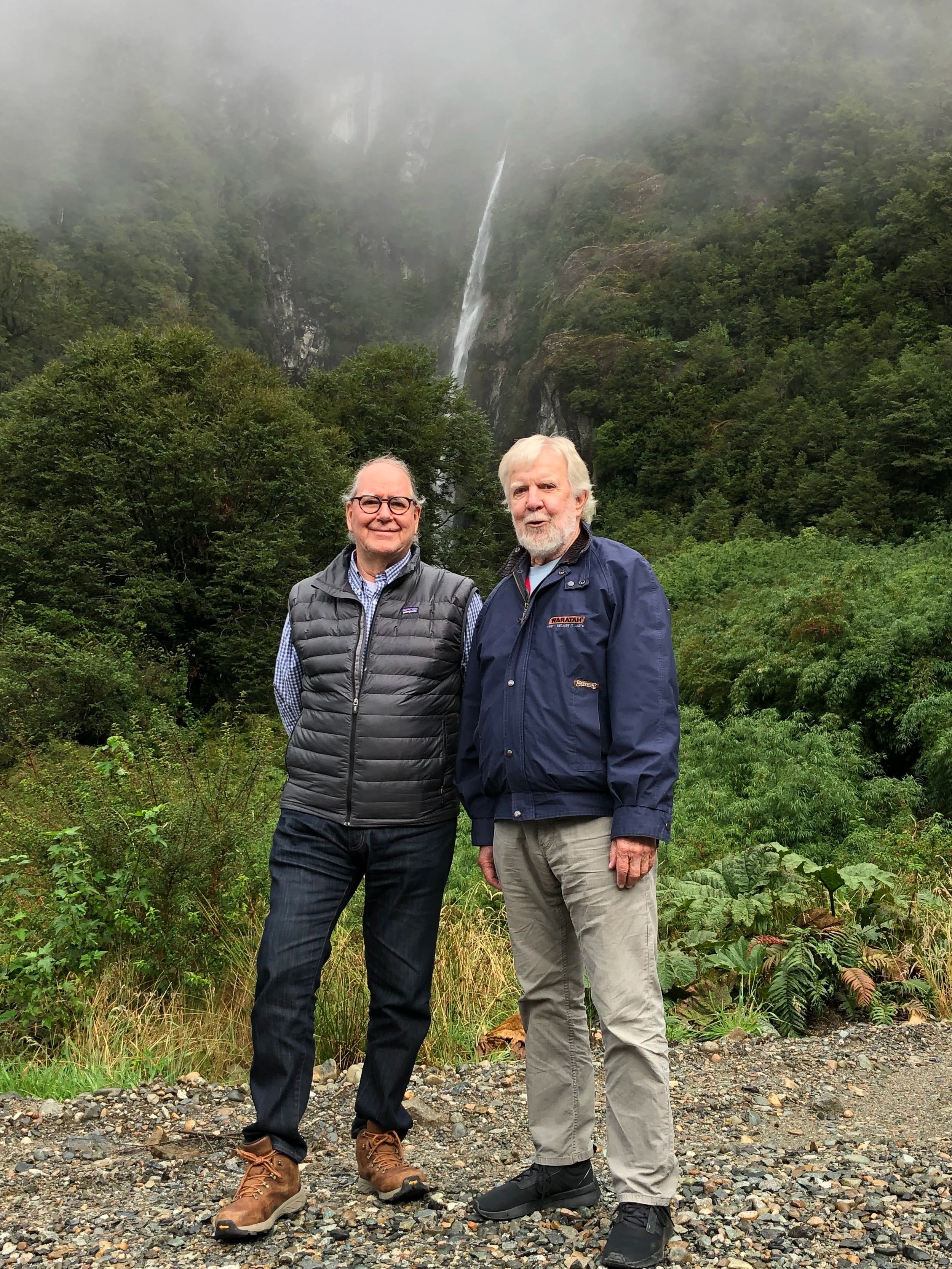
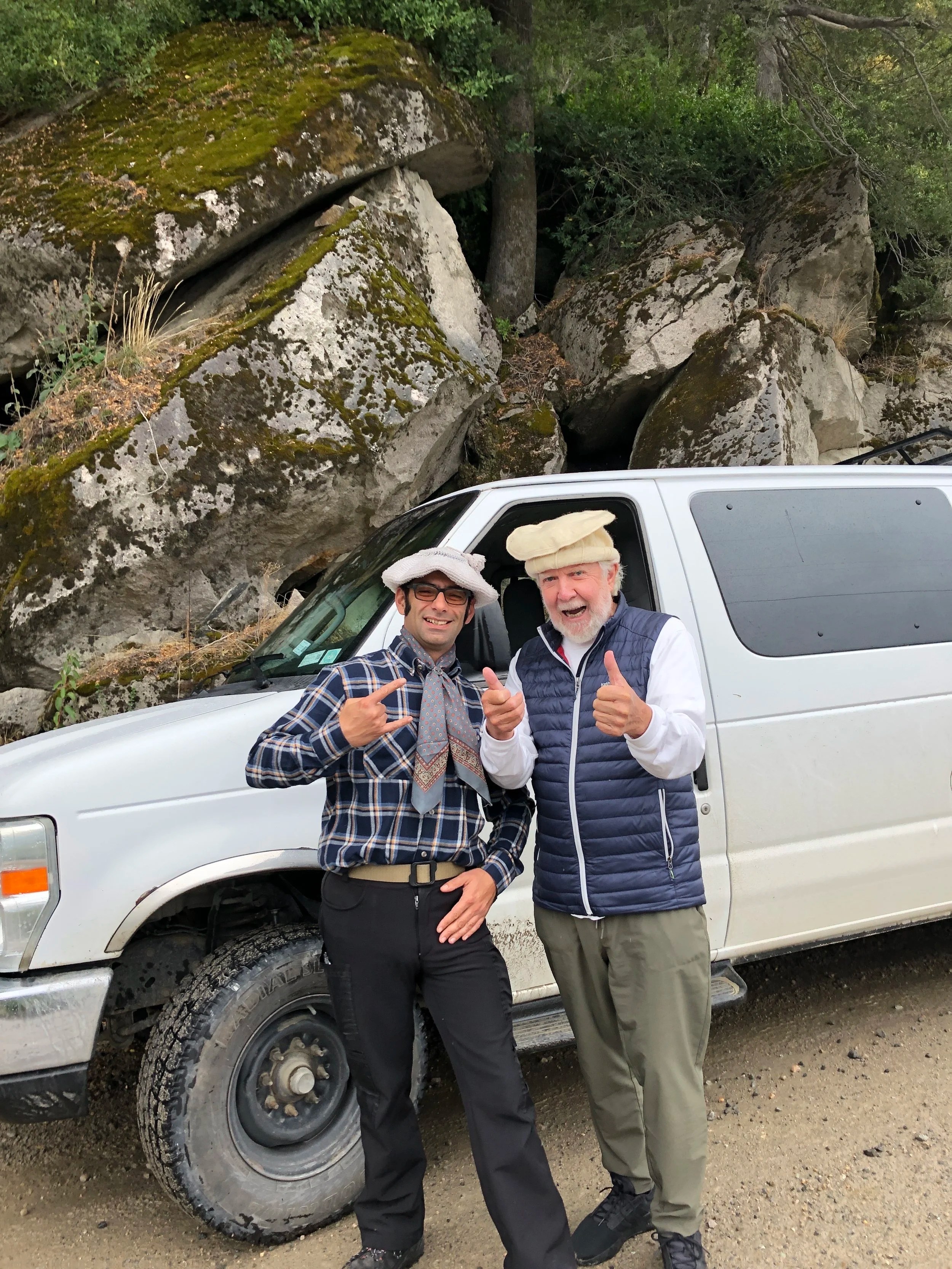
Robert and Hans, our driver. No, I’m not revealing who is whom…
I write this on Wednesday March 8 in a wonderful, modern hotel called Tierra Chiloé about 5 kilometres outside of Castro, the main town on the island of Chiloé.
“Chiloé has been described by Renato Cárdenas, historian at the Chilean National Library, as “a distinct enclave, linked more to the sea than the continent, a fragile society with a strong sense of solidarity and a deep territorial attachment.”
Chiloé’s history began with the arrival of its first human inhabitants more than 7,000 years ago. Spread along the coast of Chiloé are a number of middens – ancient dumps for domestic waste, containing mollusc shells, stone tools and bonfire remains. All of these remains indicate the presence of nomadic groups dedicated to the collection of marine creatures clams and mussels among others, and to hunting and fishing.
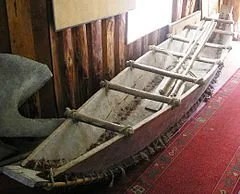
When the Spanish conquistadores arrived on Chiloé Island in the 16th Century, the island was inhabited by the Chono, Huilliche and Cunco peoples. The original peoples navigated the treacherous waters of the Chiloé Archipelago in boats called dalcas with skill that impressed the Spaniards.”
Dalca
“Perhaps best known for its lush rolling hills, green fertile farmland, and wooden Jesuit churches, Chiloe is a quaint albeit eccentric place that welcomes just a smattering of visitors each year. Isolated from the mainland and no stranger to rain, this dreary and overcast island has a number of terrifying legends which still prevail today.
The most famous Chilot mythology surrounds the mysterious brujos, a coven of male warlocks who lived in caves and terrorized the townsfolk. The brujos are said to have inhabited the region since before Spanish rule, but it wasn’t until the nationwide witch hunts of the 1880s that the grisly details of their practice became widely known.
In a rejection of Spanish Catholicism, the brujos underwent an intense initiation ceremony which involved de-baptizing themselves in a waterfall for 40 days before performing a pact with the devil. Next, they were forced to slaughter someone close to them and use their skin to sew a bag for their spellbook. Upon completing the initiation, the spellbook enabled them to shapeshift into animals or cast powerful curses.”
I tell you all this because it is part of the reason for my having the time to write this post.
I arrived in Santiago, a bright modern clean and very pleasant city on Monday, having landed three hours late from a flight that was scheduled to leave Toronto on Sunday at 23:00 but which didn’t depart until 02:00 on Monday morning. Because the last couple of months since Christmas have been intensely busy with a couple of Board projects with which I have been involved, I have felt that I was running on empty for some time now and dealing with a 3 hour delay for an overnight flight left me hoping for a peaceful and quiet time to recharge batteries once I had arrived in Chile.
I was met at our Santiago hotel by Robert, my very good friend and travelling companion for the next couple of weeks. After a shower, dinner and an early bedtime, the sleep that was to “knit up the raveled sleeve of care” did not arrive and my sleeve of care was still very much a mass of raveled threads the following morning.
We flew from Santiago on Tuesday and arrived in Puerto Montt in the early afternoon to begin our Carretera adventure. We were met at the airport by Hans our guide and driver, and we bundled all of our bags into the van that will be our second home for the next two weeks, and prepared for the drive to Chiloé.
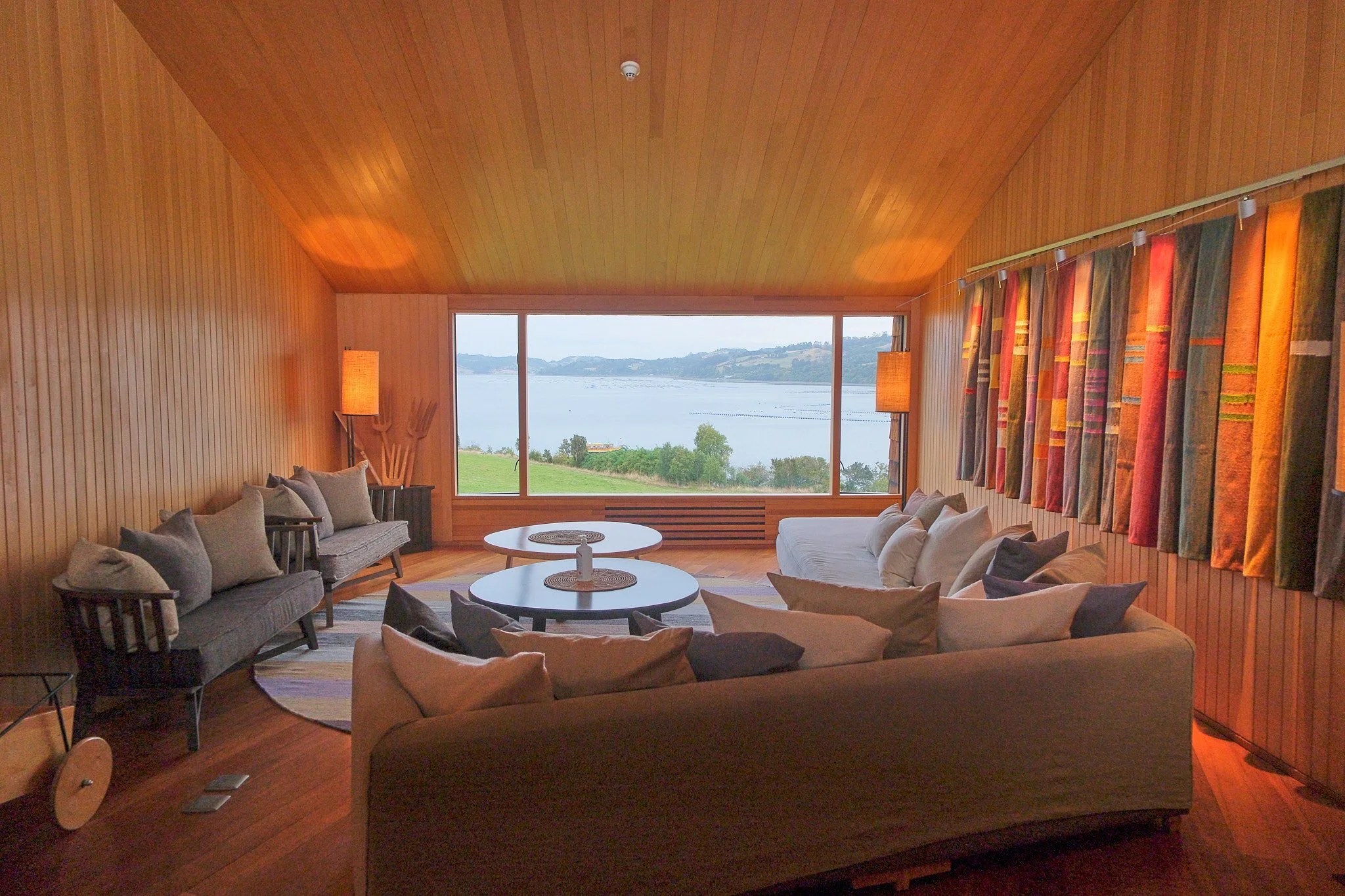
One of the seating areas in our hotel, Tierra Chiloé
After a drive of a couple of hours we arrived at the car ferry which was to take us to Chiloé where we would drive to Tierra Chiloé, our first overnight stop of the trip. The car ferry was pretty standard but the 5Km wide channel that we needed to cross to reach Chiloé certainly was not. We made our crossing at the peak of high tide and the tidal current was so strong that there were swirling standing waves, white capped, wherever the water encountered any underwater obstacle. The ferries could barely make headway against it and piloted themselves across the channel by angling their course on a diagonal well above the dock on the other side so that they could drift down with the current toward their landing spot. This sounds perfectly normal for a canoe or a sail boat but this was a huge car ferry loaded with cars and transport trucks being treated by the current as if it were a piece of straw. There is a massive tugboat that remains permanently anchored in the middle of the channel in the event that, should a ferry lose power for any reason the tug could race to their rescue and take them in tow otherwise they would quickly be dashed on the rocks.
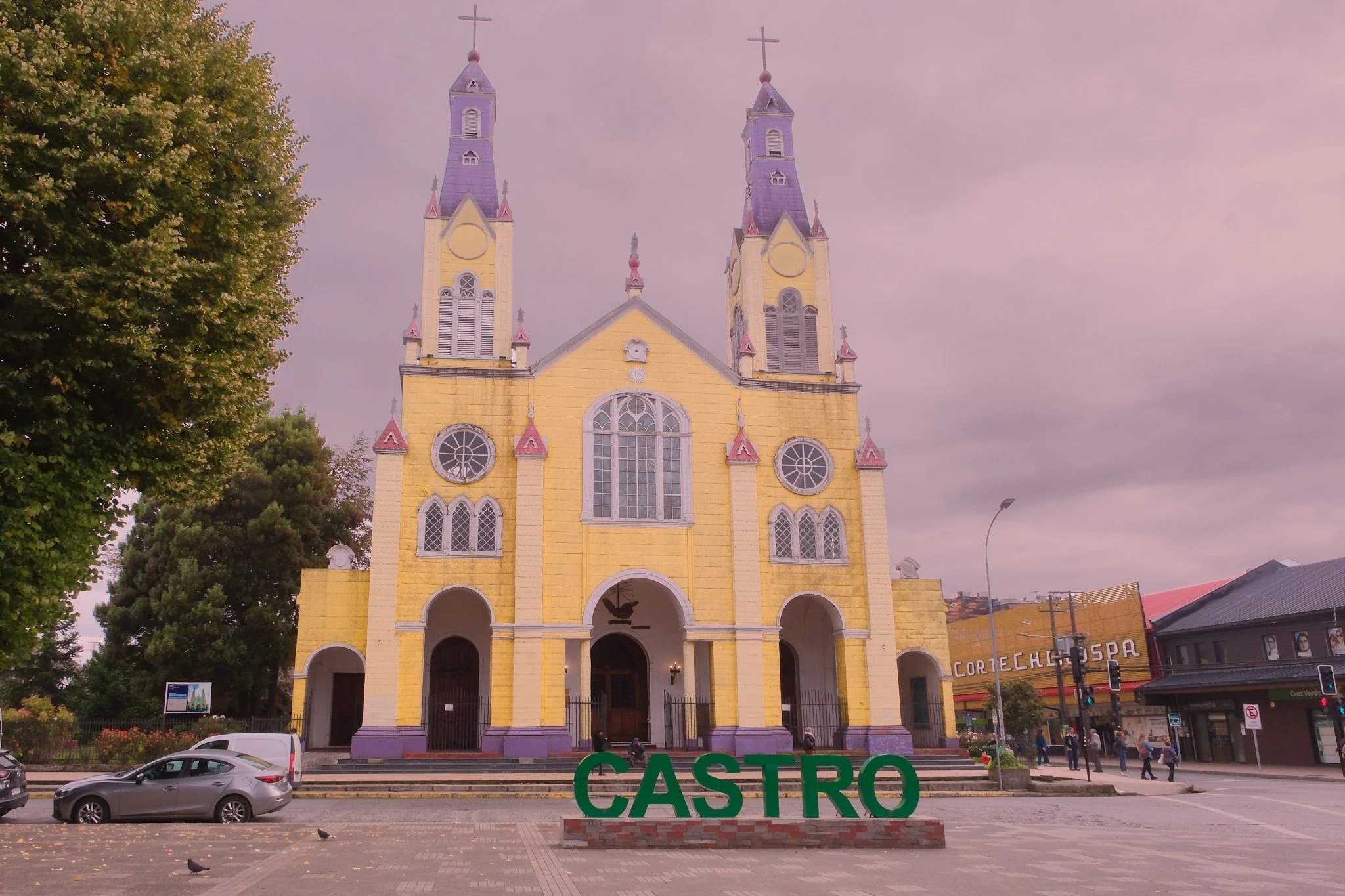
Wooden Cathedral of San Franciso
Welcome to Chiloé.
The hotel where we spent the night was, as I said at the outset, welcoming and a much looked for oasis where we were to spend our first two nights. Once again a good dinner, a relatively early bed and a hope for a good nights sleep. Perhaps the dinner might have been a little too good, a powerful Pisco sour pre-dinner and a bottle of a very good Pinot Noir with dinner, after all R and I had a lot of catching up to do. The outcome was that I met the witches of Chiloé overnight who all insisted that I keep them company until the sun rose. Apparently they took turns keeping both R and I company and when we met for breakfast it was clear that it was going to be a very long day.
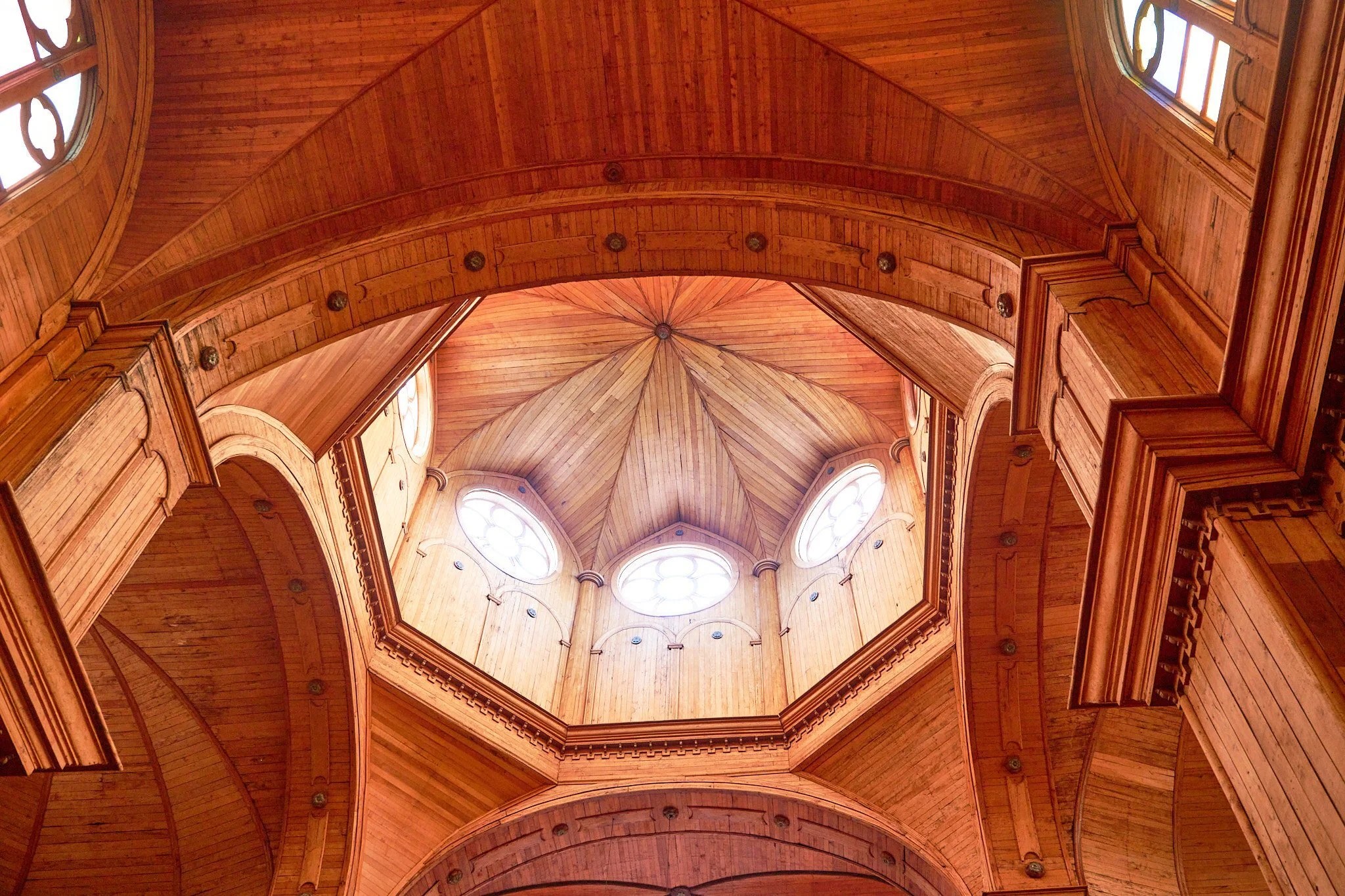
Interior cupola over the main alter, Cathedral of San Franciso
We explored Castro, the capital city of the region in the morning, discovering the Cathedral of San Franciso was the highlight. It is seemingly the largest wooden cathedral in the world and is built, inside and outside only of wood, including the twin bell towers and the flying buttresses. Likewise the interior walls furnishings and altars are all of local wood of the local region, really quite stunning. But by noon we were really dragging and so decided that we needed to give ourselves the afternoon off. And so here I am, desperate for a good night’s sleep but, thanks to the witches, with the time to write this post.
I leave this evening for Santiago, Chile on the first leg of a long-planned and long-delayed adventure, driving from Puerto Montt in the more northern part of Chile to Villa O’Higgins at the southern end of the Carretera Austral.
I had originally planned to make this trip almost exactly a year ago, a trip which is a textbook example of “since I’m here anyway I might as well…”. For those of you who may not recall, I sailed the Southern Ocean from Ushuaia at the southern tip of Argentina to to Antartica and South Georgia Island last February. The original plan after leaving the ship, and since I was in the region anyway, was to get myself to Villa O’Higgins at the extreme southern end of the Carretera where I had planned to meet up with a very old friend, Robert and drive from the bottom end of the Carretera to the top.
I first met Robert at OISE more than 50 years ago. In those days R was finishing his Ph.D. and I was working as a Research Assistant in the Faculty of Educational Planning, an oxymoron if there ever was one. We became very close friends and after R returned to Australia we remained in touch. R spent his career in academia and we would meet up periodically when he was in North America for conferences or I was in Australia on business. However the last time we meet was in 2011 so this seemed like a great opportunity to re-connect and share an adventure that I have wanted make for a very long time.
Covid prevented the trip from happening last March but at that time we decided to put it off for a year and try again in 2023, so tomorrow that day has arrived and our adventure begins.
For those of you not familiar with the Carretera Austral, it roughly translates as the Southern Way, and has a strategic function because of the difficulty of land access to a significant portion of Chile’s southern territory. This area is characterized by thick forests, fjords, glaciers, canals and steep mountains. Access by sea and air is also a complex task due to extreme weather conditions. So, for decades most land transportation had to cross the border into Argentina in order to reach Chile’s Patagonia.
In order to strengthen the Chilean presence in these isolated territories and to ensure the region’s connection to the rest of the country, the government decided to build this road in the late 1970’s. The work was carried out by the Chilean Army, and involved more than 10,000 soldiers who worked on its construction.
The first section of the highway opened to traffic in 1988, and by 1996 was almost completed. The last 100 kilometers to Villa O’Higgins were opened in 2000 and some small branch roads have beed added since then. There are both paved and unpaved sections and while it is only about 1,300 kilometres long we will spend almost two weeks on the drive.
The scenery will be fabulous so I’m looking forward to some great photo opportunities and it will be fun to spend a couple of weeks with my old friend, R.
My apologies for the lack of photos, will make up for it when I’m actually there.
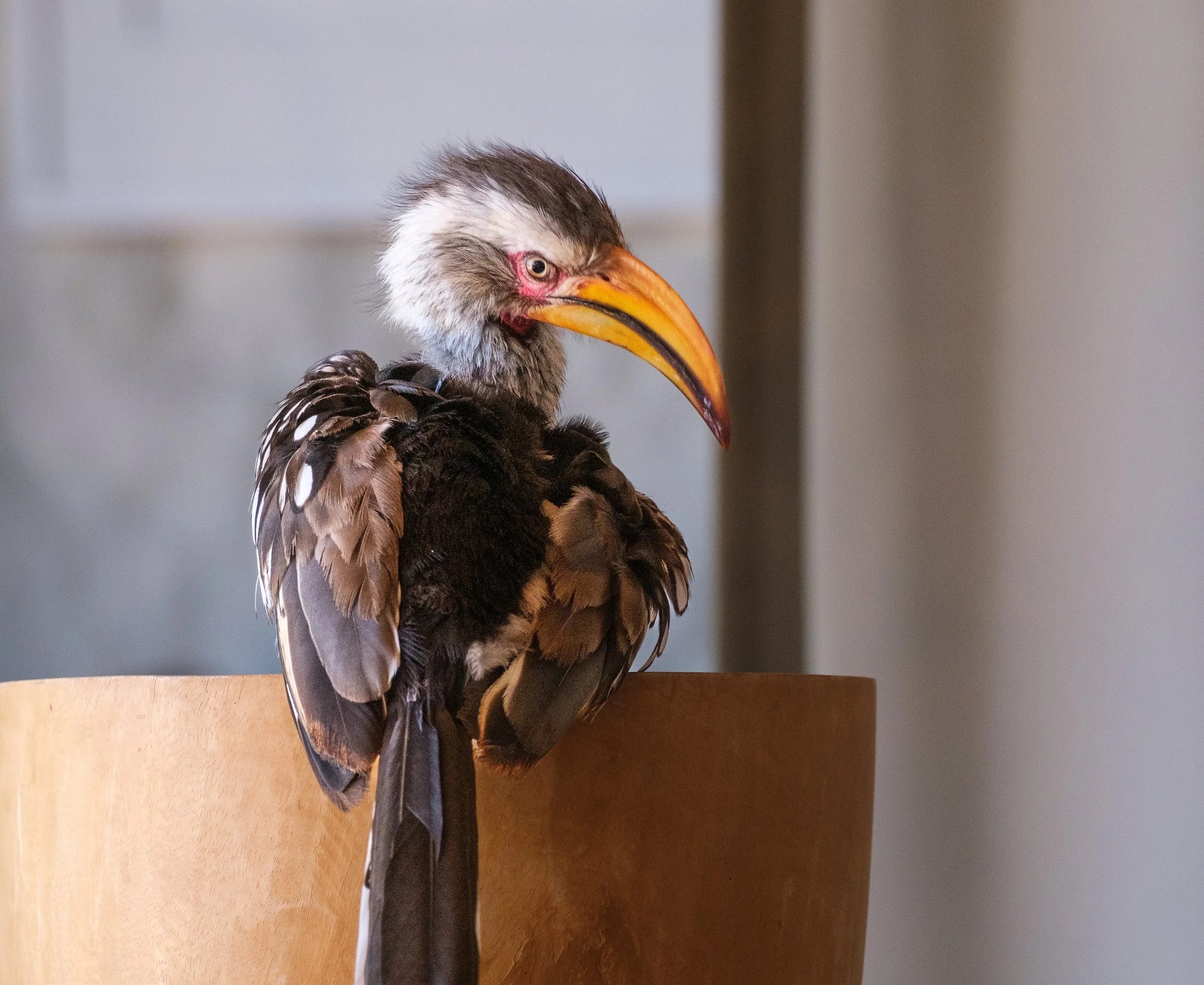
Yellow hornbill, a visitor to the outdoor veranda of our Tswalu house
As promised in my last post, let me tell you a little about a typical day in our safari camp. However, before I continue with a typical day on safari, I’ll attempt to answer a question we’re often asked, why do we choose the particular camps that we do?
A couple of things are very important to us. For photographic needs I/we like open country, hence the number of trips we have made to the Masai Mara, the Serengeti, the Kalahari and Namibia. They all share for the most part, wide rolling plains or deserts and open country where life is lived in the open. The animals are more easily spotted in that setting but beyond that, at a purely aesthetic level, we love the landscapes, the light and the wide sweeping vistas. On the other side of the equation, most of the camps in southern South Africa are also wonderful and we spent our first safari camping in this region but there are just too many vehicles and the areas tend to be heavily treed with lots of heavy vegetation and shrubs. The animal populations in these parks are carefully protected so there are many animals to be seen and certainly lots of people enjoy them in this environment but we don’t find the experience to be very enjoyable. If you are planning to make only one or two trips to Southern Africa and your only requirement is to tick off the Big Five on your bucket list as quickly and predictably as possible, these camps are a great. But if you like to be able to watch animals interacting and to have a better window into their behaviour and their personalities and have the leisure to to do so for extended periods of time then I don’t think you can beat very large game areas in a wide sweeping landscape.
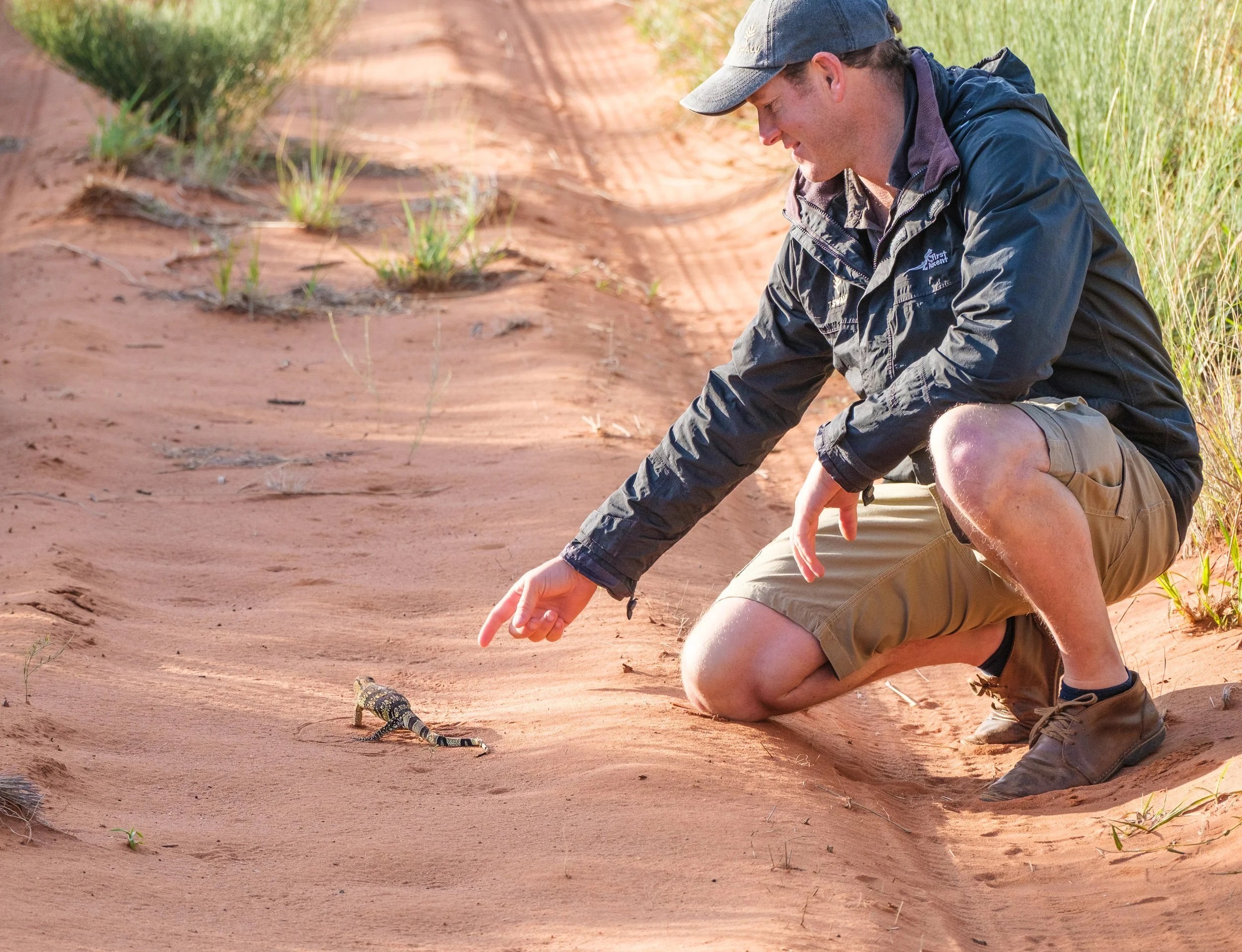
Barry, our Tswalu guide with a baby monitor lizard
In addition, we like camps that are remote or in secluded areas, where there few or no other vehicles. That allows us to have lots of time to sit and watch without constantly having to find a good observation point while many other vehicles battle for position and the air is filled with noise and diesel fumes. Lest it seem as if I’m giving the South African game experience an unfairly negative review, that’s not my intent. The couple that flew with us from the Jo’burg private air terminal to Tswalu love the southern South African camps and make 3 or 4 trips a year and all to camps where I know we would not be happy. Tswalu was their first attempt in 20 years of African game trips to get away from their normal routine. In this, as in all other areas of life, “chacun à son goût”.
The other important criteria for us at any given camp are a private vehicle of an open Land Rover type and a driver guide who will let me sit in the front jumper seat.
Pygmy falcon, he’s about 8 inches long with a wingspan of about 14 inches. The smallest raptor in Africa
Many camps use closed vehicles that look like Land Rover minibuses with closed windows. The centre section of the roof is open with a secondary roof covering the open section so that photographers need to stand up and poke their upper bodies and cameras through the open section of roof in order to take pictures, while non-photographers simply sit in their seats and look through glass-covered windows. This, for us, is a non-starter.
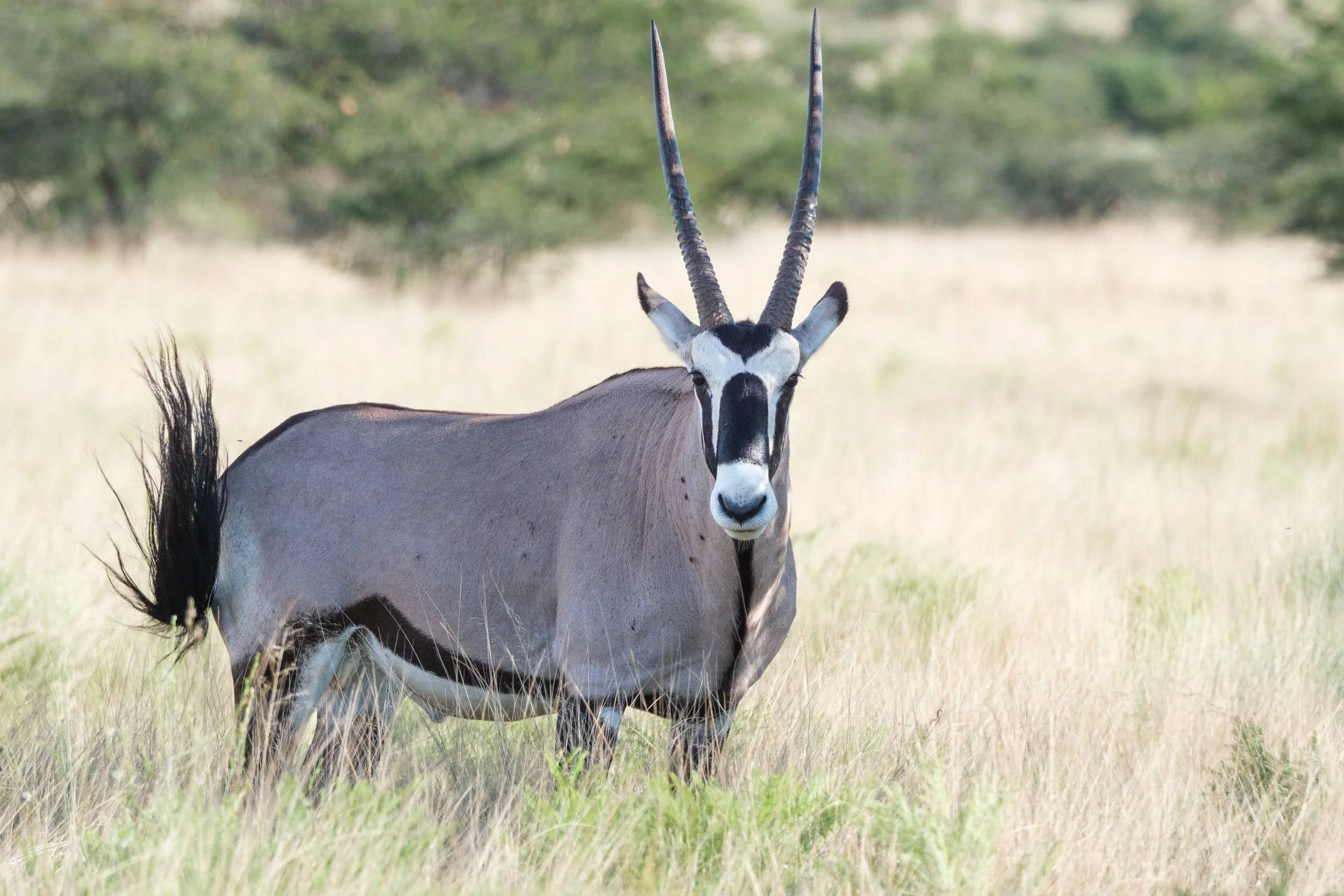
Stunning male Oryx
The reason for an open sided vehicle is obvious, you can’t see and smell and feel the atmosphere nor can you take take good photographs behind a pane of glass or standing up 6 or 8 feet above an animal. The downside of an open vehicle of course, is that you are fully exposed to the wind and rain. In the Serengeti we had days with winds in excess of 50 mph so after several hours it did feel as if we had been Mohammed Ali’s sparring partners and the other day here at Tswalu it was a day of biting cold winds and heavy rain so the only things that were properly covered were our cameras. But these are petty problems when compared to being sealed behind glass in a closed vehicle.
Our second requirement, a private vehicle, is probably our most important requirement. We have only ever been in a shared vehicle for two or three game drives on our first African trip and I would rather not go out than share a vehicle. Almost all camps will put 6 and sometimes 8 people in a vehicle, sometimes a few as 4, but usually at least 6. In such a populated vehicle photography is far from ideal, since you are constrained to the arc of view whose limits are set by the people around you; with a long zoom lens you need a very steady base when handholding the camera so as not to create shaky or out of focus shots, but every time someone shifts or moves, the camera and lens responds to the movement and shakes the camera and ruins your shot. Additionally, populated vehicles move frequently to mollify the passengers with the shortest attention spans.
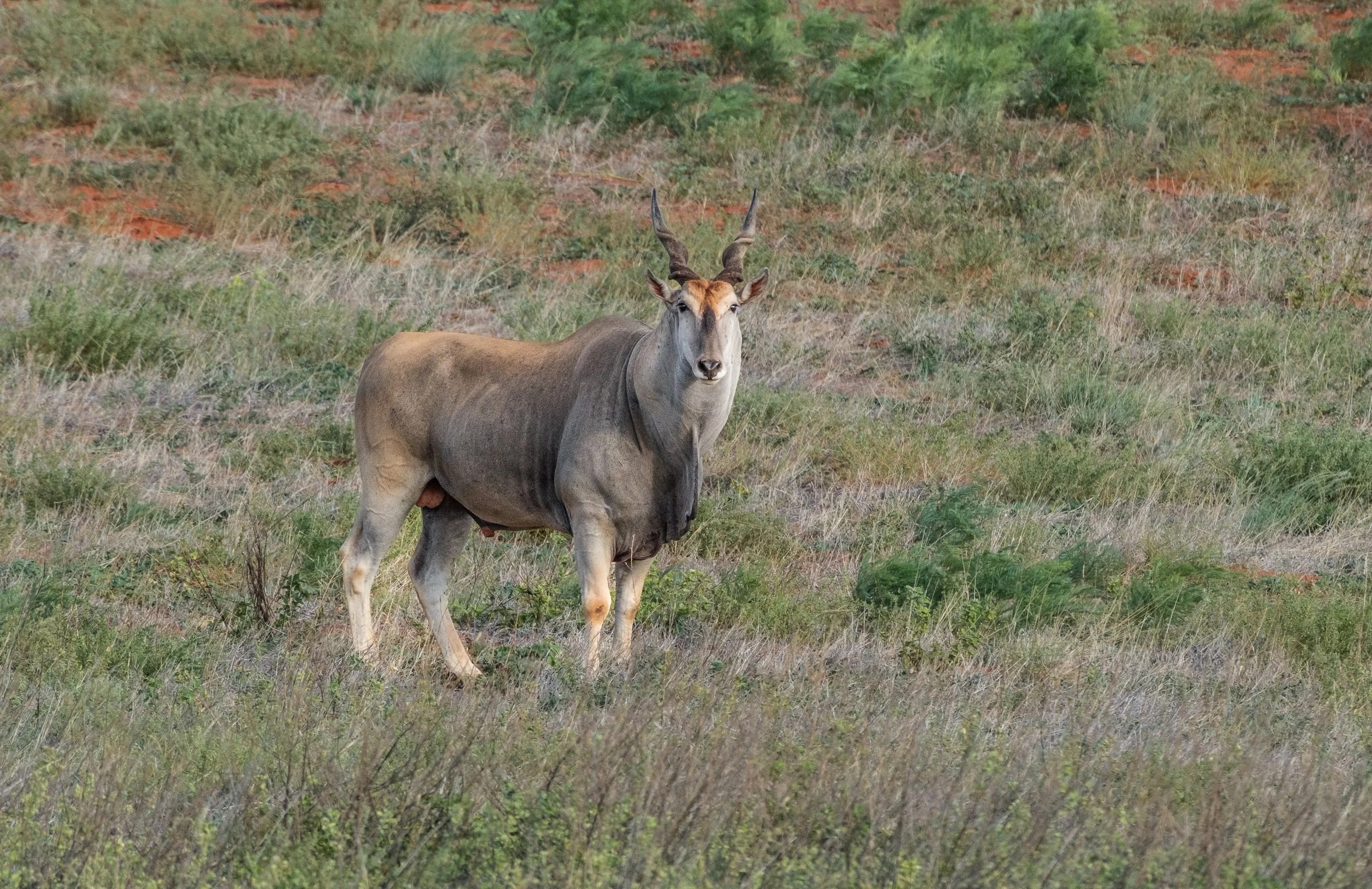
Male Eland
Part of the joy of game drives is watching animals behave in their natural environment; watching them respond to each other and to their surroundings. We have frequently spent an hour or two sitting in one spot watching a lion pride or a coalition of cheetah brothers interact with each other or preparing to hunt. In a populated vehicle it’s simply too frustrating to have someone bouncing around in their seat complaining about wanting to move on and see something else.
My third requirement, a personal one, access to the front passenger seat, all has to do with the way I want my photographs to look. The three or four rows of seats behind the front driver and passenger seats are raised up so as to give a good view from a higher vantage point for their occupants but their downside is that the perspective of photographs taken from these seats accentuates their downward perspective. Admittedly lots of times I have had to stand on my front seat to get a shot since bushes or shrubs may have been in the way, but when I have a clear field of view I can shoot a lion or most animals at eye level. Why is this important? When I photograph animals I’m trying to create a portrait, I want to capture their character and I often like to fill the frame with their face or their profile. I don’t know many interesting portraits that are taken with the sitter’s head below the level of the lens, showing the top of the sitter’s head from above. I’m not always successful in doing this but it’s important for me to try. I want to create the conditions for me to respond to the animal as an individual with their own sense of self and life and emotions in their eyes as I look directly into their eyes.
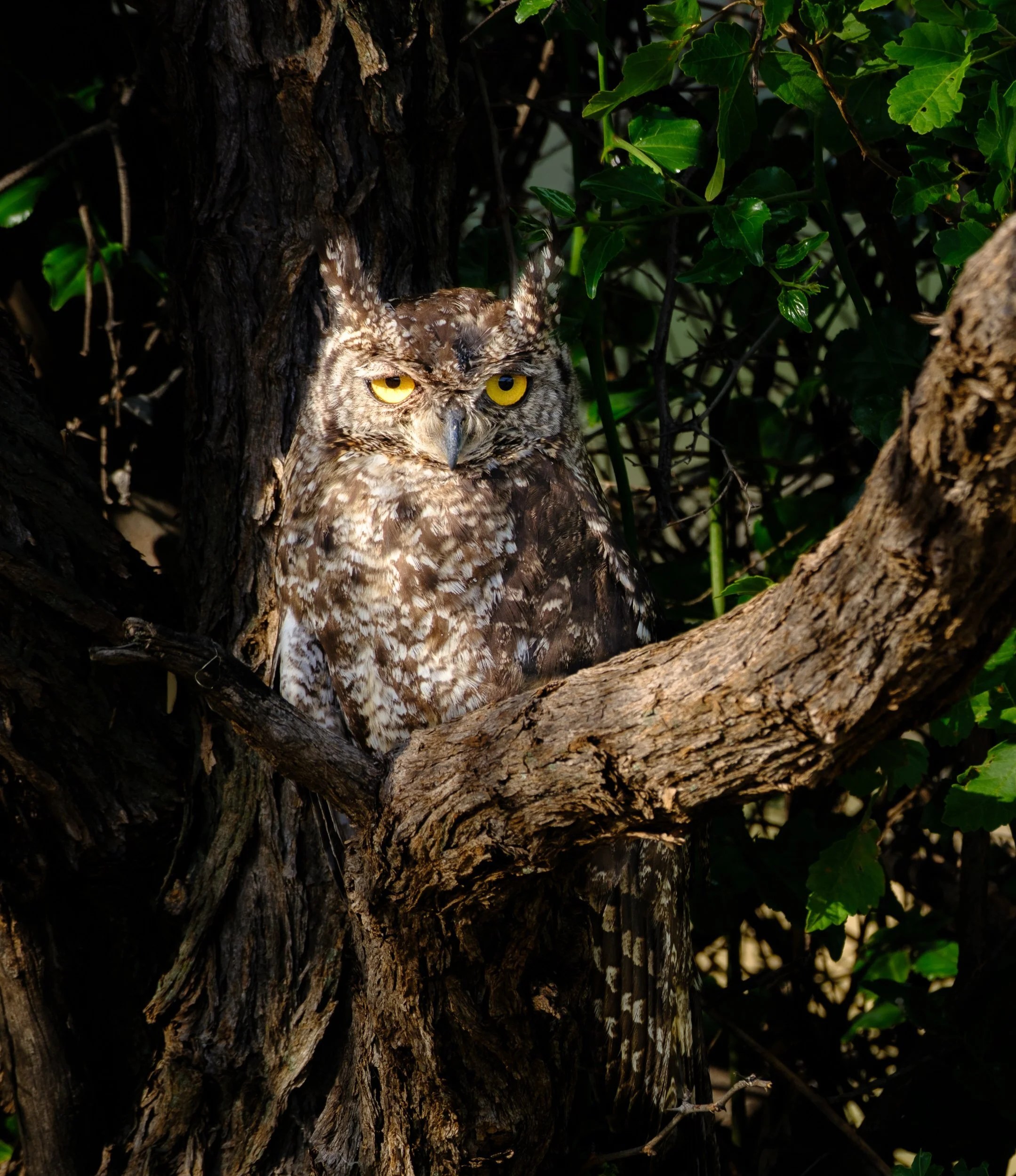
Spotted eagle owl
Wow, I started to tell you about a day in a safari camp and I’ve moved into my personal wildlife photography manifesto! Sorry, won’t happen again!
By the way, I’m finishing the writing of this post at home, having arrived last night after 36 hours in transit, 18 hours in the air on 3 flights from Tswalu to Toronto and 18 hours in airports awaiting next flights. A very long day only to discover on arrival in Toronto, while collecting our checked luggage, that V’s suitcase was sans lock, the suitcases straps were undone and her bag’s zipper was open about 6 inches. On arriving home, when she opened her bag to examine the contents for missing items and expecting the worst, she discovered that a large ziplock bag, weighing about a kilo and filled with red Kalahari sand was missing. As an aside we have many bags of sand from around the world, V’s determination to collect sand is representative of the larger question, why do some people have the urgency to collect curious and seemingly mundane items? It’s a question worthy of further study.
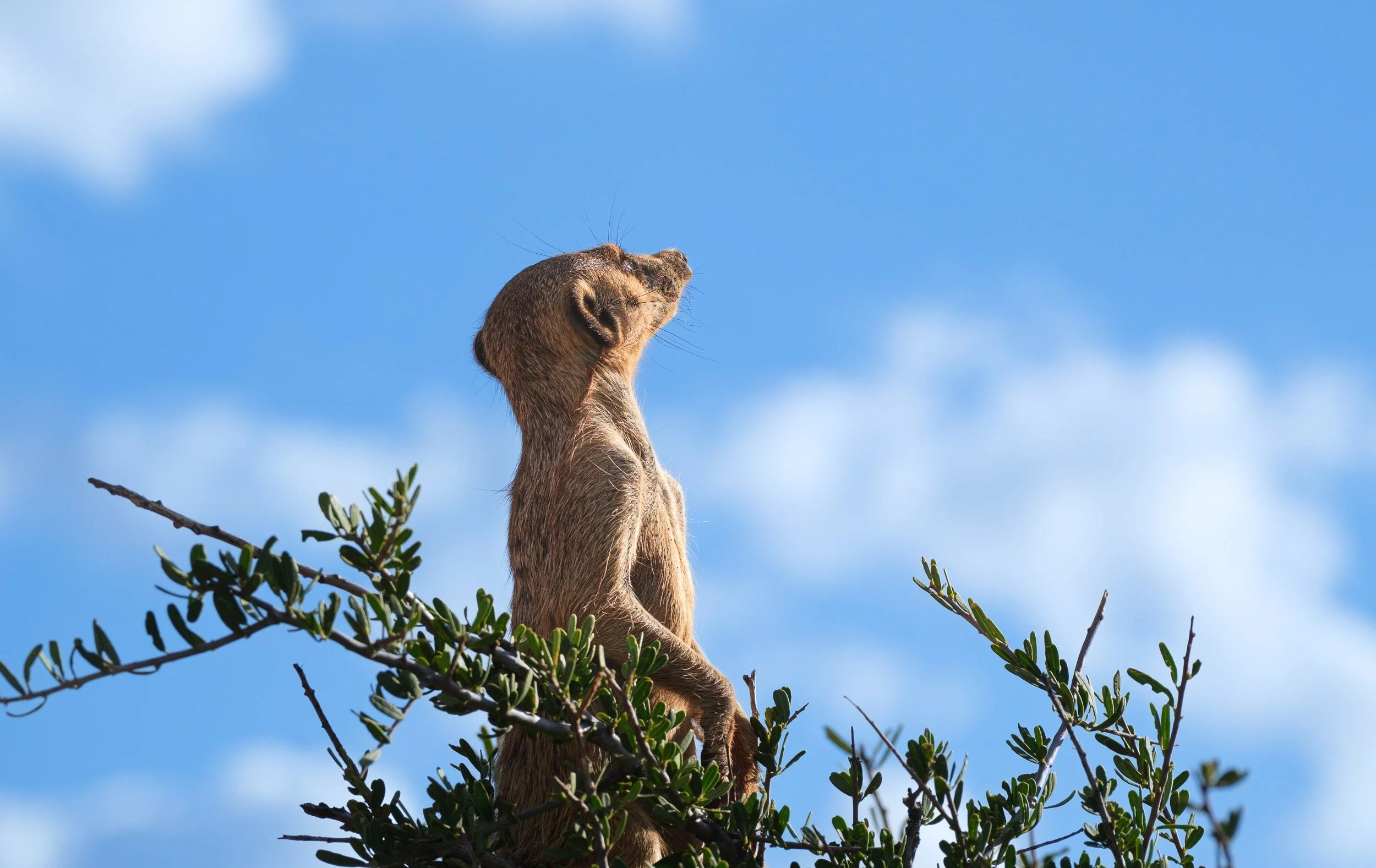
A behaviour we’d never seen before. A meerkat at the top of a 6 foot acacia tree, scouting for birds of prey.
In any event, the sand in its bag was found at the bottom of her suitcase along with the lock. I can only surmise that when her bag was x-rayed, the security folks must have thought that they had hit the mother lode of drug smuggling and therefore had been very disappointed to discover only sand, to the point that they simply threw the sand back into the bag along with the lock and didn’t bother to restrap it or rezip it properly. Behind every silver lining there is a dark cloud and some security officer’s hopes for promotion and a great Xmas bonus had been ruined, not a good day for him or her but a wonderful day for us!
But back to a typical safari day. So what is a day in camp actually like? Depending on the time of sunrise and sunset and the time of year the schedules may vary but the overall structure is reasonably similar among all the various camps at which we have stayed over the years.
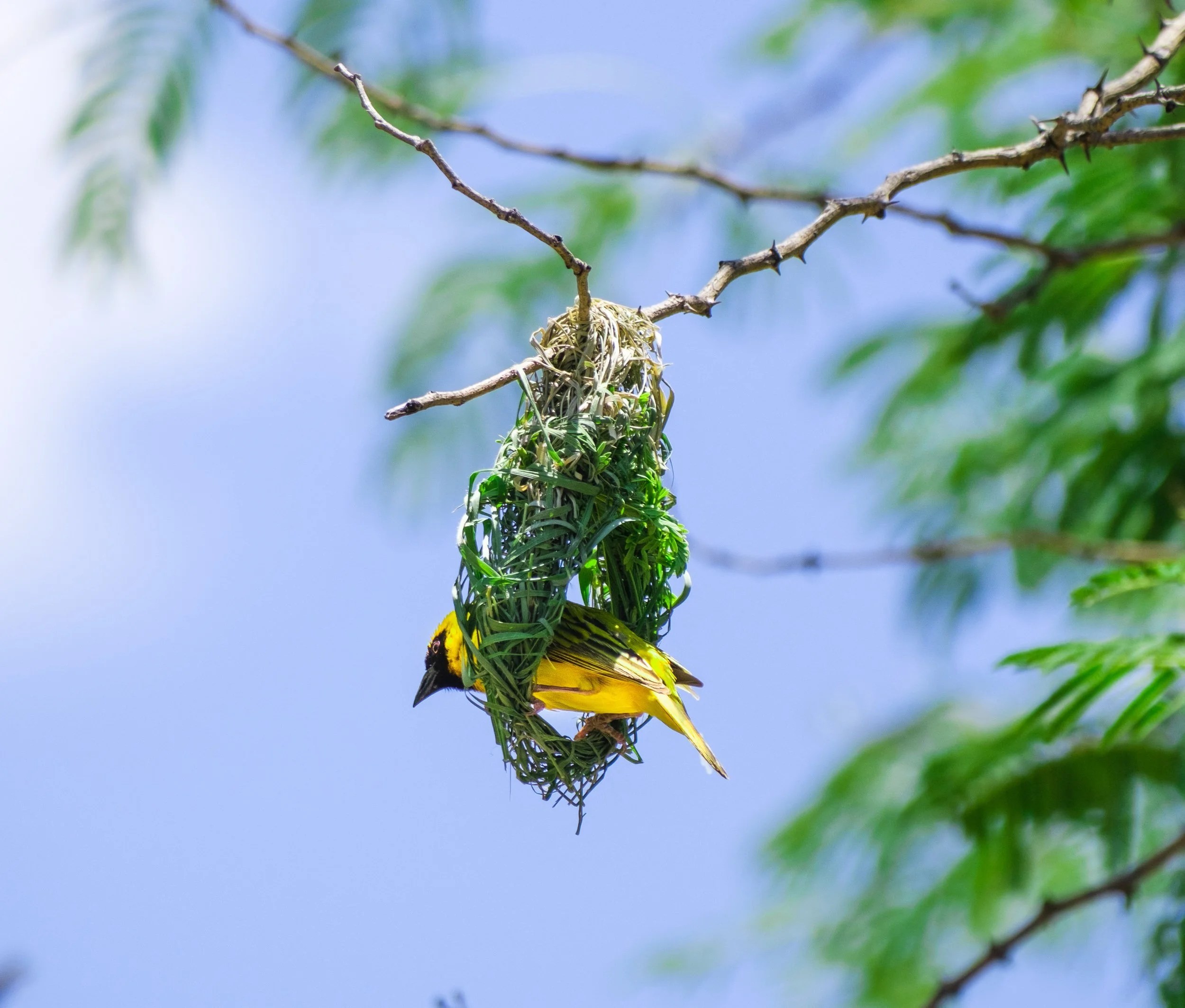
Male Southern Masked Weaver building a nest for his mate
Each day requires some preliminary preparation the previous evening. All camera batteries need to be charged, images downloaded from camera cards to the computer, and all camera equipment cleaned, readied and packed in their carrying case for the following morning. With the advent of the iPhone, this too needs to be charged; it can be very useful for emergency videos and shots.
Our next day’s clothing needs to be organized and at hand, fumbling half-asleep in the dark does not make for a great start to the day, particularly when you’re putting on clothes, not shedding them.
Because the sunrise on the Serengeti was about 6am our wake-up call was at 5:30am and we were washed, dressed and loaded in our vehicle and on the trail by 6am. Here at Tswalu, much farther south, the sunrise is at about 5’ish so our wake-up call is at 4:30 and we’re in our vehicle and off by 5am. We can manage to brush our teeth, wash, and dress by about 4:50 which gives us ten minutes to grab a latte and a freshly baked croissant at the lodge to take in our vehicle as we begin our morning’s photo hunt. The kitchen is up very early and has prepared the croissants, snacks and fresh orange juice but we’re happy with a croissant and coffee.
So, climbing into our carefully curated vehicle, we start our day, cameras at the ready. The guide driver and the tracker are extremely knowledgeable and watching them read signs and tracks as they try and locate an animal is an education. They seem to know every bird and can tell you about the plants, flowers, insects, animals, ecology and geology of the region and the behaviour of all the life around them, endlessly fascinating.
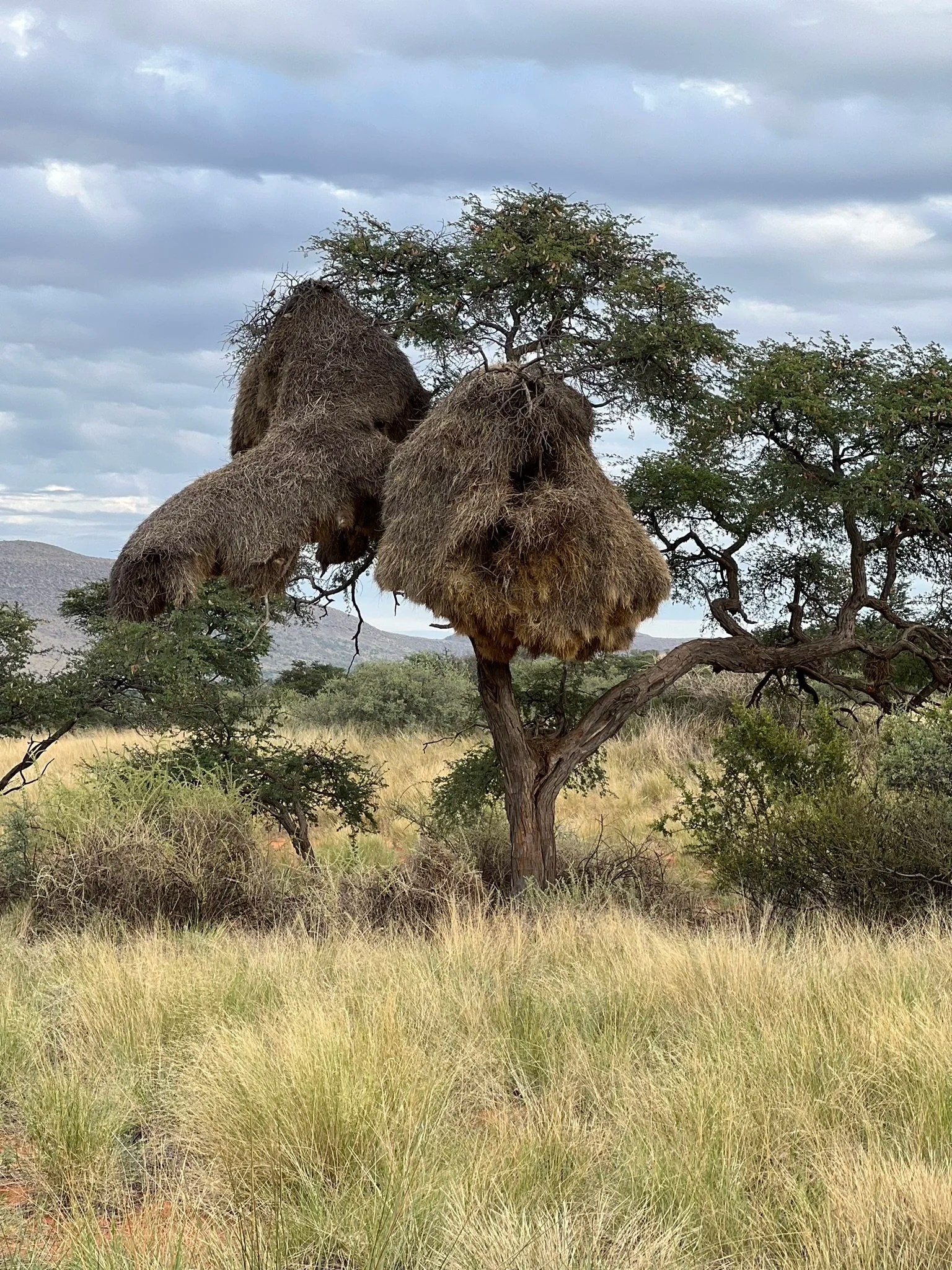
Sociable weavers’ nests. They can be massive and are the home to dozens of familes. You often see them of such a size that branches or whole trees are unable to bear their weight and fall.
But we are not mere passengers along for the ride. V and I are constantly aware that in order to fully enjoy the experience we need to be active participants. You can be a passive watcher but you cannot be a passive seer. Animals and birds come in a host of sizes and shapes and colours and their environment can be brushy, grassy, sandy, rocky or treed and it is always filled with light and shadows. Looking for patterns, things that don’t quite fit, things that shouldn’t be there or things should be there and aren’t, these are all part of the process of active seeing and the joy of the process is spotting something that has heretofore eluded the eye and finding a picture where none had existed a moment before. This is not to suggest that we are even slightly good at this, we simply don’t know enough and have not experienced enough to be able to make sense of everything that we see and what it’s telling us, but It’s fascinating to try.
We are looking for animals and birds to photograph, to see and capture something that we have never seen before and which gives us an insight into an animal or bird that helps lift them off the page of the bird book or the animal guide and makes them partners with us in a world we all share and are trying to come to terms with. We can never understand what it must feel like to be who they are and face what they face but it’s the closest way that I know of to appreciate the fact that they are fully alive, not scientific definitions or the subjects of a television documentary, and that sometimes allows us to make a single, brief, tenuous connection.
One other important requirement that we always ask camps for is that they assign us a driver who is him or herself a photographer. Driving a vehicle for a photographer is a very subtle art, there is a lot more to it than simply finding an animal to photograph. As difficult as the finding can sometimes be, it’s only the beginning of the process. The driver needs to try and stay downwind of the animal, certainly during the tracking process, so as not to prematurely warn of our presence and make the animal wary or cause it to bolt. The driver needs to be aware of the sun’s position in relation to the animal, needs to line the vehicle up while the animal is resting or moving so that the photographer is in an ideal shooting line and needs to understand animal behaviour so as to anticipate what it’s likely to do next and where the ideal next position needs to be to ensure a clear shot. Light and shadows, wind direction, the sun’s position and intervening obstacles constantly change and need to be taken into consideration to make for a clear, open, properly-oriented shot. Our two guides on this trip, exceptional photographers in their own right, were superb and I think the best we have ever had. Hats off to you both, Dula and Barry. Should any of my readers ever want to try a trip to one of these camps be sure to ask for Dula in Namiri Plains and Barry at Tswalu, cannot recommend them highly enough.
A mother Bat Eared Fox and her kit. They were about 50 metres away and the camera is doing a wonderful job of focusing on the grass, not on the animals!
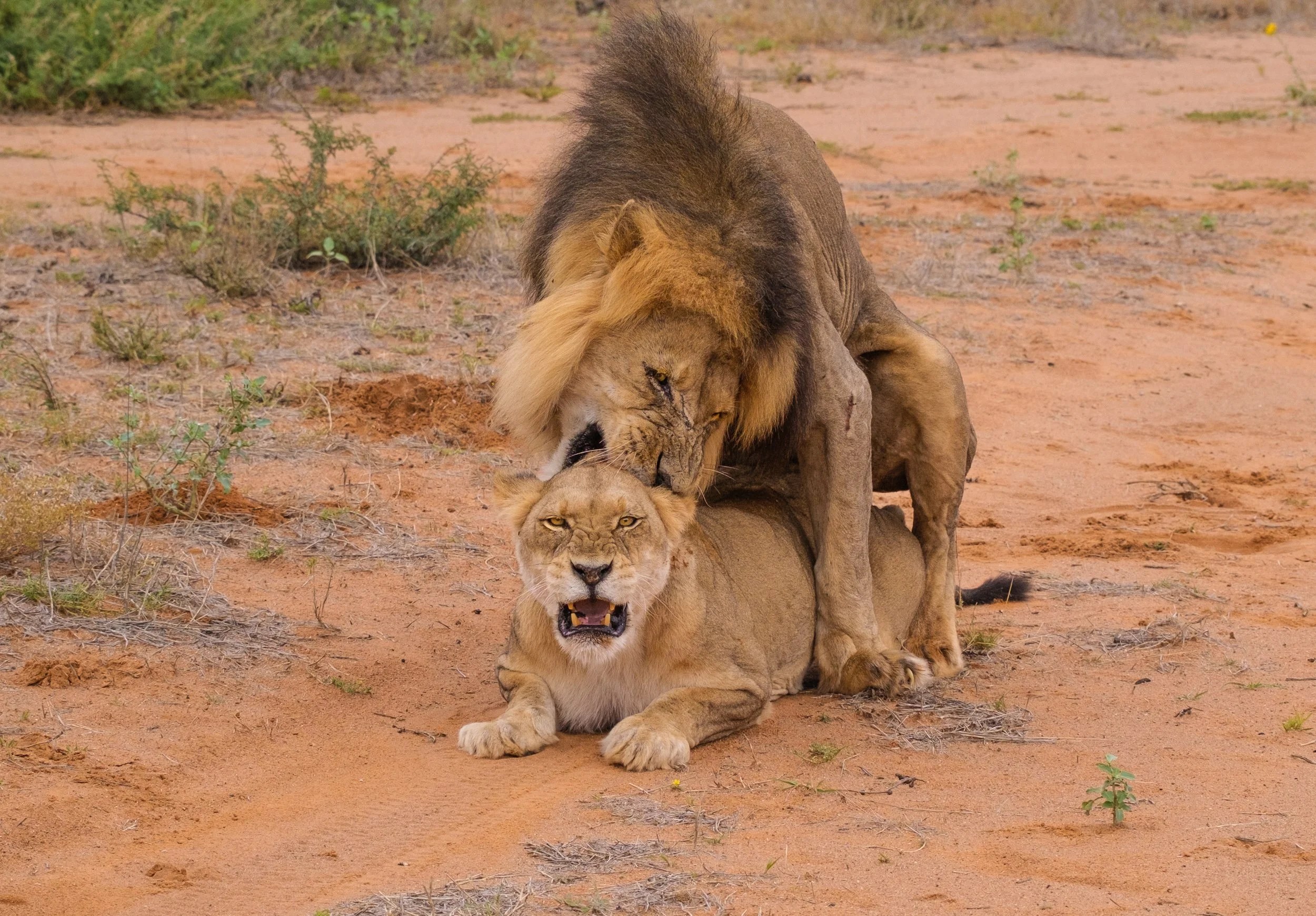
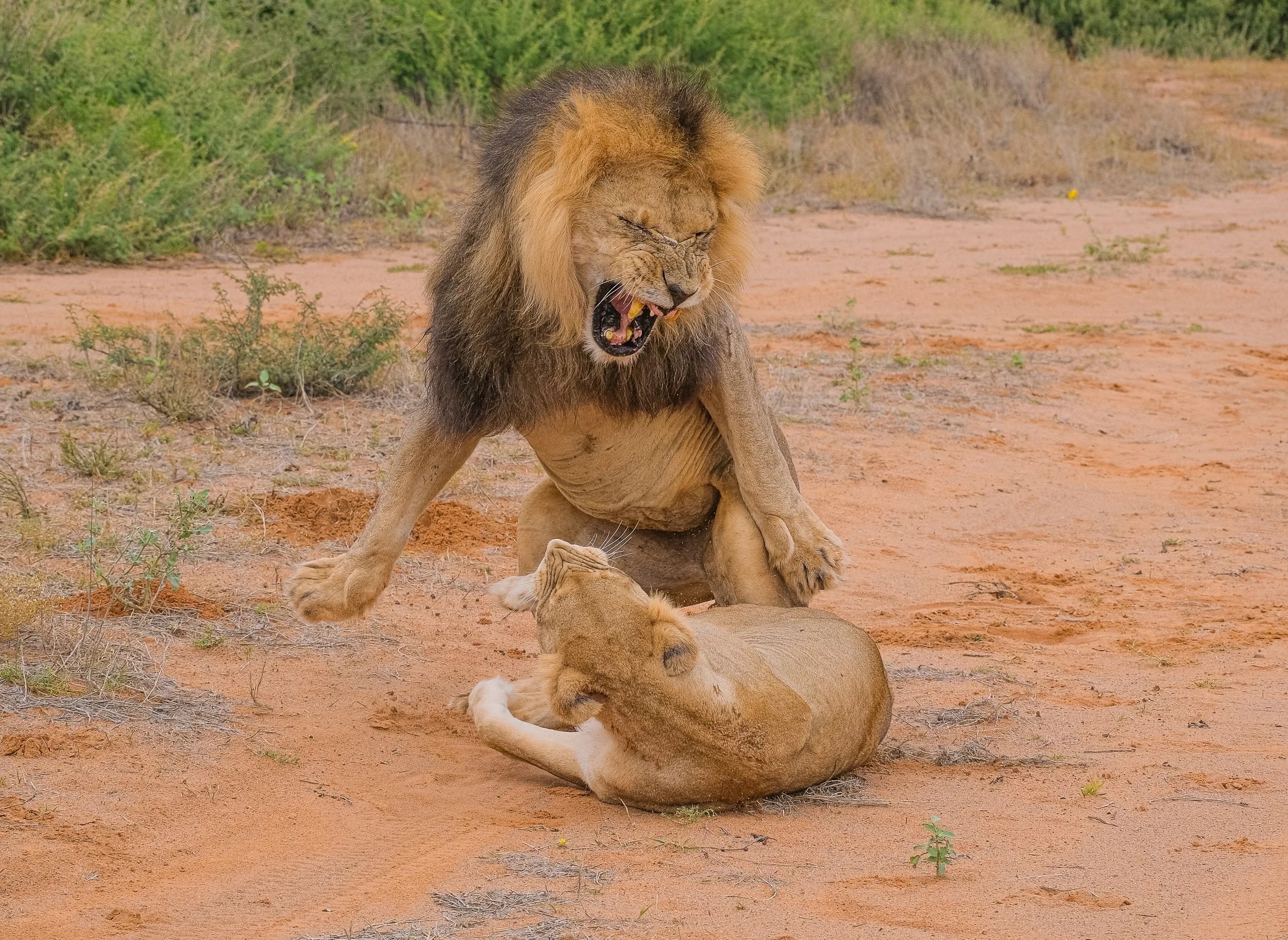
I’m often asked why we keep going back, haven’t we already seen lots of lions? Yes we have but we keep going back, not to collect yet another lion shot, but to experience and capture images that show interactions or moments of intimacy or those rare moments that allow V and I to share our own wonder at lives so different from ours but, in some very real way so similar as well. For example, in Tswalu we stayed with a pair of mating lions for a significant length of time. We have had this opportunity once before but that first time the mating pair were surrounded by 5 or 6 vehicles each filled with 7 or 8 people who were loudly enjoying the spectacle, it felt somewhat creepy so we left.
In this instance, the mating pair were both out in the open, resting on the red sand of the road, with no other vehicles in sight. Previously unknown to us was the fact that while the female is in estrus, a period of up to a week, her chosen partner mates with her about 6 times an hour, day and most of the night for the entire 6 or 7 day period. The mating act itself only consumes 20 or 30 seconds but is violent and can be bloody. By common consent, we couldn’t see if it was the male or the female that initiated the encounter, the male would mount the female and hold himself in position on his haunches and by grabbing the back of her neck in his jaws. The female’s neck exhibited many fresh, bloody bite marks and the male for his part had wounds on his forearms for, when they decouple, there is a savage exchange of snarls and bites, no quiet post-coral cigarettes here. We stayed for a number of cycles and were exhausted watching, the amount of energy expended was enormous. I assume that the process ensured that they met an evolutionary criterion, those animals who were not strong and vigorous enough and without the endurance required to meet these extraordinary demands would not the be able to pass on their genes. It’s the privilege of being able to experience these moments that keeps bringing us back.
During matingAfter mating
But back to the mundane, we continue our exploration, existential and photographic until about 9:30 or 10 and then head back to our camp for breakfast. The food at Tswalu is excellent and our daily struggle is to keep appetite in check so that we won’t need two seats each on the plane home in which to squeeze our overfed bodies.
We have our afternoon in which to download and work on photographs, write blogs, shower and clean up, and catch up on sleep. Added to that on this trip is the necessity for Christmas shopping on-line in hopes that everything will be delivered by the time we return, a week before Christmas.
At 4pm we’re back on our vehicle for a game drive that will end around 7:30pm and our return drive to the lodge in the dark. Time for a beer and then a very good dinner and glass of wine and into bed by 9:30 after having prepared for the following day’s expedition.
With some diversions along the way, that’s how we spend a day in camp, and now that we’re back home and catching up on sleep and rest, I’m already thinking of how and when we’ll be back.
After Note:
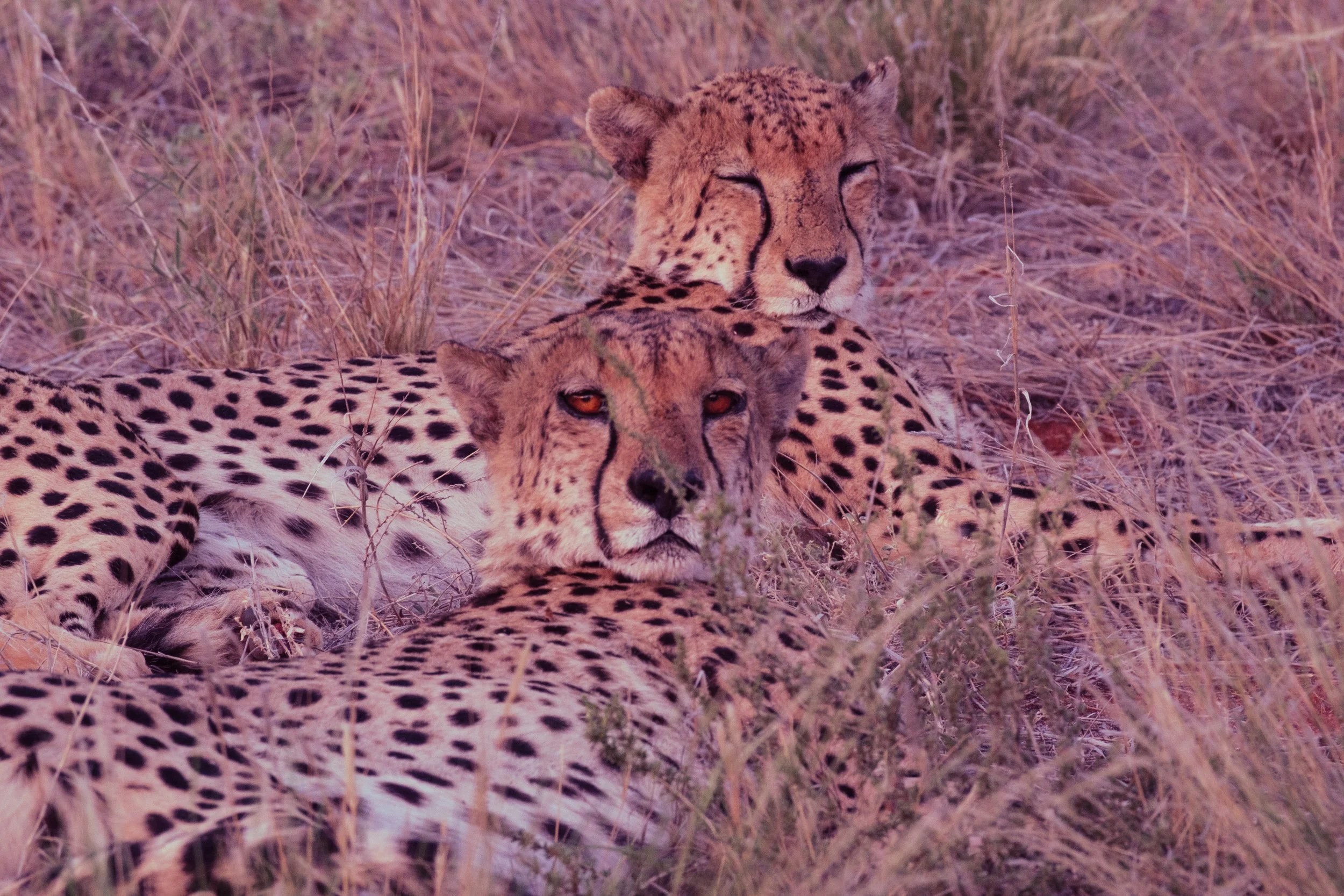
Cheetah boys now.
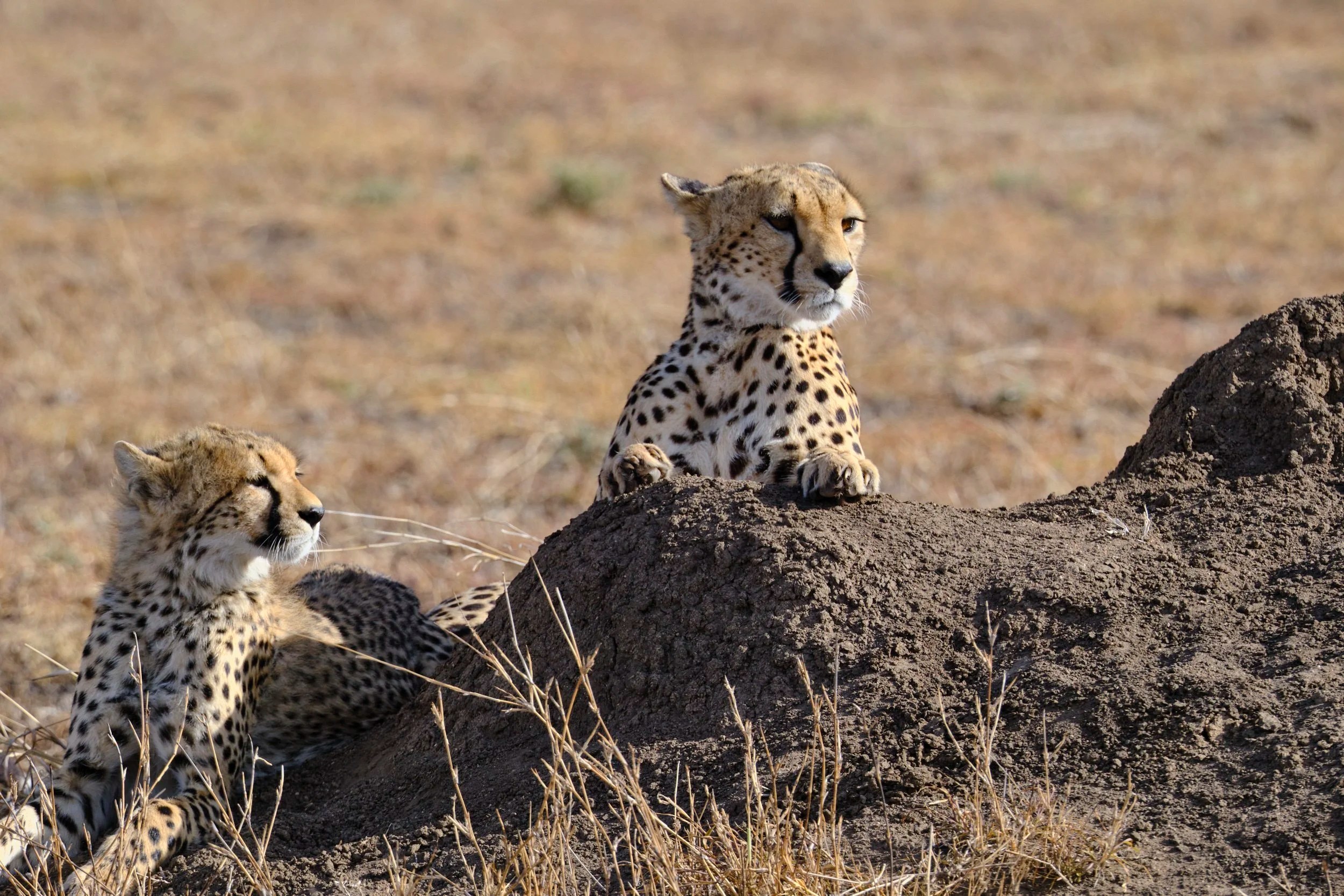
One of the more special parts of our trip occurred at Tswalu. We have always loved cheetah and seeing them in their natural habitat was one of the original drivers for our first trip to Africa in 2012. At that time, during our first visit to Tswalu, we were lucky enough to spend time, over a couple of days, with a pair of cheetah brothers who were then 2 years old and hunting on their own.
You should know that it is quite usual for brothers, both from the same litter and across litters, to come together and form coalitions which provide more security, cheetahs are after all the prey of lions, leopards and hyenas, as well as significantly improving their hunting capability. These coalitions can be very long lasting, life-long in many cases. I’m sure a few of my readers will remember our last trip to Kenya and the Masai Mara in 2018 when we followed, at times with a BBC film crew, a coalition of 5 brothers who hunted in the Mara as well as across the border into Tanzania. They were very well-known, hence the film crew, and were the offspring of a very famous mother, Malika, who I also wrote about at that time. She was an extremely capable, very intelligent cat who, unusually, survived after being left as an orphan and grew up into cheetah with a very strong personality and character. We had seen her on earlier trips to the Mara and I had the very sad honour of having taken her last photo. Shortly after we last saw her, it turned out to be a couple of hours before she died, I was able to get a shot of her. She was last seen attempting to cross a river swollen by a heavy downpour and was washed away. She was never found. Both V and I were very upset when we got the news; such is the hold that cheetah have on those of us who admire them.
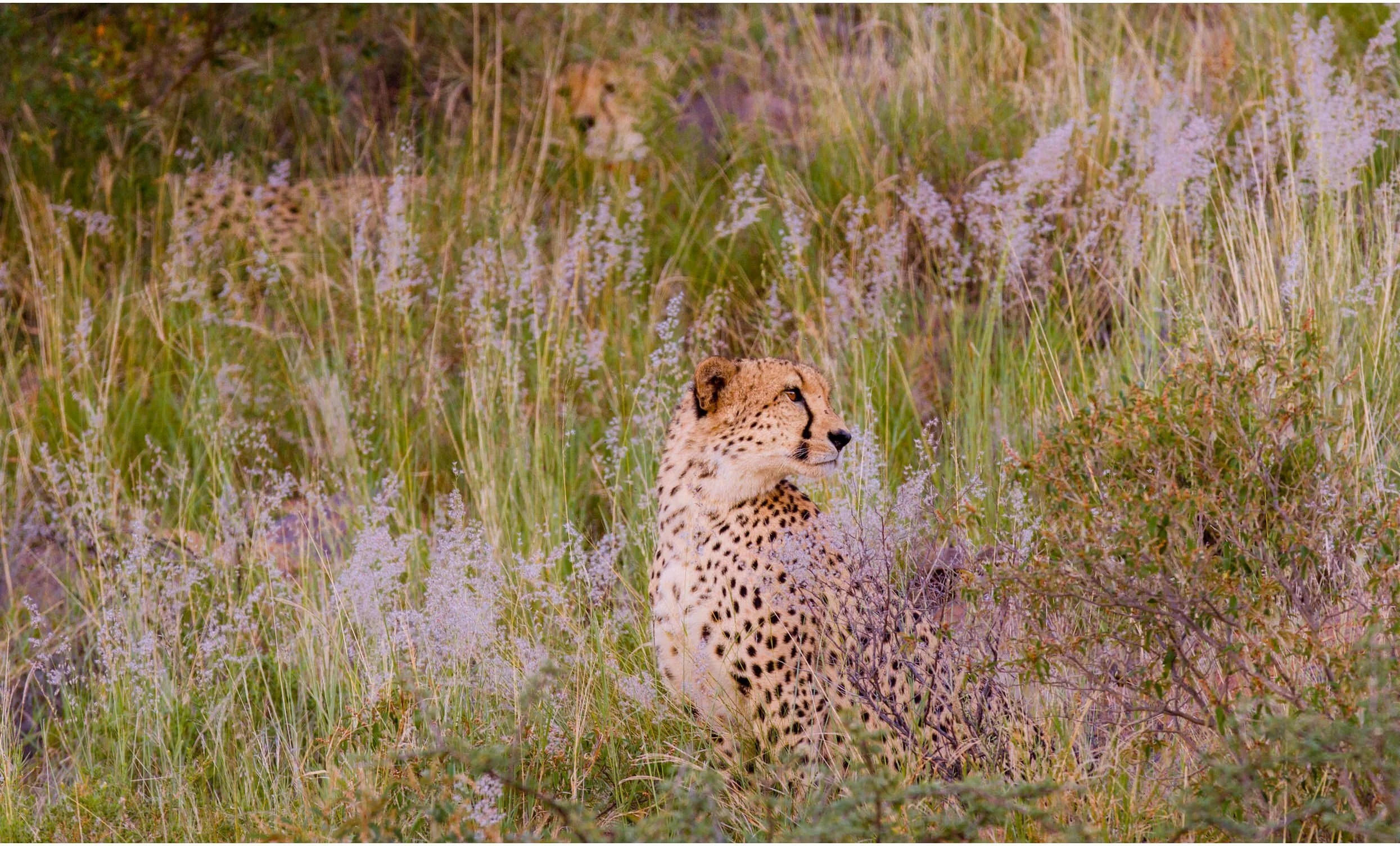
Cheetah boys 10 years ago.
But back to my story. The two cheetah boys at Tswalu were still holding their own and it was an emotional reconnection to see and spend time with them after 10 years. Cheetah, with extraordinary luck, can survive in the wild for up to 14 years and our two boys who at that age were still capable of hunting and surviving, but were showing their age. We know that if anything happens to one, the other one will be unable to survive on his own so it too was a sad farewell when we left. Our last visit with them was in the sunset of our last game drive. We stopped our vehicle to watch them and then Barry our guide asked if I’d like to get out of the vehicle and try and get a closeup, and so we did. They let us approach to about 3 metres and my last shot of the trip is of our two brothers, washed in the red glow of the setting sun.
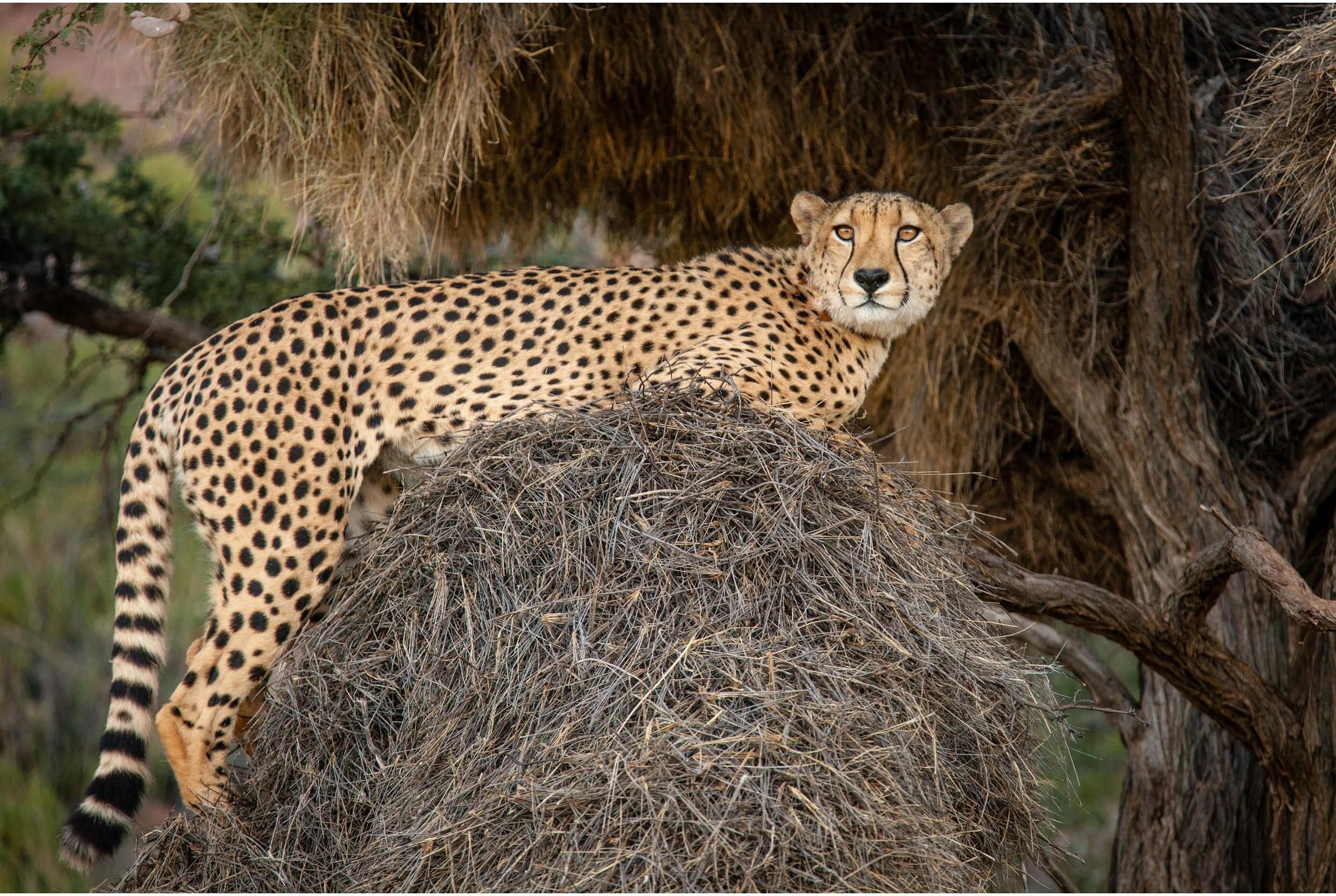
Cheetahs don’t climb trees but this is one of the two cheetah boys from 10 years ago on a sociable weavers nest
Final fun note, a lagniappe, we discovered two new terms for groups of particular animals. A group of rhinos is called a “crash” and a group of giraffes is called a “kaleidoscope”.
I’m writing this in blissful quiet. It’s 7am and the rain is pouring down so we have a respite, and very welcome it is. We are now in Tswalu, a camp and conservation property in the far north-west of South Africa in the Kalahari desert. We were here during our first trip to Africa in 2012 and I have wanted to return since then but our itineraries could never quite work.
The property is owned by the SA diamond family, the Oppenheimers, who have spared no expense on both the guest and the conservation side to create a place that is ideal for the animals and the guests, in that order. I say that without irony or criticism. The property contains a Research Centre where visiting researchers can carry out long term studies on habitat sustainability and there are programs in place to re-build a number of animal populations, most notably, those of cheetahs and black rhinos.
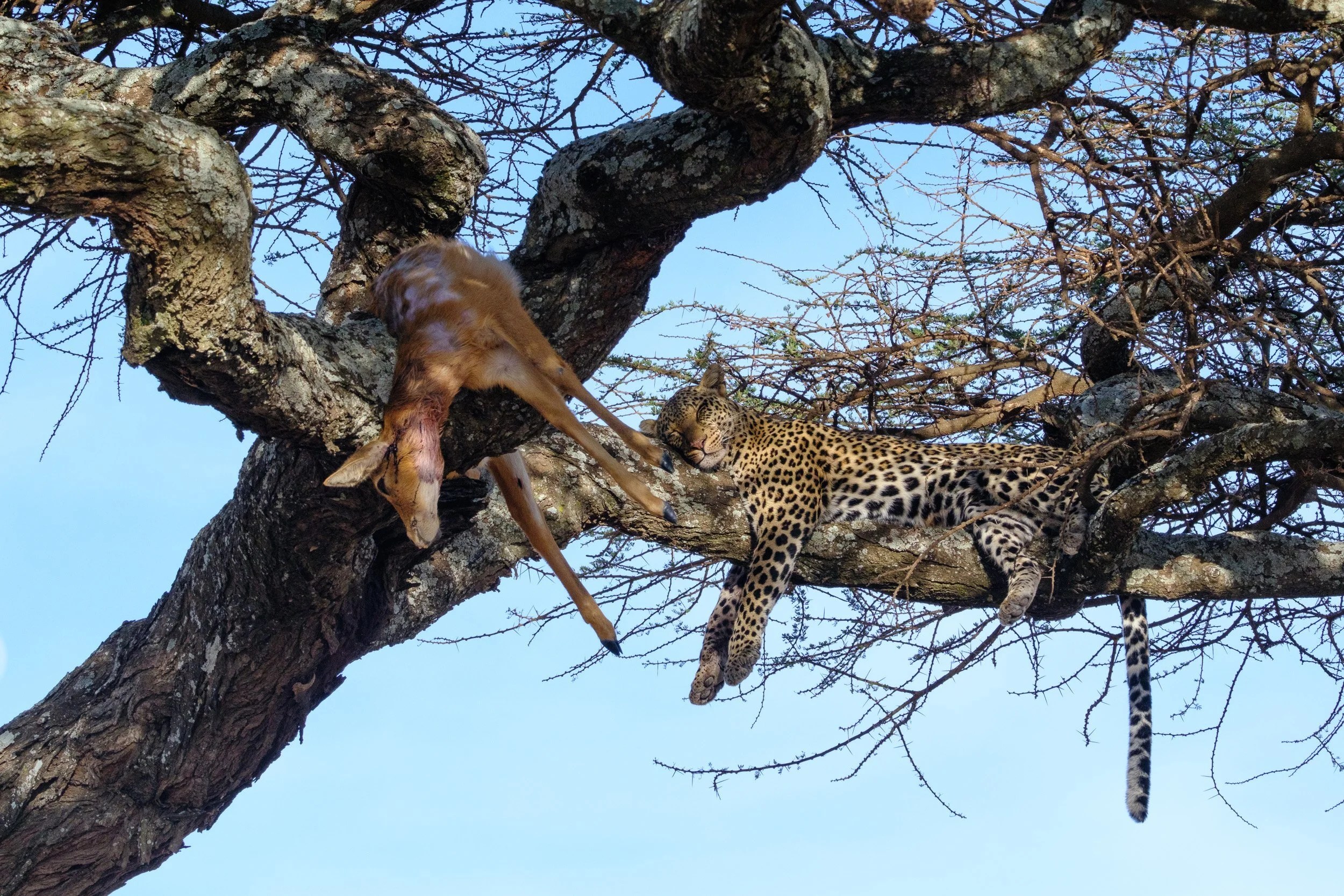
Sad I know, but leopards have to eat
The property is spectacularly beautiful, it’s temperate savannah, so while the red Kalahari desert sand is never far from the surface, it’s largely covered by grasslands and is a region of rolling hills and wide grassy plains.
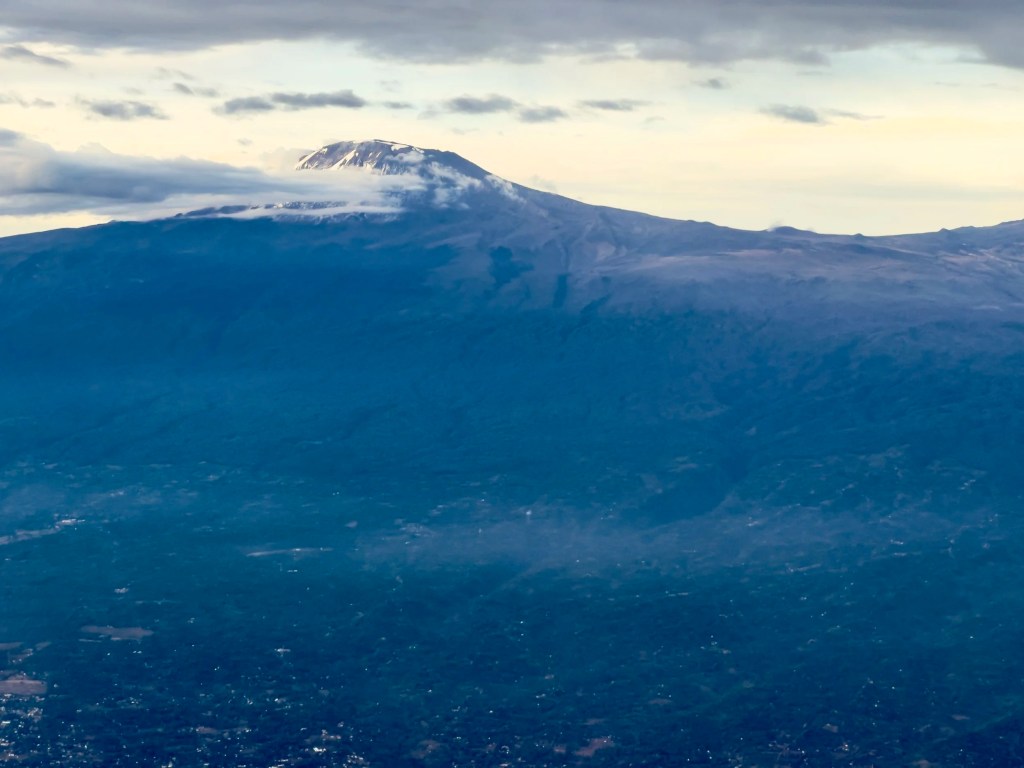
We arrived here after one of those trips that are planned in nightmares and shares with a nightmare the knowledge that there is nothing that one can do to change it. As previously journaled we flew into the Kilimanjaro airport in Tanzania in a wind and sand storm that prevented us landing so required us to re-route to Nairobi. We did finally manage to land in Kili and our time at the Namiri Plains camp was magic but getting up at 5:30 every morning for our game drives and being out on the land until past dark at 6:30-7:00 made for very long days and prevented us from ever really catching up on rest.
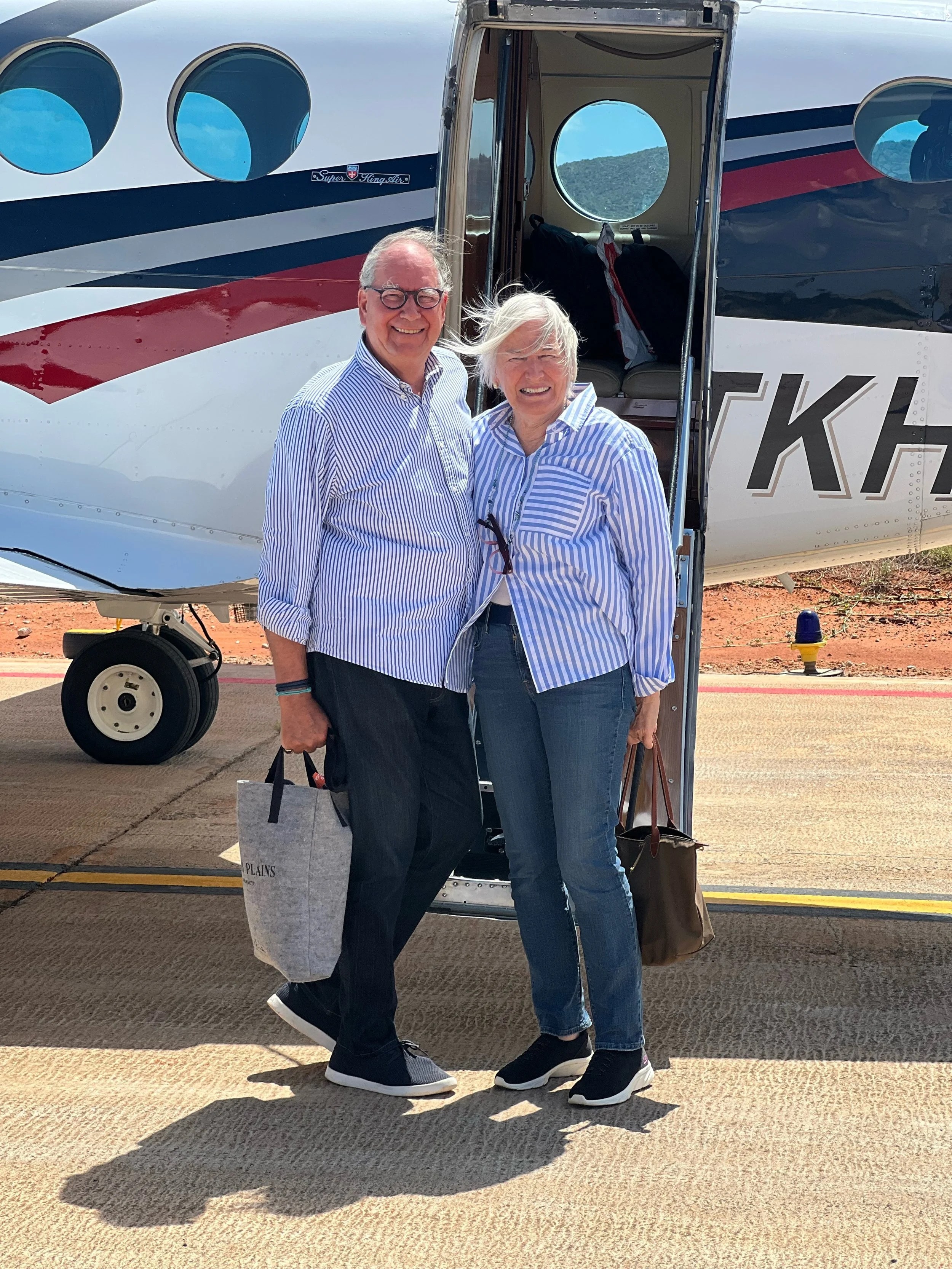
On our final morning at camp we had the blissful pleasure of sleeping until 6am before loading our vehicle and leaving at 7:30 for the bone bruising Land Rover ride back to our little dirt air-strip. It’s about a 2 hour drive to the airstrip, a measure of how far removed we were at our camp, we only saw one other vehicle during our week at Namiri. We then boarded a small single engined Cessna which carries about 8 people, for our ride back to Kili. That ride, bumpy though it was, was also magical for a couple of reasons. We flew directly over the Ngorongoro Crater, a place we have always wanted to visit, and fabulous to see from the plane. We then landed on another desert airstrip along the way to drop off a couple of passengers. As we came to the end of the runway on our takeoff, about 100 metres past the end of the runway, and as we began to climb, the land suddenly dropped away hundreds of metres deeper than the edge of runway, we had flown over the edge of the Great Rift Valley. I’m sure everyone remembers high school geography and learning about the Great Rift Valley and how at the fault line of two tectonic plates, the land suddenly dropped hundreds of metres, along a length of hundreds of kilometres. It was staggering to be suddenly confronted by this unexpected view from the window of a small plane.
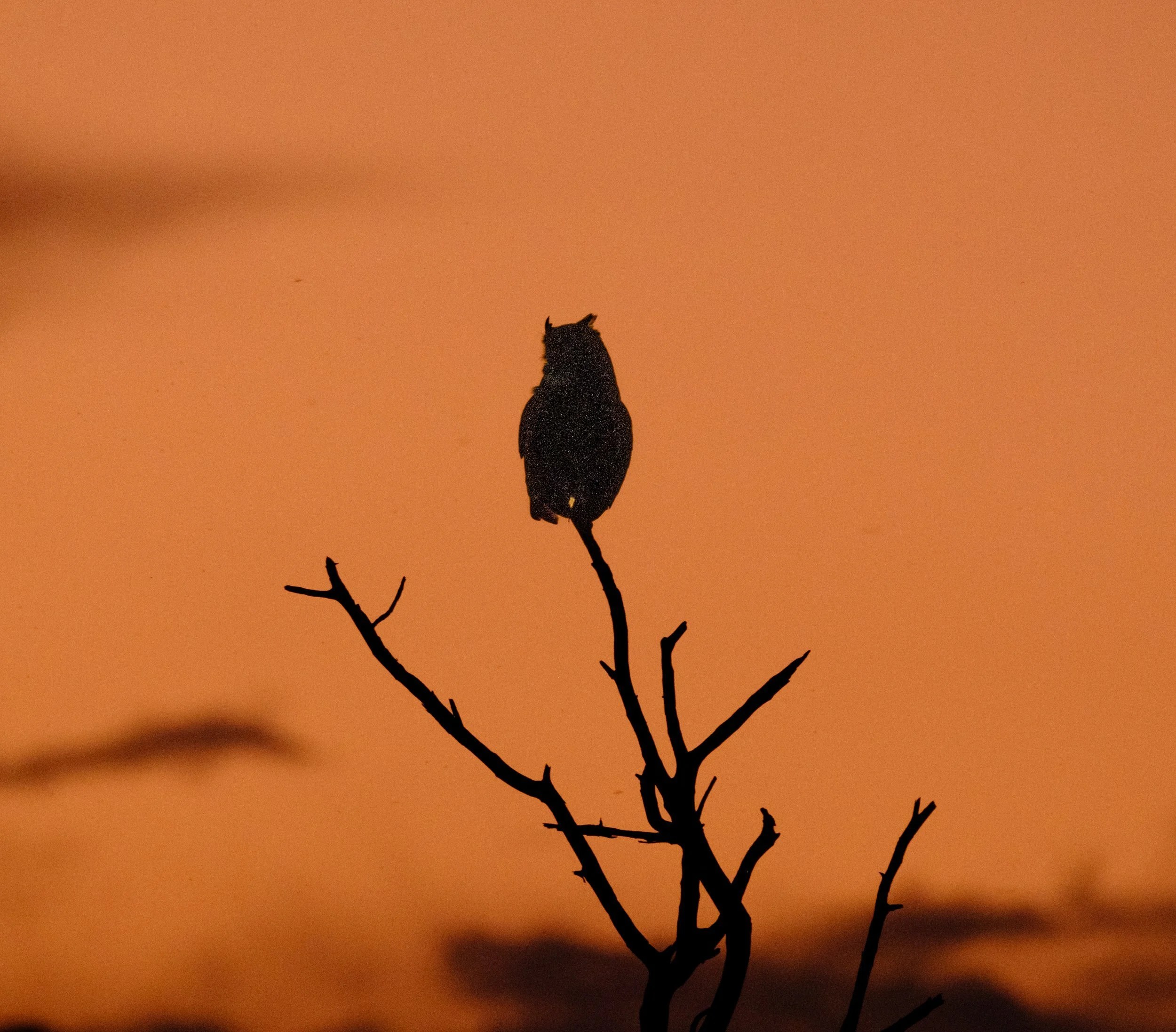
Tswalu, spotted eagle owl against the setting sun
We landed in Kili and were then required to wait for 5 hours for our Ethiopian Airlines flight to Addis Ababa in Ethiopia. Why, you ask, are we flying due north for 3 hours in order to go due south to Johannesburg? They subtleties of inter-country political relationships do not allow any direct flights from Tanzania to SA so one of the only ways to get to SA from Tanzania is to fly to Addis or Nairobi and then pick up a flight to SA. The Nairobi connection was our first choice but since there was only an hour between the daily flights and we had to change airlines this was definitely a non-starter. So off to Addis where we then spent another 4 hours waiting for our midnight flight. We arrived in Jo’burg at 4am and walked to the Intercontinental Hotel, attached to the airport terminal and one of our favourites, and waited in the lobby for early check-in at 8am. It had been 24 plus hours since we left Namiri Plains and we were weary.
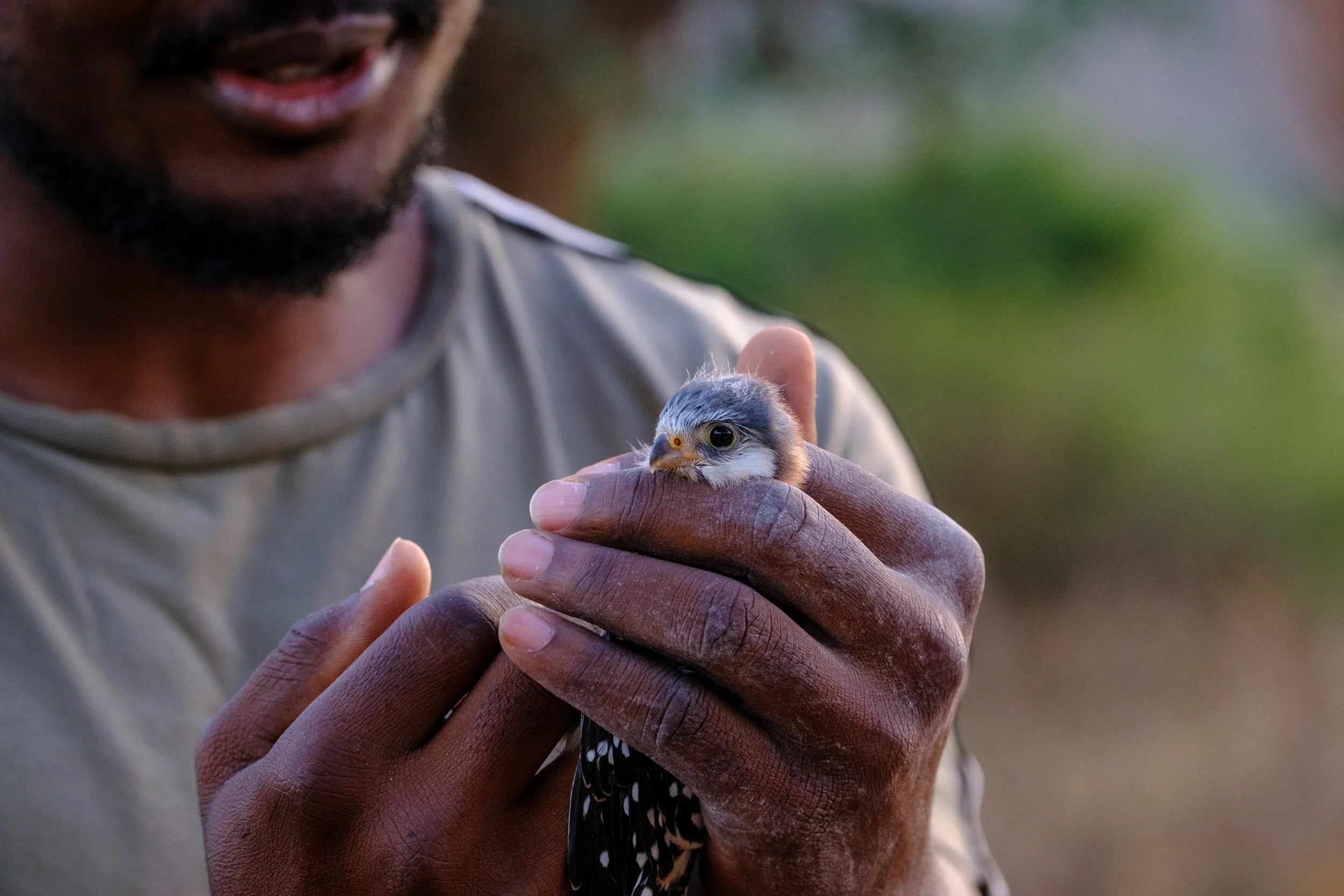
Pygmy falcon being banded by a researcher, Tswalu
We spent a relaxing day, recharging batteries, technical and internal, and prepared for our flight to Tswalu the following day. While our day went a long way toward ‘knit(ting)up the raveled sleave of care’ there were still lots of hanging threads that needed more attention.
Our Tswalu flight, as different, as my mother would have said, as chalk from cheese, was a pleasure and a delight. The two of us were picked up at the Intercon by a BMW SUV and uniformed driver and taken to a private terminal and hanger adjacent to the main OR Tambo Airport runway. It is very much gave the appearance of place used by people whose private jets needed new spark plugs and so were not immediately available or by children of those parents when Dad had taken the big plane. I’m not disparaging it even slightly, it was immensely pleasurable and in reality used by senior corporate and business leaders. The private terminal is two stories of glass and steel and we were met by uniformed attendants who took us to a second floor waiting area and to a chef in whites who brought us platters of fruit, cheeses and charcuterie. The terminal also has a gym, a spa and a very good kitchen to while away the pleasant hours while waiting for your plane.
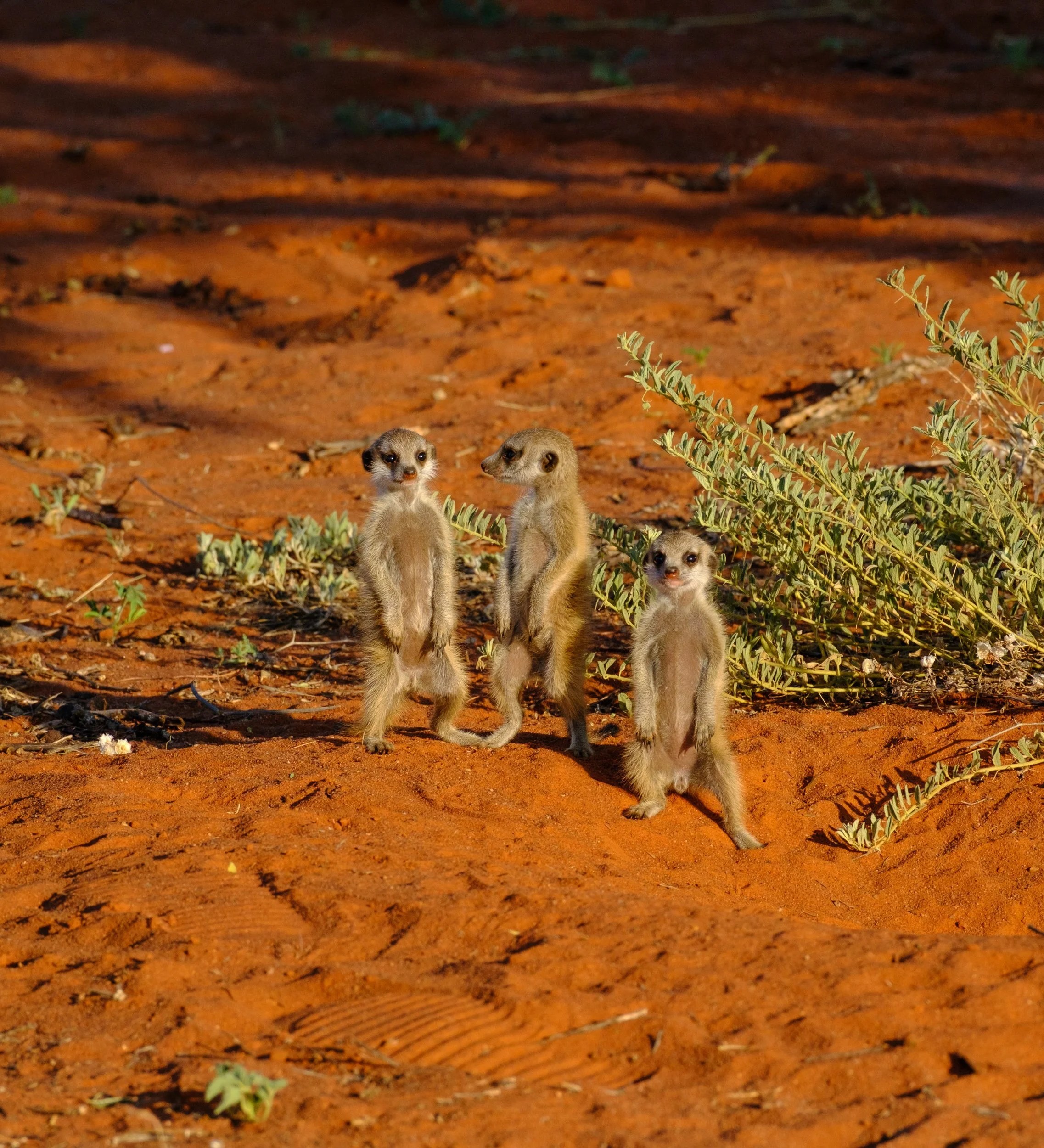
Three tiny meerkat kits, copying their parents’ “on guard “stance, Tswalu
In moments we were taken to our plane along with another couple we had just met and who were joining us on our ride to Tswalu.
If all of our previous African small-plane flights were in aging, tired but well-maintained VW buses, our Tswalu flight was in a relatively new Audi A6. The plane was a twin-engined turbo-prop with 6 glove-soft leather covered chairs and a couple of small leather sofas. We taxied away from our terminal, through a wide, very guarded gate in the high chain link fence surrounding our terminal and onto the main runways of OR Tambo International airport.
The flight was smooth, easy and quiet as we cruised at 19,00 feet and an hour and a half later landed on a paved, private air strip, a short cross-country drive away from Tswalu. To set context, the fact that it was a paved runway is significant. All the air strips in all the camps where we have stayed are scraped dirt and rocky and in order for us to land, often need someone to chase grazing animals off the runway. In addition to the paved runway, by the side of of the small open building which serves as a terminal, were 4 firemen, fully dressed in heavy firefighting gear in the 34 degree sun along with their fire truck. Their skills have apparently never been required but they are always there for every flight, as a precaution.
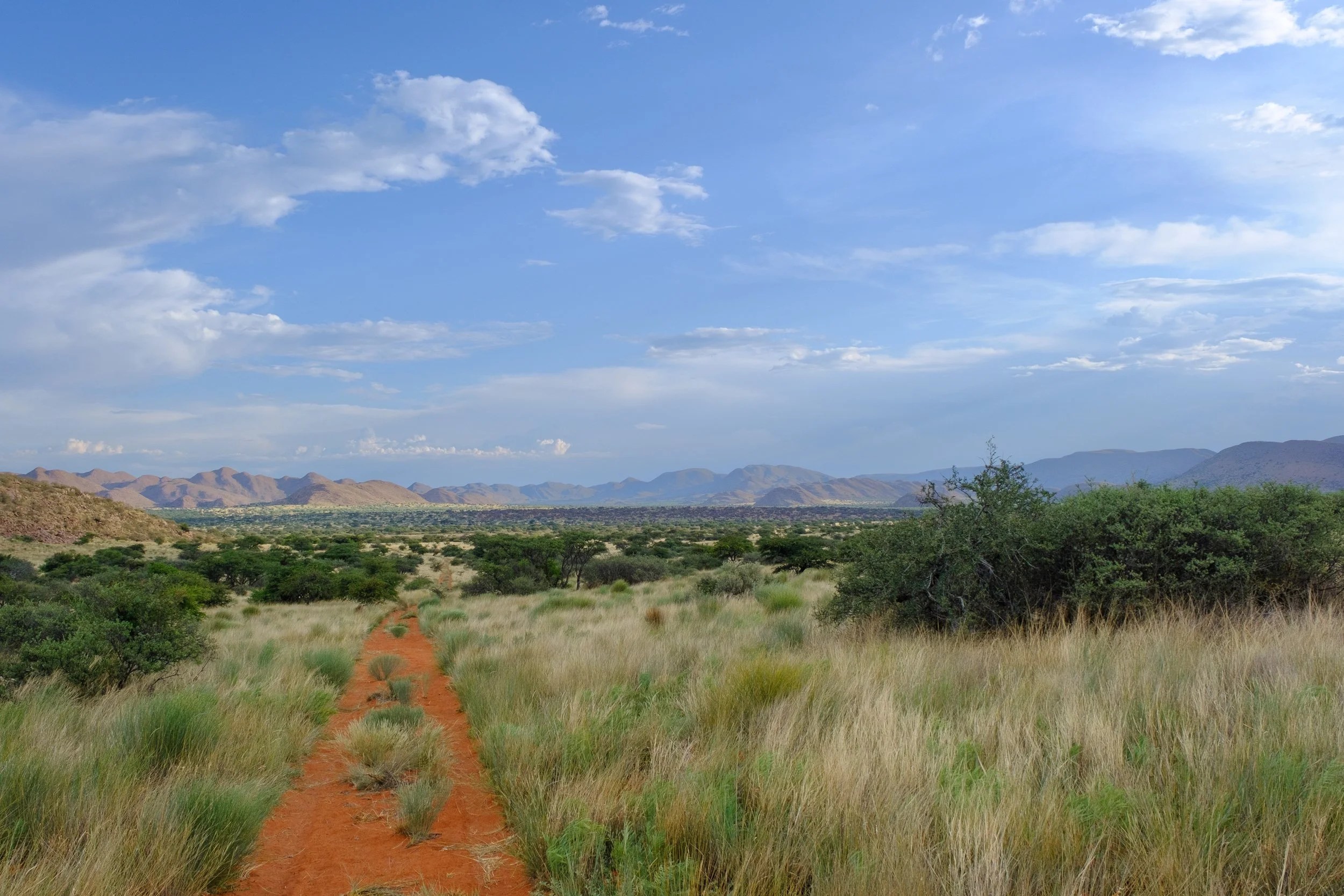
A section of the Tswalu landscape
After 10 years away, arriving at Tswalu felt like coming home.
Some of my readers I know will be asking why I go to such lengths to describe the fine details of our travels. It’s simple, because I’m able to. The writing process allows me to tell my story at my own pace without concern that someone will cut me off in mid-sentence to say, “If you think that’s bad, let me tell you about the time that I…..” It’s nice to have a polite audience!
in my next post I’ll talk a little more about Tsawalu and a day in the life of a safari camp.
This will be a short note, given our schedule there really isn’t much time for more. In my next lull I’m planning to describe a day in a safari camp but this will have to suffice until then.
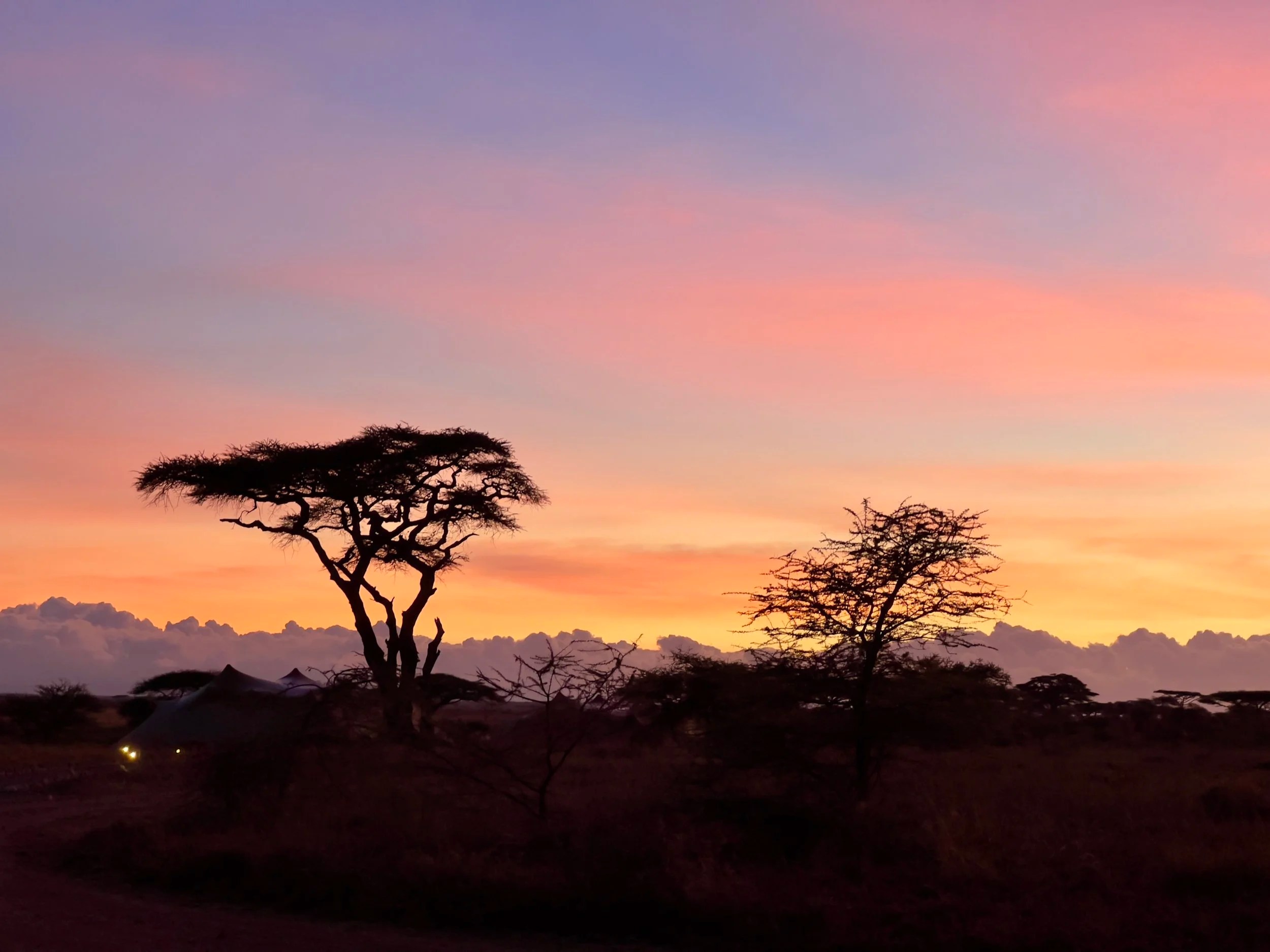
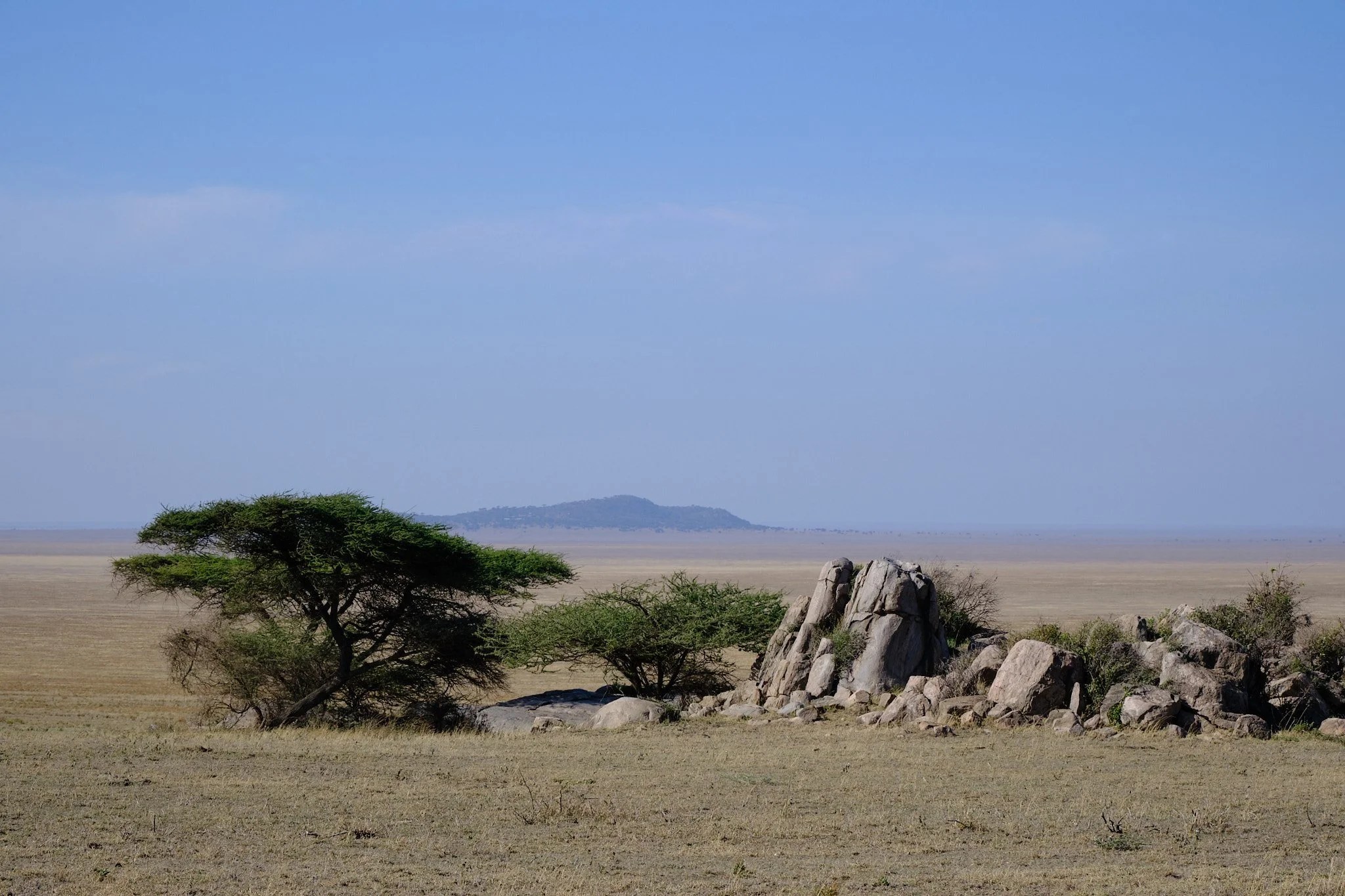
Our camp, Namiri Plains camp, is in a remote part of the eastern Serengeti, far from other camps and is in the middle of an open expanse of wide plains. It is a tented camp, although that’s slightly misleading , as the individual living units are square boxes of local sandstone covered by a huge fabric tent. The interior of the sandstone building is solid, well-appointed and spacious and proof against the winds that have periodically raged here since we arrived. So, we have all the conveniences of a robust, well-built cottage with all the fun of a tent which extends beyond the building on all sides and covers our veranda and an outdoor shower and tub.
We are about 150 metres away from the main building which houses an open-sided dining area and bar. Our closest neighbour is about 50 metres away and about 100 metres from the main building. All tents’ occupants are required to be accompanied by a staff person when we move back and forth from our unit to the dining area. We are in the middle of a vast plain full of animals who can wander freely through the property, and very often do. A couple of days prior to our arrival a large male lion and a lioness wandered by the tents and past the open dining area while everyone was having dinner, so caution is the watchword.
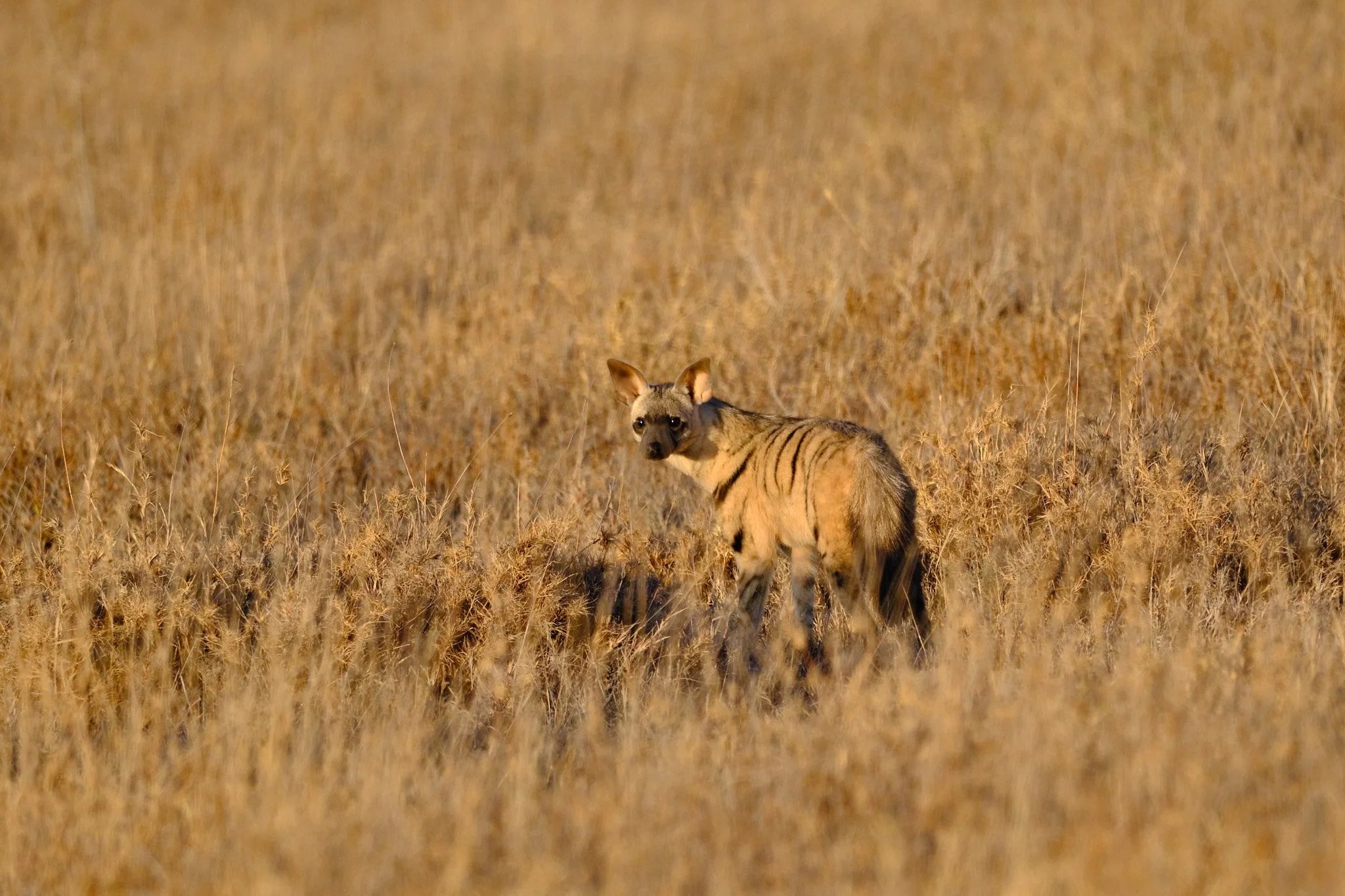
An ardwolf, hyena relative who lives entirely on two species of termite. A very rare sighting.
With all this mind, we left the dining room last night accompanied by a staff member with a flashlight to walk back to our tent. There is a very large acacia tree growing next to the path between our tent and our neighbours and you should know that the acacia is the primary food of giraffes. The acacia’s branches are covered by wicked 2 or 3 inch long thorns but they provide no protection against giraffes who seem not to be even slightly deterred by them. They use their agile prehensile lips and tongue to skilfully navigate the thorns and pluck the green shoots without harm, incredible to watch. Our safety walker normally leads us along the path and keeps his flashlight beam focused on the path behind him so that we can see our way. However he periodically sweeps the light around the area to make sure that there nothing lurking in the tall grasses. At one moment, as we approached the large acacia tree between our two units, he swung the flashlight beam around only to discover that we were about three metres away from walking into a giant male giraffe who was midnight-snacking on the acacia.
We have seen lots of giraffes over the years and thought that we had a sense of their size but it’s always been from the seat of a vehicle and not standing on two legs, mere feet away from one. He was massive and overwhelming, a male giraffe can reach heights in excess of 6-7 metres and weigh over 1000 kilos. His legs alone were taller than we were and his head was plucking leaves from the very top of our vary large tree 5 metres higher. I don’t know who was more surprised but he stepped back a pace or two to give us room to pass and watched us as we made our way to our tent. I know this because we never took the light away from him as we moved the last 50 metres to our tent. Truly a gentle giant.
Life is full of surprises, some good, some less so. This post is dedicated to my friend Randy who follows my posts, in hospital in Toronto. Stay strong
When last heard from I was leaving Buenos Aires and on my way home, returning from Antartica and South Georgia Island in March. In the intervening months the Covid menace has stepped down from the headlines and we are all infinitely sadder but not noticeably wiser. The vast multitudes of Covid deniers with their heads in the sand and their behinds in the air have not noticeably changed their posture, not a very pretty sight. Let us never forget that there are also large numbers of people who still believe that the world is flat and that Donald Trump was a great president.
At this present moment we are on the Serengeti in Tanzania, carrying through on a trip originally planned for last December, a tad hasty, and which we are now completing. We will be spending a week in a wonderful tented camp, Namiri Plains Camp in a pretty and remote section of the Serengeti. Then we are off for another week in Tswalu, a camp we loved on our first trip to South Africa in 2012.
This the first trip that V and I have made together since the fall of 2019, just shortly before Covid struck, and it’s a very curious feeling to be on the road again. Covid and the hiatus it created, really is a marker and so much is defined, reflected upon and thought about in pre and post-Covid terms. This is especially true as it’s the rare instance of an event that was and is, quite literally, shared by the entire planet. Everyone everywhere has a common language when sharing experiences, we have all been touched by it, and are all still trying to come to terms with it.
Our flights here have had their own adventures; our landing at the Kilimanjaro airport in Tanzania had to be aborted because of severe dust storms. Visibility was so reduced by the blowing dust that the pilot could not see to land and so we circled the runway and then diverted to Nairobi. We spent a couple of hours on the tarmac in Nairobi, refuelled, and then flew back to Kilimanjaro to try again. Fortunately, while the winds had not abated, the dust had blown itself out and we able to land, hours late. As unpleasant as this was however, it was still better than the alternative which was to fly to Entebbe in Uganda and overnight there before re-trying our landing the following day.
Resting after a big meal
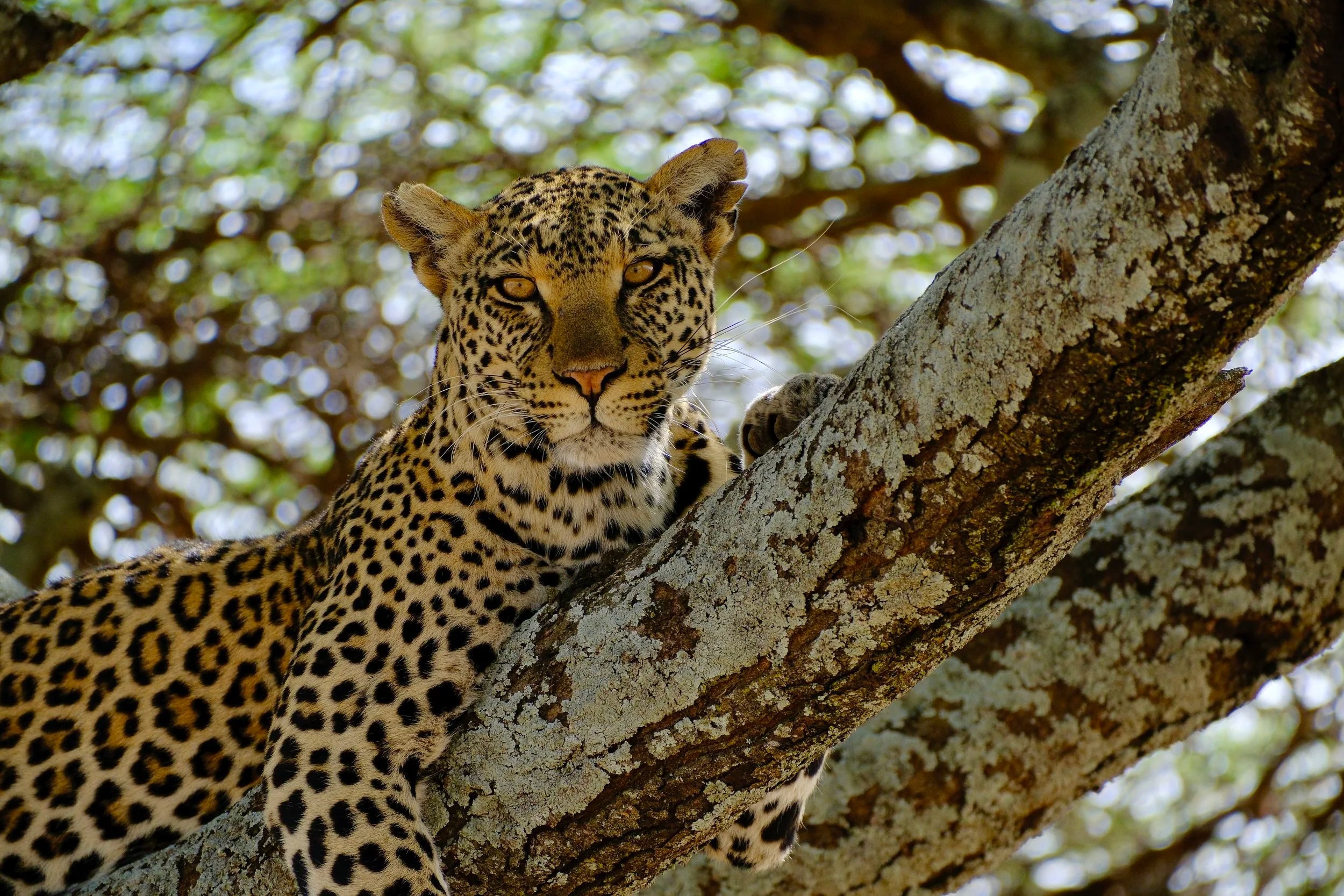
These winds have been ever-present and have continued to blow relentlessly since our arrival so our drive to the camp in an open vehicle yesterday and again on our first game drive this morning, were both punishing. Having said that, we are in a wonderful, remote portion of the Serengeti that has only recently been re-opened after a number of years being closed in order to re-build its cheetah population. Unlike the Masai Mara in Kenya which contains vast tracts of fairly open grasslands relieved by occasional acacia trees and scattered shrubs, the Serengeti is, in many places, an ocean of windswept grassland with virtually no no trees or low-lying vegitation. And wind-swept it is at the moment. However this hasn’t prevented us from having a sighting that in all of our previous 6 trips to Africa, has eluded us. We spent a happy hour this morning watching a female leopard on a tree limb about 3 or 4 metres over our heads. She had just fed and her stomach was bulging as she stretched herself out to relax and varied her time by lazily watching us or having an occasional nap. A magical moment and made even better by the primary reason for us having chosen this camp, not another vehicle in sight. Our camp is far removed from others and we only briefly saw one other vehicle for the entirety of our 6 hour drive.
I’m looking forward to other peak moments and will keep you up to date as the week progresses.







 Site Title