A strange title, I know. I’m on my way to Buenos Aires to meet Robert my very good friend and travelling companion in Chile last year, now off on a new adventure in Argentina. But first a short digression.
2024 was and is a year book-marked by painful moments of loss. Is there a scale to measure loss and its impact? Should it be constrained because its source is not human?
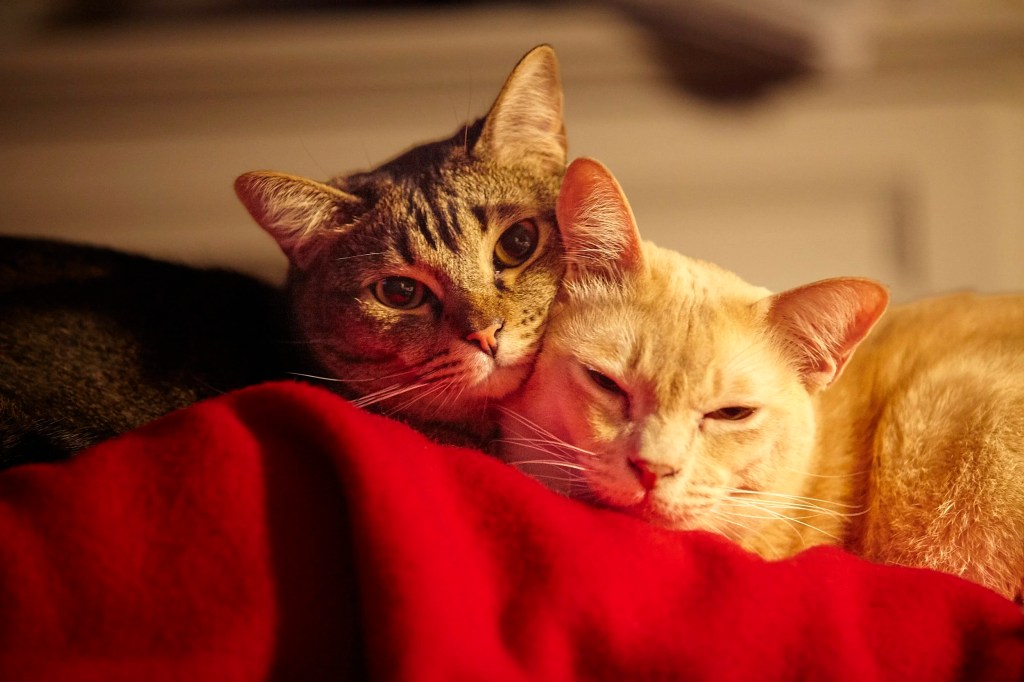
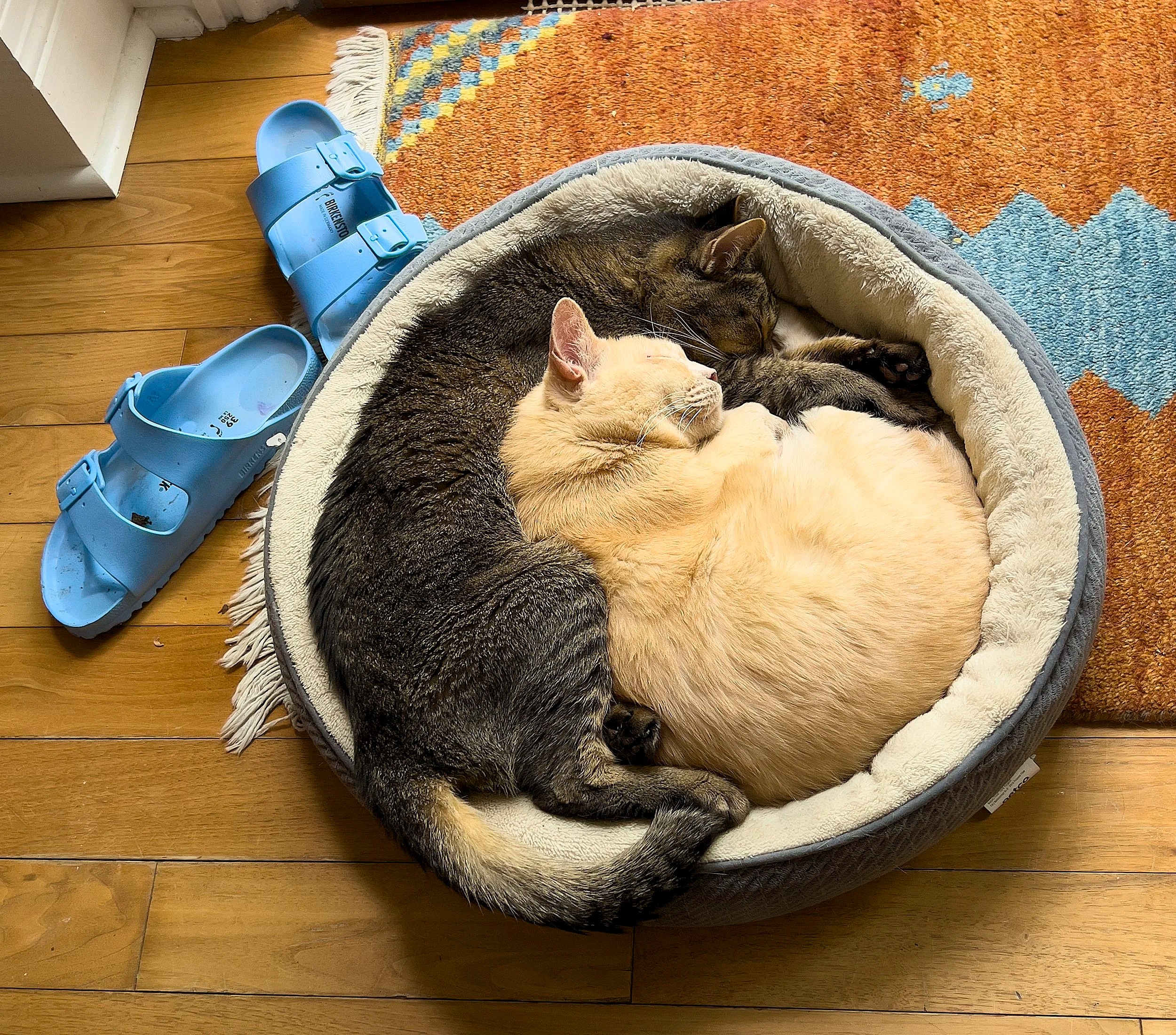
We have been very lucky in the animals who have shared our lives, in our case, cats. Most recently, in 2010 the year I retired, when V presented me with 2 cats who were to be my companions in retirement, Harry, a Burmese and Toby, a Burmilla. From the beginning, and we are both long-time felineophiles with a life populated by many of their ilk, they were both, in very different ways, special. They were both raised by a breeder who did all the correct things, handled and socialized them, kept them indoors and ensured that they realized that they were social beings who had a responsibility to maintain an interesting conversation and put guests at their ease. They were not trained to do tricks, they were grown-ups and expected to be treated as such.
In the intervening 14 years they have both become very important parts of our lives, Harry, for me, in particular. Harry and I shared a bond that I have shared with few humans. Flawed souls that we all are, we both accepted and loved each other unreservedly, and we forgave each other absolutely for any transgressions. Harry sadly passed away on New Year’s Eve last year, a heart-breaking launch for 2024.
Harry and Toby
Toby, much quieter and more reserved but equally loving became for V what Harry had become for me. Toby and Harry were also bosom friends and very dependent on each other, having come from the same breeder at the same time and having grown up in the same household. Our concern at the time was for the effect that Harry’s demise might have on Toby and this sadly proved to be prescient. I don’t think he was ever quite as happy on his own and seemed to begin a slow decline that unfortunately culminated on the eve of my departure, when he too died.
They will both be deeply missed and life will skip a beat.
In my next post I will return to our Argentina adventure
How to describe two and a half weeks in the Serengeti and in Zambia? Not easily done.
Why did I wait so long to file dispatches? We were off the grid for virtually all of that time and although we were nominally able to access wifi at intervals during that period, the signal was so fragile and we were so tired from our expeditions that mustering the patience to deal with a ragged wifi connection required more than we could manage. Hence my reporting dilemma. So, rather than a documentary, I’ll try to capture some, a very few, of the many bright spots that immediately rise to the top of the memory heap.
I write this just after we have returned and we are ragged with tiredness. Over the course of three weeks away our itinerary took us on 12 flights, many of them in small bush planes landing on dirt airstrips where the pilot often has to buzz the landing strip to chase the animals away. Our return flights required 20 hours in the air and 5 or 6 hours in lay-overs so jet-lagged as I am, I ask forgiveness in advance for all the insults I’m sure to offer to the language and to grammar in the pages ahead.
After a long but surprisingly pleasant ride on Ethiopian Airlines from Toronto to the Kilimanjaro airport in Tanzania and a couple of R&R nights in Arusha we left on a small Cessna 10 seater bush plane and landed at the Seronera airstrip in the north-west corner of the Serengeti National Park. During the 3 hour cross-country Land Rover ride to the Nameri Plains camp where we first stayed in December of 2022, we noticed a number of Superb Starlings, superb starling does sound like an oxymoron but surprisingly they are, hovering, screeching and flying in very tight circles mere feet above a spot nearby. We had time to notice this because the roads were a chaos of ruts and holes, now dry, caused by the torrential rains of the rainy season so we were forced to drive at a bone-jarring, walking pace. The starlings were in full danger-warning mode and centred their attention on a very large rut at the side of the road. They would hop to the edge rut, screech and then jump back or lift themselves a few feet into the air and hover, but they were clearly not going to stop alarm calling until the danger was past. After stopping and watching this for 4 or 5 minutes, the source of the danger, did eventually pour itself out of the rut and into the grasses of the savanna. It was a very large puff adder as thick as my upper arm and about a metre and a half long which had stretched itself along the bottom of a very large rut deep enough that we were unable to see it. The hair did stand up on the back of my neck. Unfortunately we had just unloaded our bags from the plane so I did not have my cameras to hand, but the memory will last me for a very long time.
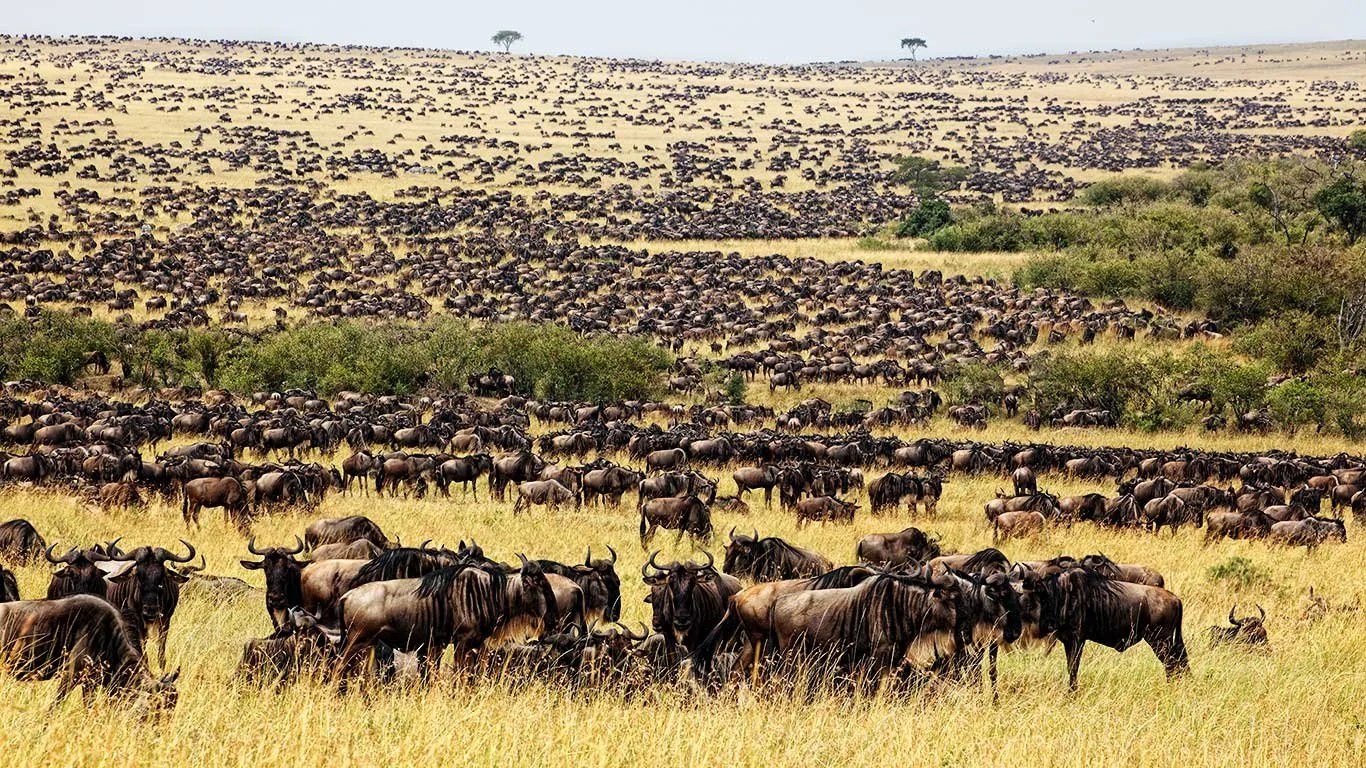
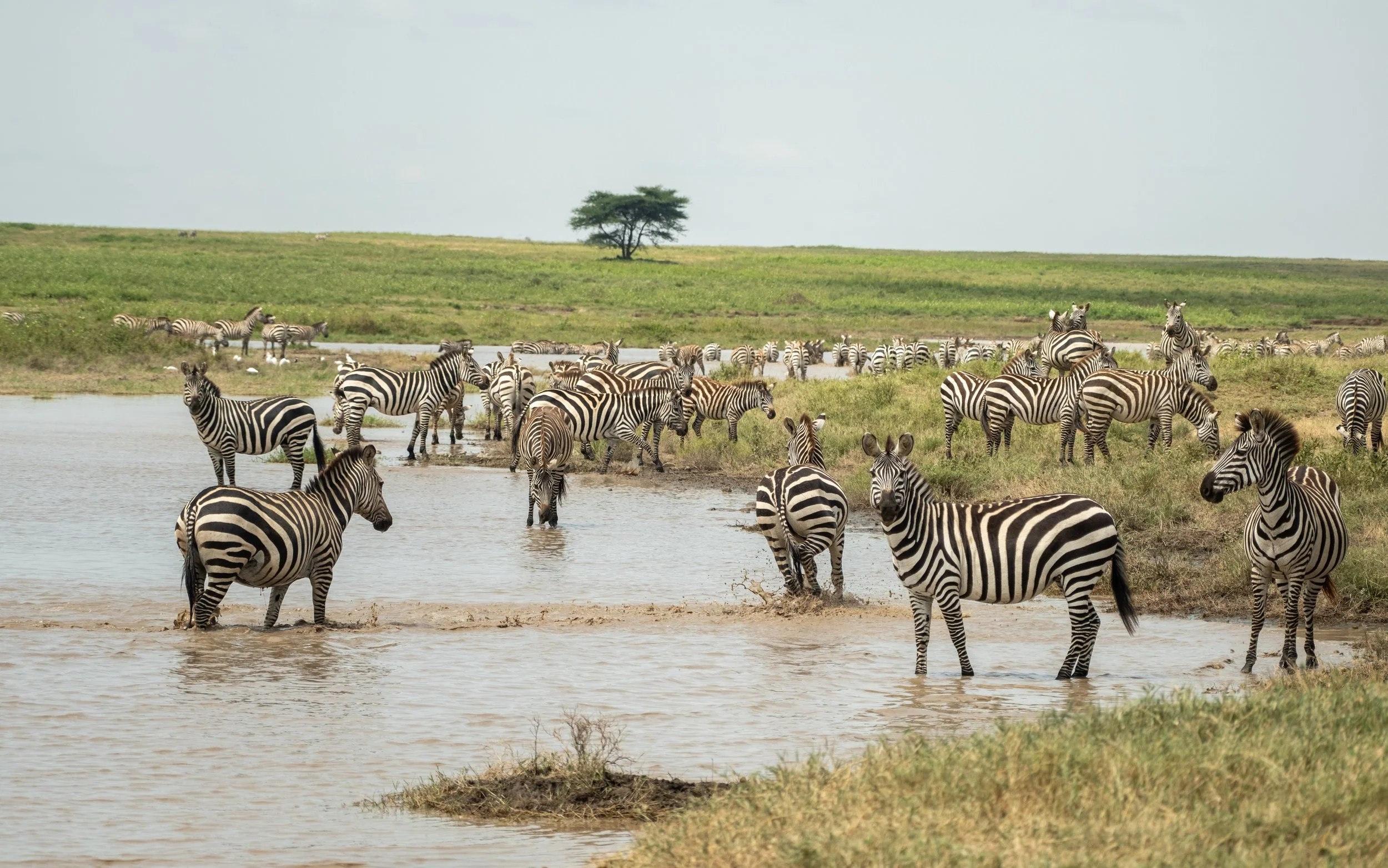
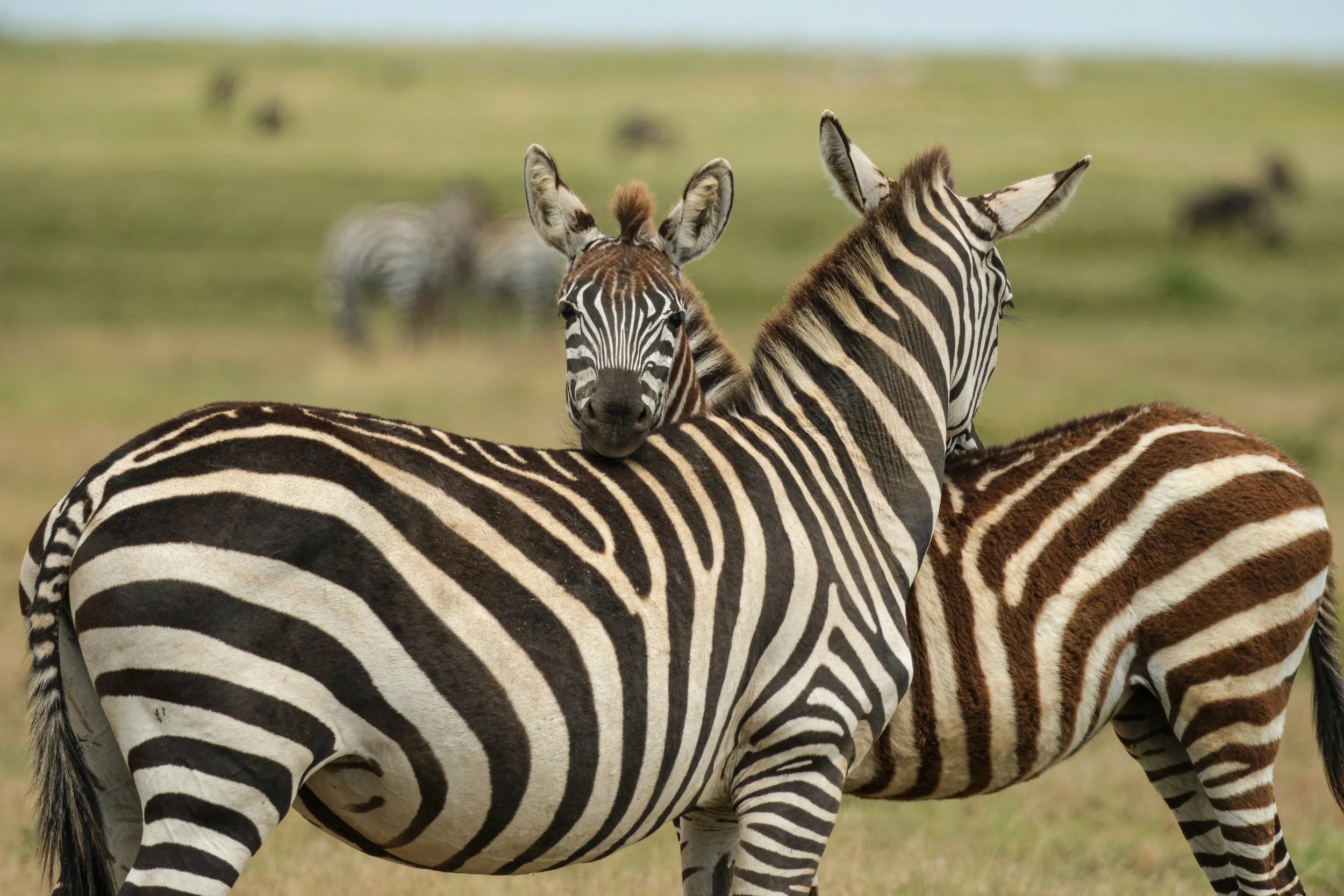
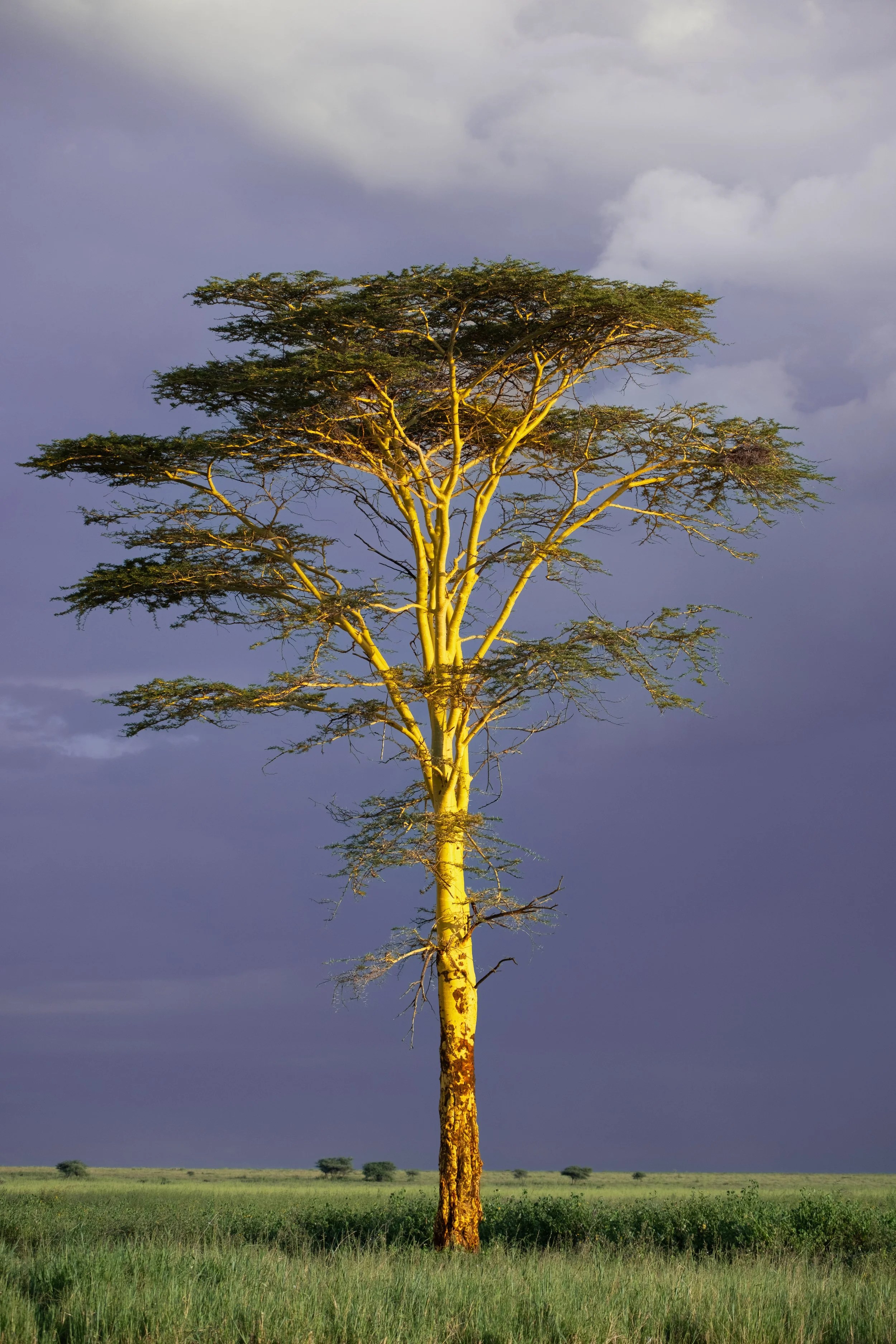
Seeing the beginning of the annual animal migration in the Serengeti. During our week at Namiri Plains, the head of the annual migration was just starting to arrive in our section of the Serengeti. Very early days but you could get a sense for the magnitude of the river of animals that would be in full spate over the next couple of months. As they follow the rains from the southern Serengeti, the animals travel hundreds of kilometres and cross many rivers from the southern Serengeti in Tanzania across the border into Kenya and into the Masai Mara. Over 2 million wildebeest and zebras as well as a host of predators, lions and cheetah and all the assorted scavengers and plunderers who join the feast, make a massive annual trek to keep pace with the fresh grasses and pasturage that the rains bring. It is stunning in its enormity and seeing even the beginning of the trek is awe-inspiring. When we arrived and drove from the airstrip to our camp, the savanna contained the usual numbers of antelope in herds, Thompson and Grants gazelles, topis, hartebeest, elands and kudu, nothing out of the ordinary. But as we went exploring in our Land Rover over the week we noticed more and more wildebeest and zebras in very large groups beginning to be scattered across the landscape. When we drove to the airstrip to leave on our last day, we looked north and there across the horizon was a long black line of animals slowly walking their way across the landscape. A thin black line that held the promise of the millions that would soon be filling the countryside as far as the eye could see.
Zebra beginning to collect for the Migration ahead of the wildebeest
One of the pleasures and interests that have taken us to the particular places that we have visited in Southern and East Africa is seeing and spending time with big cats but more especially with cheetah. I have always been fascinated by these animals certainly by their skills, speed and lithe beauty but also by the very narrow ecological niche that they fill, it’s almost surprising that they continue to exist at all. They have only one superb capability, their speed. Yes, they also have wonderful eyesight and other useful tools for their trade but speed is their essential and defining characteristic, but they have made an evolutionary bargain which puts them at enormous risk. In exchange for their speed and dexterity they have stripped their body down to a minimum to reduce their mass; their legs are very thin, their body is built for aerodynamics not heavily muscled for defence, they are slender, weighing about 56 kg and to generate their instant speed their metabolism must run at a very high pitch, therefore they need to constantly hunt to fuel up. But because they have traded away their mass and size to gain speed they are the targets for every other predator including all the other cats but more especially hyenas. Racing an antelope at 110 kph and making a kill is exhausting in the extreme but keeping their kill can be an even more demanding problem. They are routinely chased off their meals by hyenas who wait for the cheetah to do the hard work and then take over. An added consideration, they do not live/hunt in groups but like almost all other cats they are solitary, so for a mother cheetah to raise a couple of cubs, the drain on their physical resources arising from the need to continually hunt, can be overwhelming.
Male cheetah often form coalitions with brothers across birth cycles who then hunt as a pack. We have followed coalitions of up to 5 cheetah brothers who hunt this way, which reduces the stress load of solo hunting and can act as a better deterrent when hyena come calling. In fact on our first trip to Southern Africa in 2012 we spent time on a number of occasions, watching three cheetah brothers who worked as a coalition, at Tswalu in the Kalahari. We were surprised and delighted when we returned there in 2022 to see two of the three brothers still together working as a unit. At that point they were about 15 years old, a very impressive age for a cheetah and still in good health but when the inevitable catches up with one of them, the other’s life will be measured in days. For fairly obvious reasons this is not a strategy available to cheetah females so for me the mother cheetah is the heroine of the cat world.
I love all cats but my real passion is reserved for the cheetah, and especially for the female.
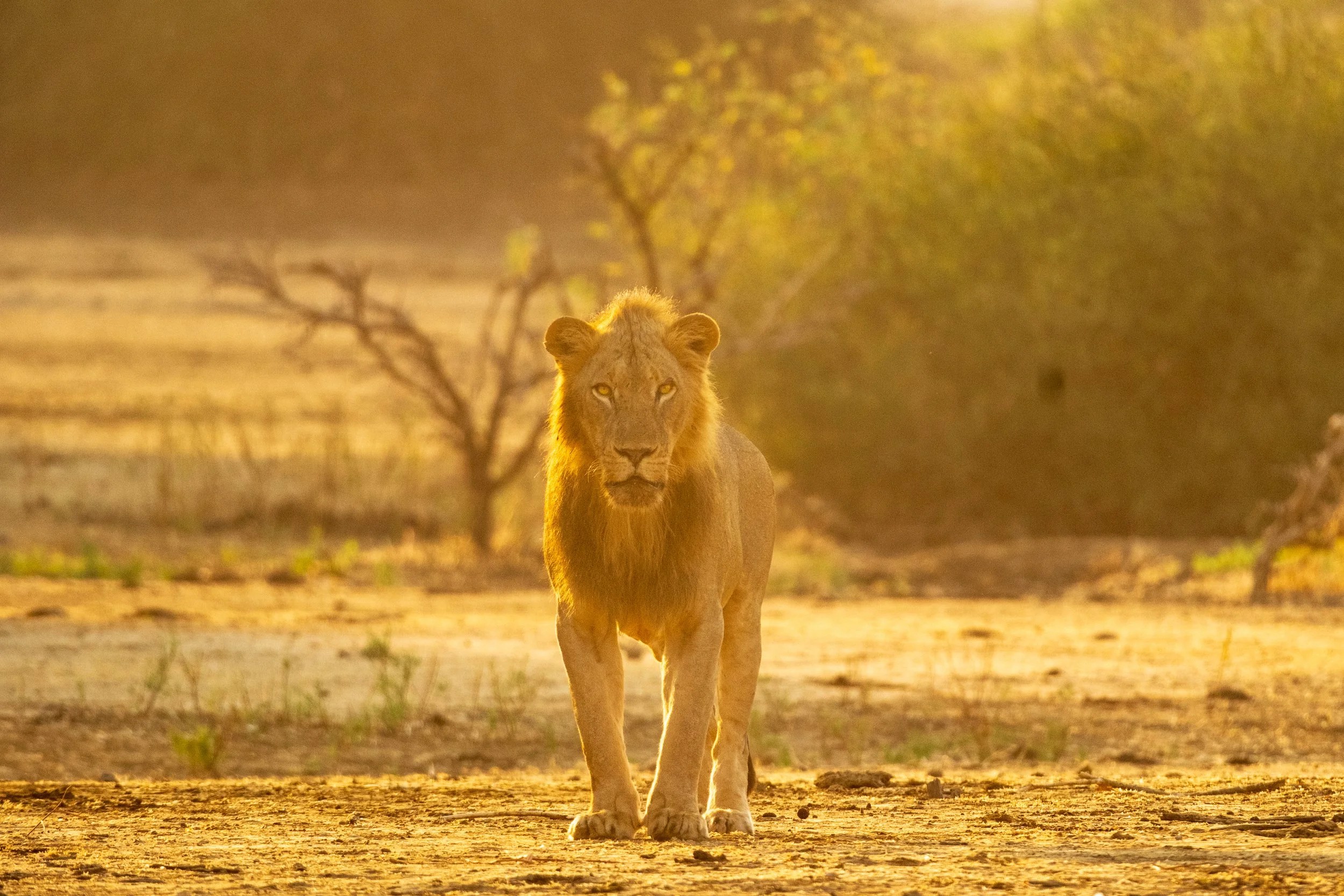
Sunrise Lion, ZambiaMale lion track, what we are all on the watch for
Lions, the thugs of the cat world, have sorted this problem out. The males may fight for domination inside the pride but when they go hunting they put all that aside and take the whole family unit to help chase and carry the groceries. In truth, it’s really the females who do most of the hunting but the males are there in a support role and take over the kill as soon as the work is done. The fight for domination begins again over dinner, they are totally self-interested when they eat and the weak go the wall, but they perform as a unit to deliver the meals.
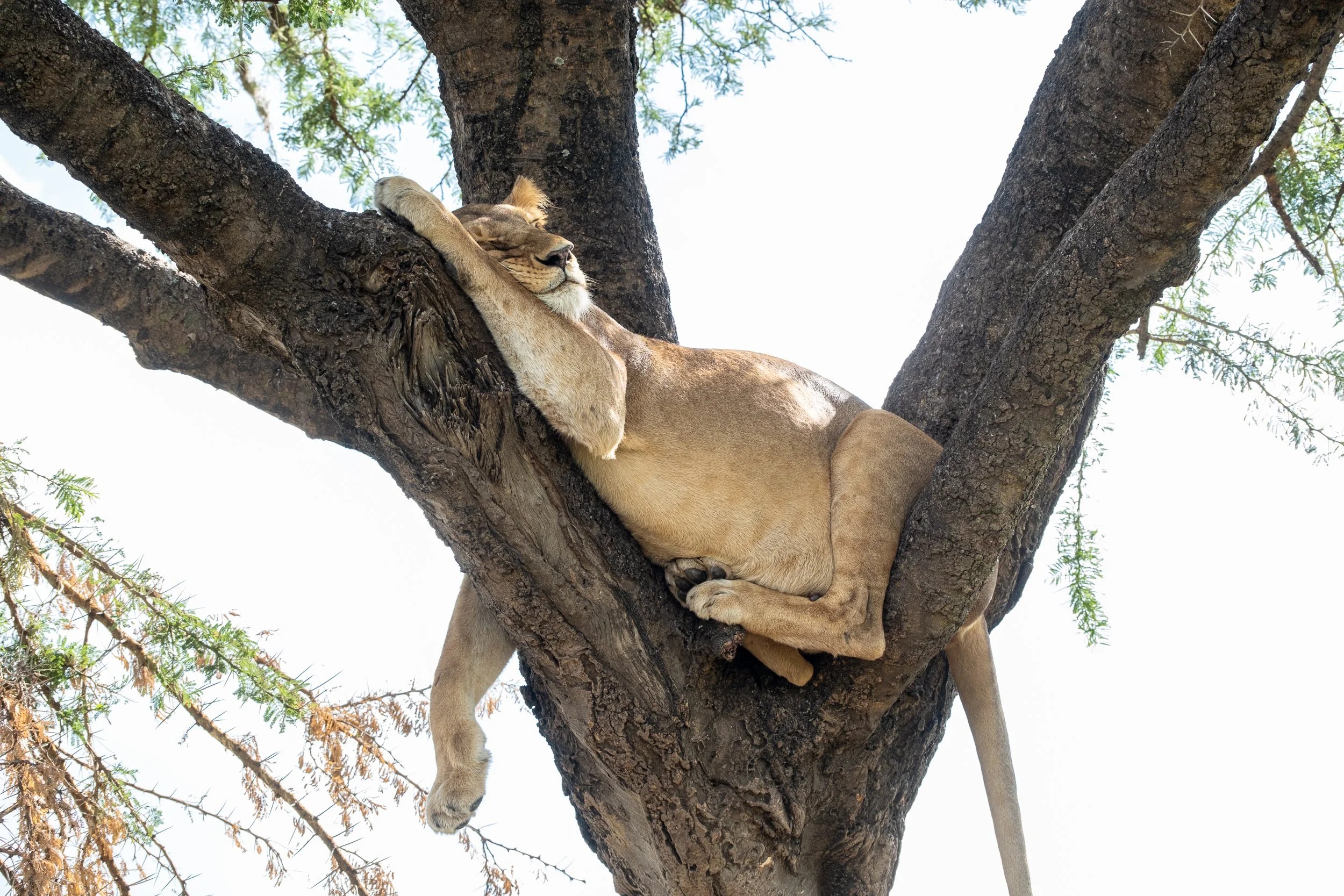
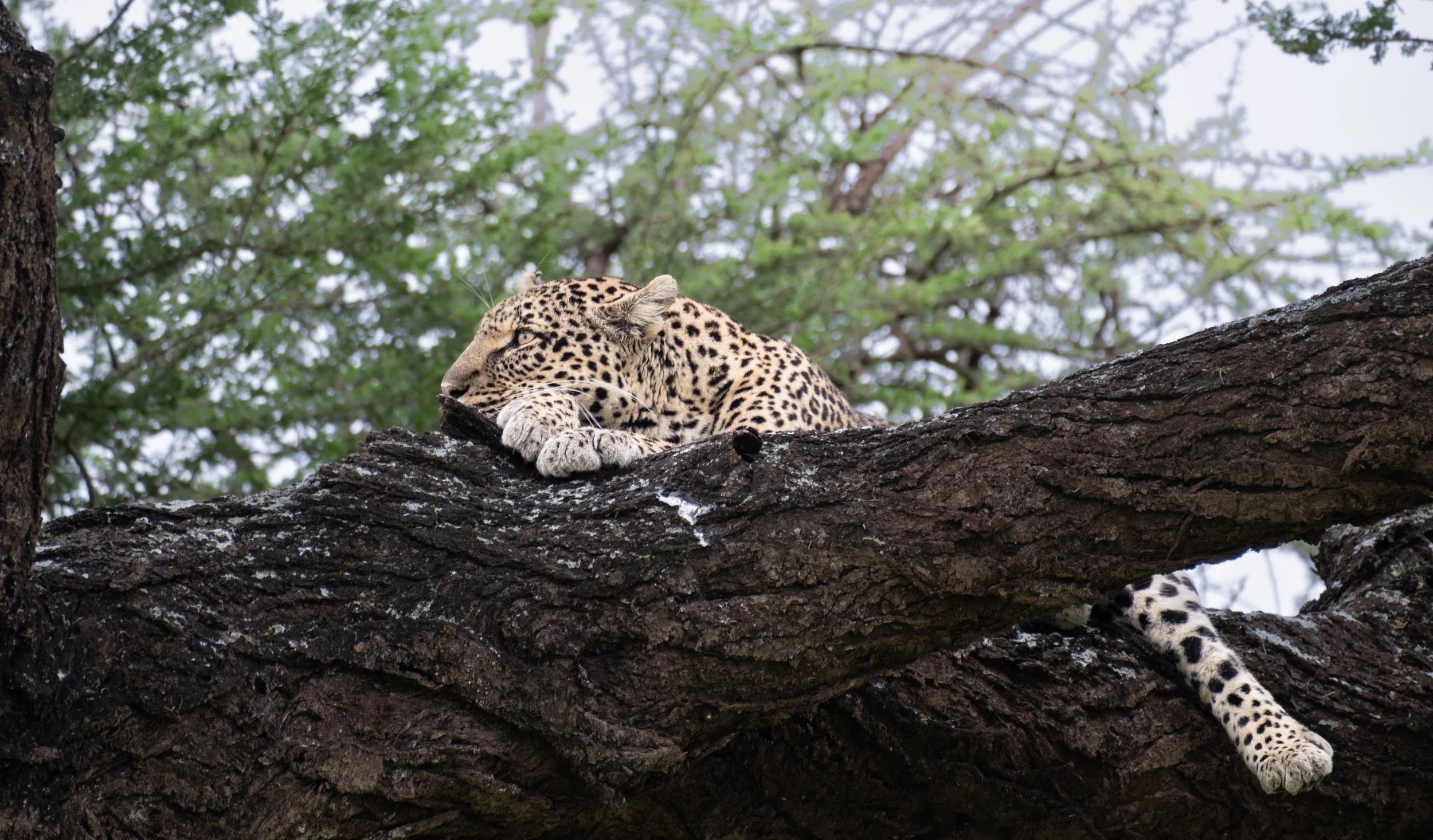
I hope this settles the argument once and for all, lions can and do climb trees, although rarely. Pregnant lioness about 4 metres up in the crook of an acacia.
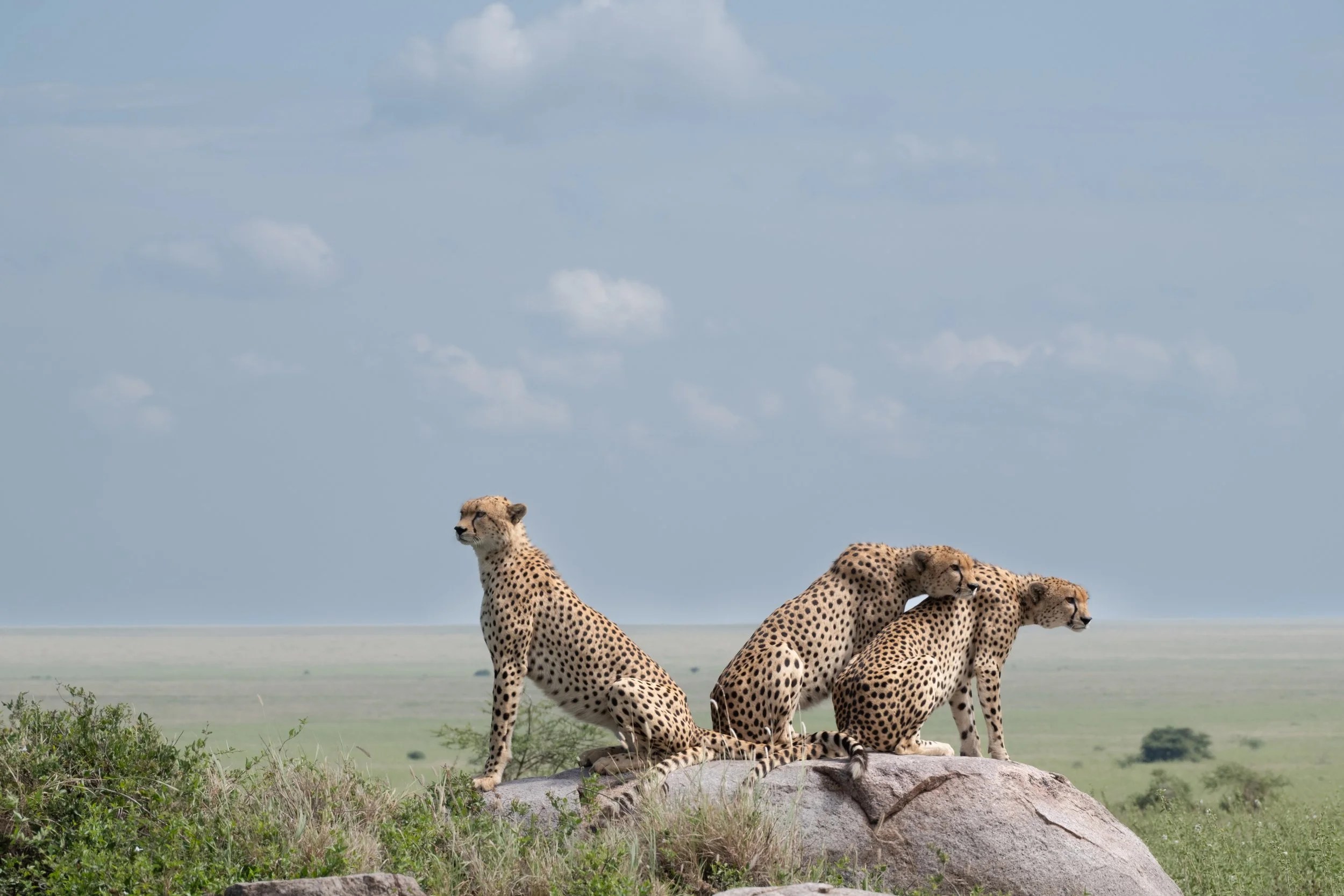
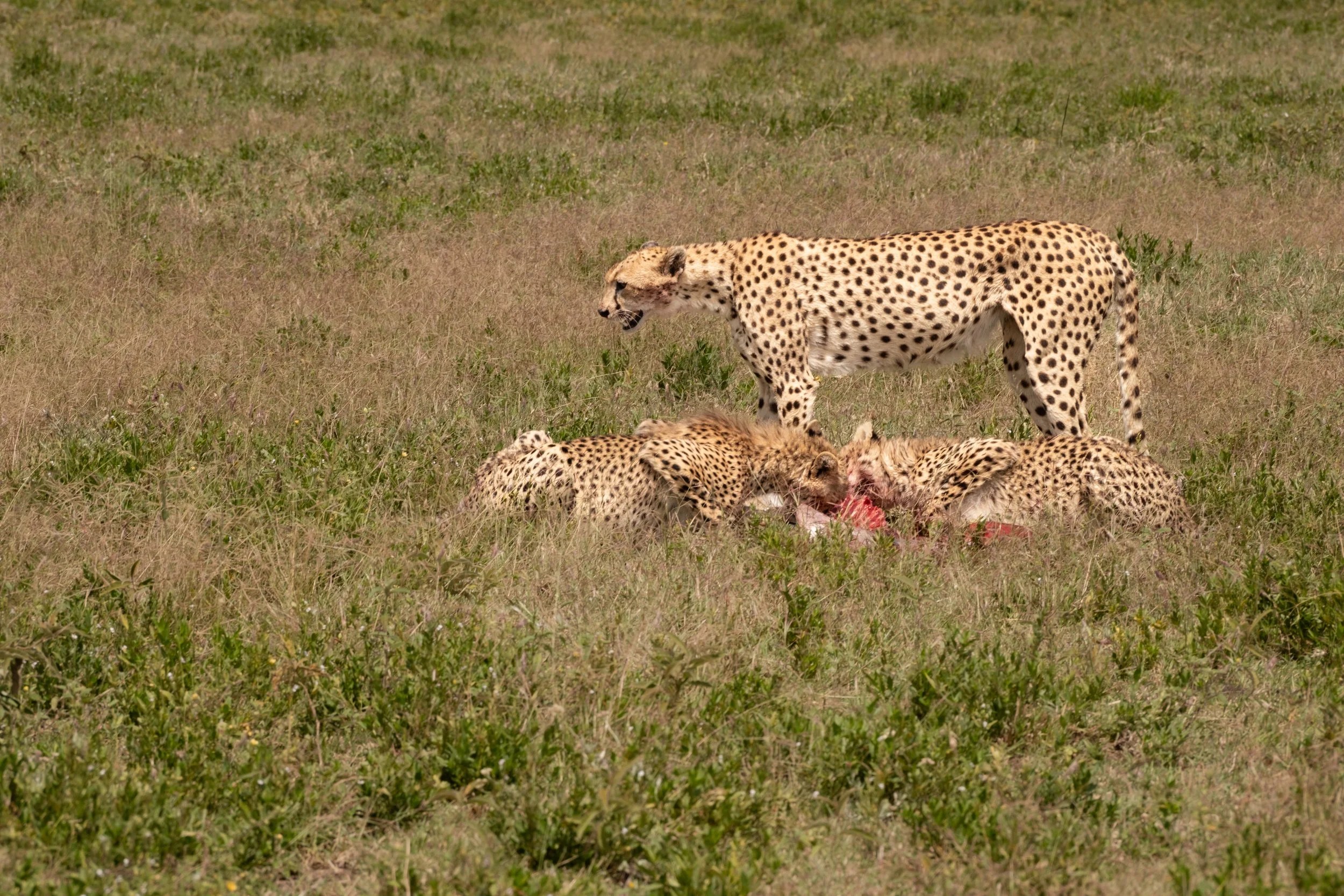
A coalition of 3 cheetah brothers, surveying the landscape, Namiri Plains, Serengeti
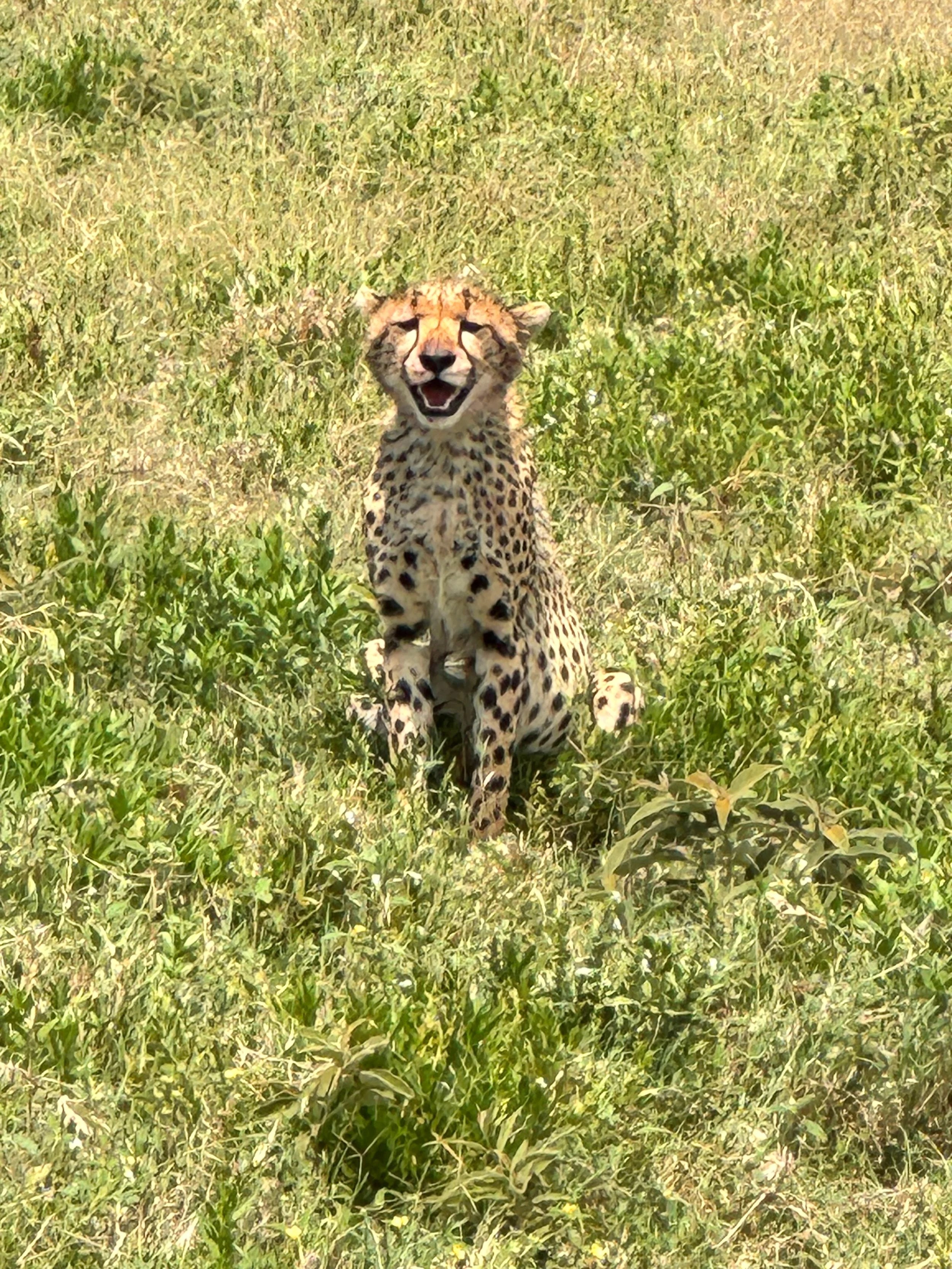
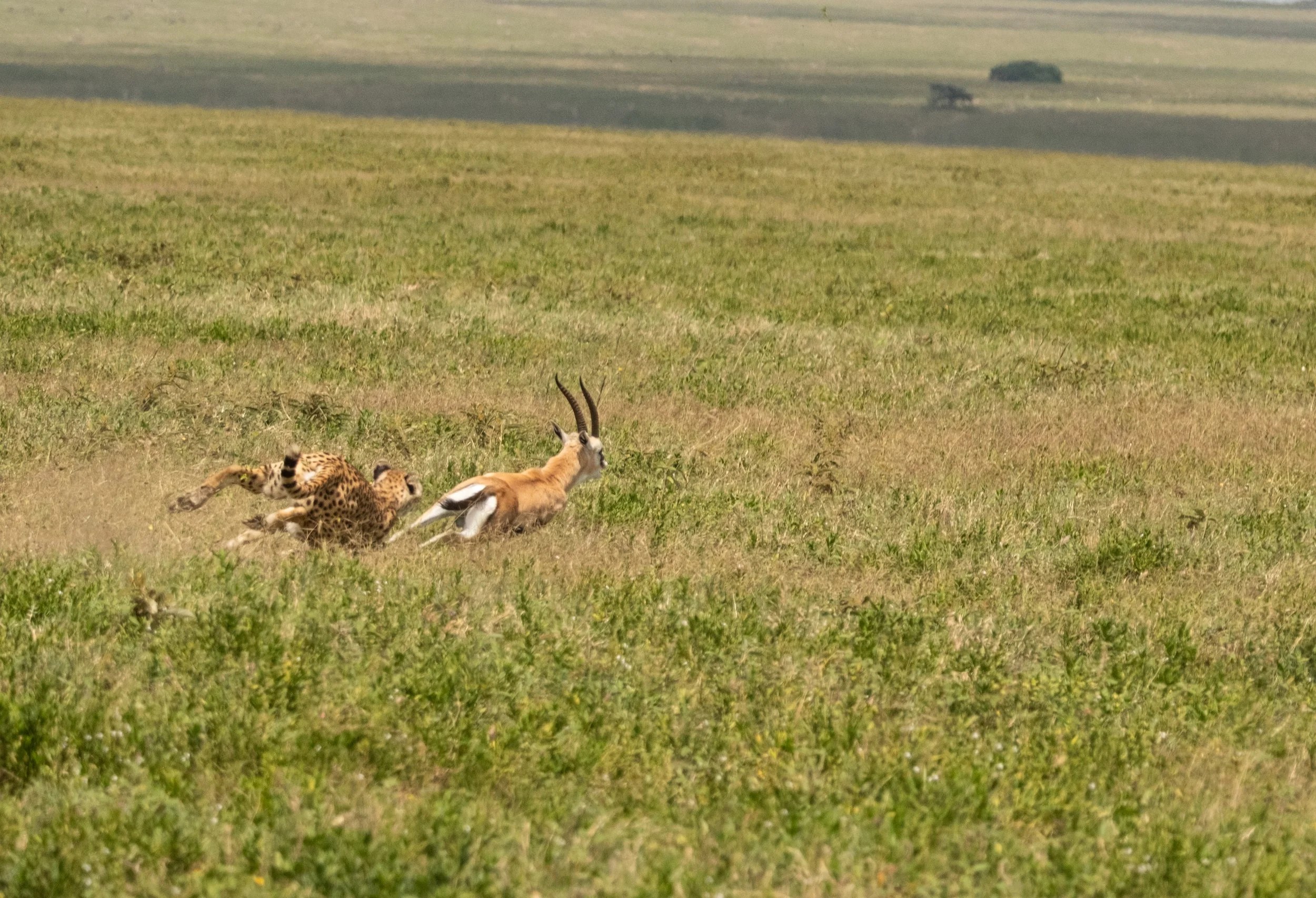
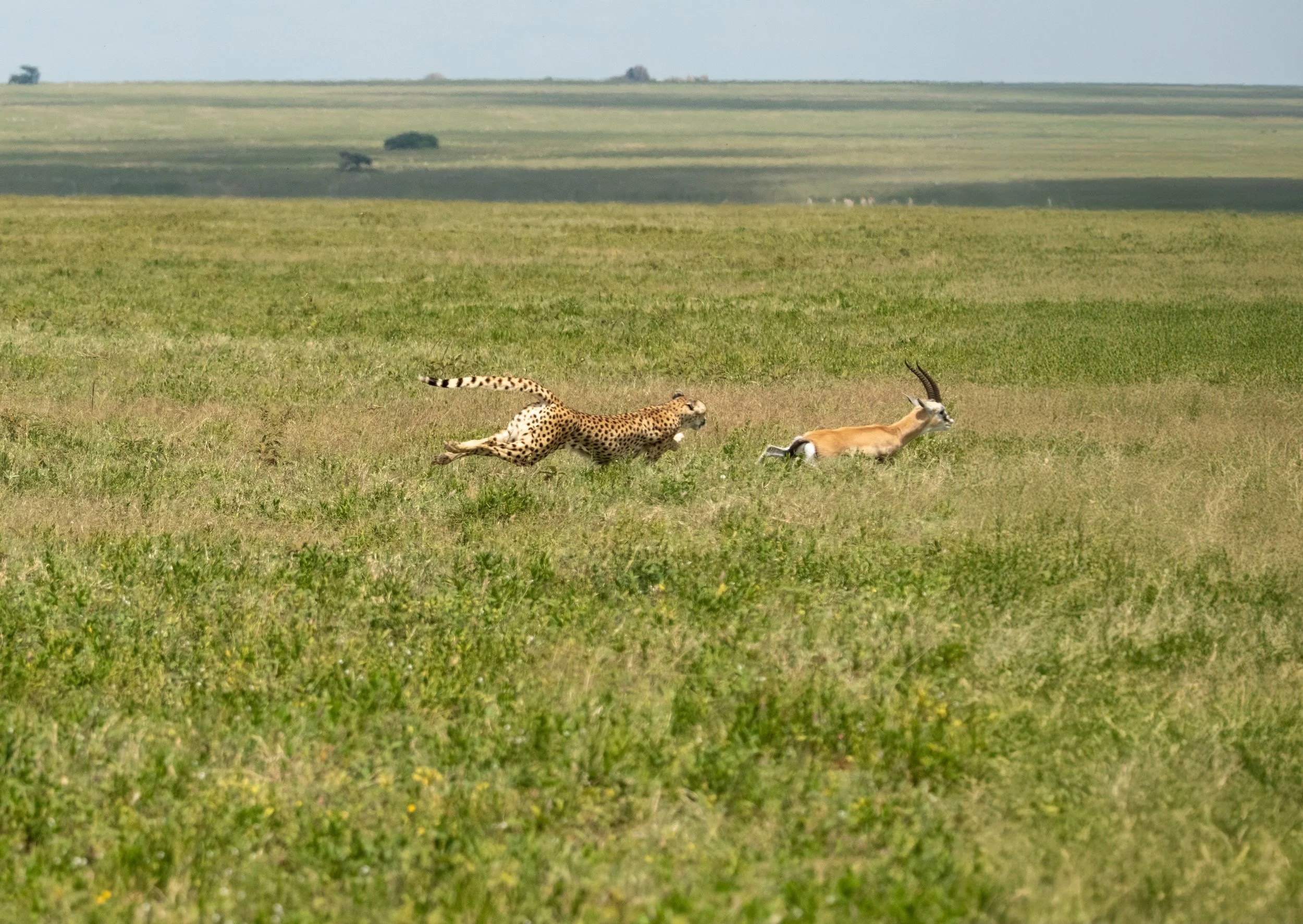
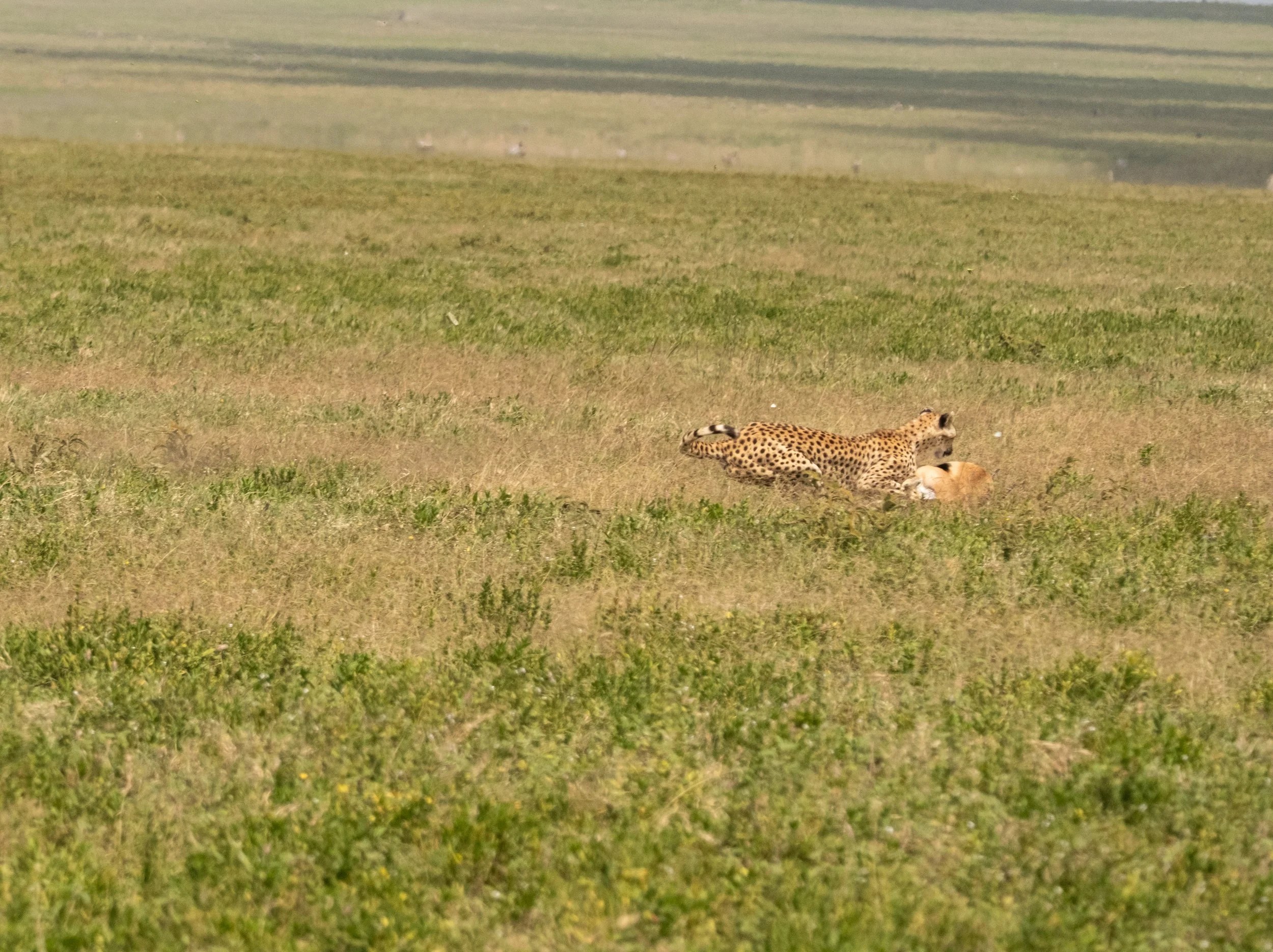
So, while we have followed and spent considerable time with cheetahs over the years, this trip to the Serengeti allowed us to see something that we had never previously seen and which created a highly-charged memory, a successful cheetah hunt. In fact we saw two of these and on both occasions a day apart, they were both carried out by the same cheetah mother.
Mum and the more robust cub were in a good situation, downwind of all of the antelope so it was a case of trying not to be spotted. Periodically, a zebra would notice them, alarm call and all the antelope would try and spot what and where the source of the alarm call was. They would stay on high alert for 3 or 4 minutes but would eventually calm down and go back to grazing. The hunting process can take quite some time as they painstakingly edge their way to within 70 or 80 metres of an antelope or a small herd without being noticed. Within this distance they are close enough to try, and with their speed and with the element of surprise they can usually capture a meal.
While this process continued, we were swarmed by bees who our guide surmised were looking for a location to establish a new colony and were moving their queen. Apparently they had decided that a safari vehicle might just be the perfect spot for a new hive. We tried moving our vehicle a number of times but the bees persisted. The other vehicles left in short order and we were left to watch the hunt on our own. Personally I do not worry about bees, they do not sting unless provoked so I did not pay them any attention and never felt any concern that we would have a problem. They buzzed and wandered around our vehicle while our guide, who claimed that he too had no problems with bees, wrapped his head in his scarf until only his eyes could be seen and madly sprayed the vehicle, us, the bees and the entire environment with some sort of insect spray which was hugely unpleasant for the human occupants but had no noticeable effect on the bees. V was not having a very happy time, is very nervous around bees and following advice, was desperately trying to subdue her instinct to swat anything that moved.
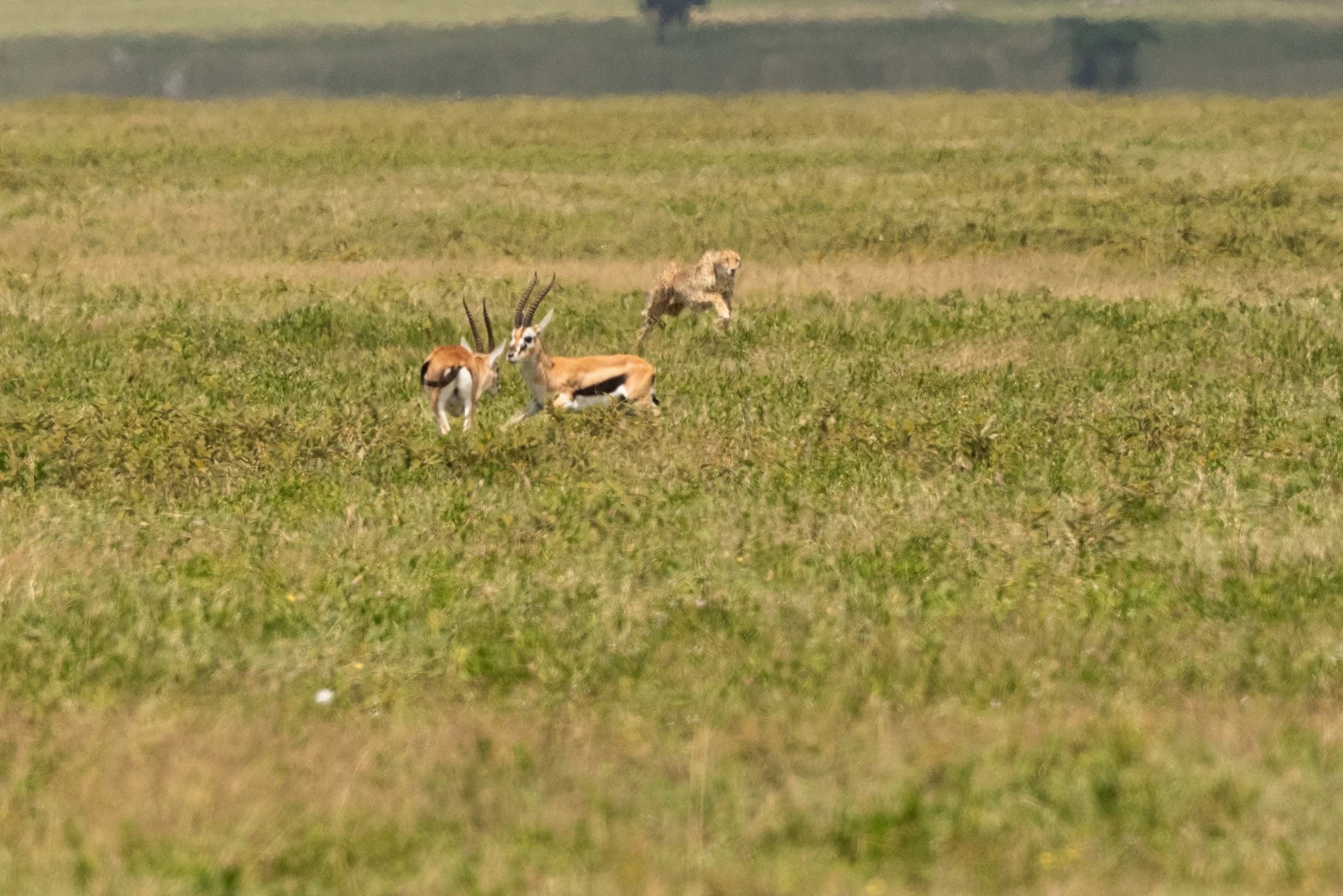
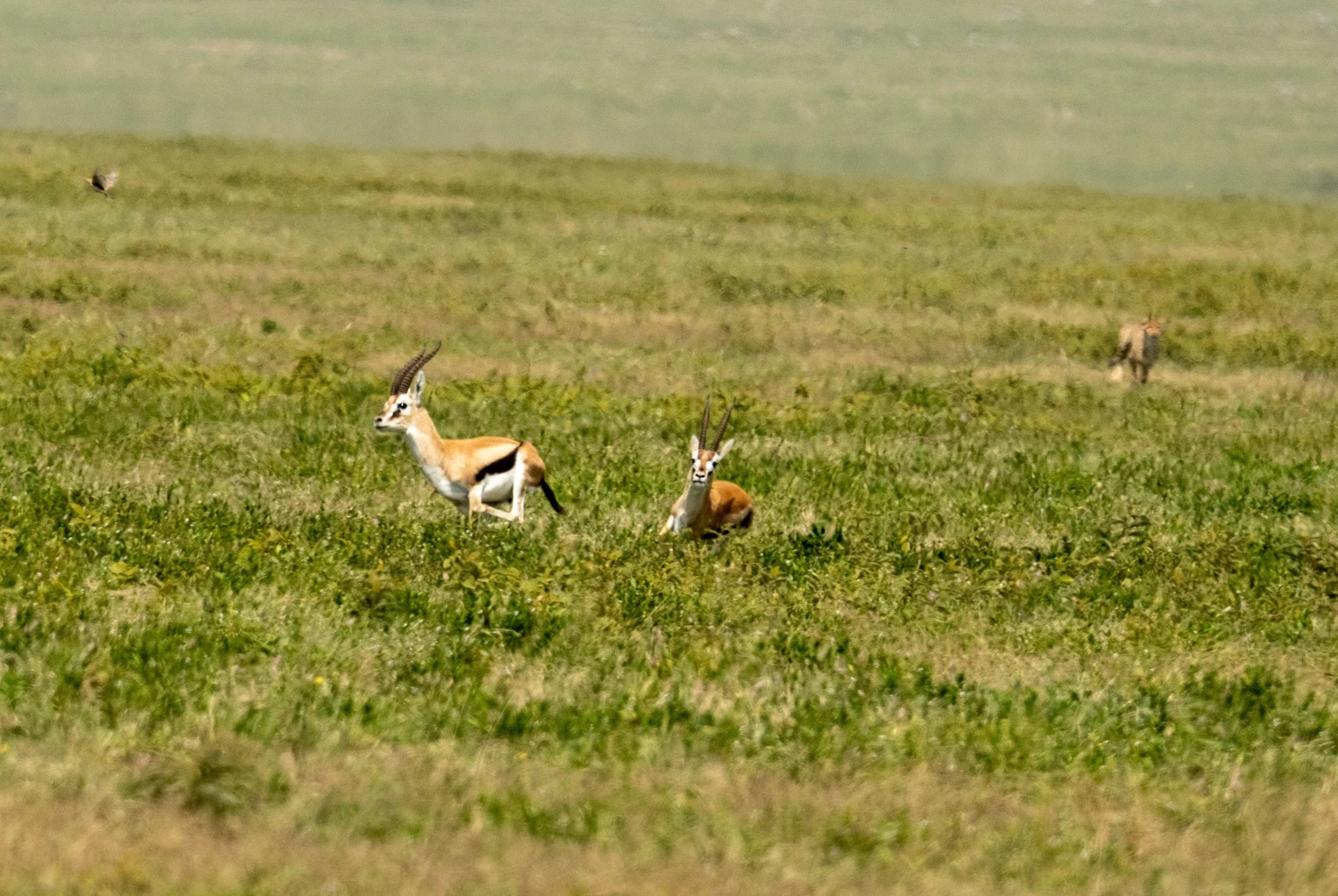
And then we saw that the cheetah mum had managed to place herself within striking distance of a small group of Tommy gazelles without being spotted and it was going to be a matter of seconds before she moved. I had my camera at the ready but I defy anyone who has not spent years practising, to keep a cheetah racing at 90 or 100 kph, in the viewfinder of a 400mm lens, just not possible. She raced behind her chosen Tommy from our left to our right directly across in front of our vehicle about 20 metres away, the Tommy made a 180 degree turn just to the right of our vehicle and they raced back across our front and then about 30 metres away, it was all over. The more robust cub came racing in help his mum finish the business and did his best while his mum fought for breath, every breath and every heartbeat shaking her entire frame.
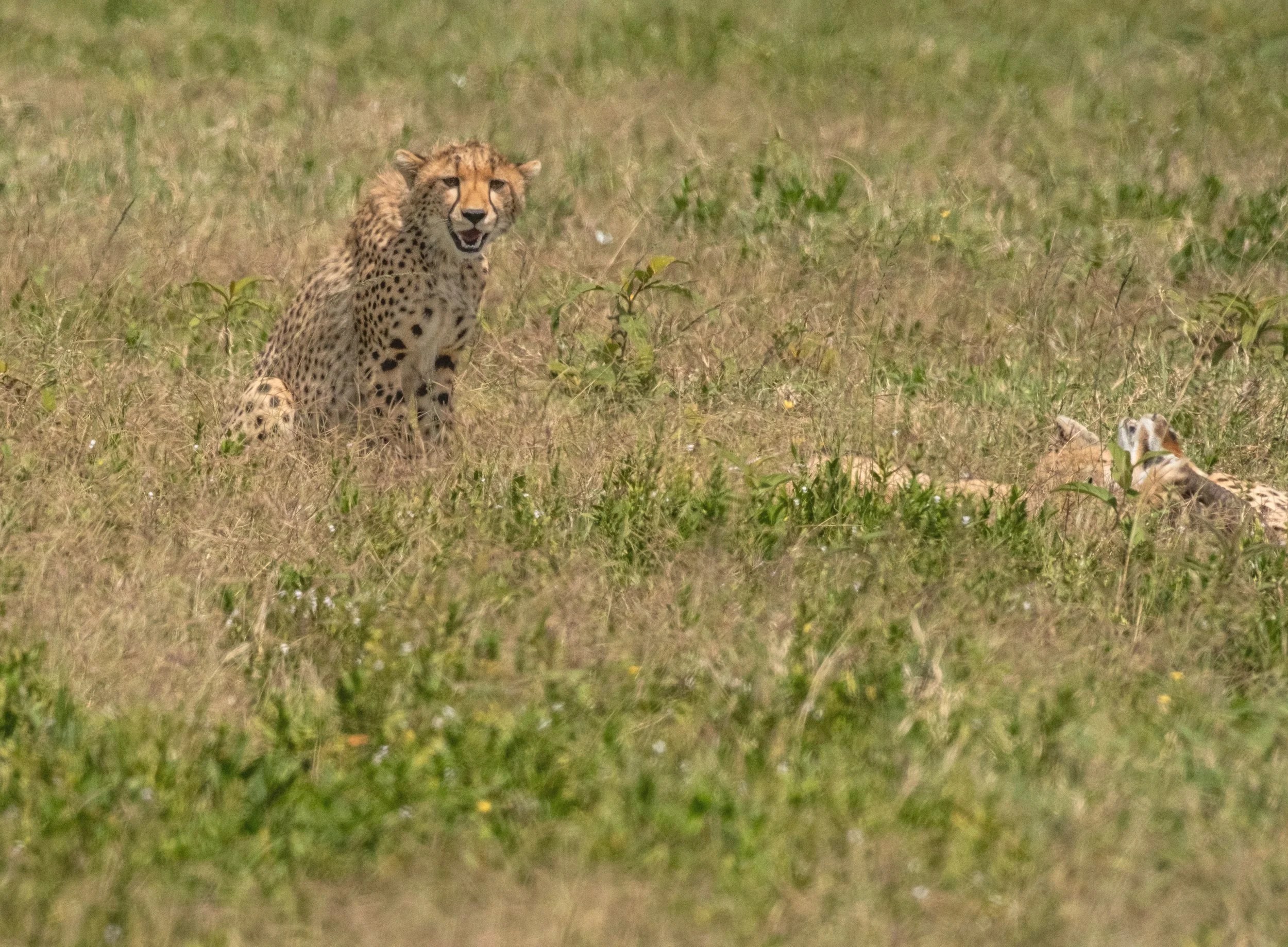
The weak and struggling cub was a few hundred meres away from the action where he had wandered off, and was calling for his mother, with no idea where everyone was. Now here’s the remarkable thing, the mother and the other son did not touch the gazelle, hungry as they were but were clearly waiting for the little one to find them. Mum continued calling but the little one didn’t seem to be able to hear her over his own cries. We watched the cub with great anxiety, wondering if he would find them or be picked off by a stray hyena following up on the hunt. It took about 10 minutes as the little cub wandered aimlessly calling for help before he finally heard mum and managed to find his way to the kill. We quite literally cheered when he arrived on the scene and then the three cats made up for lost time and took full advantage of the meal on offer.
The three of us in the vehicle, the guide, V and I agreed to bend the rules in favour of the cheetah family and so we determined that we would stay with the cheetah and if any hyena came along that we would chase them off and give the family a chance to make it through to another day. There are strict regulations prohibiting anyone from interfering with the animals and their natural behaviours so we would very definitely have crossed a line had we done so. Fortunately we did not have to intervene, no hyena having spotted the hunt, so we spent a leisurely 30 minutes watching them make a very good meal. Had we intervened I definitely would not have recorded it in the blog.
Interestingly, while the bees continued to buzz around, during and after the hunt not another word was spoken about them, in fact no one even appeared to take notice of the fact that they were still there. There’s a lesson in there somewhere.
The first week of our trip was spent on the Serengeti, one of our favourite places in the world, not least because it’s one of the best places to spend time with cheetah. We travelled there because of our classic rationale, ‘since we’re going anyway, we might as well…’. In this case, since we were going to Zambia anyway, we thought that might as well stop in the Serengeti along the way. However, after the Serengeti our next 10 days journey took us, for the first time, to Zambia. Zambia was the location of and the catalyst for the trip. We were there to help our friends Rich and Susie celebrate their engagement 16 years before on the banks of the Luangwa River, a major tributary of the Zambezi River in north-eastern Zambia. And not only their engagement but their successes in the following years including managing a safari camp on the river where Rich proposed, right next to one of the camps where we stayed and the successful travel planning business that Susie has built after their camp management experience. And last but certainly not least, a very happy family partnership with two wonderful kids.
In fact Susie has planned and had a hand in every one of the 7 trips that we had previously made to Southern Africa as well as organizing trips for a large number of friends and family over the years. She is a remarkable woman and we wouldn’t travel to sub-Saharan Africa without involving her.
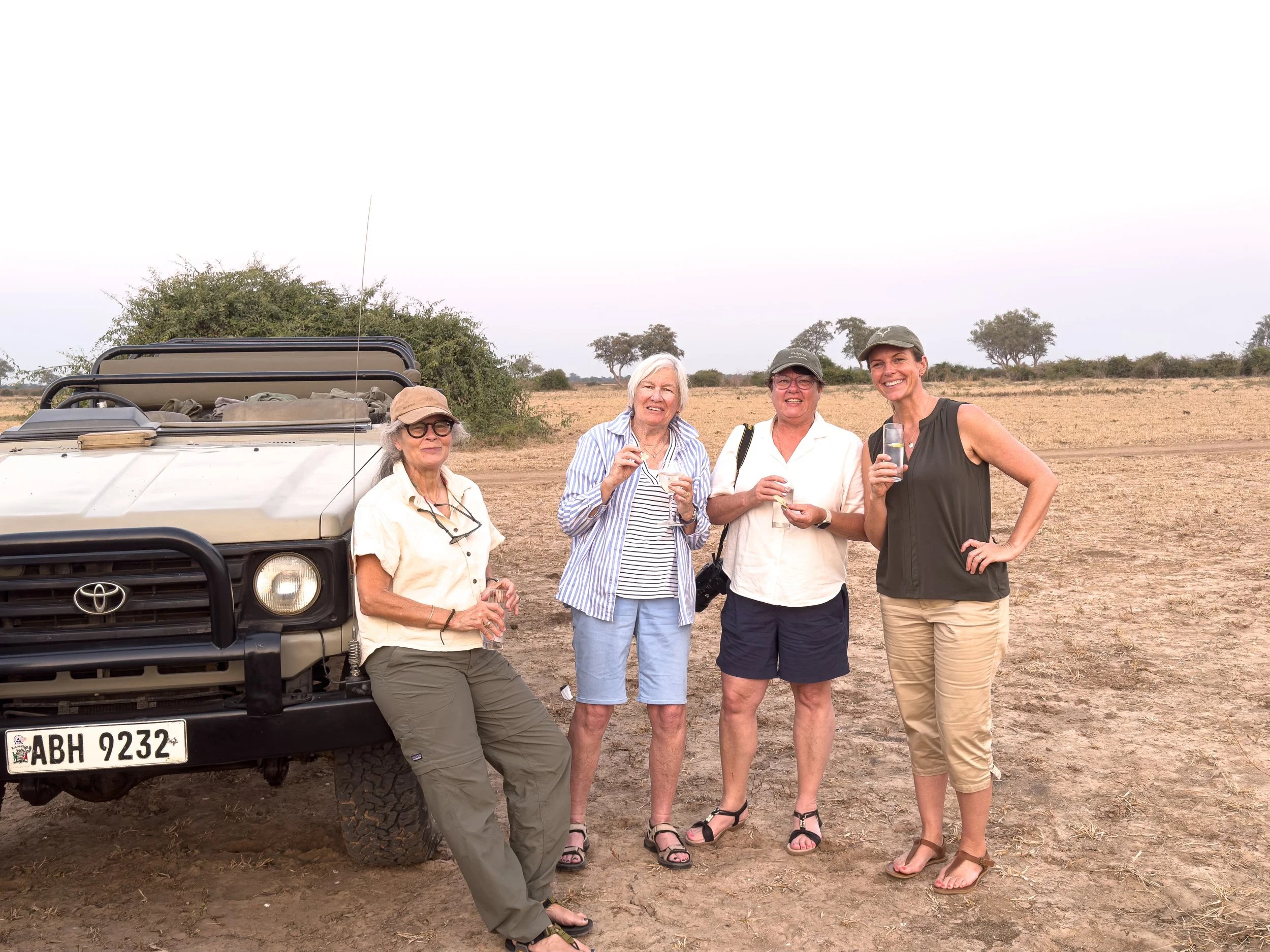
This trip was the first time that Rich and Susie had returned to the area since they had left the camp that they managed so a nostalgic homecoming. Susie had invited a couple of clients who have become very good friends to help them celebrate and so in addition to R&S our group included V and I, two other Canadians, Hazel and her partner Tim and two lovely American women from the Southern US, psychotherapists both who have known each other since university days. Hazel was my successor as CEO of the company that I ran prior to my retirement. She and Tim have also been bitten by the Africa bug and in fact introduced me to Susie in 2011. They are both old Africa hands so it was a very congenial group with a lot of shared experience.
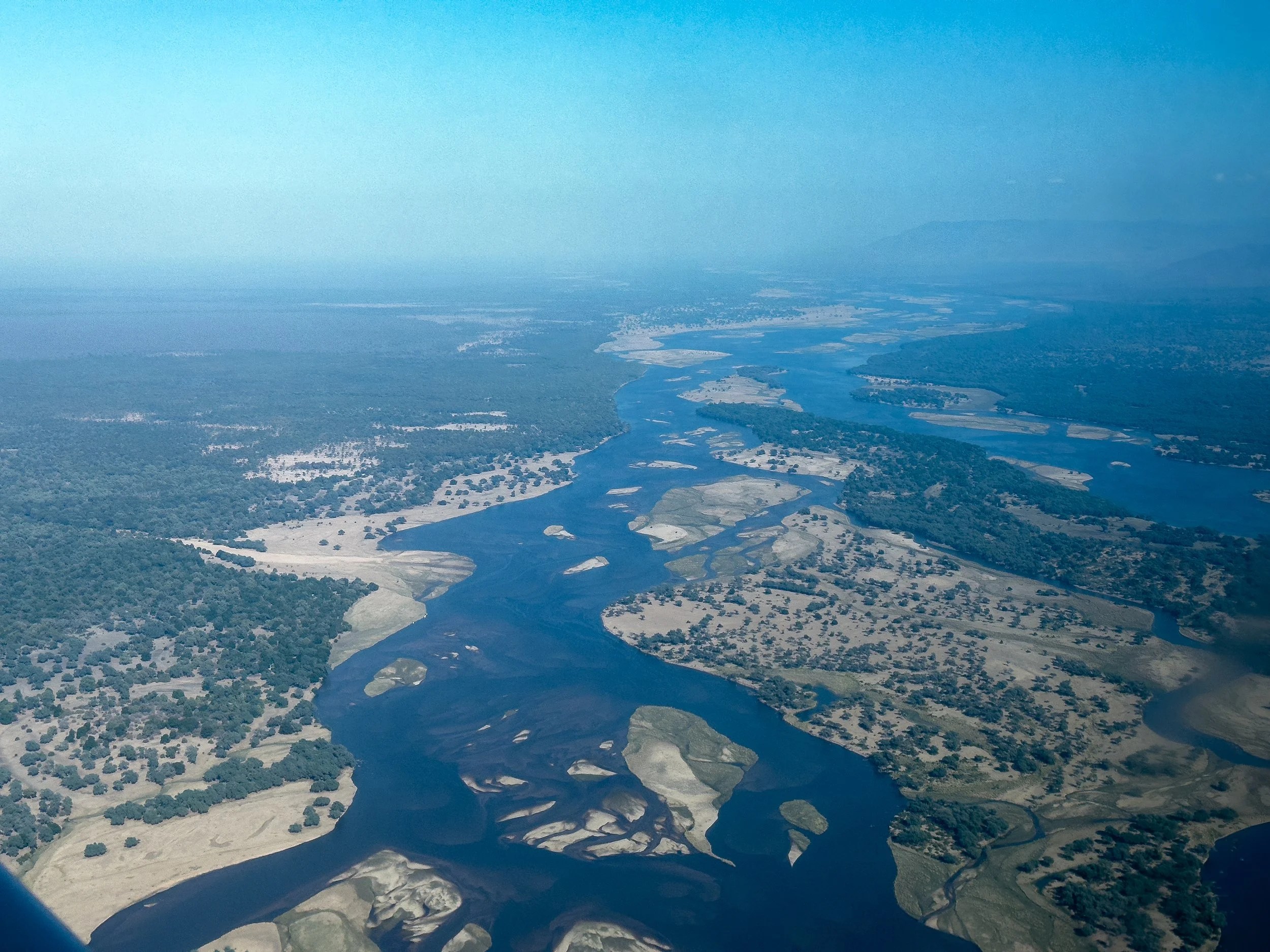
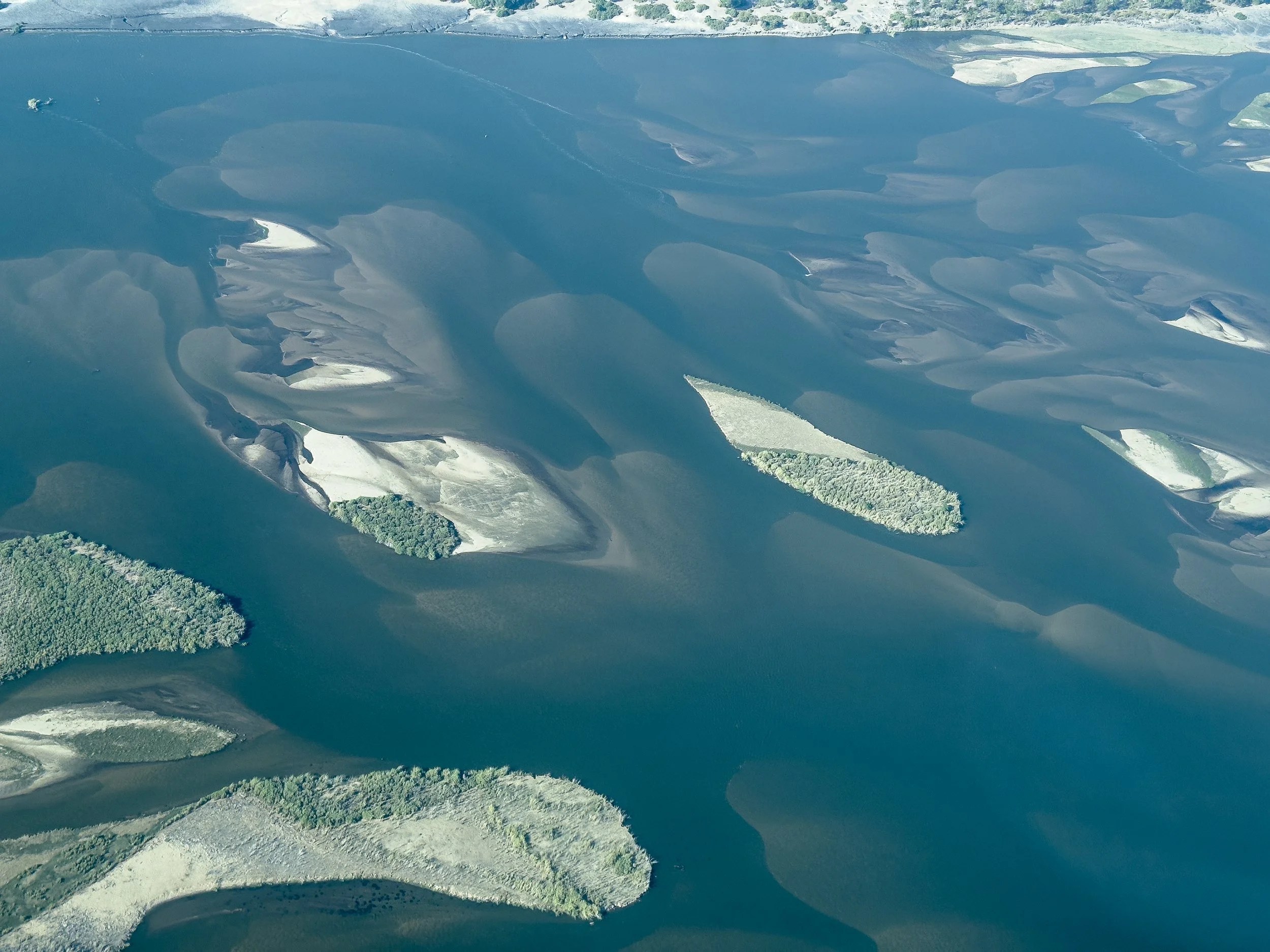
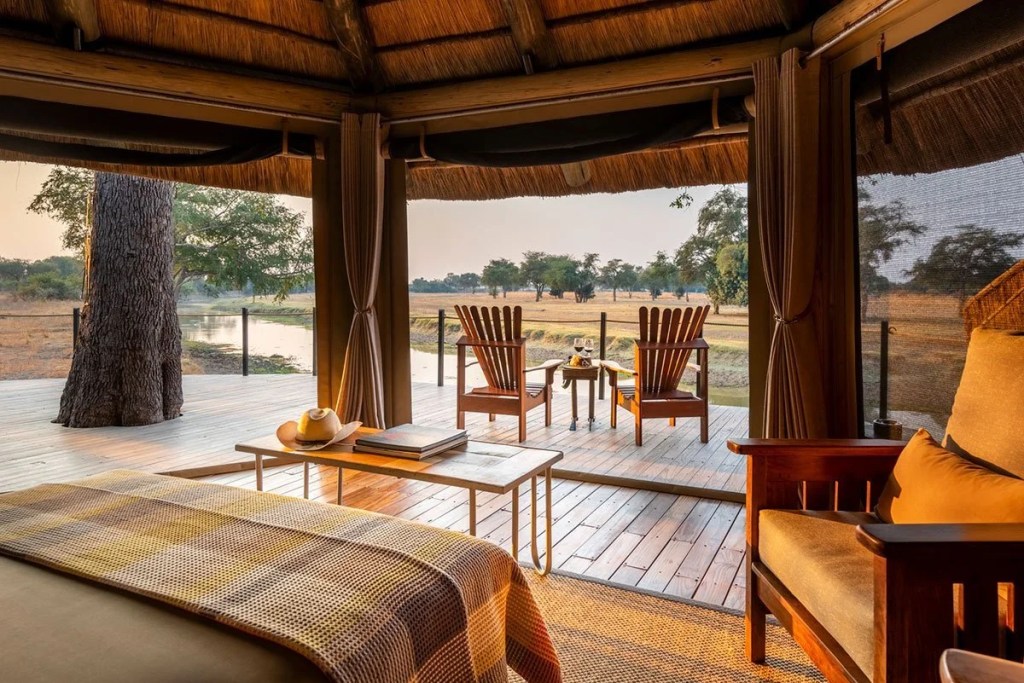
We spent our first 7 days with the group in two camps on the Luangwa River where Susie and Rich were engaged and managed their camp. On our final three days we left the Luangwa River to fly down to the Zambezi River, which forms the southern border of Zambia between Zambia and Zimbabwe. The Zambezi, a river out of my romantic childhood imaginings of Africa, populated by Dr Livingstone and legions of heroic British explorers and formed by Boys Own Annual and Just So Stories, did not live up to my youthful imaginings. In place of the dark, dank, heavily treed and dangerous region of my childhood expectations, it was wide, clear , sunlit and open, bordered by areas of very tall grasses as well as by sections of tall trees and bush. I had expected The African Queen and Humphrey Bogart and instead I found a deceptively pleasant and sunny landscape with nothing threatening to be seen wherever I looked.
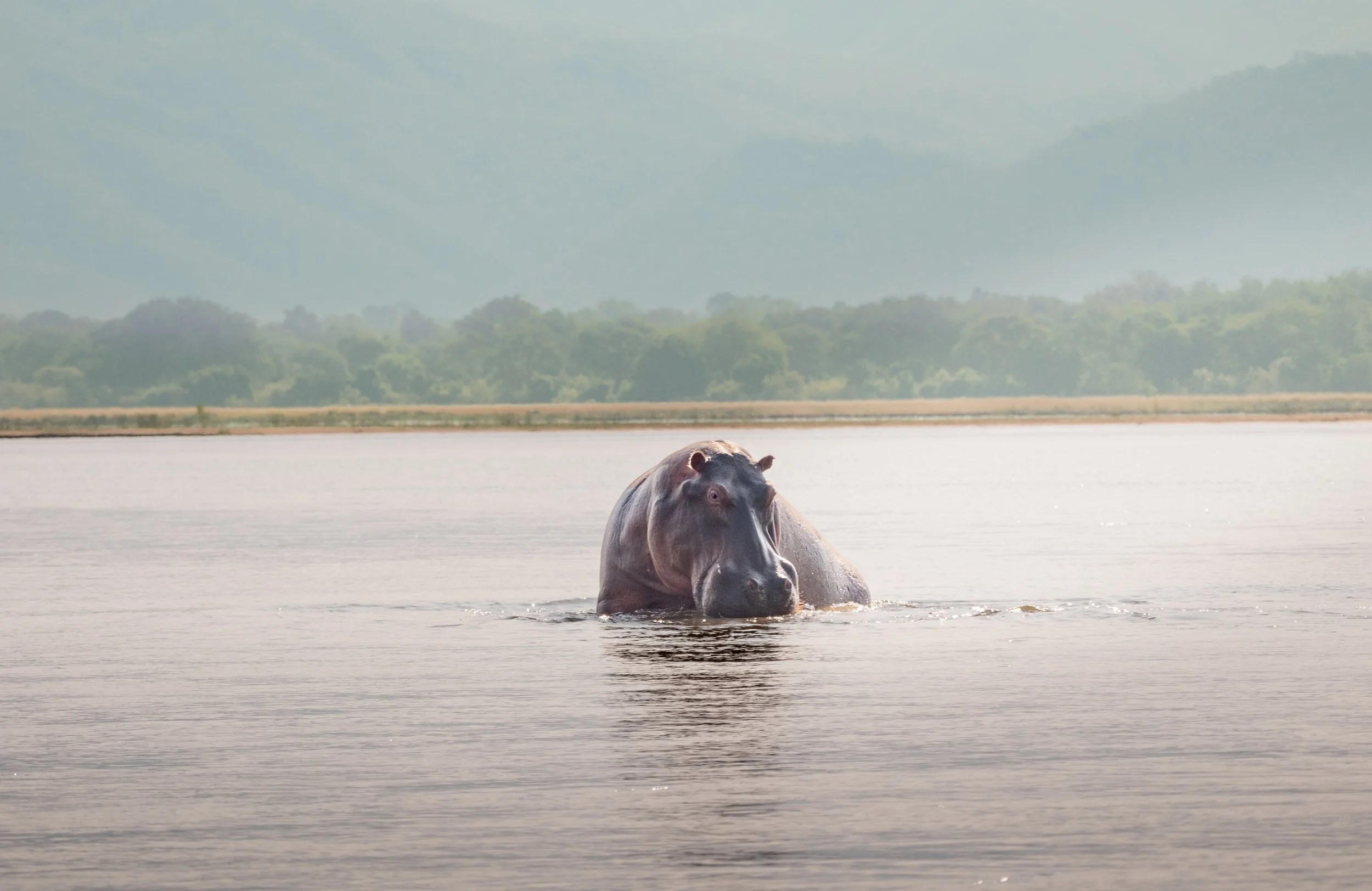
Hippo giving us a beady look…
I say deceptively however because we were continually surrounded by the most dangerous mammal in Africa, the hippo. Hippos can run at speeds of over 30kph on land, can weigh over 1500 kilos, and a male hippo’s canine teeth can exceed 50 centimetres in length, but most importantly they are extremely territorial and do not hesitate to charge. Hippos are responsible for more than 500 deaths a year in Africa, more than any other mammal. In fact, in our Zambezi camp two days before our arrival, one of the guests was attacked and killed by a hippo and her companion was severely injured. Needless to say, the staff were in shock but there was no fault on anyone’s part, it was simply a tragic accident. Hippos are not things of beauty, neither are they a creature to be taken lightly.
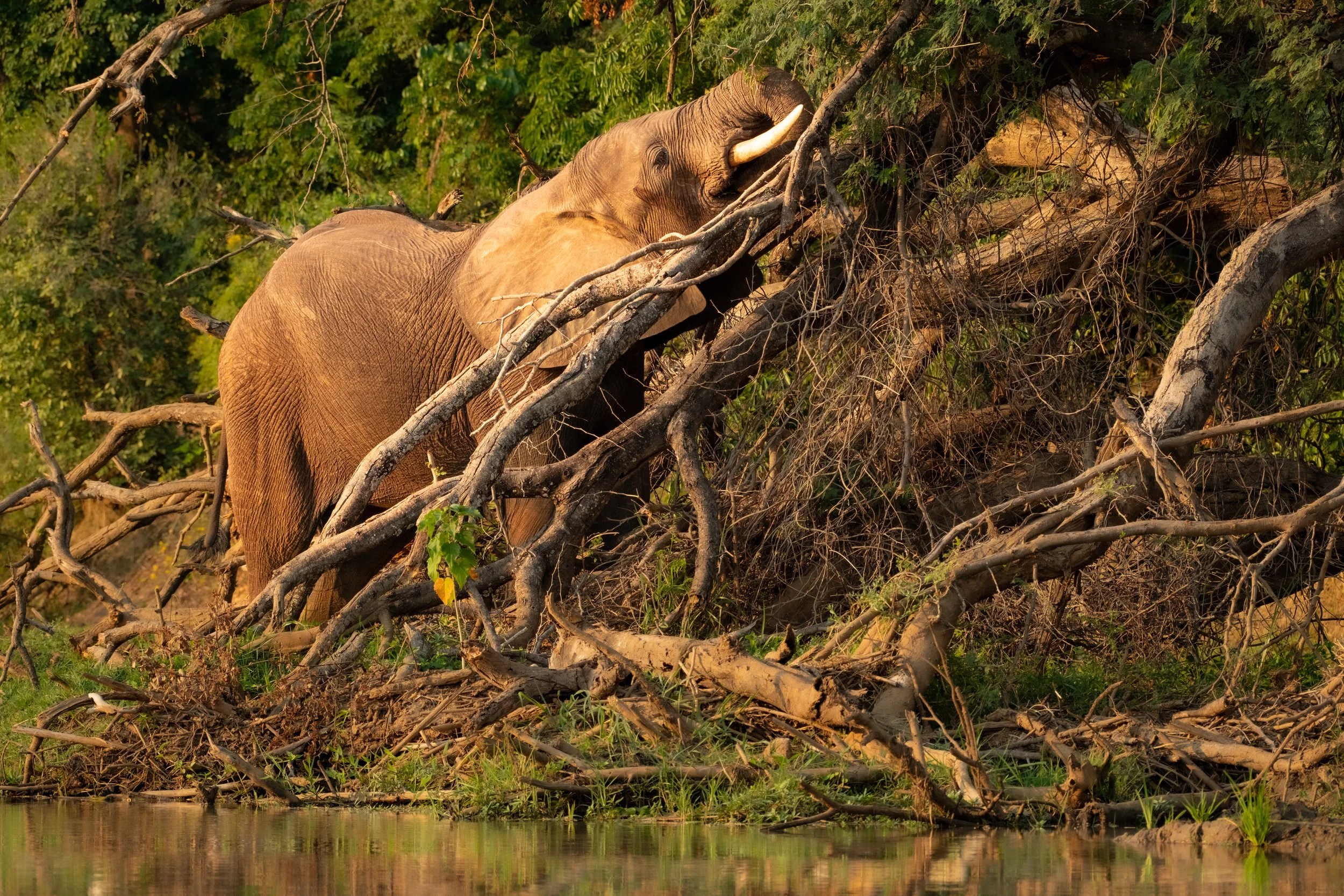
So let me move from that awful event to one of my top memories of our trip and one that very deliberately did not include hippos. One of the opportunities available to guests at our camp was a canoe trip, the guides insisted in calling them Canadian canoes, on the Zambezi, or at least a small tributary of the river. We could not miss an opportunity like that so on the second day of our stay we were taken by motor boat about 45 minutes up river and into the entrance of the small river channel that ran into the Zambezi. There were 5 of us in three canoes, V and I in one and all three paddled by guides who were familiar with the waters. We were cautioned not use our voices above a whisper and only to speak to the other occupants of the canoe. The river channel fortunately was too shallow for hippo but elephants grazed on its banks in large numbers and there was lots of other wildlife feeding or drinking from the water. We were expected to take about an hour to an hour and a half for the journey but we ended up taking two and a half hours because of the large male elephant pictured above.
He was determined to feed and tear up branches to intimidate us, well aware of the fact that we could not paddle past him, too much of a risk since we would have to pass within a few metres of him. We simply had to wait until he tired of us and moved back into the bush, which he did about 45 minutes later.
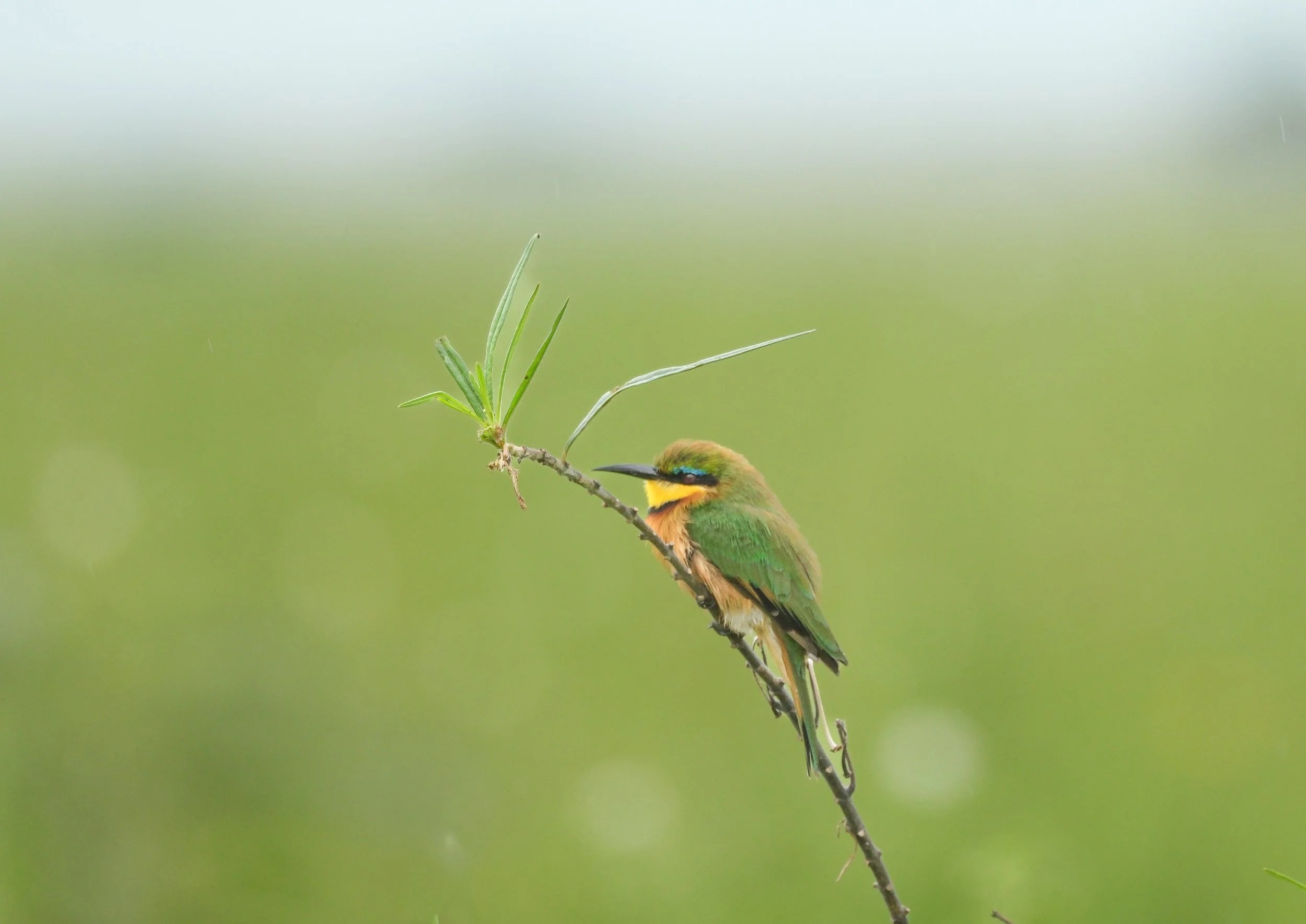
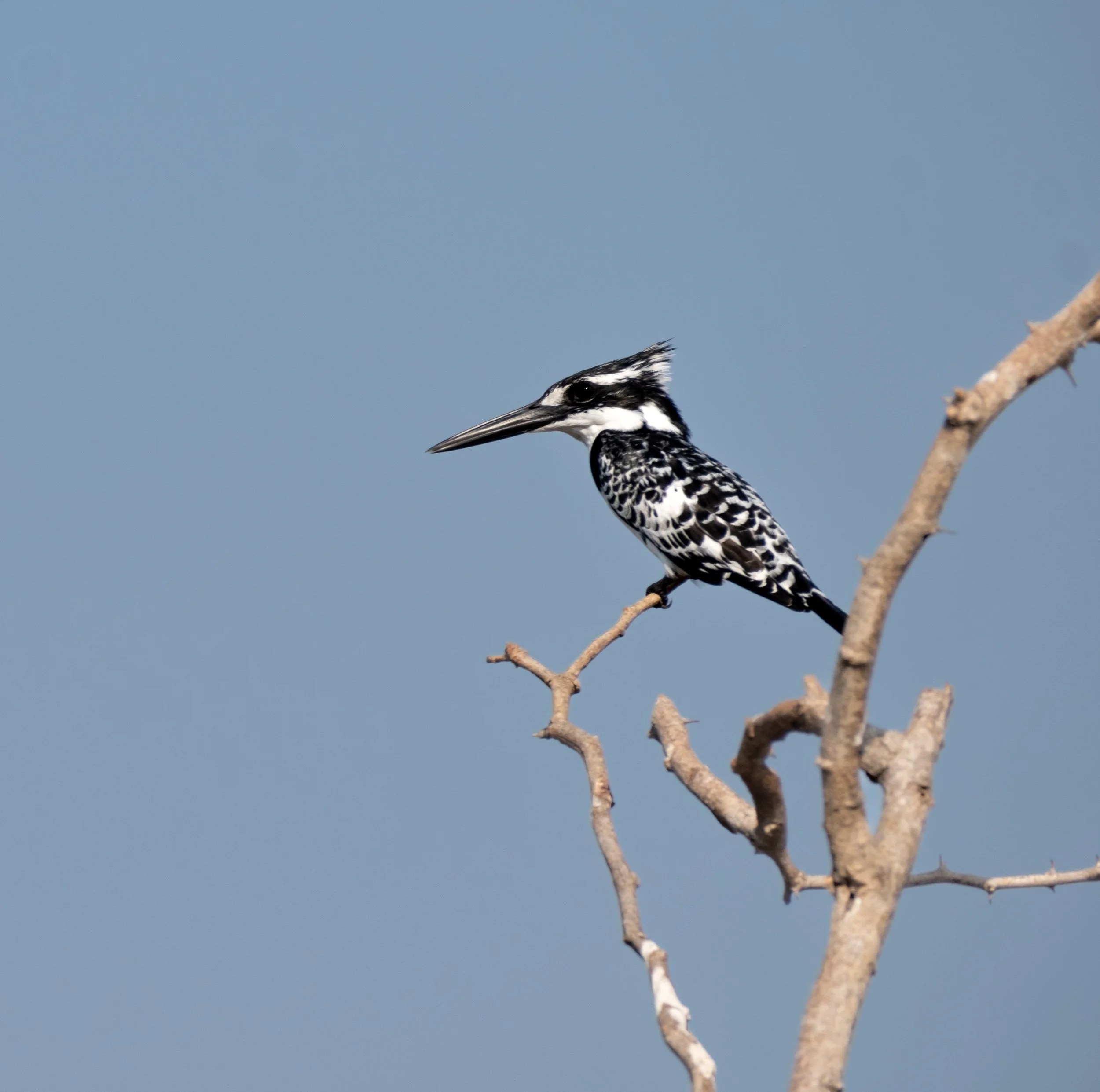
It was magical watching him, as was the whole canoe journey. Gliding silently up the river, Cinnamon Chested Bee-eaters and Little Bee-eaters, one of my favourite birds, darting in and out their nesting holes on the river’s bank and a whole variety of birds and animals buzzing, flitting and climbing in and out of the water. One of the best memories of our trip.
This was also a trip of birthdays, both prospective and retrospective. Tim’s birthday took place on the day we left camp for the airstrip and the end of our adventure but Susie had organized a cake and a choir of all the staff at the camp to sing a local version of Happy Birthday to Tim on the night before our departure. I’m assuming it was a happy birthday song but the melody was certainly not familiar and lyrics were in the local dialect so not comprehensible. I just feel that the staff was enjoying itself much more than you would expect for a simple birthday song but unfortunately, we’ll never know.
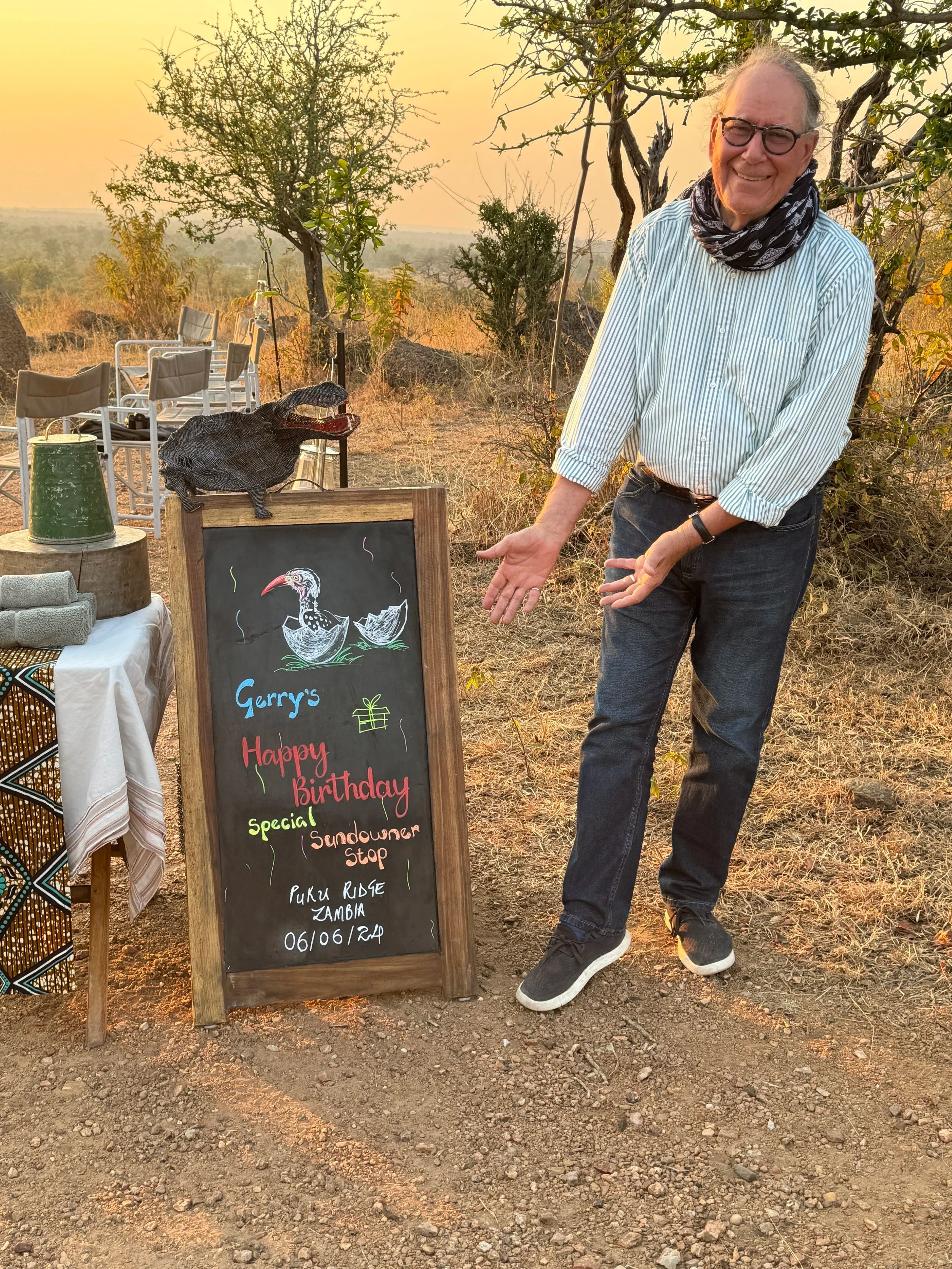
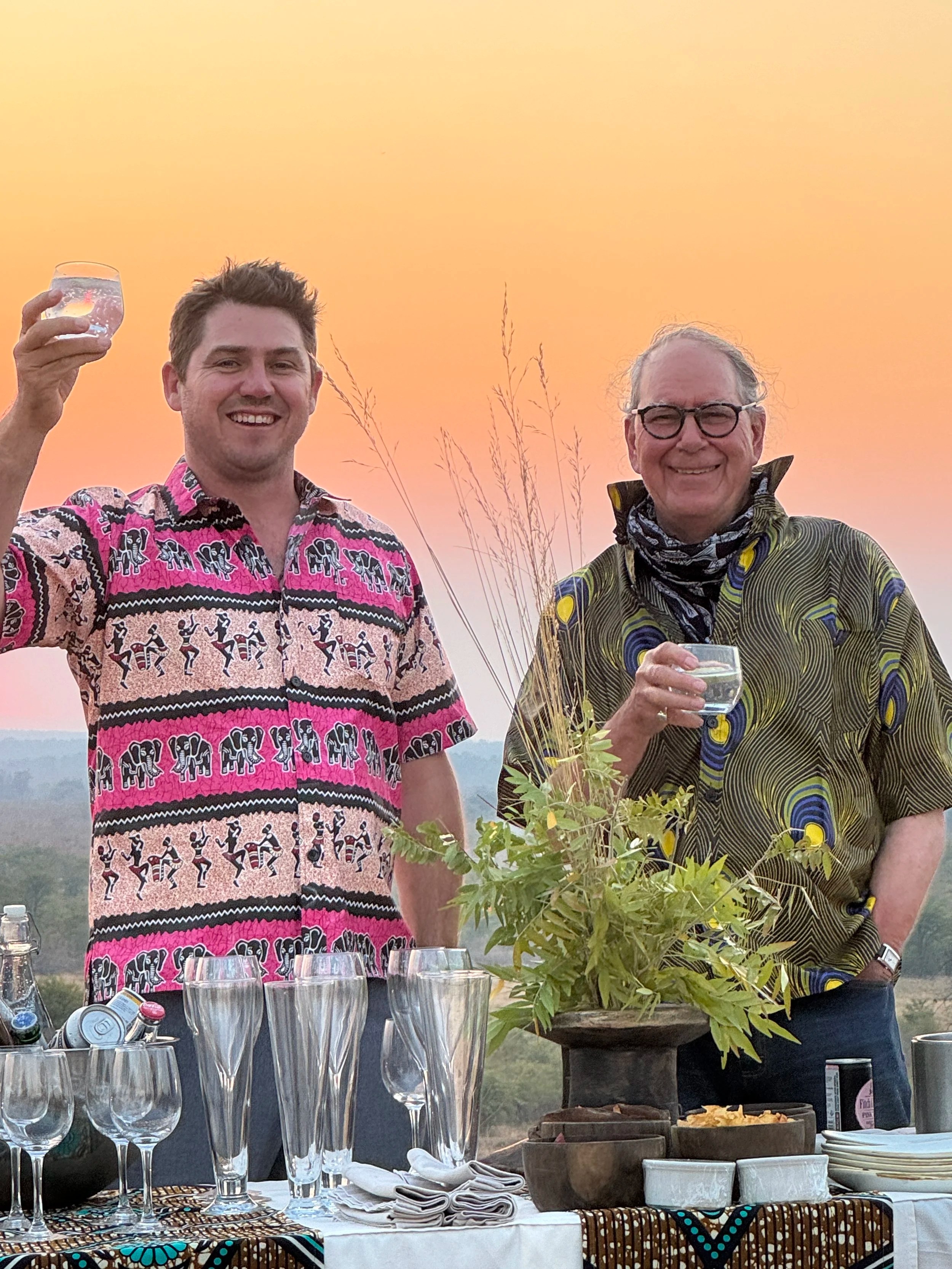
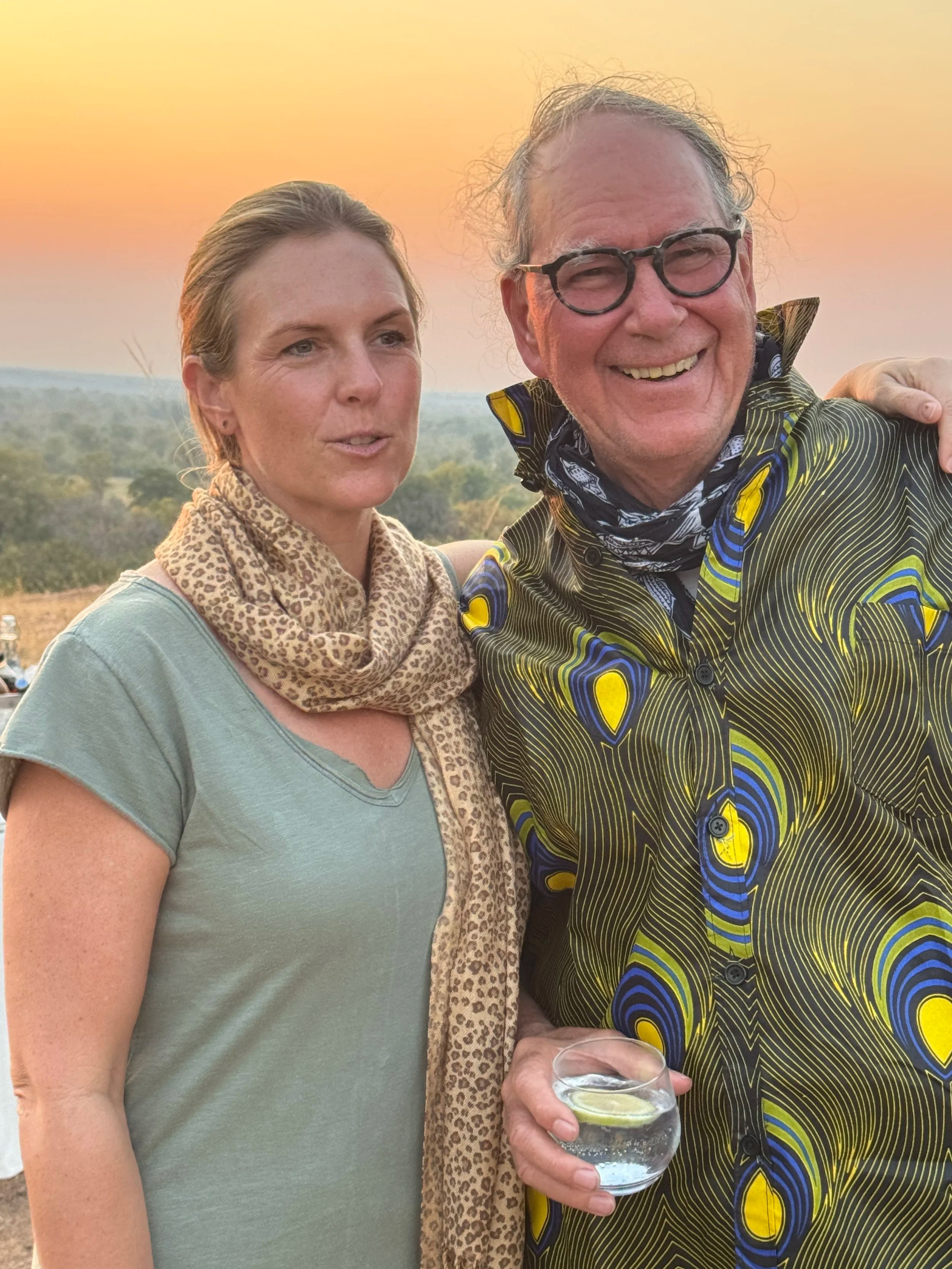
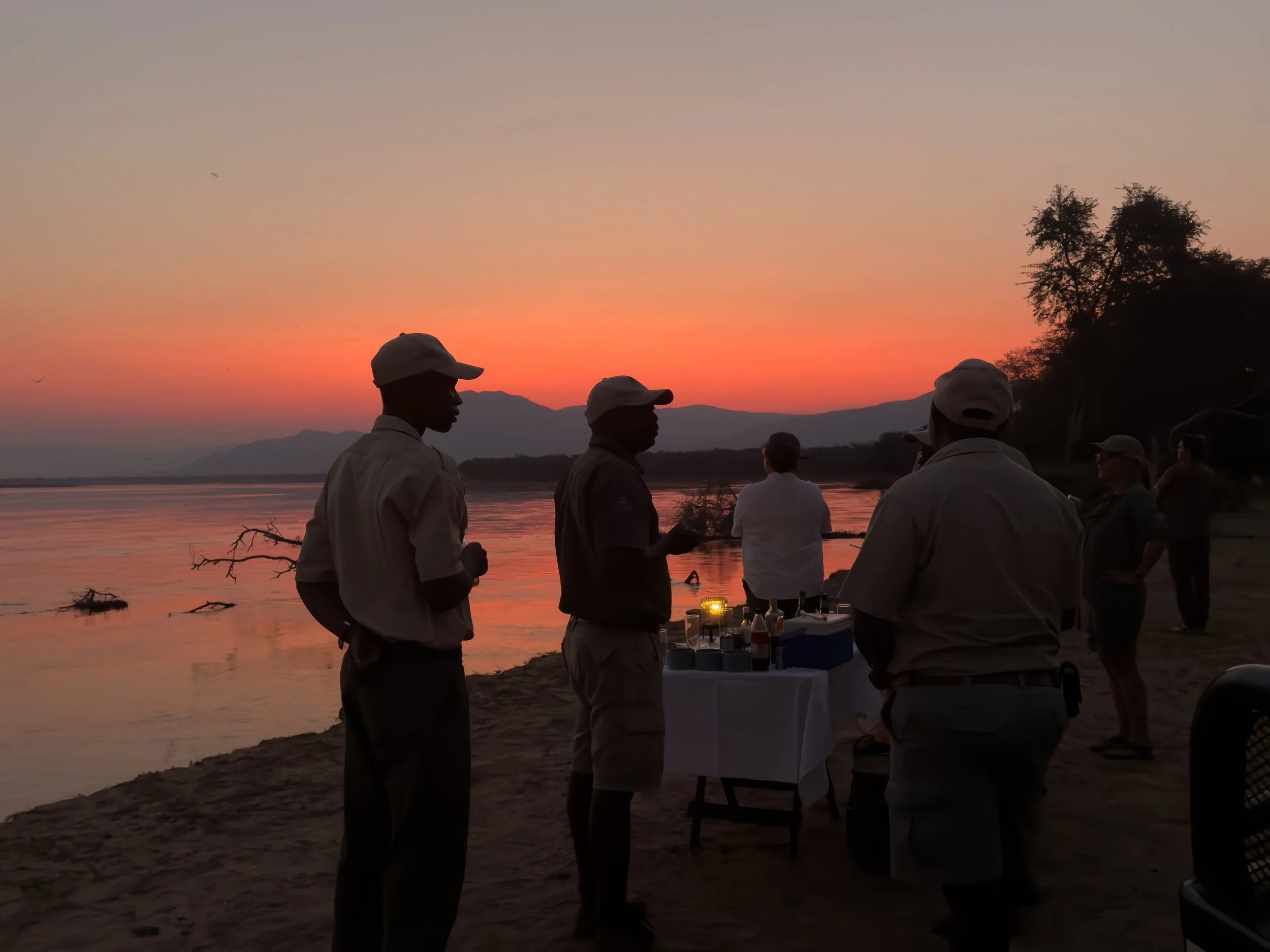
I celebrated my 80th birthday in March but Susie surprised me by arranging a b’day celebration at Puku Ridge, our last camp on the Luangwa before we left for the Zambezi. We were driven out to a hilltop looking over the Luangwa valley for sundowners and everything was setup for a surprise celebration.
That memory will stay with me always, looking out over the mountains lit by the setting sun, surrounded by friends and wearing Susie’s birthday shirt. It was a moment that could happen only in Africa, that’s why we keep returning and that’s why we will most certainly go again.
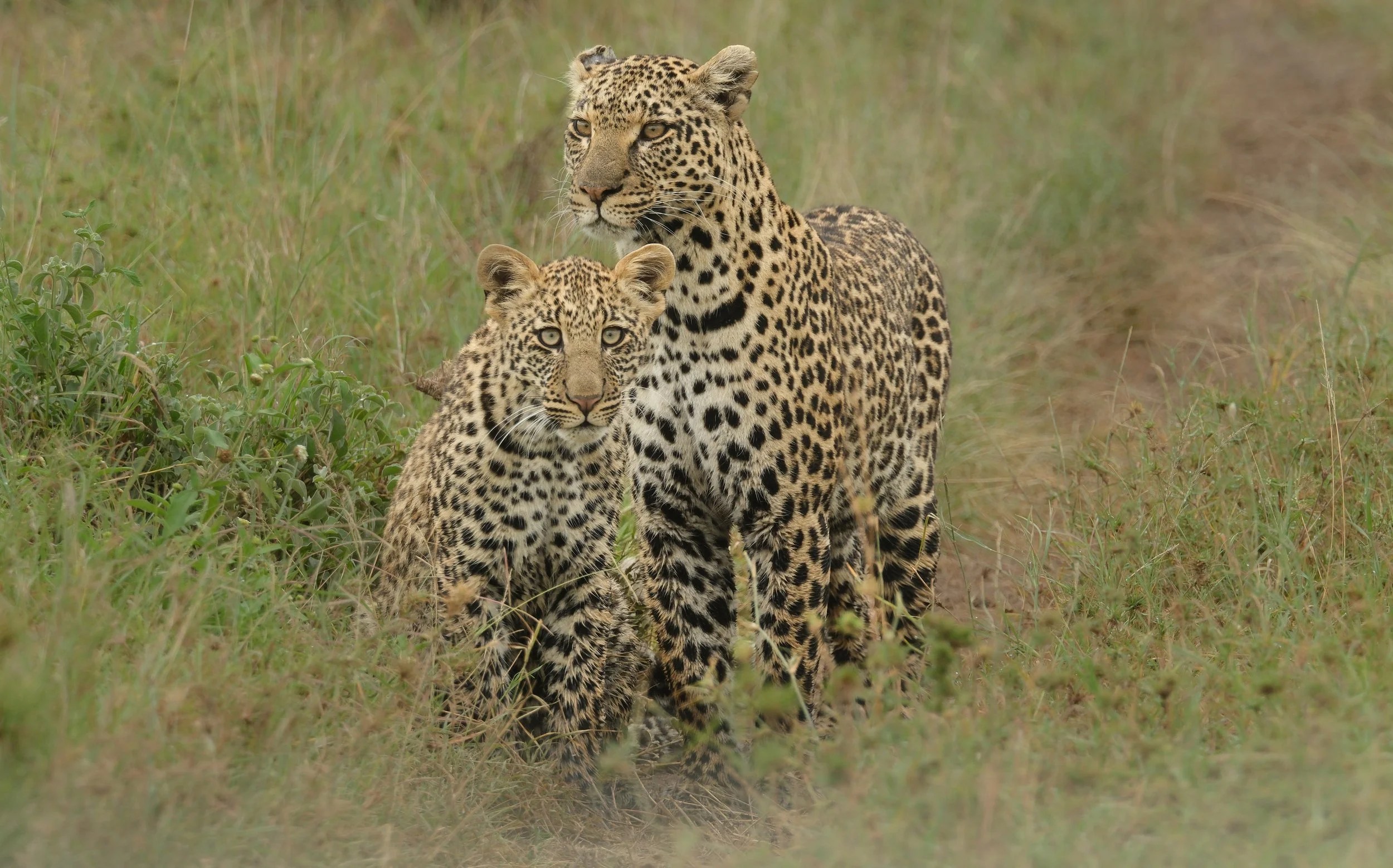
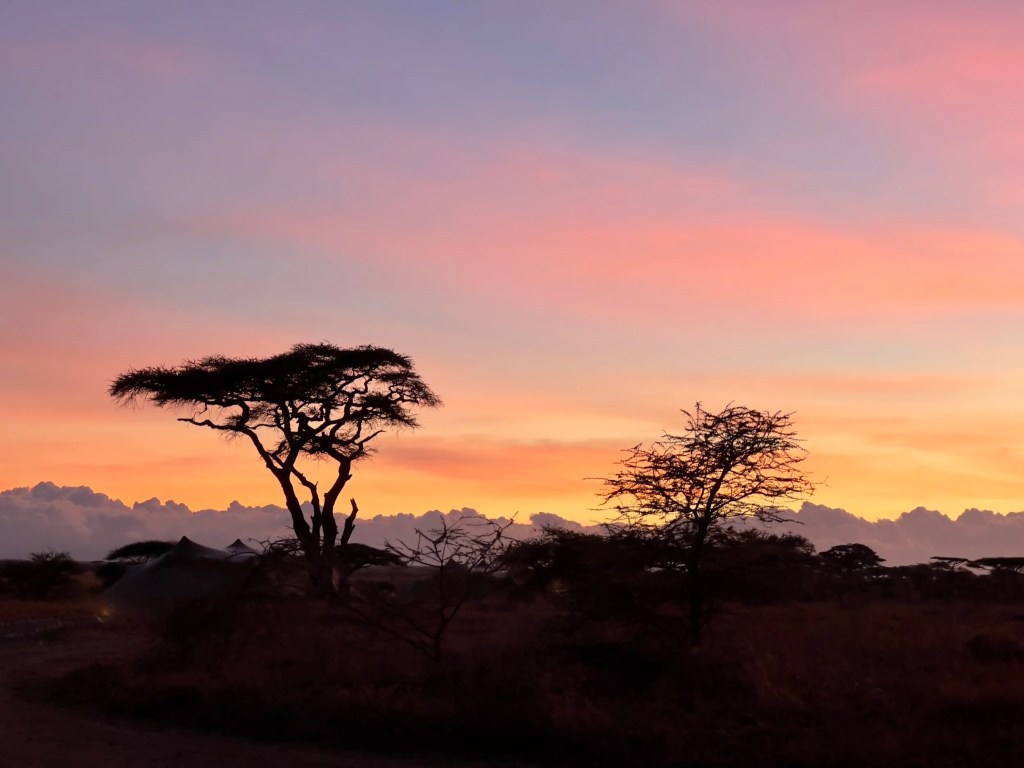
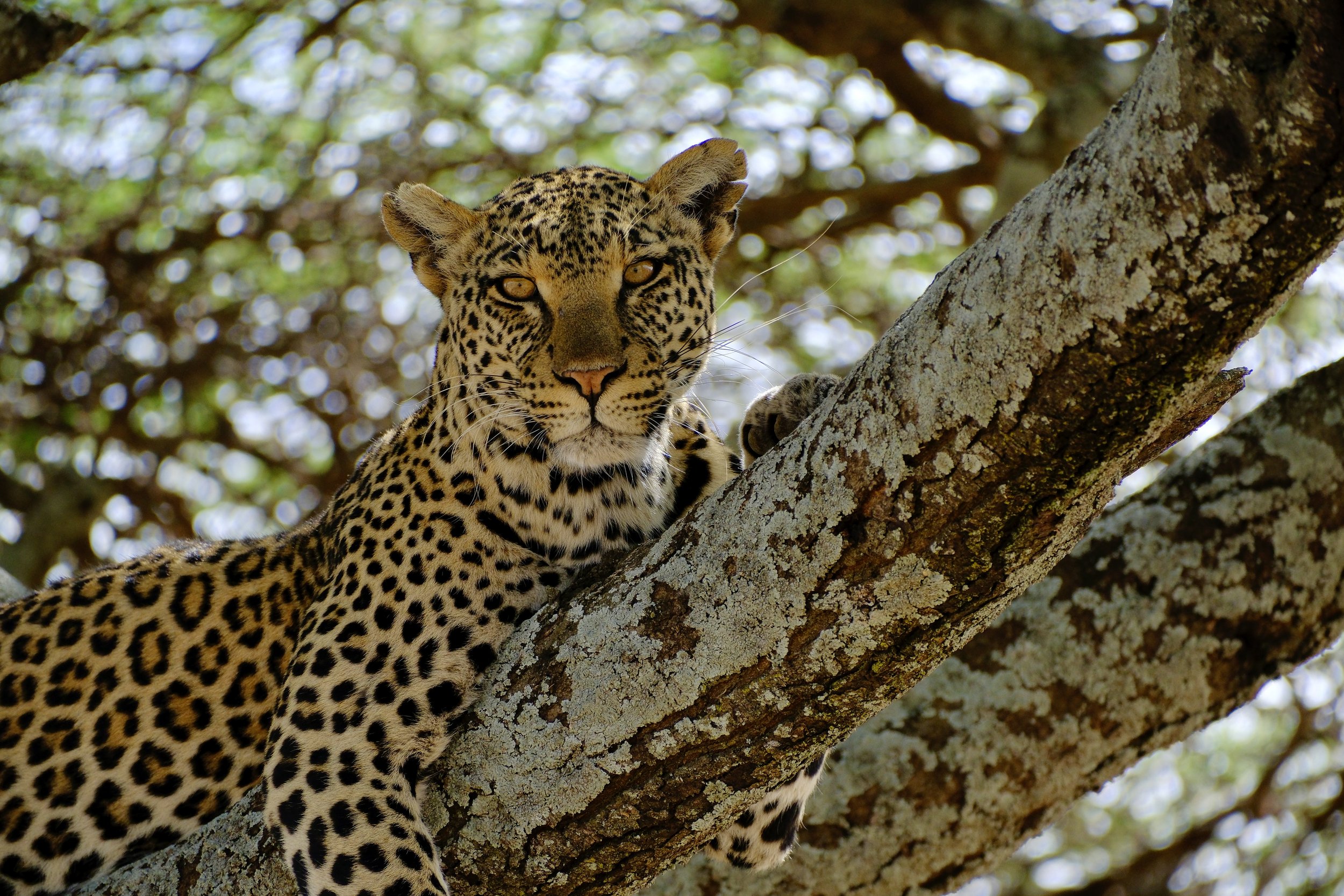
I wrote about 5 memories, an arbitrary number, it could as easily have been 10 or 15. So, no mention of leopards, some of the best sightings of any of our trips in both Zambia and the Serengeti. Nothing about our marvellous guides, nor about a pack of wild dogs that we tracked in Zambia. Not a mention of the sunsets and the spectacular scenery, the landscapes and the magic light as we set out at 6am with the sun rising over the Luangwa River. Not a word about our always interesting conversations over dinner, a mix of characters and personalities that ensured that every conversation held small insights and large ideas that lingered long after the meal was over.
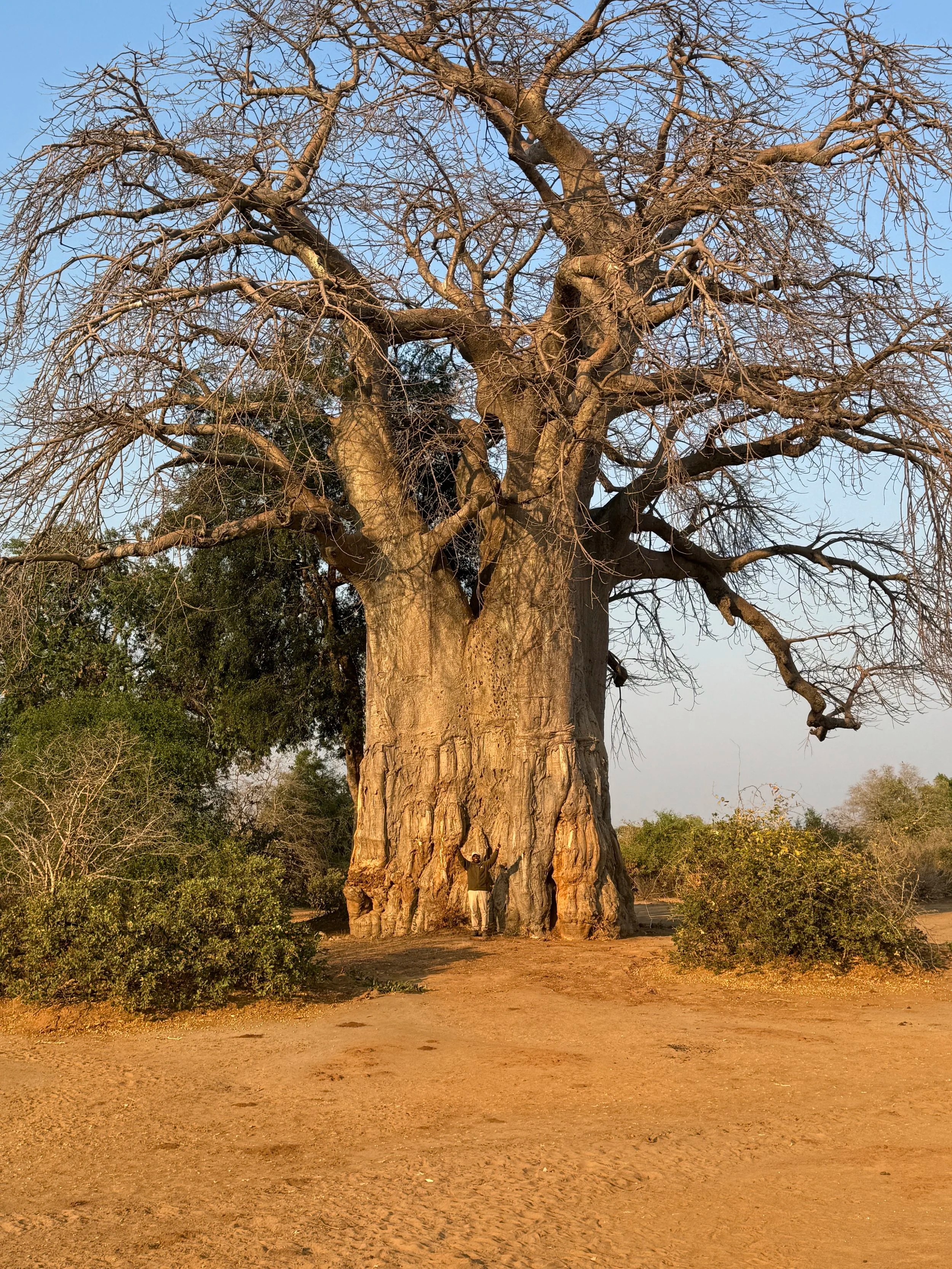
No time to talk about baobab trees, a tree which always brings to mind Saint-Exupéry’s The Little Prince, and which are huge and ever-present in the Zambian bush. No giraffes, no serval cats, no buffalo. But all grist for another mill on another day.
As has become depressingly normal, we now begin a new travel adventure without having finished documenting the last one. When last heard from we were leaving our ship in Hokkaido and on our way to a week in Tokyo, which turned out to be the highlight of our trip. In fact, we enjoyed Tokyo so well that we are planning to go back next year. We had added it on to the end of our boat trip around Japan in a classic ‘since we’re there we might as well..’ moment but unfortunately that was as far as our thinking took us, the boat trip having captured the majority of our attention. Fortunately we had sufficient forethought to make a hotel booking but our, or at least V’s, normal research and planning for our week’s Tokyo sojourn was conspicuous by its absence. Nonetheless we had a fabulous time and unhindered as we were by any commitments, with the exception of a couple of restaurant reservations, we wandered, discovered and thoroughly enjoyed.
One of our Tokyo restaurant reservations was particularly memorable but I will follow-up at a future date with a more detailed description of our discoveries, memorable moments and thoughts on Tokyo. However, as I’m writing this on our first day in Tanzania I think I’d better focus on the here and now.
Some of you may recall that a couple of times in the last year or so I have talked about this tripBack to Africa You Say. In that post I talked about the trip and our motivation for taking it, and now the time has arrived. And in keeping with the motivation for our Tokyo trip we are now in Tanzania because, since we’re here we might as well…!
We loved our Tanzanian camp, Namiri Plains, when we spent a week there in December 2022 and we’re returning there for another week prior to the Zambian leg of our trip. Namiri Plains is located on the Serengeti in a portion of the huge National Park that is focused on supporting and rebuilding big cat populations and in particular, the cheetah population. What could be more compelling to cheetah lovers and so here we are again!
We flew in to the Kilimanjaro airport yesterday and are spending a couple of nights prior to our small plane flight to Namiri tomorrow. We are staying in a lovely lodge, Arusha Coffee Lodge, in the middle of a coffee plantation near the town of Arusha. It’s charming and relaxing and a great place to get over the jet leg of a 13 hour flight, a 4 hour layover in Addis Ababa and a 2 1/2 flight to Kilimanjaro.
We are lucky enough to be here in the off-season as we were when we first visited in December 2022. Right now the rainy season is just over, the days are warm, the nights are cool and there are very few people here. In a month or so as the weather heats up and the huge migration begins its slow progress, the Serengeti will be crawling with visitors to see the huge herds of wildebeest and antelope move north and cross rivers into Kenya and the Masai Mara for better grazing. As spectacular as this is we have always chosen to visit when visitors and jeeps are at an absolute minimum and we have the leisure to spend a quiet time watching the domestic daily life of the Serengeti and the Masai Mara play out undisturbed.
I’m really looking forward to keeping you posted on what we see and can capture on camera. Apologies for the lack of images, we have just arrived and my camera has yet to be taken out of its bag but am using a couple of shots from our 2022 trip.
A quick word before I begin, apologies for my rambling discursions in my last two posts, I’m well aware of my tendency to drift rapidly off course at any given opportunity so to get back on course let me tell you a little about the nature of this trip. This is the second time we have travelled with Abercrombie & Kent, who charter Ponant ships for their expeditions, although I also travelled with Ponant on my Antartica trip in 2022. It’s unlikely that we will do another one of these trips, not because of any shortcomings of the voyages but simply because of our primary reason for taking them has been met to our satisfaction.
We are not cruisers by nature but we have taken these trips for two reasons; they allow us to access places and events that we would not ordinarily be able to access by any other means and they are created as expedition trips, not cruises. We have travelled with A&K to Greenland and the Arctic and now on this trip, to small ports and cities around the coast of Japan. In both instances, the ports and sites we visit would either be completely inaccessible or at the least, very difficult to reach. And because they are built as expeditions, they dive deeply into local culture, arts, music and history and require active participation. Travelling with the ship are a number of subject experts who rotate in providing a couple of lectures a day on a wide ranging list of topics, from the use of space in Japanese gardens, to the history of Russo-Japanese relations to the culture of the geisha and the floating world.
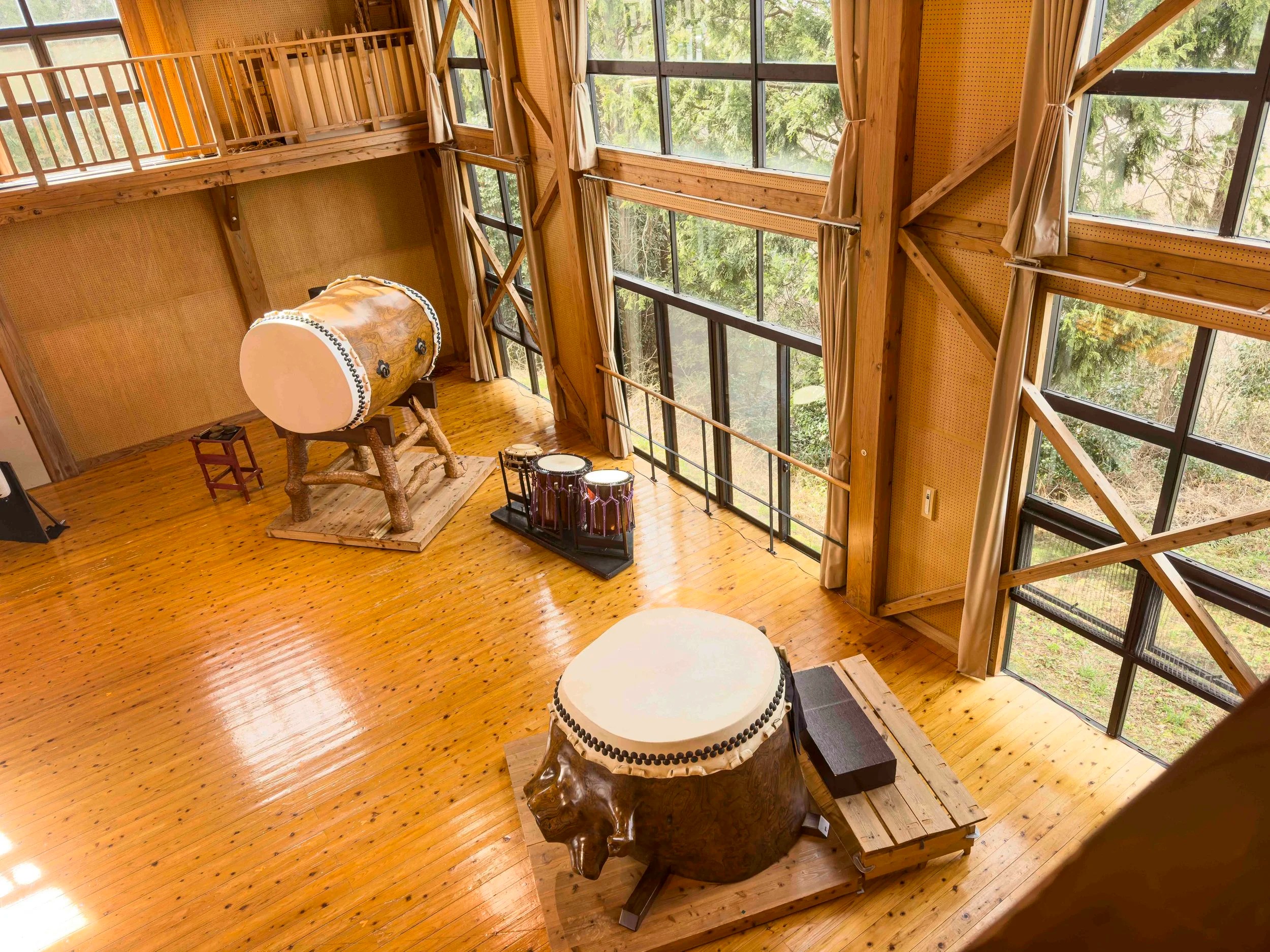
Kodo Drummers rehearsal space
Each day also has a number of scheduled activities which we pre-selected prior to travelling which allow us to leave the ship and be taken to interesting sites and activities, some of them requiring significant hikes or climbs. Each expedition begins around 8:30/9:00am and ends around 4:30/5pm. Nobody really chooses to stay behind on the ship. The logistics of getting 150 guests out to three different expeditions each day is mind boggling. There are busses lined up at the bottom of the gangplank when we disembark (after the required passport inspection), each large bus carrying a maximum of 20 guests, plus a local Japanese guide and 3 A & K staff. Timing is carefully worked out so that there are never more than 20 of us at a site at a time, we can’t imagine the complexity of working this all out!
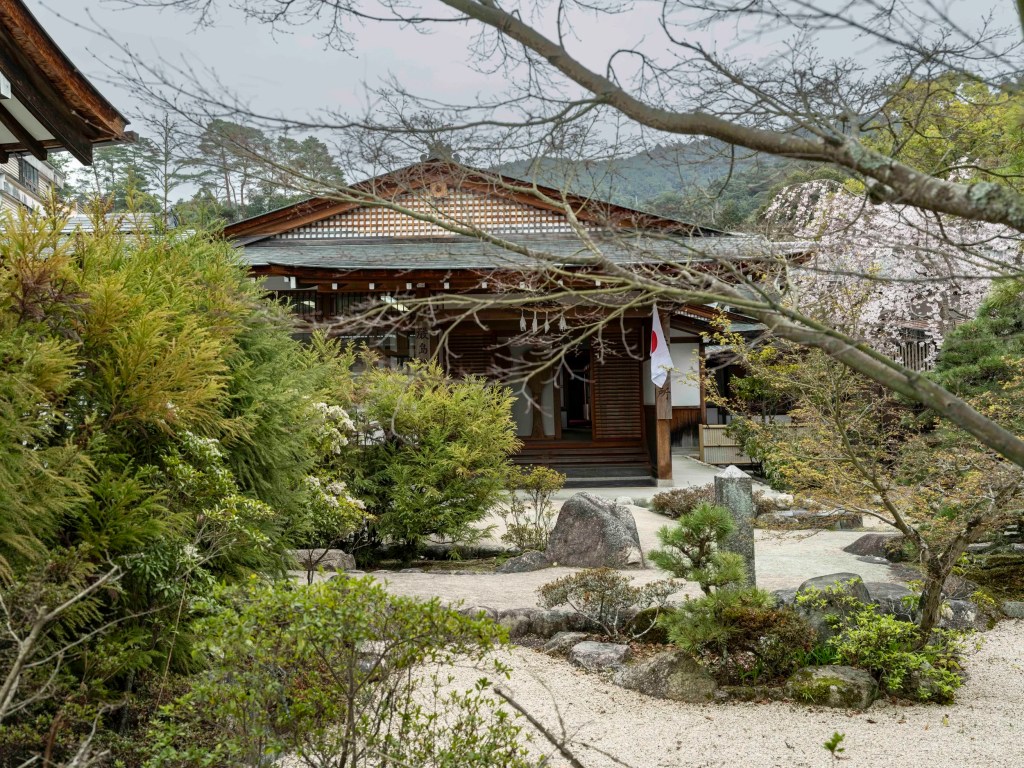
In addition, because of the reach and influence of the A&K organization, they have negotiated access to private activities that are not easily available to travellers trying to set these things up on their own. Yesterday for instance, we were allowed into the rehearsal space of the world-famous Kodo Drummers and were given a private concert. The location is on Sado Island, which has a very shallow harbour and entrance, so it was a bit nerve-racking even for this relatively small ship since the depth of the very narrow channel was 7 metres and the ship draws 5.5 metres. The community was out in force to welcome the ship and again to see us off, much waiving and singing.
Example of Kodo Drummers performance
The drummers’ rehearsal space was stunning and the proximity to the players meant that we were mere metres away from massive drums which when struck, quite literally made your whole chest cavity vibrate in sympathy with the drumming. I wouldn’t be surprised if one’s heart did not slip into rhythm with the drum as well.
The drummers are equal parts athletes and musicians, the strength and endurance required to play these instruments means that they train as monastic athletes, undergoing rigorous daily practice including a daily 10k run, no cell phones or personal relationships and drumming practice every day from sunrise to sunset.
If you have never heard them, this YouTube video gives you an approximate idea of the effect but a computer/phone cannot begin to convey the enormity of the experience. The drummers in the company spend approximately 1/3 of the year practicing, 1/3 of the year giving concerts in Japan and 1/3 of the year giving concerts around the world.
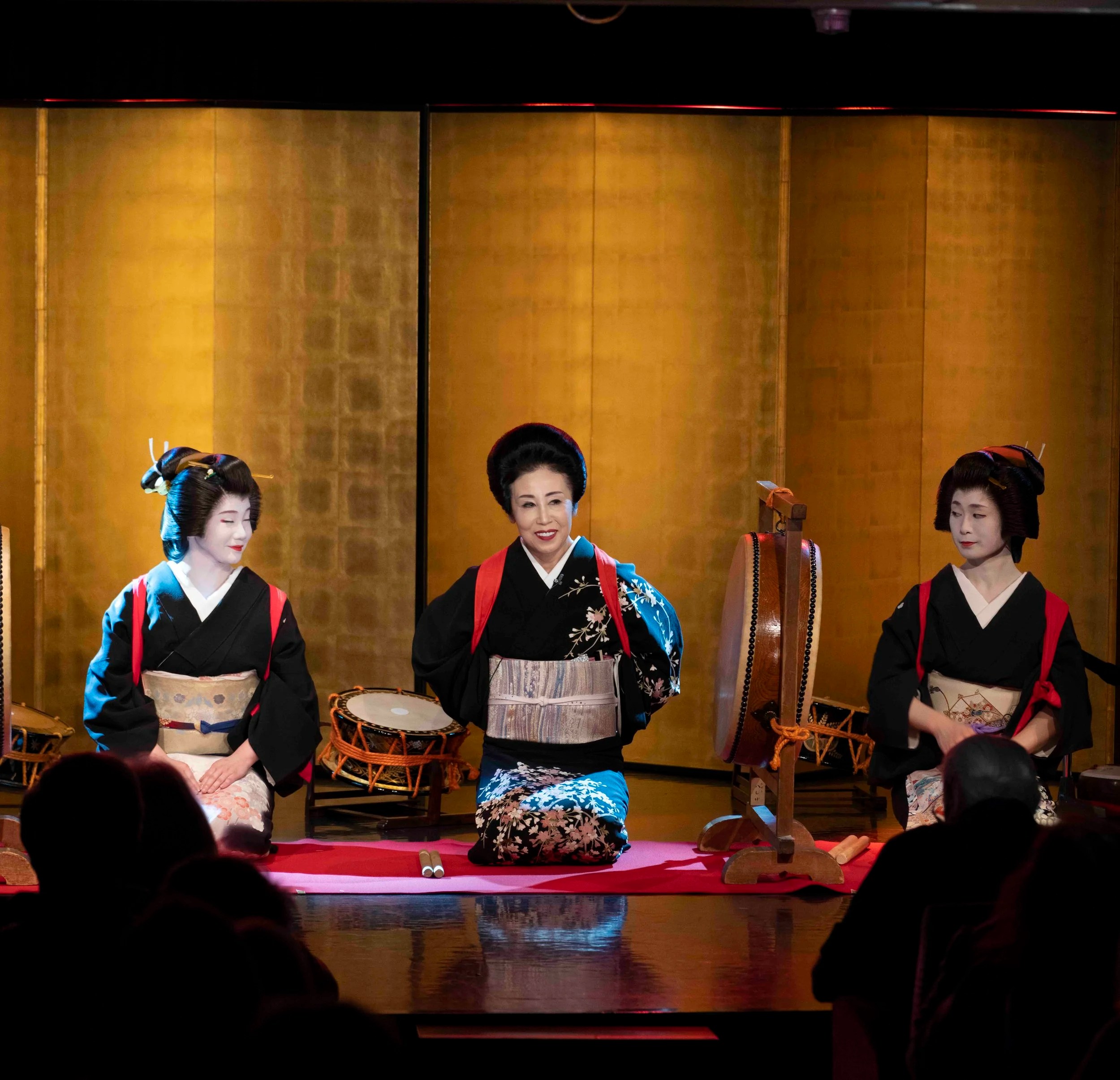
Our daily expeditions, of which the Kodo Drummers is an example, have allowed us access to the Imari porcelain kilns, a private viewing of a Noh play, a lengthy and candid conversation with a Zen Buddhist monk, and a private viewing of a a series of geisha performances. What is also interesting about these trips is that they self-select people who are interested in learning about their world, in expanding their horizons, are actively engaged in their learning and are physically fit enough to actively take part. This also means that they themselves tend to be open and interesting so many good conversations do arise. A secondary effect of this is that everyone takes part, there are no people who are here simply to sit by the pool all day and sunbathe. Aside from the fact that our bathtub is larger than the (unheated) pool, everyone participates in the various expeditions. They are all on time, cheerful and interested so a very happy bunch to travel with and since they are for the most part American, we stay as far away from politics as we can and keep life simple and in the moment.
Geisha performance
The only unfortunate part of the trip is that on any given day there tends to be more than one excursion that is tempting and since we are only ever in one location for a single day one, much like the rest of life, must live with the choice that you have made. In effect there are three different trips taking place so memories and impressions can vary widely but for the most part I think it’s safe to say that we have been very happy with our choices.
I would not hesitate in recommending A&K to anyone whose travel needs match my description of our trips’ frameworks. The reason that I say that we are unlikely to travel with A&K again is that, for the most part, there are few places that we would be likely to travel to that we would not be able to plan and execute on our own. A&K has served its purpose well for us but we’re ready to be back on our own.
Today has been a very pleasant and relaxing day. We have been at sea since 6pm yesterday, Saturday, and I’m writing this on Sunday afternoon, expecting landfall in Otaru sometime later tonight. Tomorrow will be a very busy day, a last excursion to Sapporo tomorrow, then pack and leave early the following morning.
Overnight from Hiroshima on April 1, we sailed to Uwajima, a very small town on a very small bay at the southernmost point on Shikoku Island and one of the most important locations for the Japanese pearl industry.
Farewell ceremony
Before I talk about this, an aside. As you may have noticed, I have described a couple of the ports as being small towns, small ports. Because of the relatively small size of the ship we are able to travel to and dock in ports that see cargo ships but very few passenger boats since most cruise ships would not be able to be accommodated, simply too large. One of the benefits of this is that our ship is treated as a very big deal by the towns that we visit and we are often greeted by townspeople coming down to the dock to look at the ship along with delegates from the town and local school bands playing a welcome. When we leave there is always a farewell event on dockside, bands and dancers and everyone quite literally waving until the ship disappears from view. As a courtesy we are asked to reciprocate, so everyone crowds their balconies on departure and waves in return.
Farewell ceremony
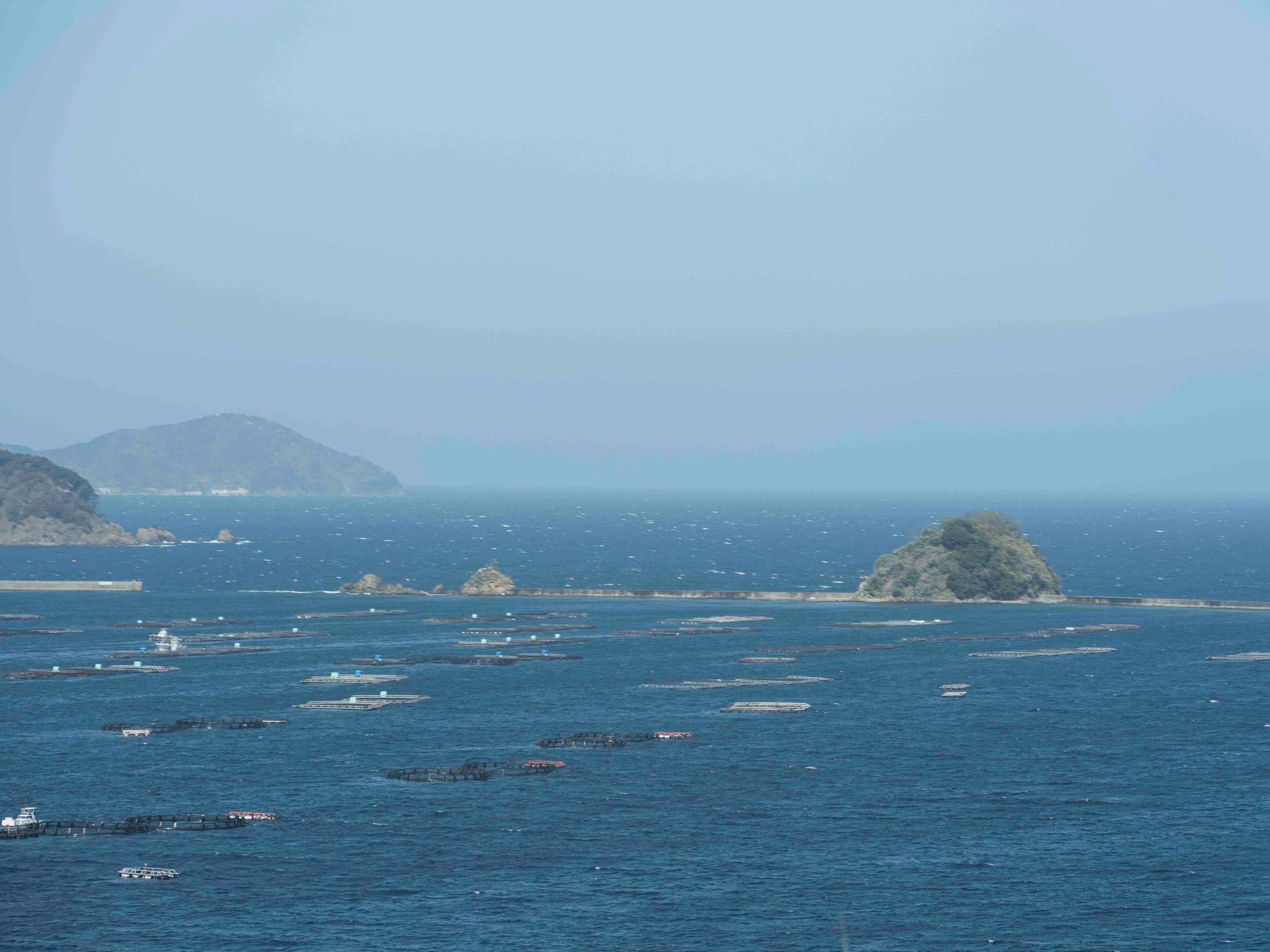
Now Uwajima, which in addition to pearls also has a local and very prized potato growing agricultural presence. Who knew, but apparently potatoes do feature in some parts of Japanese cuisine. Because flat agricultural land is a rare commodity in Japan the potatoes are grown, much like rice in Thailand and Myanmar, on terraces built up the side of very steep hills that rise out of the sea with a foreshore of probably no more than 50-100 metres. On this narrow strip of 50-100 metres along the coastline all the buildings, homes and roads must be built so the only space left for agriculture is up the sides of the mountains. On the day that we visited the sky was clear and lapis blue and the sun was brilliant as we climbed up through the potato terraces along a paved path that zig-zagged its way uphill, along which we were met by shifting and stunning vistas of sea and sky.
View from the top of the potato terraces with rafts of oyster beds
I won’t spend any time on the pearls, the potatoes having two distinct advantages, edibility and affordability.
On the drive from the pearl fishery back to the ship our Japanese guide spent much of the trip explaining the concept of “inside” and “outside” to us. The term uchi literally means “inside”, while the term soto is the opposite and literally means “outside “. These words are used to differentiate social behaviour between people from the same group (uchi) and people from different groups (soto). Through these concepts, Japanese people classify the people around them: those inside, and those outside. The way Japanese people behave, speak and relate to people in one of these groups is very different.
Family is the core of the Japanese social code. That is why the term uchi is commonly used to refer to the “house” and, consequently, to the “family” (because family members are those inside the house, their intimate space). Therefore, uchi would include those people from our closest environment, such as our family, our closest friends, our city and prefecture, school, university or the company where we work. On the contrary, the soto group would include those that are more external to our environment, but still have some kind of relationship with us, such as our company’s clients, distant acquaintances or foreign people. In Japanese there are expressions such as “uchi no daigaku” (“my / our university”), “uchi no kaisha” (“my / our company”) where the word “uchi” is used to name everything that is in our environment.
According to Japanese thought, we can only be truly ourselves with the people of our uchi, while with the soto people we must follow the strict guidelines of the social codes established by the term tatemae (the “facade”, the things that one should say and feel in public), which is contrary to the term honne (the true feelings and opinions). In general, Japanese people treat those considered soto in a polite and respectful way, although sometimes it may seem a little cold, because deep down there is the feeling of “you are not from my close circle” or “you do not belong to my uchi”.
This is expressed in many ways, not least, in the requirement that shoes be removed when going into a house. This is less about sanitation, dirty shoes in the house, but is a ritual of respect to ensure that the outside, the sato does not pollute the sanctity of the uchi. This also felt in other more profound ways, Japan is a collectivist society and does not easily allow sato peoples, eg foreigners, to be readily admitted to their uchi group. However, it’s not much different than Maritimers who treat non-locals as CFA’s “come from away’s” and who need at least one generation to be regarded as local or uchi.
Imari porcelain being painted
Leaving Uwajima in the evening we sailed for Karatsu, the in the vicinity of which are to be found the Imari ceramic kilns. Imari and Japanese porcelain in general has a long and compelling history which I won’t attempt to set out here. I’m sure that most of my readers are familiar with Imari porcelain but whether you are or not, please do look them up on the web, they are stunning and their history and its complex interweaving with Chinese and Western culture and Western history is rich, complex and fascinating. It was my favourite moment of the trip so far.
Imari porcelain being painted
Unfortunately when I returned to the ship from this expedition I collapsed in bed with the flu where I have been since then. The only moments of excitement occurred the day after our Imari ceramics when I had taken to my bed and we had sailed to Busan In South Korea. On our passage over we had winds gusting to 55 knots and 3 metre swells so the boat was rocking and rolling but in my fevered state it felt perfectly normal, not so to V unfortunately. At the same time we were told that there was an earthquake in Taiwan and the potential for a tsunami that might affect the Japanese coast, which fortunately did not occur.
Arriving in Busan, I had to crawl out of bed and present myself to the Korean Customs and Immigration people who came aboard to stamp our passports. Luckily they were not particularly vigilant and it was a swift and routine procedure. The following day when we returned to Japan, it was less so. At that point I had seen the ship’s doctor twice, and although I had been tested for Covid and another Chinese flu that is making the rounds right now, I tested clear from both. Nonetheless I had to be reported to the health authorities in Japan prior to our arrival. Luckily I had crawled into the shower and made myself look as human as possible in preparation for facing the Japanese entry authorities. Hearing a knock on our stateroom door, V answered the knock and found a Japanese Quarantine doctor, an Immigration official and the ship’s doctor in the corridor waiting to be admitted. This was a real surprise since we had been told that we would have to get off the ship to meet the entry people, so I was somewhat concerned that they had found it necessary to come to me. My luck held as I was not in bed but sitting in a chair, with the lights low when they arrived to examine me. I was still running a fever of 100.5 but the ship’s doctor rallied valiantly in my defence as the Quarantine man wavered but ultimately he came down in my favour. So here I am feeling significantly better and with a couple of days still left on our adventure.
Much has happened since my last post. Apologies for the hiatus but we had a whirlwind couple of days on board and then for the last four days I have been entombed in my berth with a dry cough, chills and fever and since we are on a French boat, la grippe with a temperature of 101F. This morning I managed to keep down some toast and a latte, my first food in three days.
In the course of lying flat for the last couple of days I kept thinking that I should get up and put together a post but my head was so unclear and buzzy that I don’t think it would have made much sense. However I woke up this morning with a clear head and a slight tingling of appetite so I think things are on the turn.
The ship’s doctor, whose English matches my French, for emergency use only, has been terrific and I grudgingly think that the improvement began when she convinced me to start a course of antibiotics which I had been resisting since I did not think it would be of much use against a virus. Whether it was the antibiotic or the fact that the infection had run its course is moot but I’m happy with the outcome.
So let me take you back over the last week.
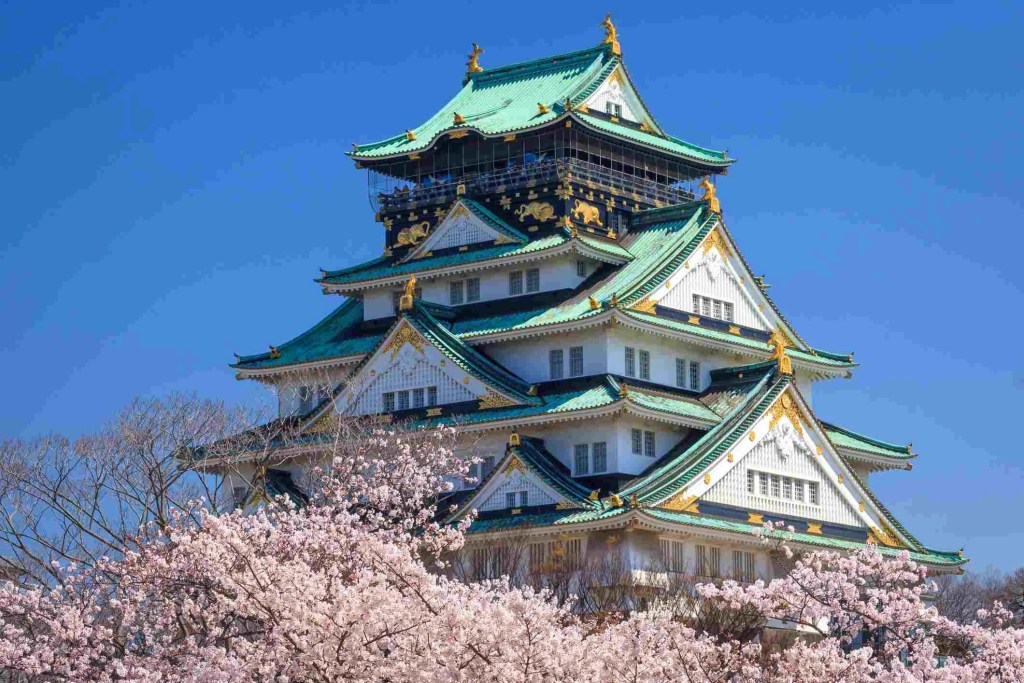
We left our airport capsule hotel the day after our flight from Tokyo, picked up by an Abercrombie & Kent driver and whisked away to the Ritz Carlton in downtown Osaka. The contrast could not have been more stark and needless to say, a very hot shower and a very big and comfortable bed set the world right again.
We quickly connected with C&E and joined them for dinner. E was undergoing severe stress during dinner, her son and his family live in Singapore, and her 10 year old granddaughter who was born with a congenital heart problem was being operated on as we dined. Her granddaughter’s condition would have had to have been dealt with at some point and the decision was taken to do it while she was still young enough to recover quickly. There are only a couple of surgeons in the world who have experience dealing with her specific problem and fortunately one was in Toronto and one was in Singapore, so the family did have options but they chose to have it done in Singapore since it took away the added stress of travelling before and after the operation. As we were having dinner E’s granddaughter had already been in the operating theatre for over 6 hours and we finally heard the good news from E later that night that after 11 hours the operation was complete, a success and she was in recovery. Enormous relief all round and it did feel like an auspicious start to our journey.
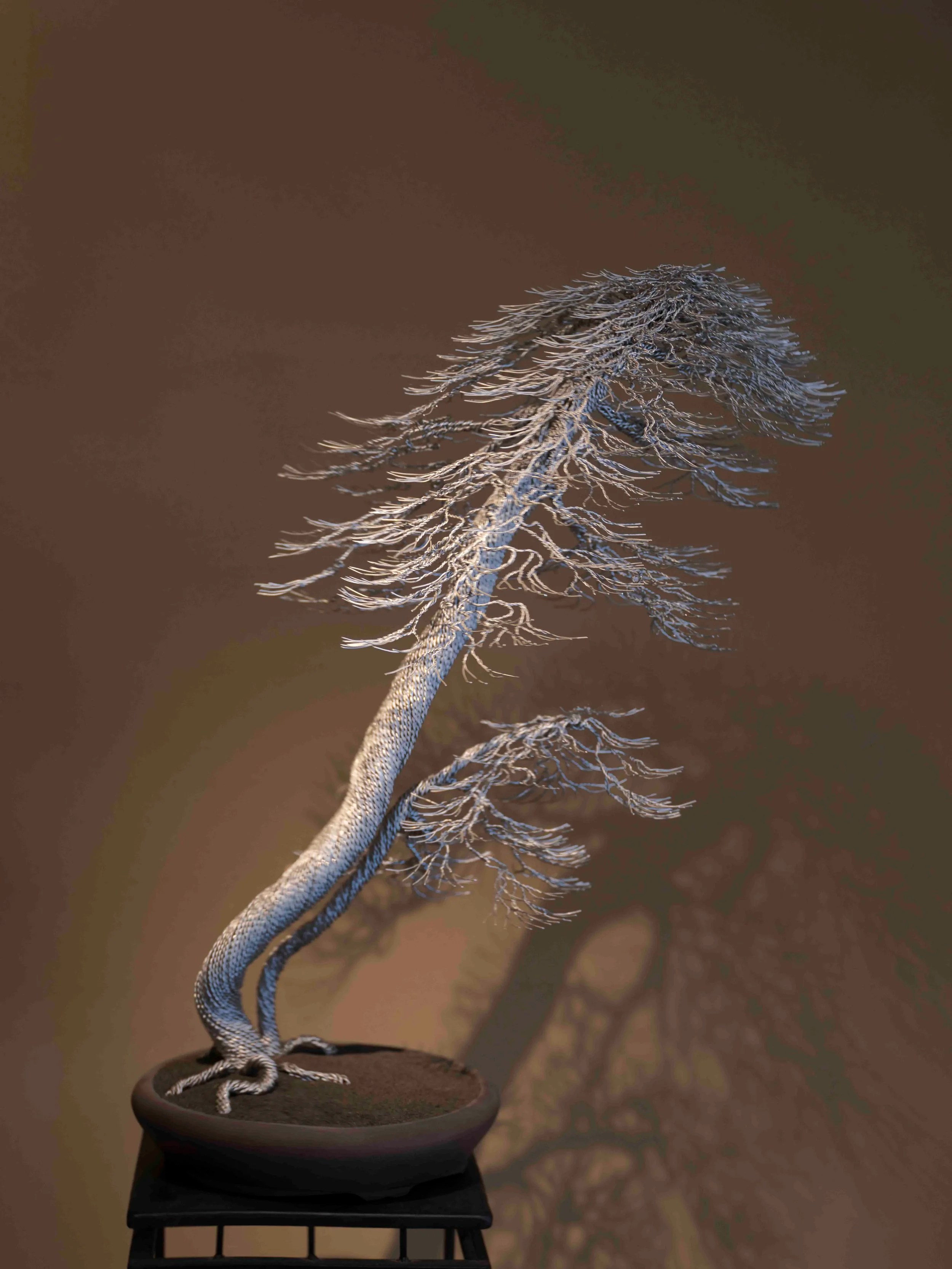
Bonsai sculpture in silver
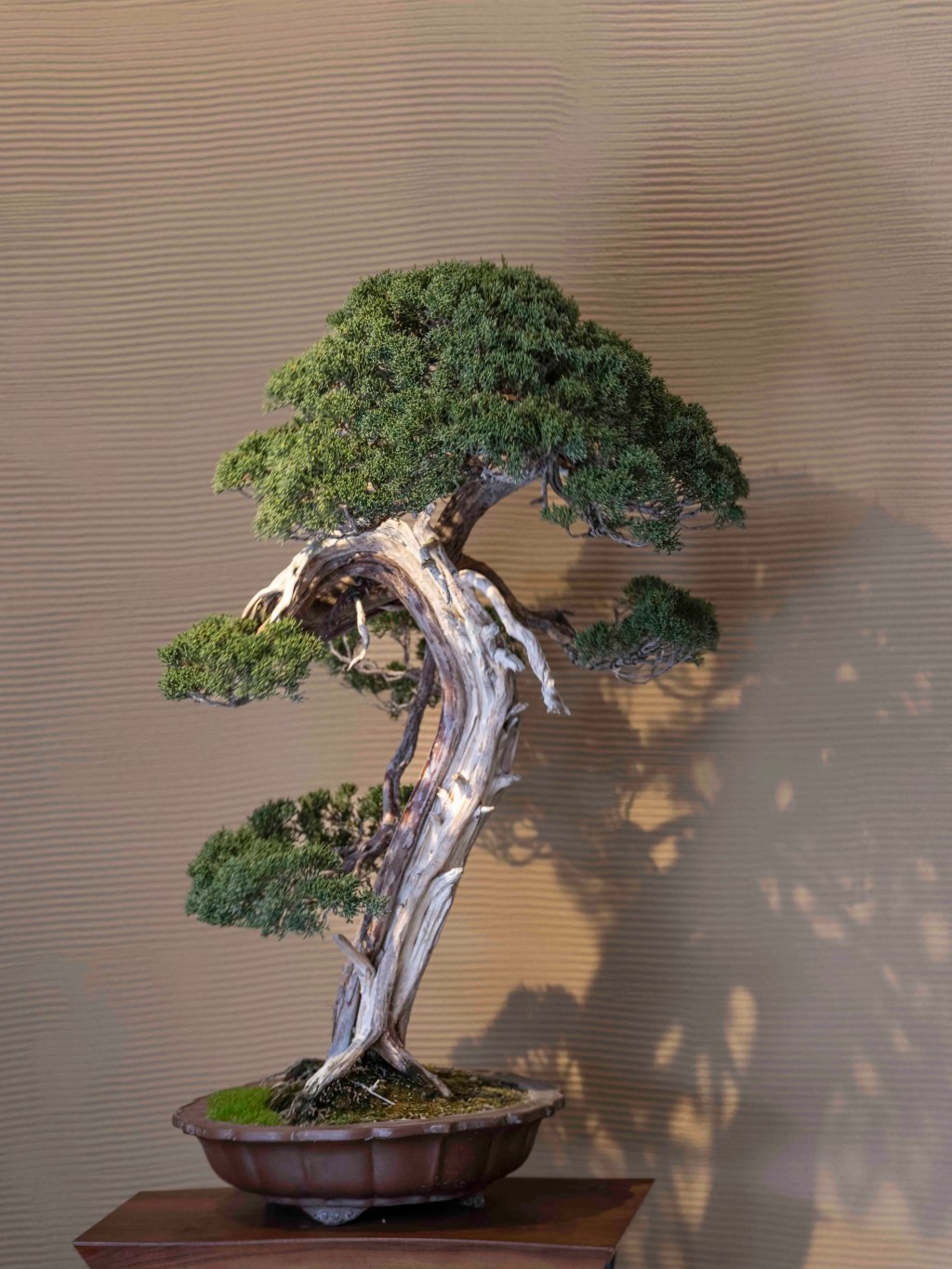
The following day we boarded the ship and set out for our first stop, Takamatsu, the gateway to Shikoku Island one of the larger islands at the southern end of Japan. We docked the following morning and I spent the day visiting bonsai growers in the area. Over 90% of Japan’s and the world’s Japanese bonsai exports are produced in this little town of 400,00 inhabitants. I wasn’t sure what to expect, but with the foreknowledge of the town’s bonsai production I had expect something on an industrial scale but the reality was entirely different. The producers are all family-owned and managed and the production is entirely hand-done. The trees are started from seed planted in small family lots, the size of a house lot scattered around the area. Each family has several lots in various locations and each lot had trees at various stages in their growth cycle. They are pruned every fall and are dug up by hand every five years to have their roots trimmed to keep them small and re-planted or, depending on their size, potted. When they are potted they are brought to the work area of the family home where they are maintained until they are sold or exported. Many of the trees that I saw were between 60 and 100 years old and some were National Treasures and cannot be sold. Stunning, if you’re a fan.
One other thing caught my eye as we visited a number of bonsai grower’s homes. The potted trees are displayed on wooden racks at waist height in outdoor spaces adjoining the growers’ homes and they are invariably displayed with large glazed pottery pots under the racks where the plants are kept. These pots are busy with colourful koi, the size of large goldfish. I wondered if this was done with a sly sense of Japanese irony or was it an uncomplicated desire to show off fish and trees, which if left to their own devices, would both be considerably larger, grosser and less appealing than their miniaturized versions.
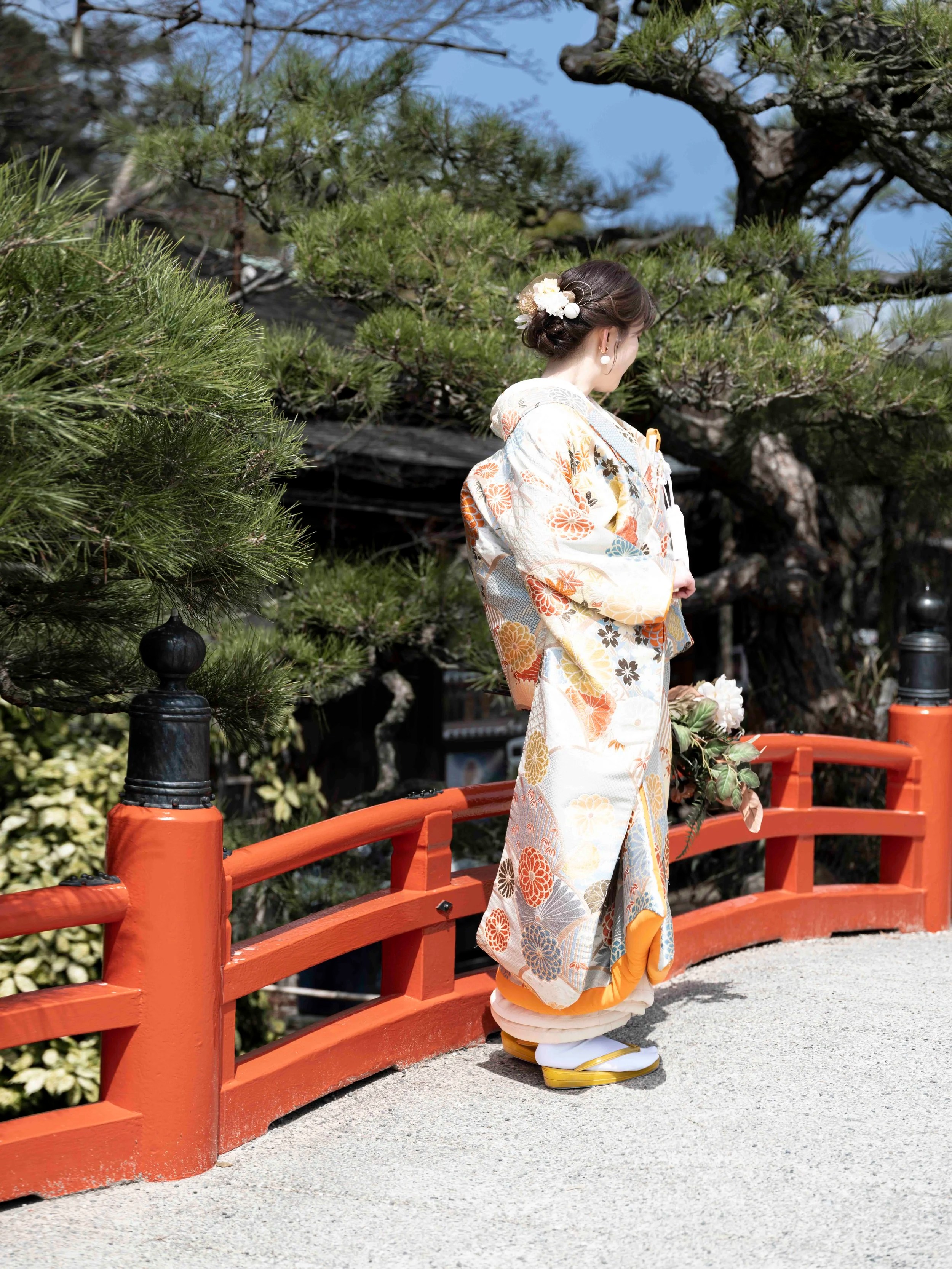
Japanese bride posing for wedding photograph in park
In case you were not aware, the translation of bonsai is a plant in a pot, so by definition the term does not necessarily mean a very small tree but one in a pot. This latter point explains why V did not join me but went off on another excursion. She claims that she can hear the thin, reedy screams of pain of the plants whose roots are aggressively pruned and then wired in place in their pots. Just to put this in context, V does enjoy a rare steak when it’s on offer.
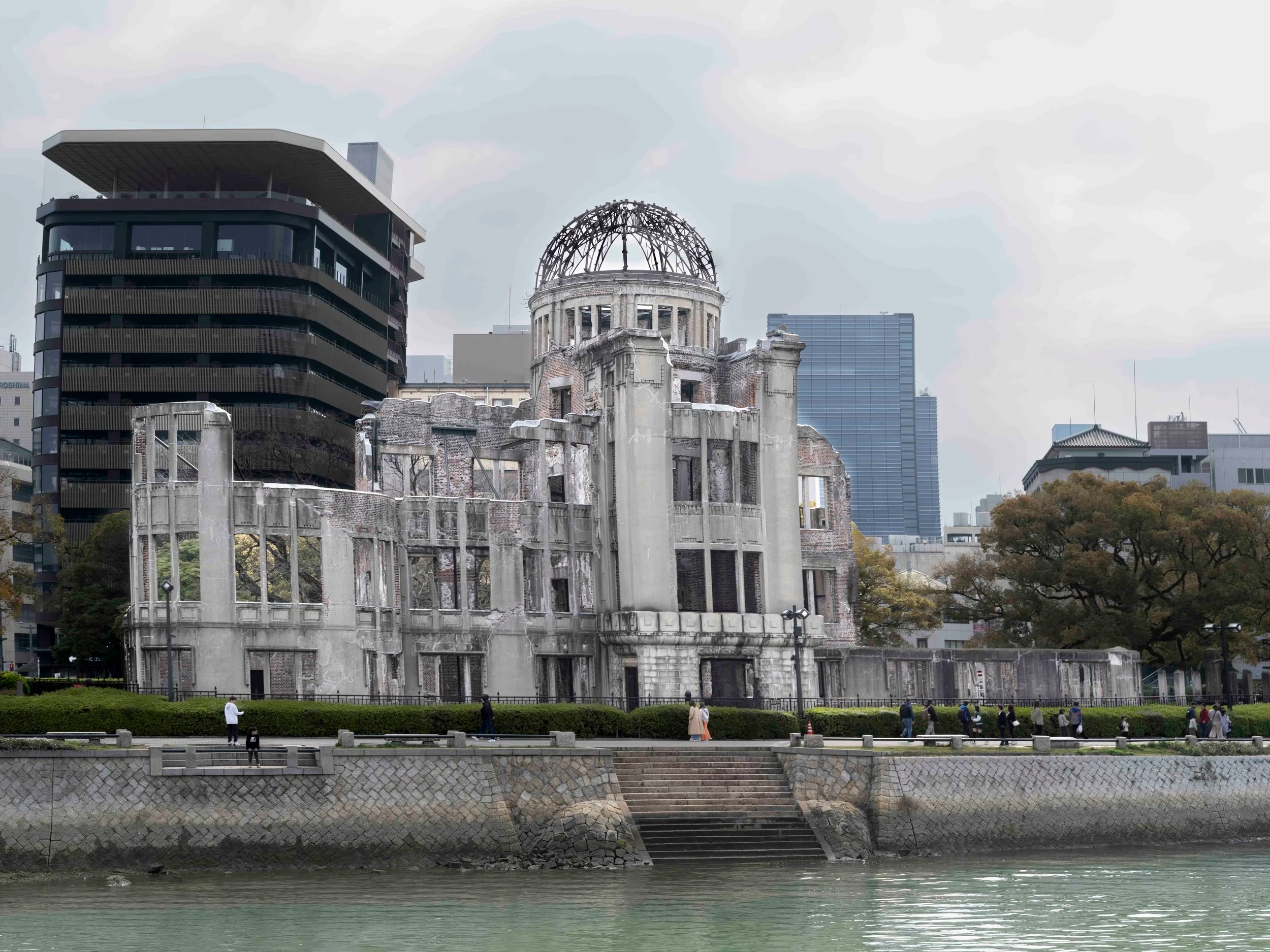
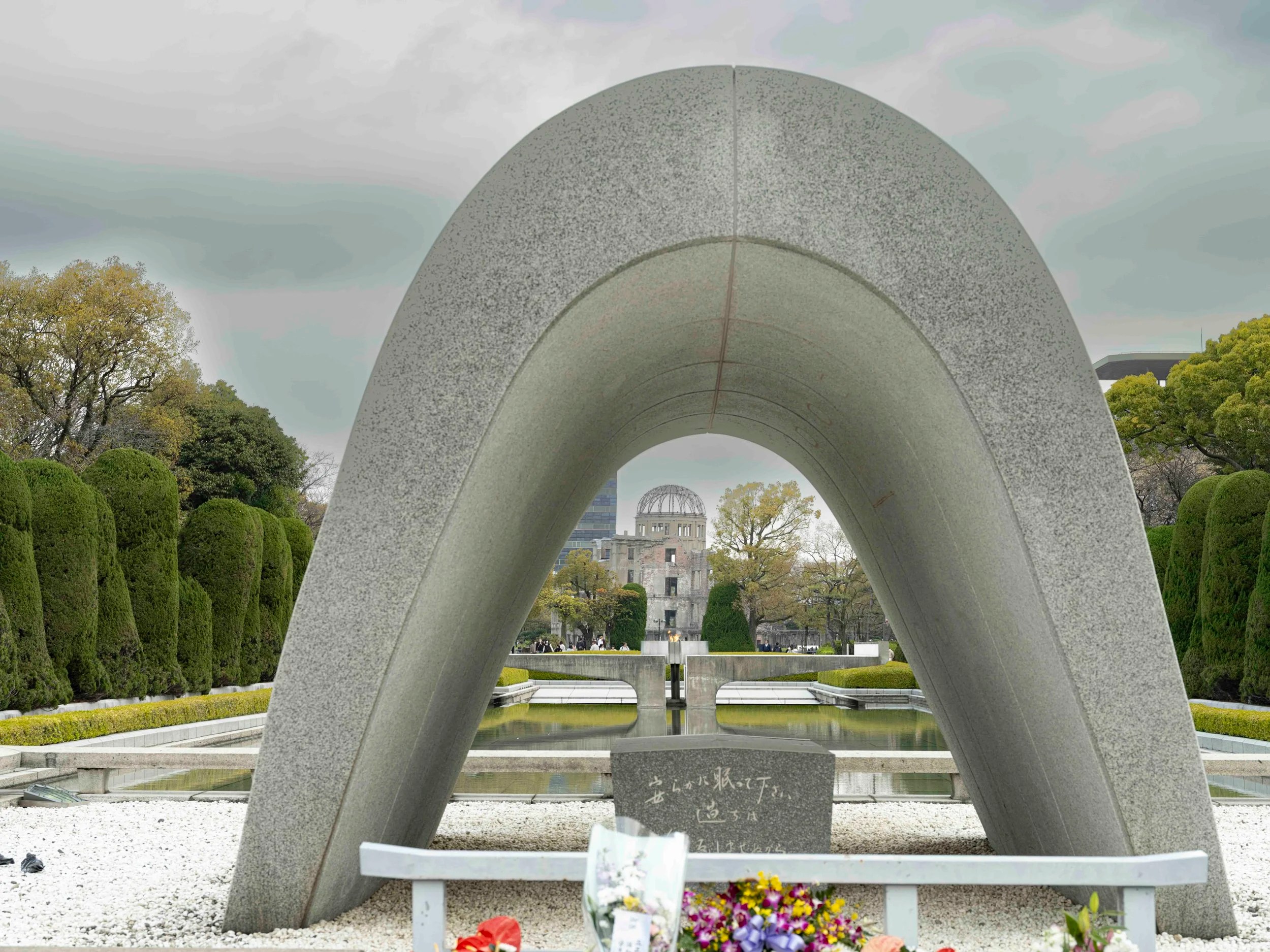
Epicentre of the Hiroshima blast. Only building that was left standing in a 1.5k radius.
We left Takamatsu in the evening and sailed overnight to Hiroshima where we spent Easter, a truly harrowing morning. I won’t try and talk you through my experience, it contained many conflicting layers of meaning and context and it will take me a very long time to work my way through it. Suffice it to say that the most overpowering feeling that I was left with was the sheer futility of everything I saw. The awareness that it has taken an enormous amount of national introspection, not by any means complete, to use the experience as a mirror and come to terms with what is seen. But also the determination to turn the experience to positive ends, to dedicate the space, psychic and physical, to peace and forgiveness. And the final futility, the knowledge that if world leaders, you pick them, were brought there and saw everything on display and understood the purpose of the site, that it would not change their behaviour one iota.
Memorial arch to the Hiroshima dead looking through the arch to the eternal flame and on to the only remaining building from the blast.
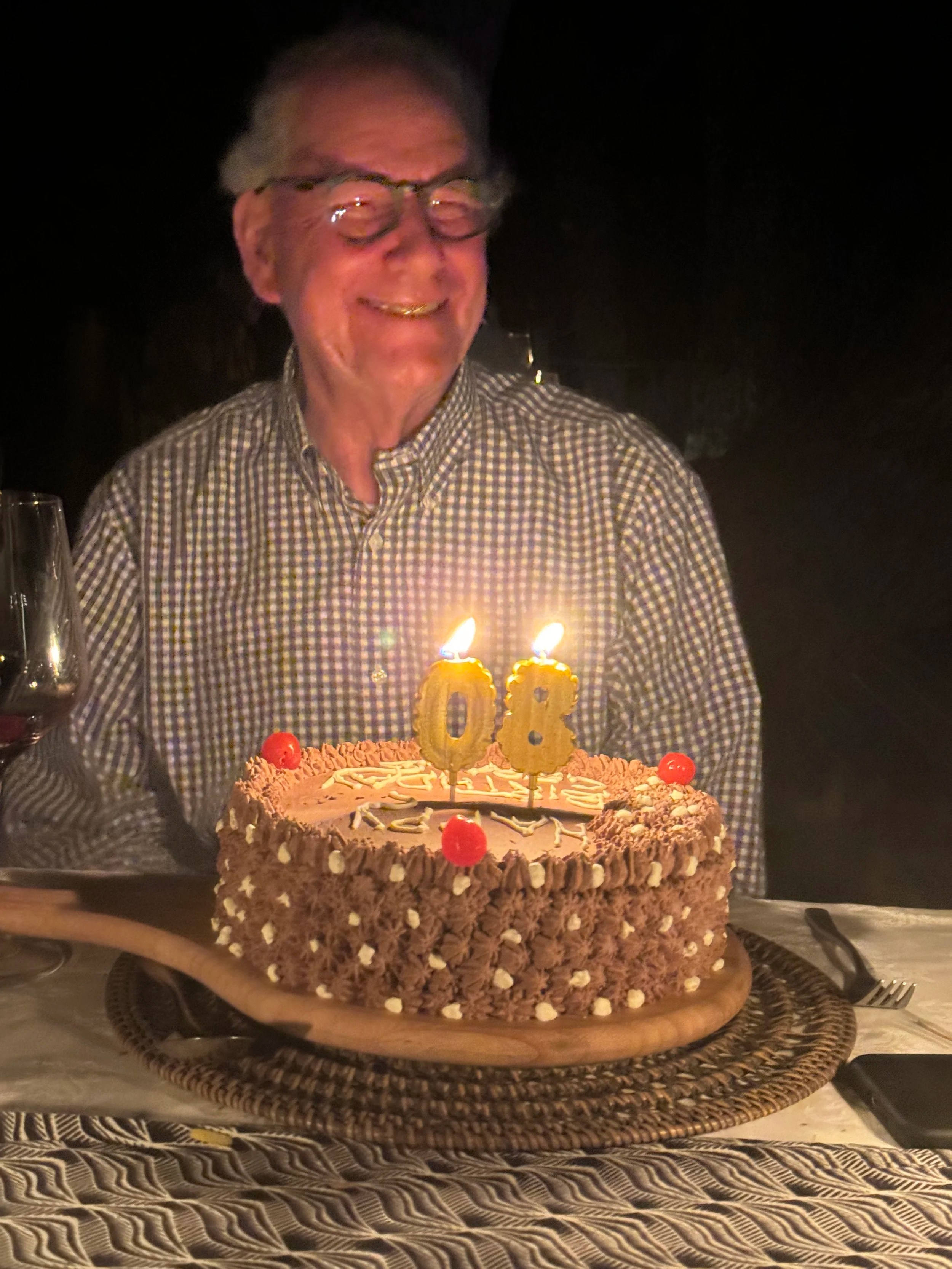
This is a long overdue post, not written at the peak of my form but written nonetheless. We arrived in Japan late last evening, Tuesday March 26 after 18 hours of flights, delayed flights and washing-machine turbulence from Toronto to Osaka via Tokyo. This trip, one to which we have excitedly looked forward, was preceded by 2 1/2 weeks in Portugal. We returned from that trip last Wednesday, unpacked, did our laundry and prepared to leave on Monday for this trip to Japan. In the interval I celebrated my 80th birthday with a fabulous dinner with family and recovered from my over-exuberent wine consumption just in time to make our flight.
We first travelled to Japan over 25 years ago and I subsequently returned there on a couple of occasions for business but we had always talked about returning and seeing more of the country than we had on our first visit. The opportunity arose when good friends Chuck and Eileen with whom we had sailed to the Arctic from Svalbard 7 or 8 years ago and then with whom we explored Bhutan 4 years ago, mentioned that they were sailing on a small French boat chartered by Abercrombie & Kent, on a cherry blossom tour around Japan. We immediately signed on. Ponant is a French sailing line and those of you who remember my trip to the Antarctic last February/March will also remember that it too was on the same Ponant line. Additionally it was an Abercrombie & Kent charter of a Ponant boat on which we sailed to the Arctic with Chuck & Eileen, so it seemed fated.
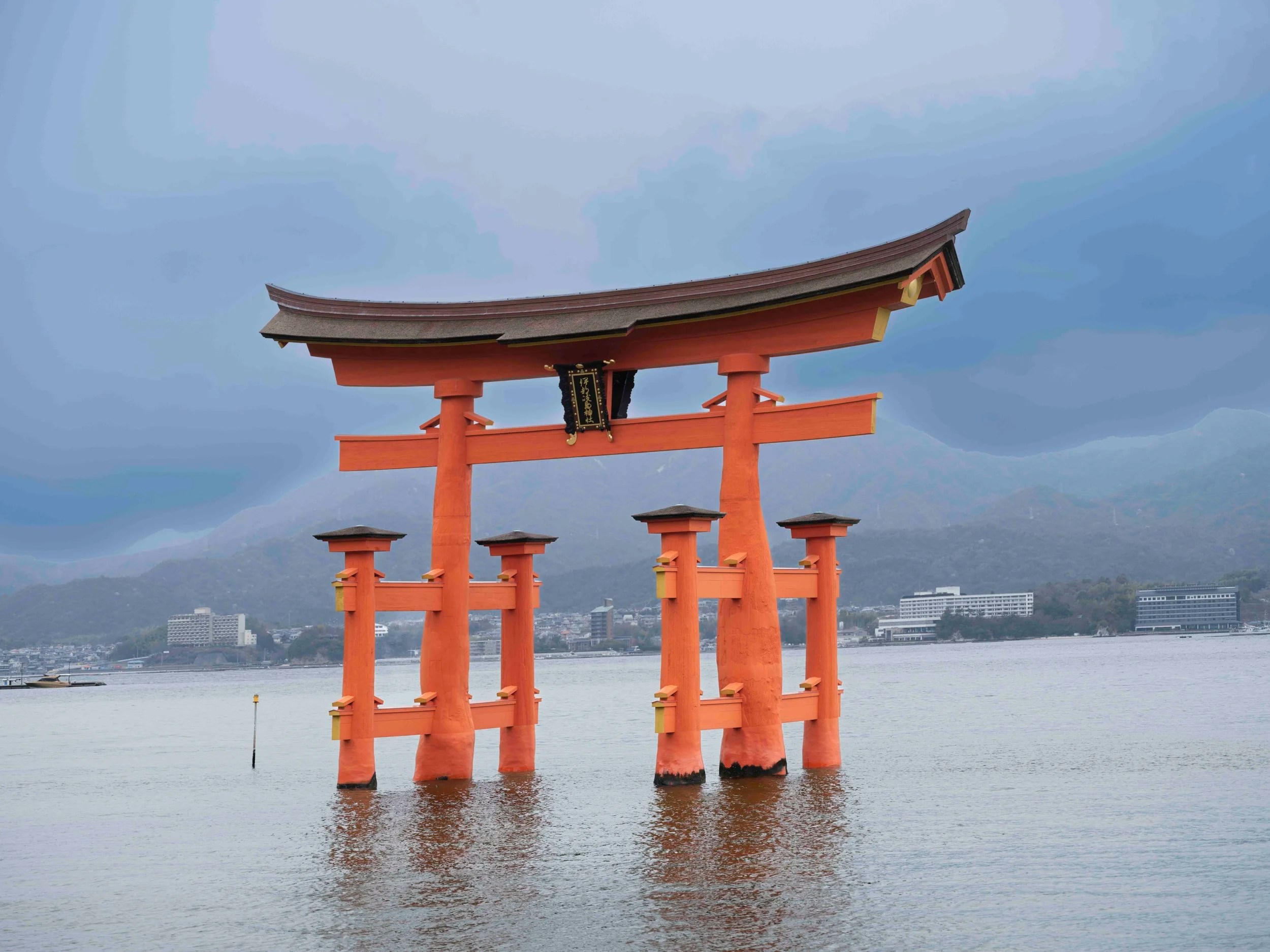
Ponant’s boats are small as these things go, on this trip there will be about 150 passengers, and due to their limited size they are able to get into smaller ports that would be inaccesable to larger ships. The boats are irredeemably French which extends to the food, wine and crew so not exactly a hardship posting and I know that my liver will pay the price. The itinerary will take us from Osaka south through the Inland Sea and then north up the eastern side of Honshu, the main island of Japan, to Sapporo on the island of Hokkaido. We will be stopping at ports along our route and will therefore have the opportunity to visit locations that would otherwise be difficult to access in any other way. The intent is that we will be following the cherry blossom season as it moves north through the country’s islands.
Accordingly we arrived in Osaka on a domestic connection from Tokyo after our Air Canada flight from Toronto. We were among a very few non-Japanese on a packed commuter flight that arrived very late into Osaka, when we learned a graphic lesson on the competing aspects of the Japanese character. The ultra-polite and gracious side of our fellow passengers’ personalities while we waited to board was replaced with a take-no-prisioners, steely-eyed intensity when disembarking, as everyone determined to be the first one off the plane. No pity for widows or orphans.
Our grand first night dinner in Osaka!
Our first night was spent in a hotel in the airport terminal which immediately took us back to our first trip to Japan 25 years earlier. Our ship’s rallying-point hotel in Osaka is the Ritz Carlton Hotel but we expected to be so tired when we arrived in Osaka late in the evening, that rather than struggle to get into town to our hotel, we decided we would stay in the hotel in the airport and go on to the Ritz Carlton the following day. Unfortunately, when we checked in we flashed back to our first trip when our Tokyo hotel’s rooms were so small that one of us had to go into the corridor if the other one wanted to unpack their suitcase, small just does not do it justice. This one was slightly larger, we could both stay in the room to unpack, but we had to take turns breathing.
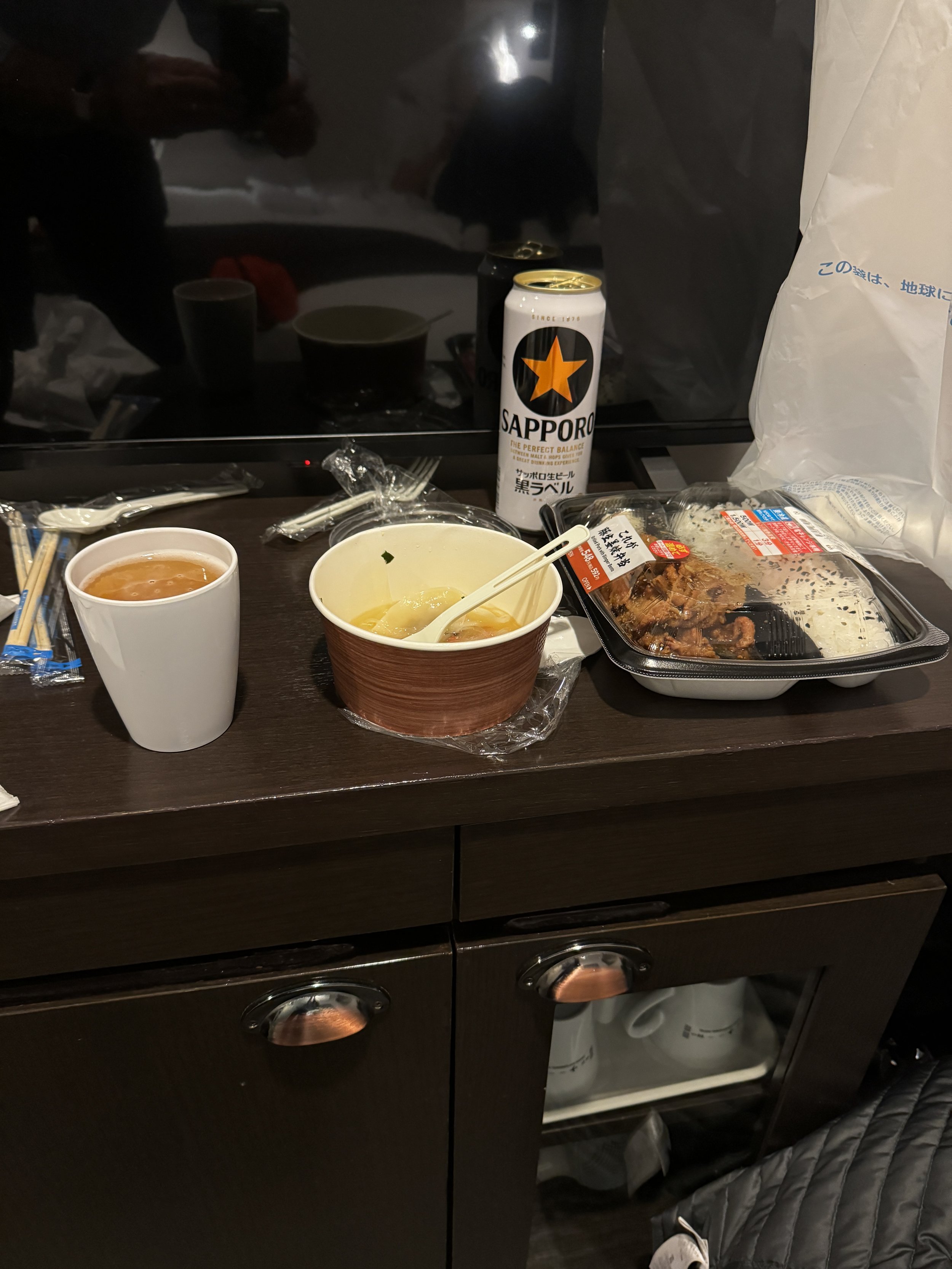
Our next adventure arose when we decided to try and find some dinner, but the hotel had no food service and at this point all the airport restaurants had closed for the evening. I threw myself on the mercy of a restaurant owner who was trying to lock up for the night and neither of us sharing a language, I tried to convey our plight to him. After determinedly gesturing that he couldn’t serve us, he signed that we should follow him. He led us down escalators, through the terminal, past the airport bus station and across the street to a mini-mart that was still open. Excitedly we saw that they sold pre-packaged food; I had gyoza soup with fresh vegetables and we each had a ginger beef and sticky rice all microwaved for us by the store. A couple of cans of cold beer and we are now ready to fight another day.
This post is the first of its kind for me, as you’ll see in a moment.
I’m not sure if I mentioned it in my posts from Tanzania and South Africa last December but as we were settling into our airline’s seats for our return trip home, V said to me, “Well, we don’t have to do that again” presumably in reference to the number of trips that we have made to Africa over the last 10 or 11 years. I think Italy was calling to her and, in fairness, some relaxing time in Europe is long overdue.
And yet, and yet…. about six weeks ago we received an email from a very good friend who also happens to be the young woman wha has planned all of our African adventures for us. Susie and her husband Rich live in White River, South Africa, near to the Kruger Game Reserve, and she is the most competent and capable trip planner and organizer with whom we have worked in any of our travels, anywhere. We found her through a business colleague when she was just beginning her travel firm and we have become close over the years.
But first, a little back story. Susie and Rich are both native South Africans and like all of us, they both set out to see the world after they left school and as fate would have it, met while they were both working aboard a super yacht owned by a Middle Eastern oil sheik. Susie was the Hospitality Director and I’m sure she honed her problem-solving and organizational skills sailing the world and meeting the needs of the ship’s owners and guests, all of whom would have had very high and challenging expectations.
They ultimately left the ship and decided to return home and create a life together.
According to Susie, “When we were foot loose and fancy free we embarked on an incredible adventure around Africa camping on our Land Rover roof top. It took us 6 months to visit 6 countries. One of those countries was Zambia and we fell head over heels.”
“When visiting South Luangwa national park we spent a wonderful evening with a group of Americans in a small camp called Mucheja. A few bottles of wine later we were having our lives laid out for us by our newly-found friends. One of the travelers said to us, you should run a camp next year … you should actually come back and run this camp. So that is exactly what we did!”
“Zambia has many memories for us as we got engaged on the banks of the Luangwa river. This is where all our dreams began. Now 14 years later – we want to go back and we would like to take with us some of our special guests and friends we have made along the way.”
That was what Susie wrote, and not even slightly surprisingly V, in spite of her earlier remark, immediately said, “gosh, too good to miss, let’s do it”. So we’re back to Africa in June 2024.
The reason for my telling you this is that a number of you have said that you’d love to travel to Africa but haven’t yet for a variety of reasons. My first thought was that this would be a perfect trip for those of you who either have never been or would like to return; an opportunity to visit somewhere a little off the beaten path. The trip is open to both couples and single travellers.
It’s a small group, 5 couples and couple of single travellers and while we do not ordinarily travel in a group, we broke our rule in this instance because it’s a trip that we would love to take with our friends. Off the beaten path but in expert hands, traveling with Susie, Rich and friends and with whole new worlds to explore and to photograph.
One point worth noting noting, V and I are fully-paying guests. Susie has not asked me to write this nor are we compensated in any way. Gosh, I sound like a YouTube video!
If you’re at all interested, take a look at the link:
There are only a couple of spots left but we’d love it if they were taken by friends, to add to the friends who are already enrolled. If you’re interested drop me a line or better still write Susie for more information at: susie@africanavenue.co.za.
It’s been a while since my last post but in the interval we have covered a lot of ground. We left Borde Baker Lodge on Friday for a town called Tortola, our last stop before Villa O’Higgins and the end of our road. Our night there was an experience that I would not want to repeat. Tortola is built at the bottom of a steep hill along the edge of a fjord, but since fjords don’t usually have a foreshore but drop from the land into the water, the houses are built on cyprus pilings around the edge of the fjord. Cyprus is a native tree and has the advantage of growing straight and true and is noted for its water and moisture resistance, a significant factor in the construction of homes and buildings in the extremely rainy communities built along the western shores of the country. Connecting all of Tortola’s houses is a walkway about 2 metres wide and 900 metres long, also build on cyprus pilings. The walkway is the only way of getting around the town. Most of the town’s houses however are not built on the walkway itself but are built up on the mountainside and connect to the town’s wooden walkway by staircases that climb up the mountainside to connect the houses and buildings to the cental walway.
One enters the town at the top of the hill abovethe town’s houses. You park your car next to the town square at the top of the hill and you get to the town proper by walking down an 85 step staircase to reach the walkway, carrying your bags and luggage. An 800 metre walk along the wooden walkway brings you to the staircase that ascends to our Lodge which is 100+ steps up a steep wooden stairway. It goes without saying that this would be a reasonably challenging exercise for the fit but for for two aging, out-of-shape and unprepared Pisco Sour drinkers, not a great way to end the day. However, an hours rest, a Pisco Sour and a good dinner prepared us for doing this trek in reverse next morning in the dark, so as to get an early start on our drive to Villa O’Higgins.
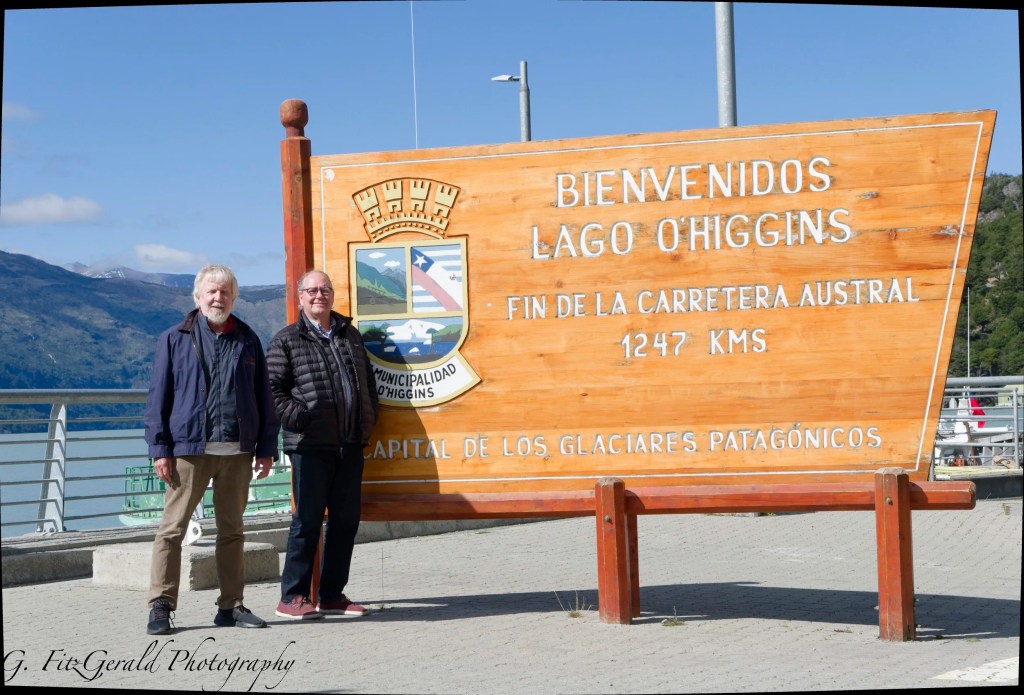
Villa O’Higgins when reached after a a 5 hour drive of relentless pounding revealed itself to be a tiny hamlet surrounded by mountains with a couple of guesthouses, 2 restaurants and a school. The Carretera continues through the town for an additional 7Km and ends at a Chilean Navy dock on Lago O’Higgins. Lago O’Higgins is a very long narrow lake on the other side of which is Argentina, hence the presence of the Chilean Navy. We took our final pictures at the trail’s end, had an early dinner and prepared ourselves for the long drive back, starting early Sunday morning.
On Sunday and Monday we covered the 527Km from Villa O’Higgins to Balmaceda Airport near Coyhaique, a distance that took us 5 days while we were travelling south. It was a punishing two day drive on unpaved roads which then allowed us the luxury of a 2 hour flight back to Santiago where I write this on Tuesday afternoon. Robert left for Australia this morning and I leave for home tomorrow evening.
The Chilean Patagonians we met were charming, gracious and helpful and were among the highlights of the trip. However, spending time with Robert after the passage of so many years was the real highlight and although we are unlikely to have another such chance, I am enormously pleased that we made this opportunity happen. Good friends are one of life’s gifts and I’m very lucky in my friends.
On balance, an amazing journey and a fabulous adventure but it did have its challenging moments. However our challenges pale in comparison to those of the steady stream of bicycles that we passed in both directions, loaded with equipment and toiling up and down the mountain passes. It seems presumptuous to compare our travails to theirs but with a 50+ year gap in our ages, I think we are allowed our own small moments of pride.
Yesterday, Tuesday, was a very long day. We arrived in Coyaique, a very pleasant and interesting town of about 20,000 inhabitants on Monday afternoon and spent the night at a B&B in the centre of town. The B&B’s restaurant was good and the staff were charming but their Pisco Sour was not one of the better versions that we have come across. Pisco Sours have become our litmus test of a restaurant/bar. For those who don’t know Pisco, it’s a colourless or yellowish-to-amber coloured spirit produced in winemaking regions of Peru and Chile. Made by distilling fermented grape juice into a high-proof spirit, it was developed by 16th-century Spanish settlers as an alternative to a pomace brandy that was being imported from Spain. The Pisco Sour is a simple drink to make consisting of lime juice, Pisco and simple syrup and ice as well as a splash of Angostura bitters. Because it is so simple no two versions taste the same and, as we have discovered, can lead to a never-ending search for the perfect version. It has become our pre-dinner drink of choice.
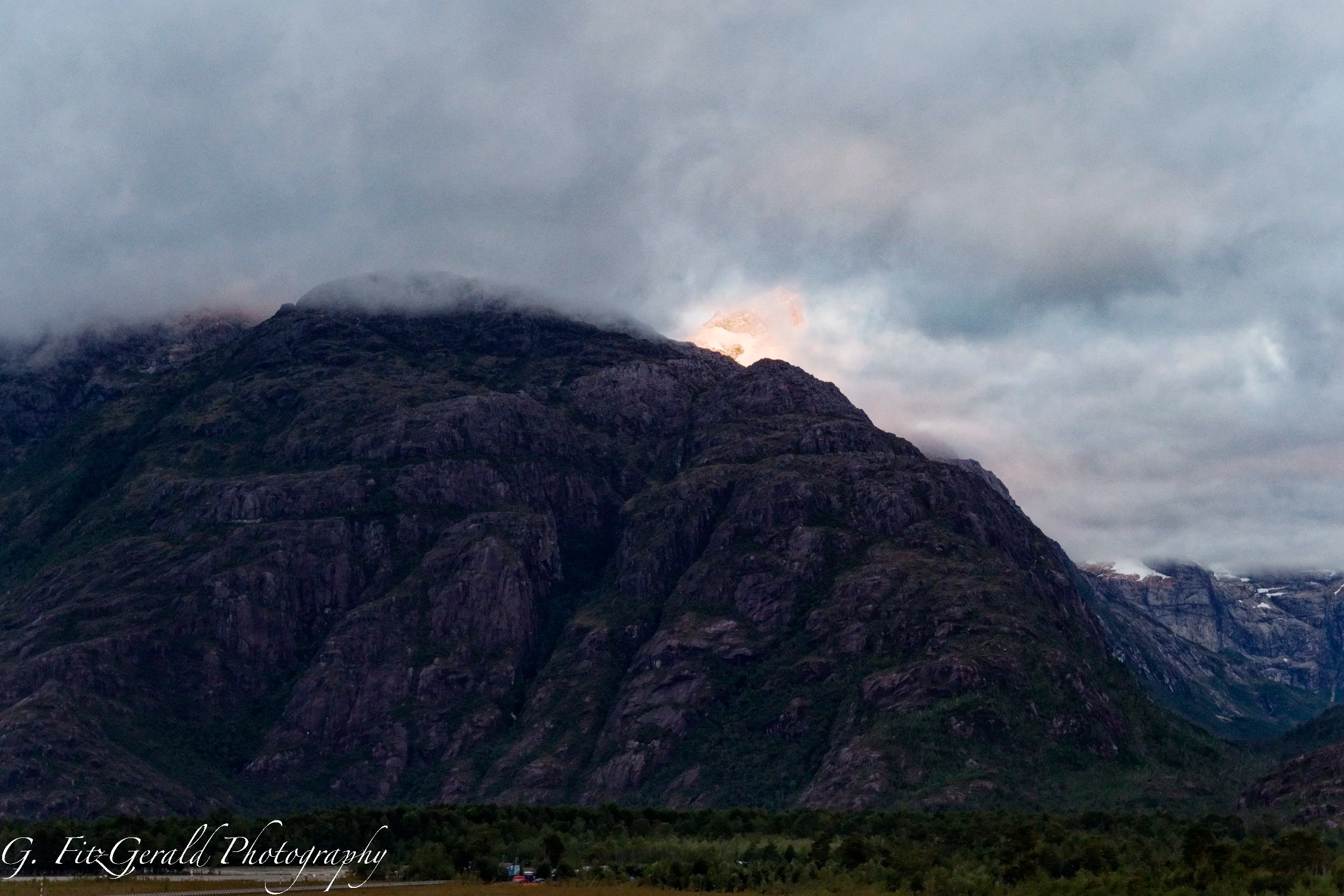
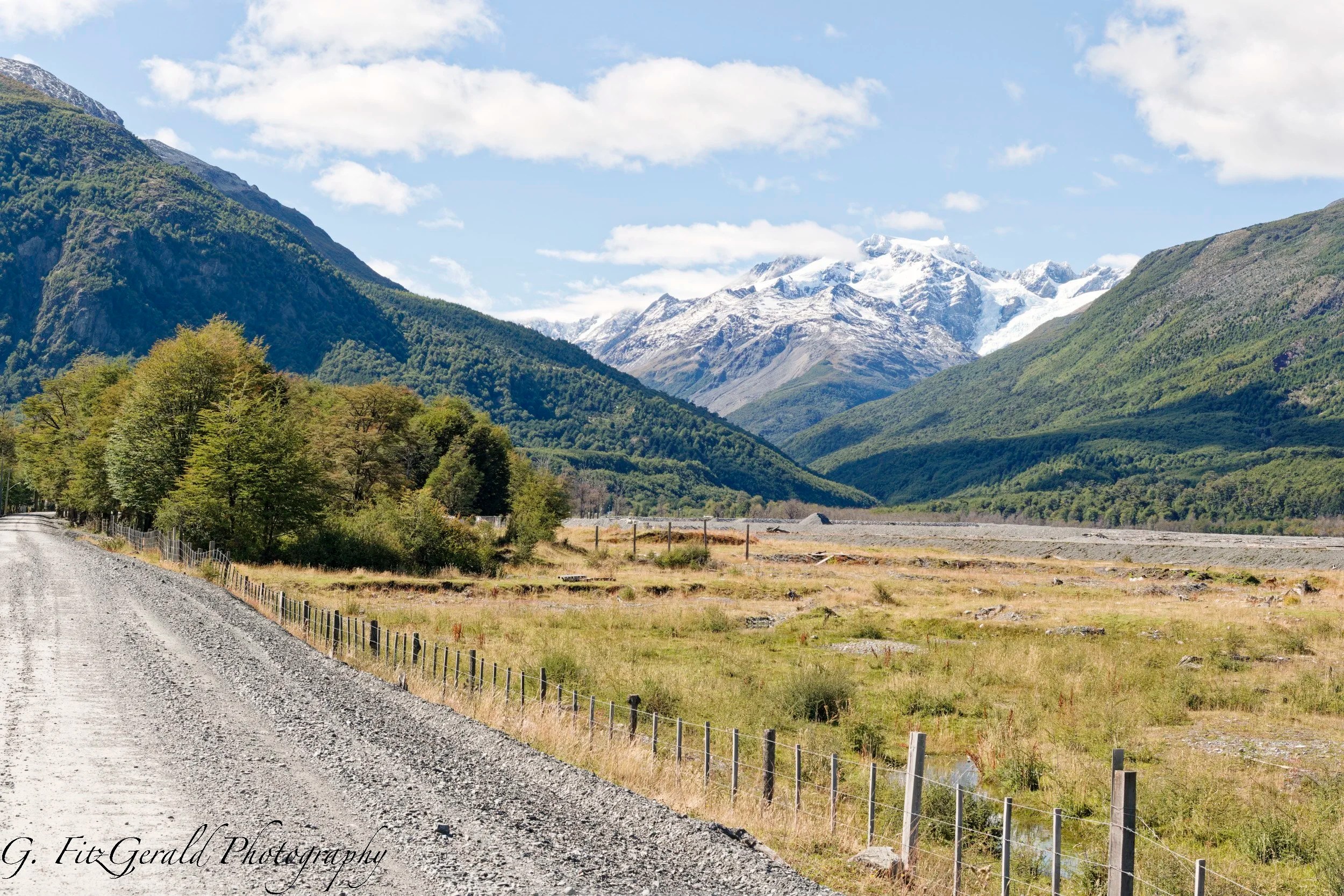
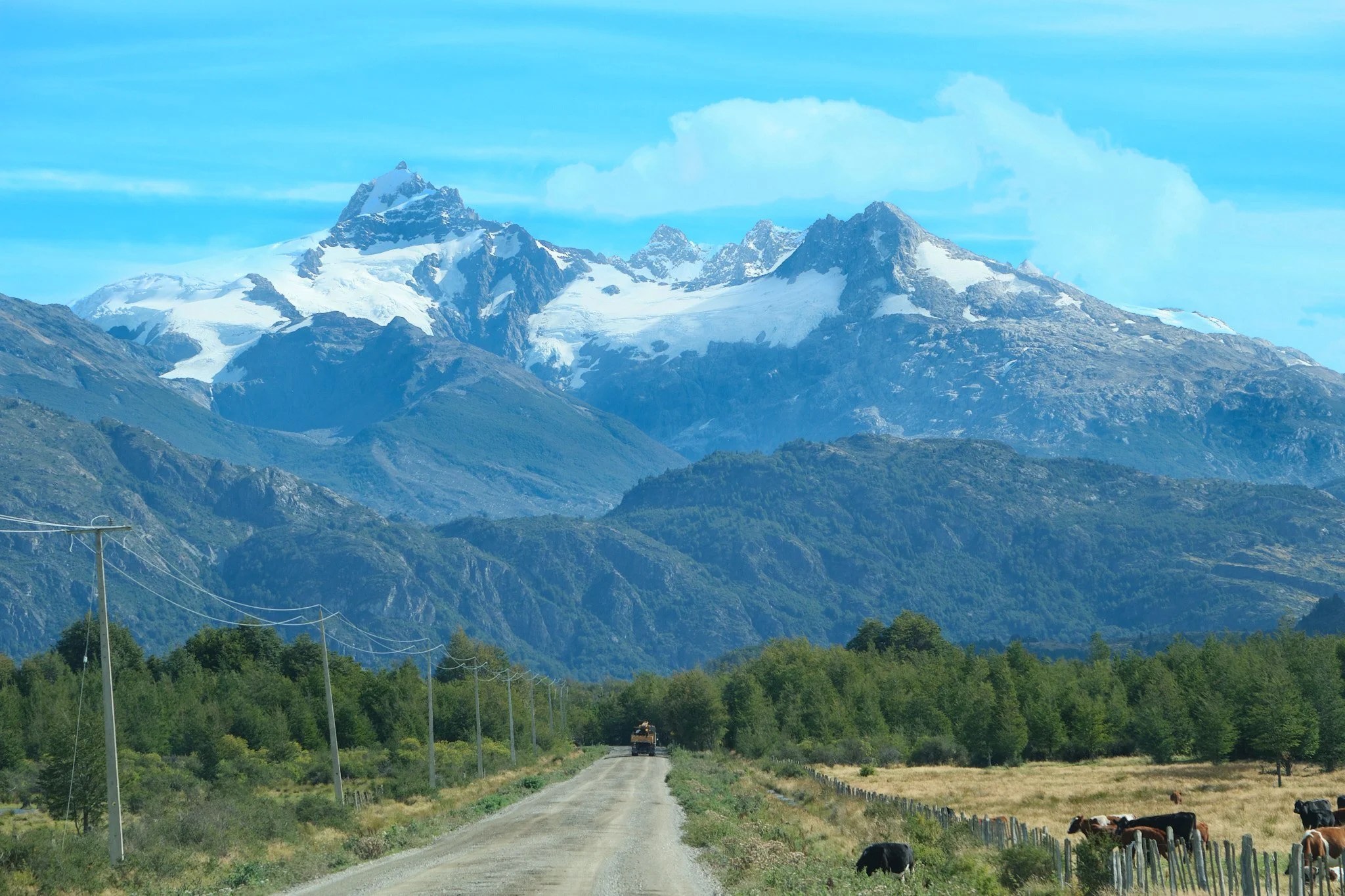
We left Coyaique at 9 on Tuesday morning and headed for Puerto Bertrand a town on the Baker River several hours drive south. As I may have mentioned in an earlier post, we are now and have been for some time, driving on unpaved roads. The early part of Tuesday’s drive took place under lowering skies and rain, and the roads were punishing.
We recently came to understand that during the week prior to our arrival the whole region from the top of the Carretera at Puerto Montt to the bottom of the continent had been hit with severe winds, up to a 100Km/h and torrential rains. Hence the overflowing rivers everywhere and more importantly for us, the precarious nature of the roads. Unpaved gravel roads are not an issue for either of us but when you understand that there is only one north-south road, that it is unpaved, that it is used by every vehicle that needs to move north-south including 16 wheel rigs with 40 tons of cargo, logging trucks and every single car, bus and truck it should come as no surprise that the roads are continually being beaten into oblivion. When you then add torrential rains and the ever-present, road-hugging mountains and cliffs whose falling rocks and slides loosened by the rain are a continuous menace you can begin to understand the condition of the road, the washboarding nature of the track and the enormity of the potholes. It often seems as if the road is an endless series if potholes, spread haphazardly and continually across the road and connected by a few small patches of smooth surface. They sound of banging and clanging from the car’s suspension is continuous as is the continuous jarring and lurching of the car and passengers as the vehicle bounces and crashes into the eternity of potholes large and small.
I mentioned in my last post that neither R nor I partook in the massage programs available at Puyuhuapi Lodge, coals to Newcastle as our drives produce more deep massage and muscle pounding than any trained, sadistic masseuse ever could.
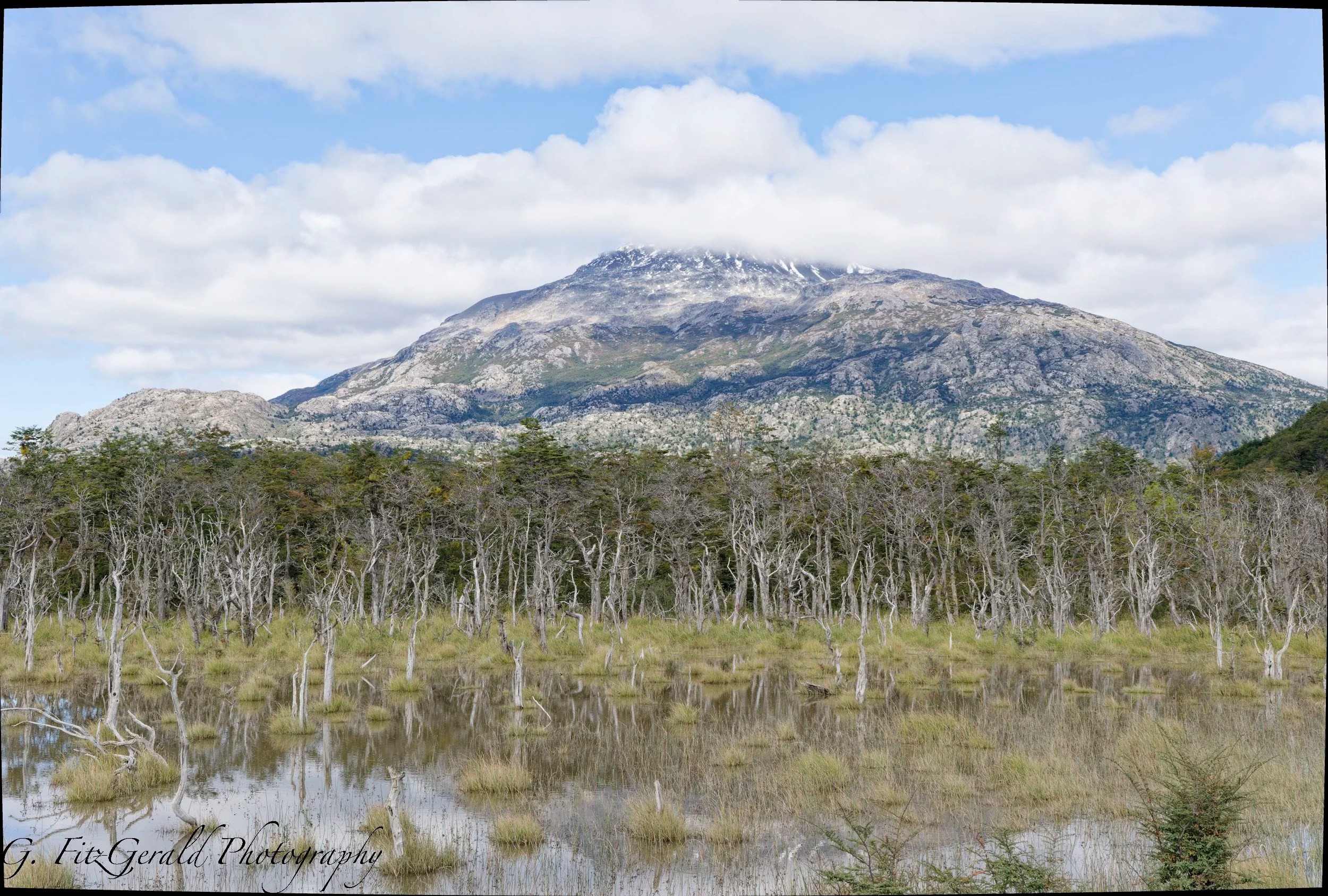
By about 2pm after 5 hours of punishing driving and having crossed a couple of eastward passes in the mountain ranges, we came into a very different weather system as we are now about 80Km east of the ocean with 3 mountain ranges between us and the sea. The sun broke through and the sky was a bright azure but with a brisk chill wind blowing. We stopped for a bio break and a snack at a service station in the town of Puerto Rio Tranquilo during which I discovered another interesting Chilean cultural food quirk. In the little food service counter in the gas station I noticed that they sold hot dogs and, I will shamefully admit, I’d go anywhere for a good hot dog. Having ordered one I looked around for mustard only to discover that the condiments available as standard practice in Chile are ketchup, mayonnaise and surprisingly, avocado paste. The avocado, the consistency of guacamole but much less flavourful, was no substitute for mustard which was nowhere to be seen. Having tried it I can safely say, not a patch on mustard and the green paste decorating the hot dog is is oddly troubling!
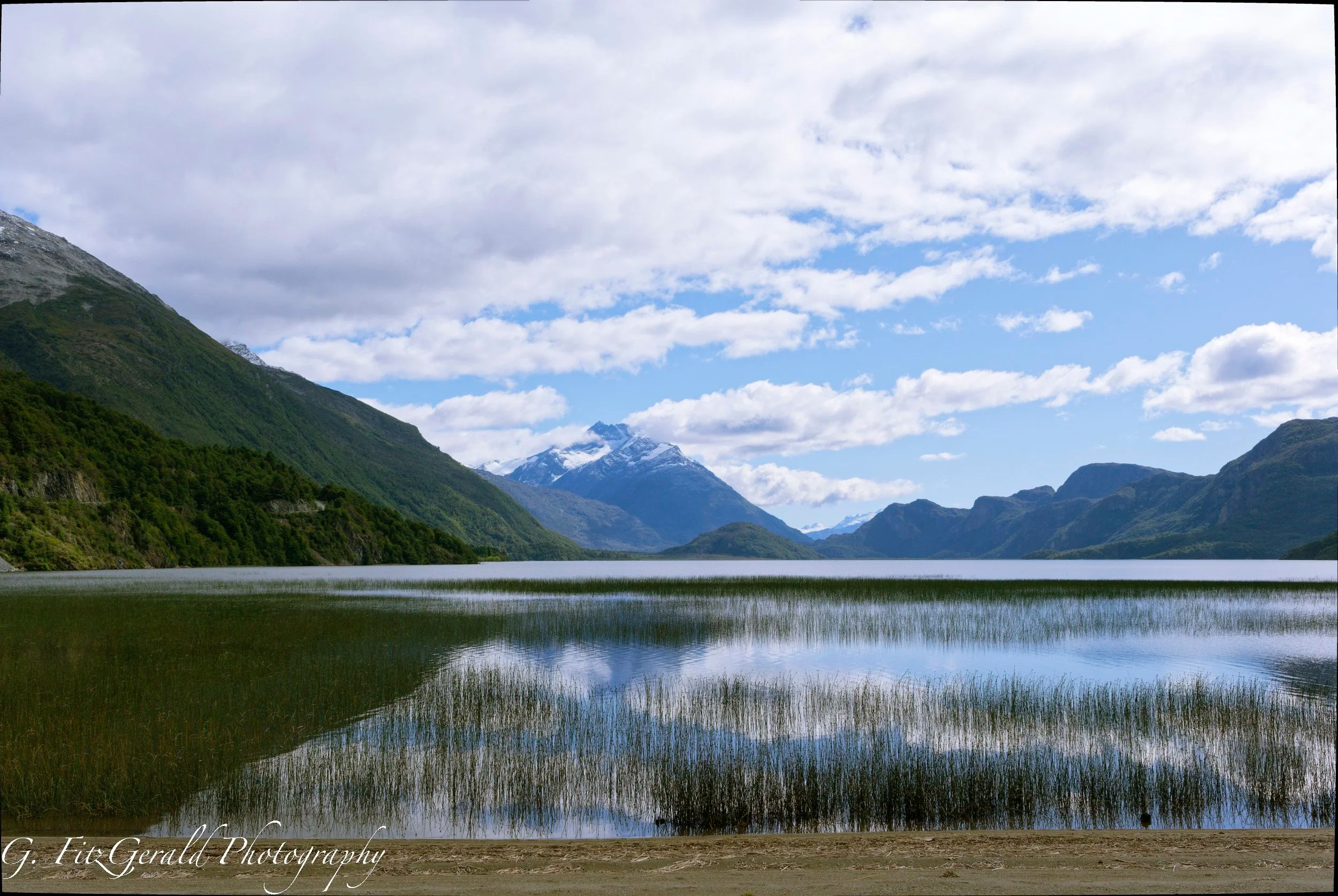
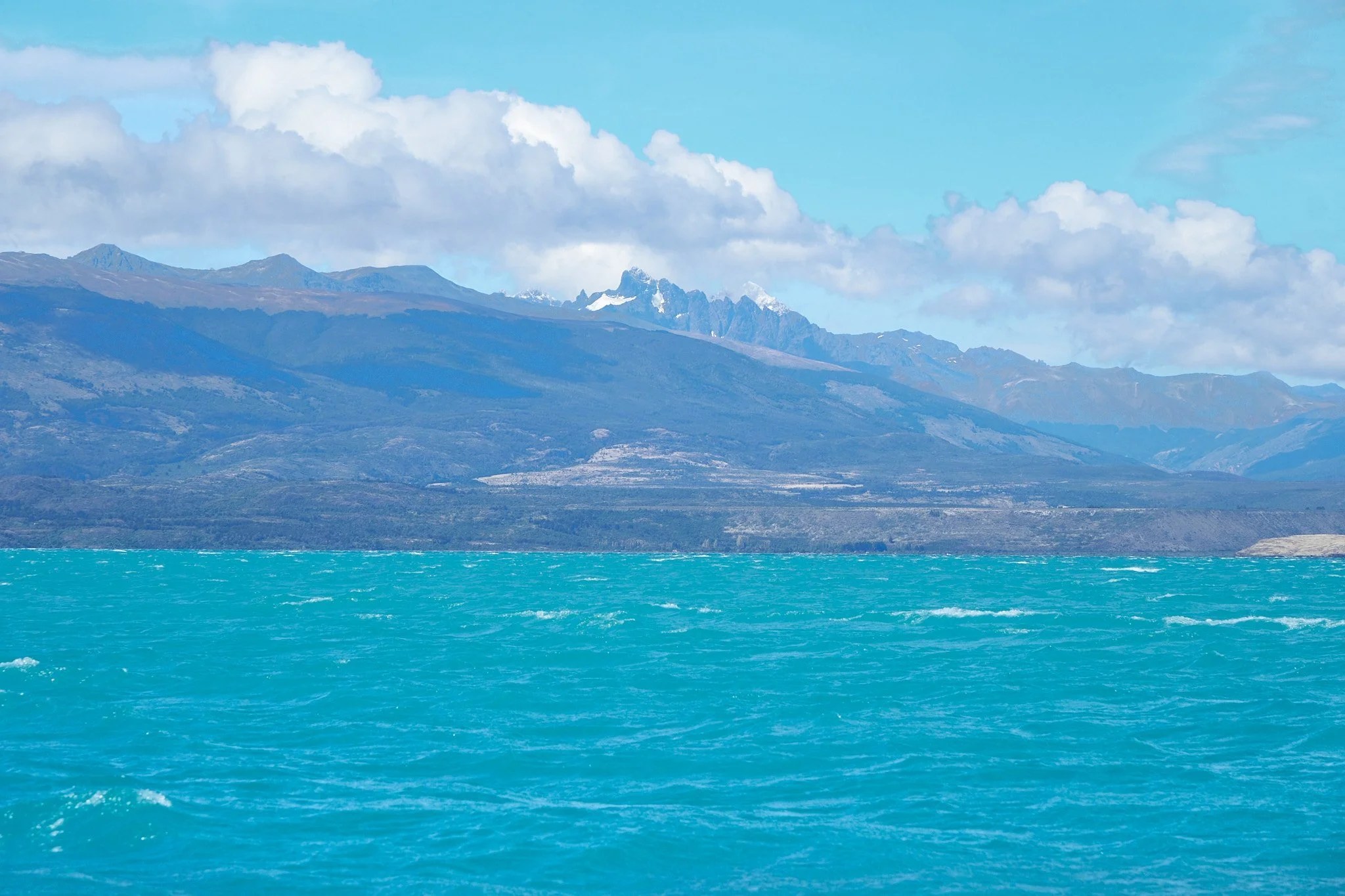
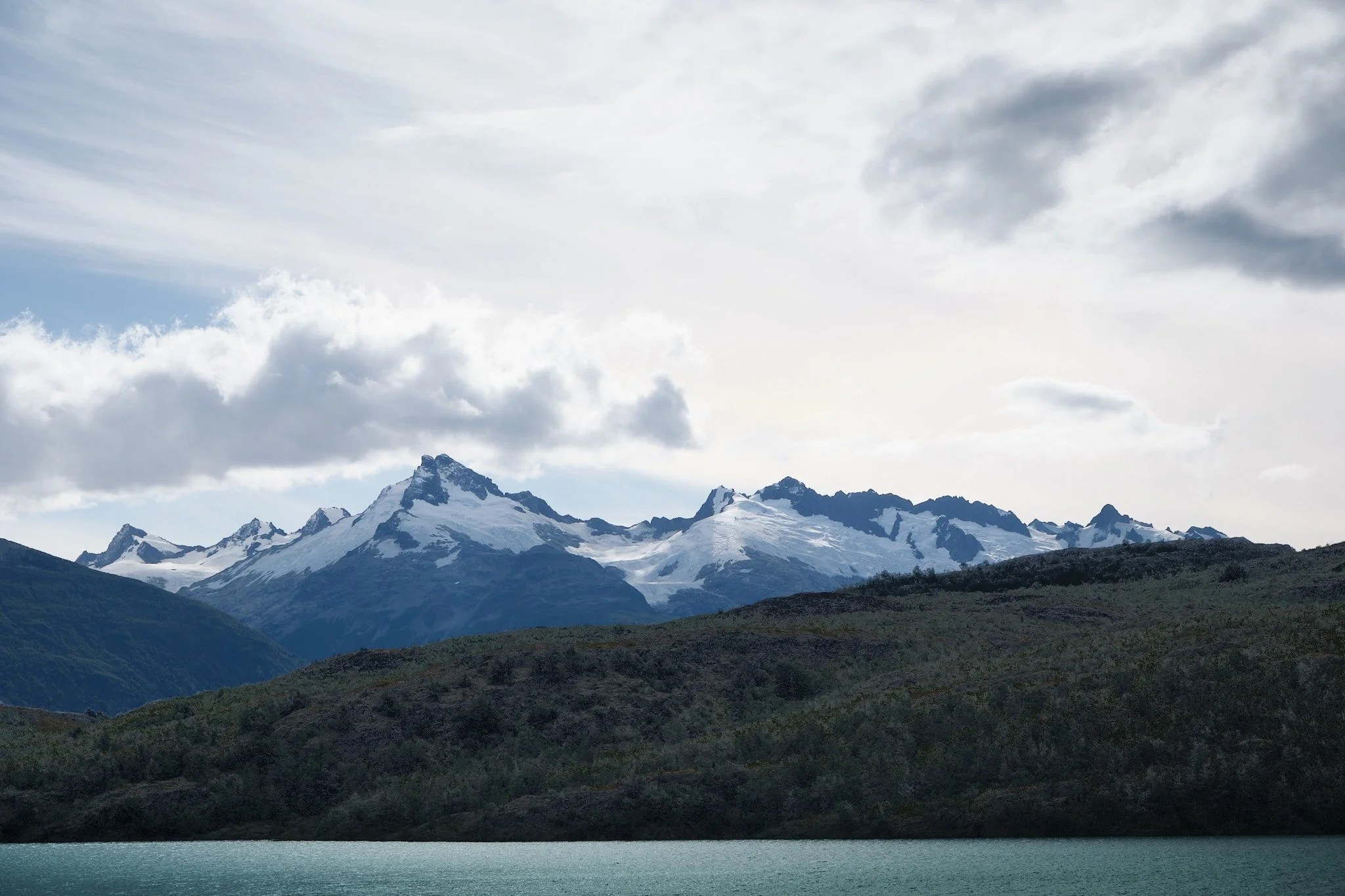
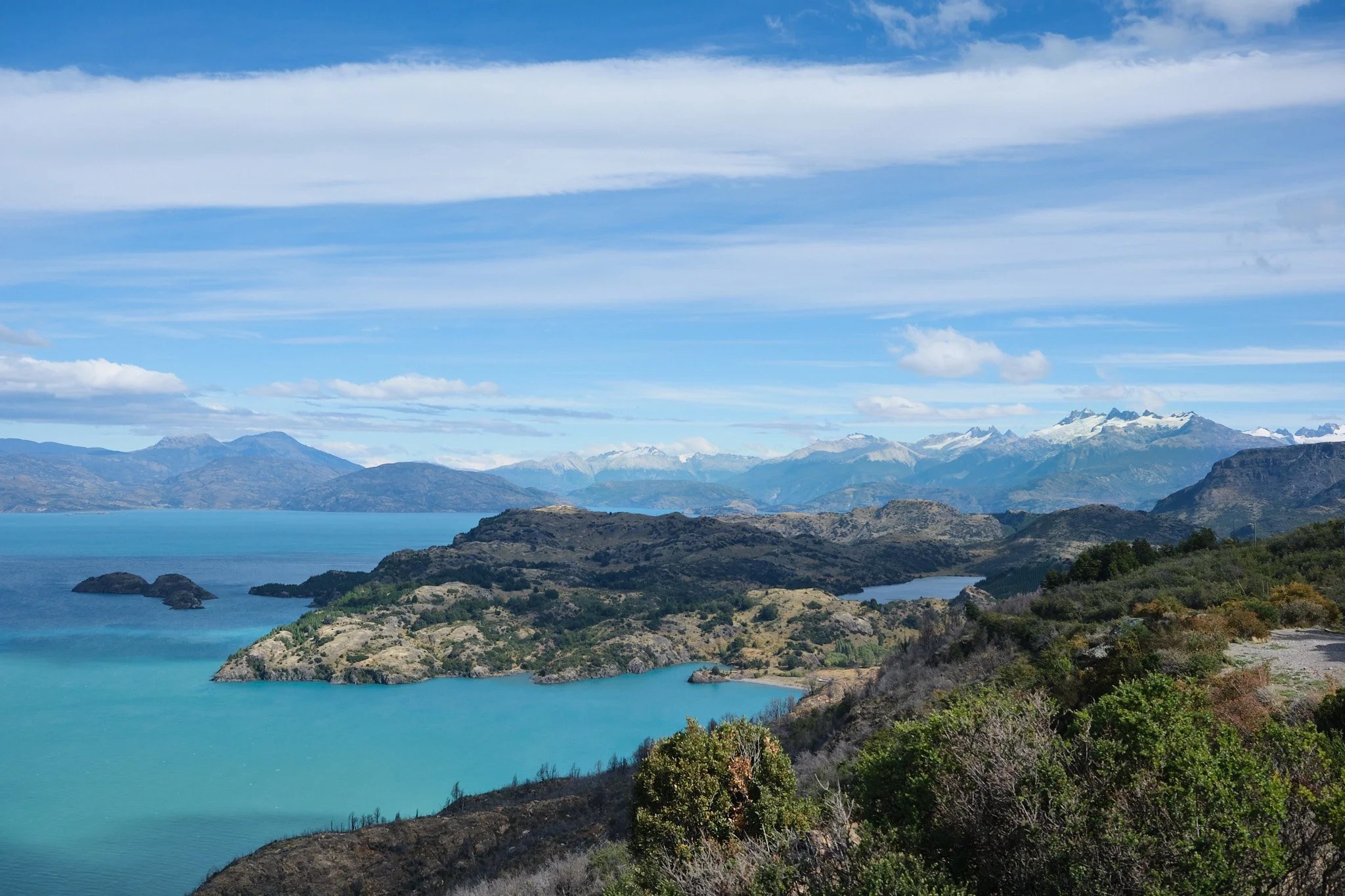
Hans, our driver/guide had arranged a boat ride for us to see something of the second largest lake in South America next to which the town of Puerto Tranquilo was located. The wind was by now quite strong and was creating significant swells on the lake and decorating their tops with white caps. The private boat that we used was equipped with about a dozen seats but there were only Hans, R and myself as well as a guide and driver on board. Our passage was was a marine analog of our road journey, the swells throwing the boat from side to side, lifting us over the swells and crashing us down on the next wave. Shortly after we departed we were told that the marine authorities in the region had called all boats back into ports and were not allowing any boats on the water until further notice. We managed to round a headland into slightly calmer conditions and chugged our way to a landing where we were met and driven back to our vehicle. The boat ride was great fun and the views from the water were fabulous but we faced another 90 minutes of driving over the road to perdition before, beaten and weary, we arrived at our present location, Borde Baker Lodge.
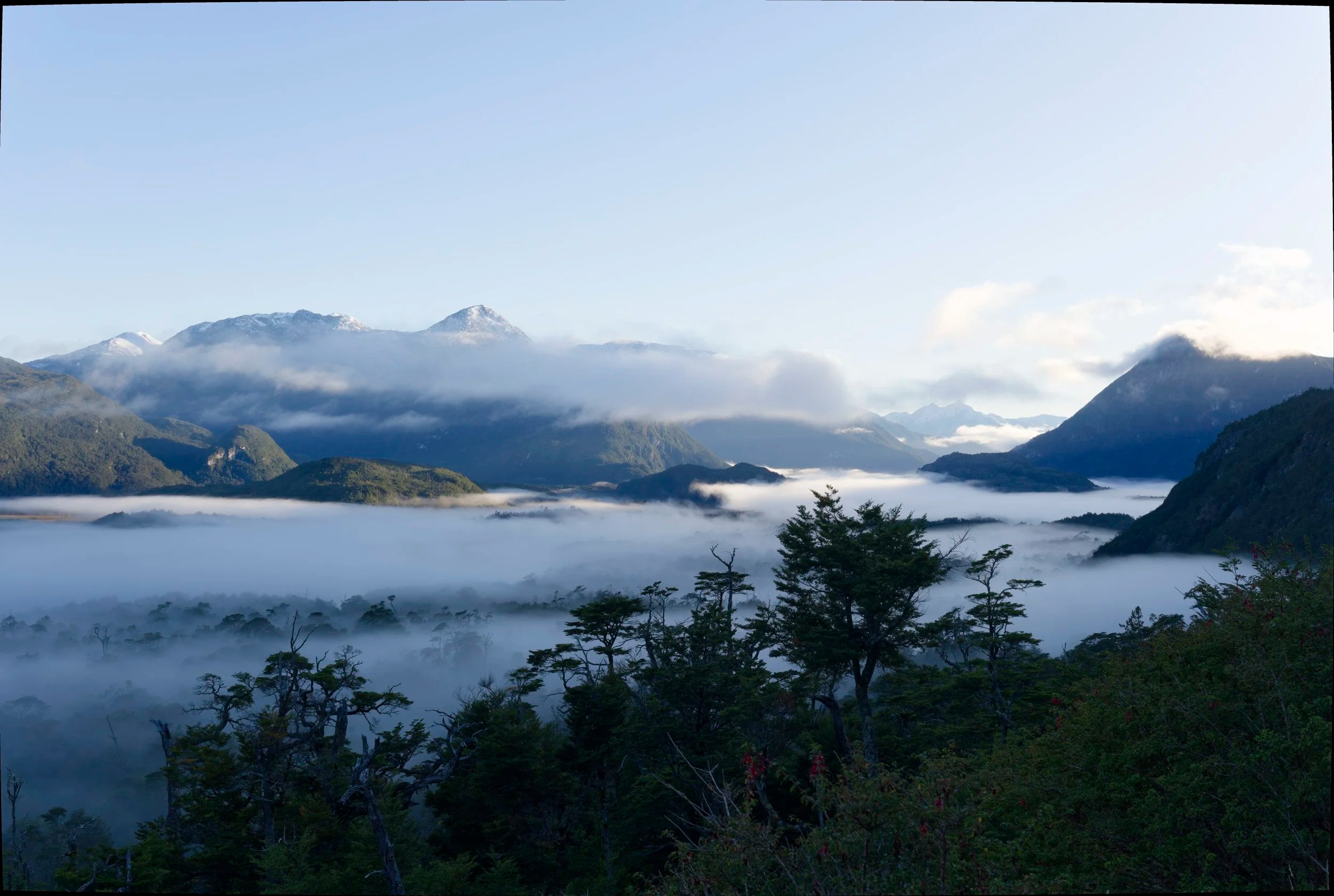
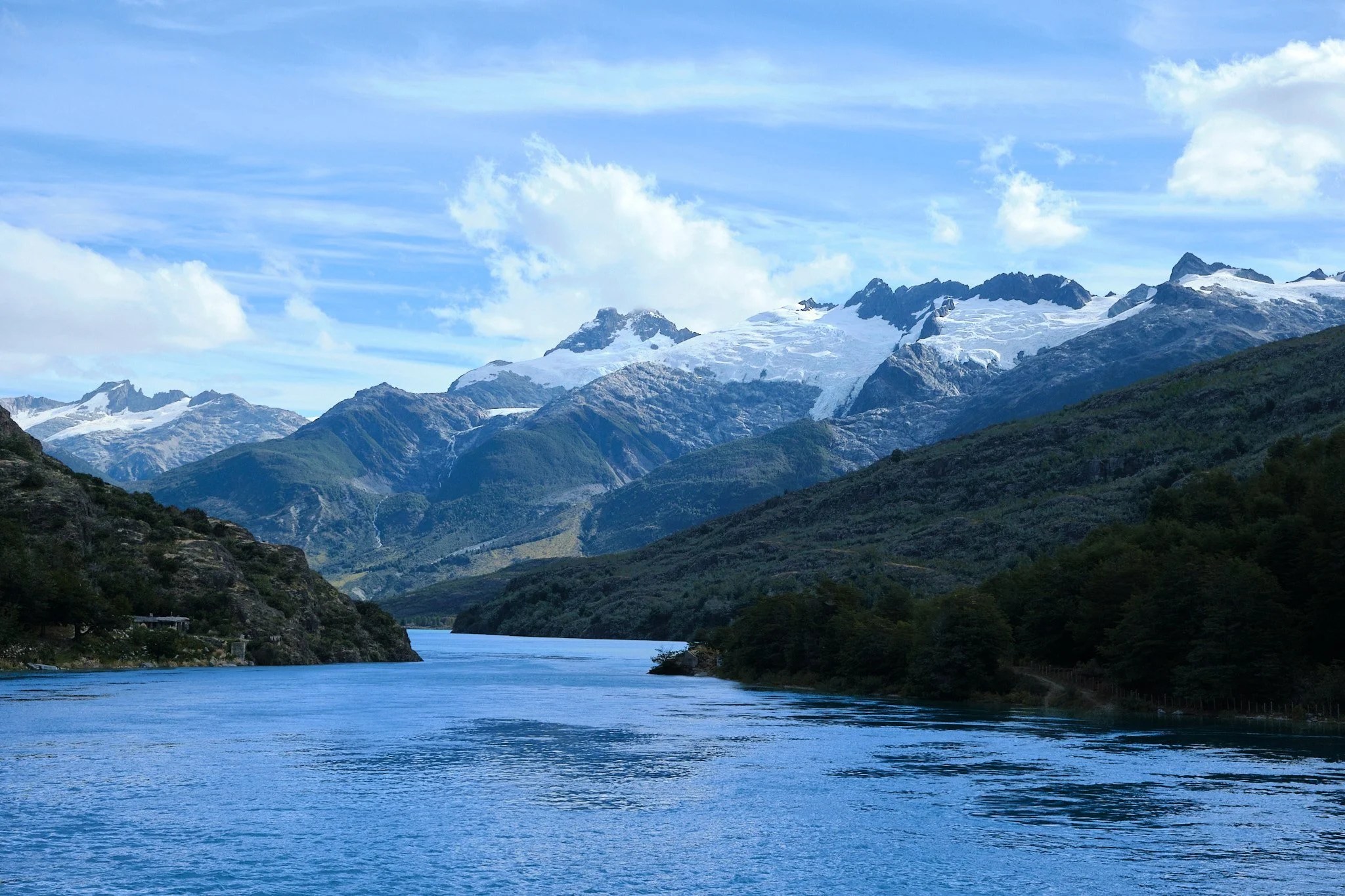
The lodge is a lonley outpot along the Baker River and consists of a series of little wooden houses connected by wooden walkway to the central lodge. Each little house contains two rooms, bedroom and bathroom and the bedroom contains a wood stove and a gas heater. There is a very pleasant veranda attached to each little house with a door off the bedroom and the view down to the river below and to the snow capped mountains is grand.I had the wood stove lit when I went for dinner but neglected to get instructions for lighting the gas heater.
By the time that I had returned from dinner the wood stove was roaring and the cabin was uninhabitable. I built a wall of pillows and anything else I could find to put on the bed between me on the outer edge of the bed and as far away as I could get from the stove, opened up the door to the veranda and went to bed. I awoke at about 2am to find the wood stove fire dead, my verandah door wide to the winds and my breath a cloud in the moonlight. Didn’t want to take a chance with a gas stove about which I knew nothing, but huddled in the blankets and oddly enough I fell back asleep. Lots to be said for Pisco Sours.
At 7:30am I awoke to frost inside and outside my cabin and no way to get it warm again. However a hot shower warmed me enough to dress and to race for the lodge for breakfast. Suffice it to say that I now know how to turn on the gas heater!

















 Site Title