• Delhi, March 2, 2025

    When last heard from we were stranded in Leh after the first major snow storm of the season. I write this in Delhi after our experiences of leaving Leh, which follow.

    Yesterday March 1, our departure from Leh can best be described in classic military parlance as a case of ‘hurry up and wait’.

    You need to know that the two previous days’ flights arriving and departing Leh had been cancelled by the snow and the airport was in chaos. We were told that we had been re-booked on a flight leaving sometime in the afternoon so should not worry about leaving for the airport, 15 minutes away, until we were given further instructions. Three of our group were scheduled on an early flight leaving at 7:30 but we relaxed with our books in our room and waited for more information.

    We decided to have a bowl of soup before we left for the airport and wandered down to the lobby at about 11 only to met by a panicked representative yelling ‘why aren’t you ready, we need to leave for the airport now, now, now!’ on a rapidly rising inflection. Scurry we did, hauled our bags, loaded our car and at about 11:30 raced to the airport for a 1:15 flight, sans boarding passes or any flight documentation.
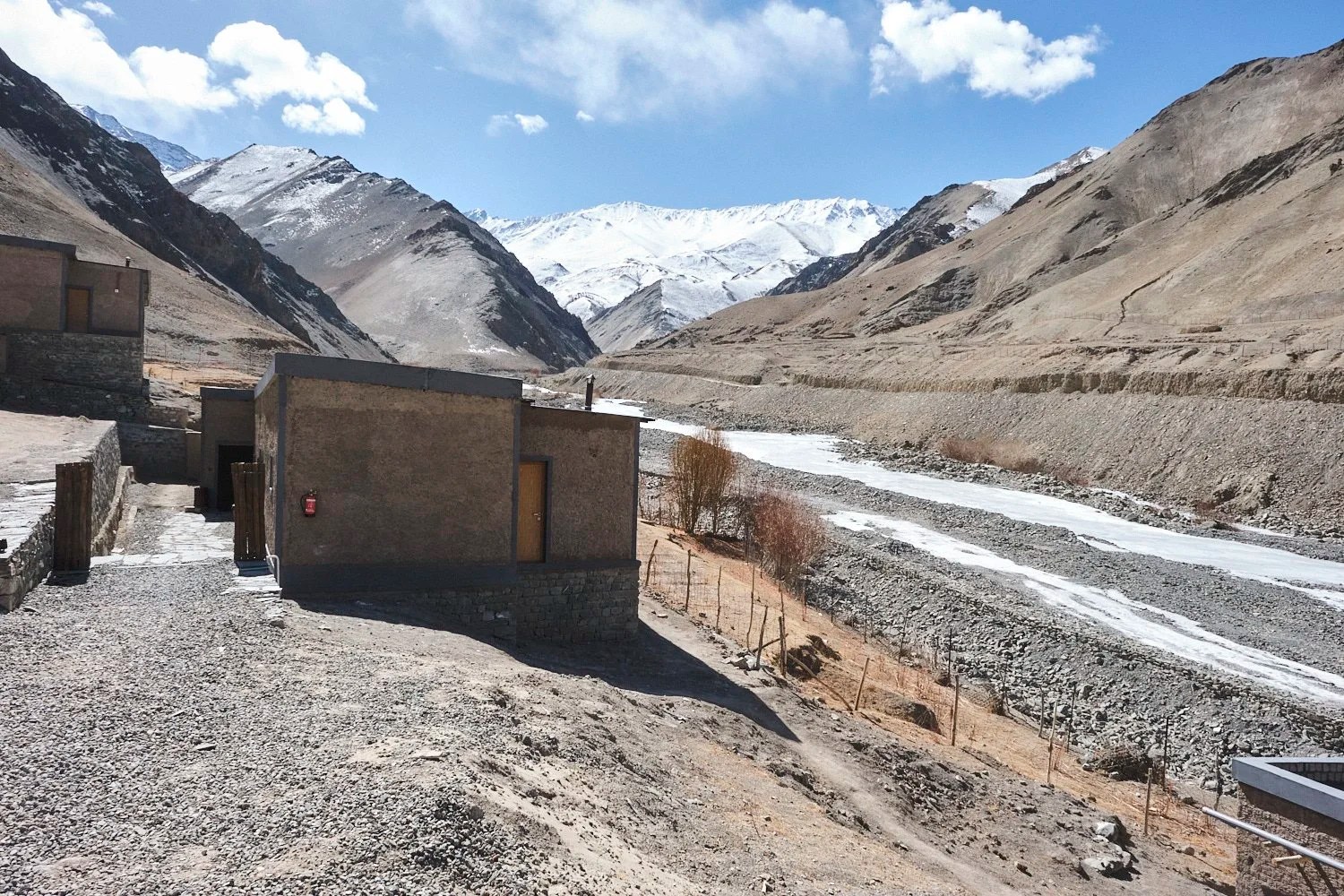
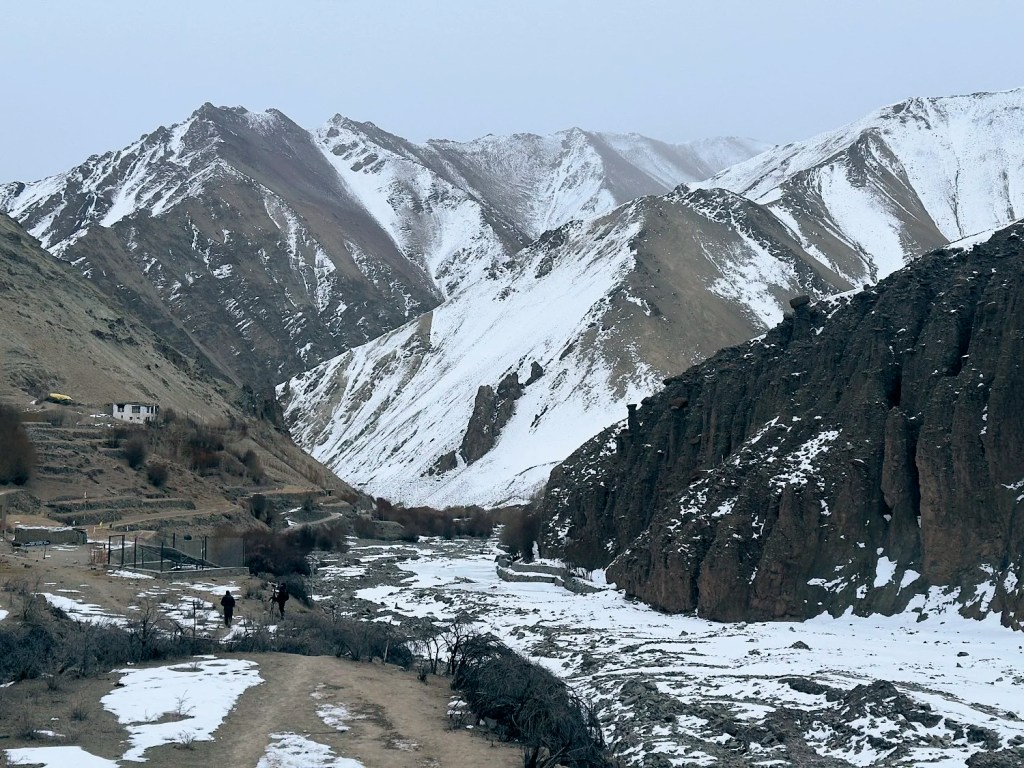
     Our eco-camp in the Rumbak Valley
    Our eco-camp in the Rumbak Valley

    Wait one, arriving at the airport we were not allowed to enter past security since we had no flight documentation. We waited with our bags in the snow, slush and cold while our rep began some quiet but fierce negotiation on our behalf which ultimately succeeded in giving us entry to the building but still no documentation.

    Wait two, on entry to the airport at about 12:15 we were told that there were no seats on the plane but that strings were being pulled and two members of the military on the flight were being bumped until tomorrow’s flights and we would be given their places. Our bags were taken and loaded on the belt at check-in while we could hear the flight that we were due to take beginning to be called… but no boarding passes. Much conversation and negotiation and we were told to find a seat and relax. V found a spot to sit but I had no intention of leaving so watched the process unfold in all its glory. After 20 minutes of continuous discussion and rapid computer keyboard typing I could finally see our precious boarding passes being printed. Our flight was still being called. I was now told that our bags were overweight but as I explained we were Star Alliance Gold members and we had a privilege that allowed an extra bag. More furious keyboard activity, more furious discussion. Another 20 minutes passed until I was told that our Star Alliance membership could not be verified. I explained that we were not Air India members but Air Canada and as both airlines are Star Alliance all privileges are honoured by all reciprocal airlines. The final boarding call had long since come and gone.
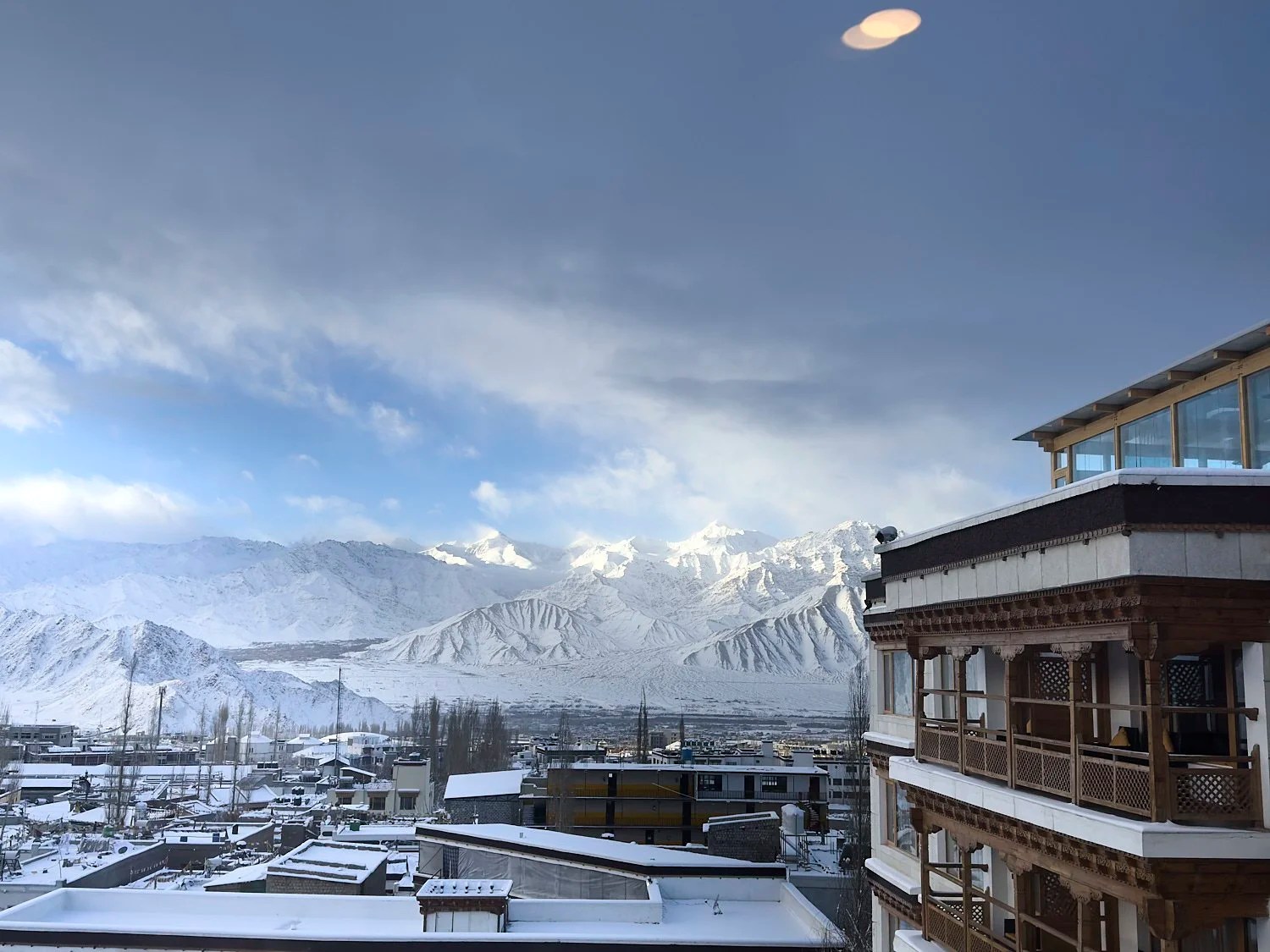
     Leh hotel post blizzard
    Leh hotel post blizzard

    At this point all the joy had gone out of the process and I simply wanted to have it done and get on the plane so I said, ‘to hell with the membership business, what do I have to do so that we can get this finished?’ I could pay the overweight was the obvious answer so our precious boarding passes were given to a staffer who hurried me out of security to a dingy office where a little cashier was busy on his computer. Now, if the British Raj left any legacy in India it’s best represented by all aspects of Indian organizational and governmental culture being imbued with a deep, passionate and abiding love of bureaucracy in all its complexity with multitudinous forms all of which have to be completed in great detail and in multiple copies. In fact, the more inconsequential the act, the more forms that are required, this was no exception. I asked how long would it take to pay the overweight and I was told about 10 minutes?! Subsequently I could have wished that that was all it took.

    Wait three. First we had to calculate the amount that would be charged for a 10k overage, then forms had to be completed supporting the computation. I was finally told that the cost would be 6500 rupees; I asked could I pay in US$? Sadly no, only rupees. Could I use a card? Of course. Do you accept Amex card? Of course sir, we accept all cards. Except that after multiple tries the system would decidedly NOT accept Amex cards. Would sir like to try a different card? Yes sir would, so sir scurried out of the little office, found V and grabbed all the cards she had and raced back to the office. I could hear the loudspeaker now calling V’s name and mine to come to the gate immediately. Thank god we had boarding passes, we were official!

    Finally a Visa card was accepted, but the ordeal was still not over. He could not let me go without giving me a receipt but alas, his printer was broken. What to do, what to do? He finally accepted that I write down my email and he would assuredly send me the receipt. My fingers were twitching to get themselves on the boarding passes but it was still required that we go back to the check-in desk and finalize everything in the system. The loudspeakers were ominously quiet but I knew that now with official boarding passes the plane was unlikely to leave without us. On returning to the desk I was met by someone who introduced himself as the airport manager who was abject in apologies that we had had to pay the overweight but he assuredly knew that we were SA Gold members and could I accompany him back to the little office and receive a refund on the credit card for the overage charges? I descended into blind panic at that point since I could only image that creating a refund was likely to be orders of magnitude more complex that creating the original charge and I literally begged him to overlook it in this instance. He finally agreed that he would have the refund processed and using my email address, would email me the refund receipt. I don’t ever expect to see it but bless him for his enthusiasm.
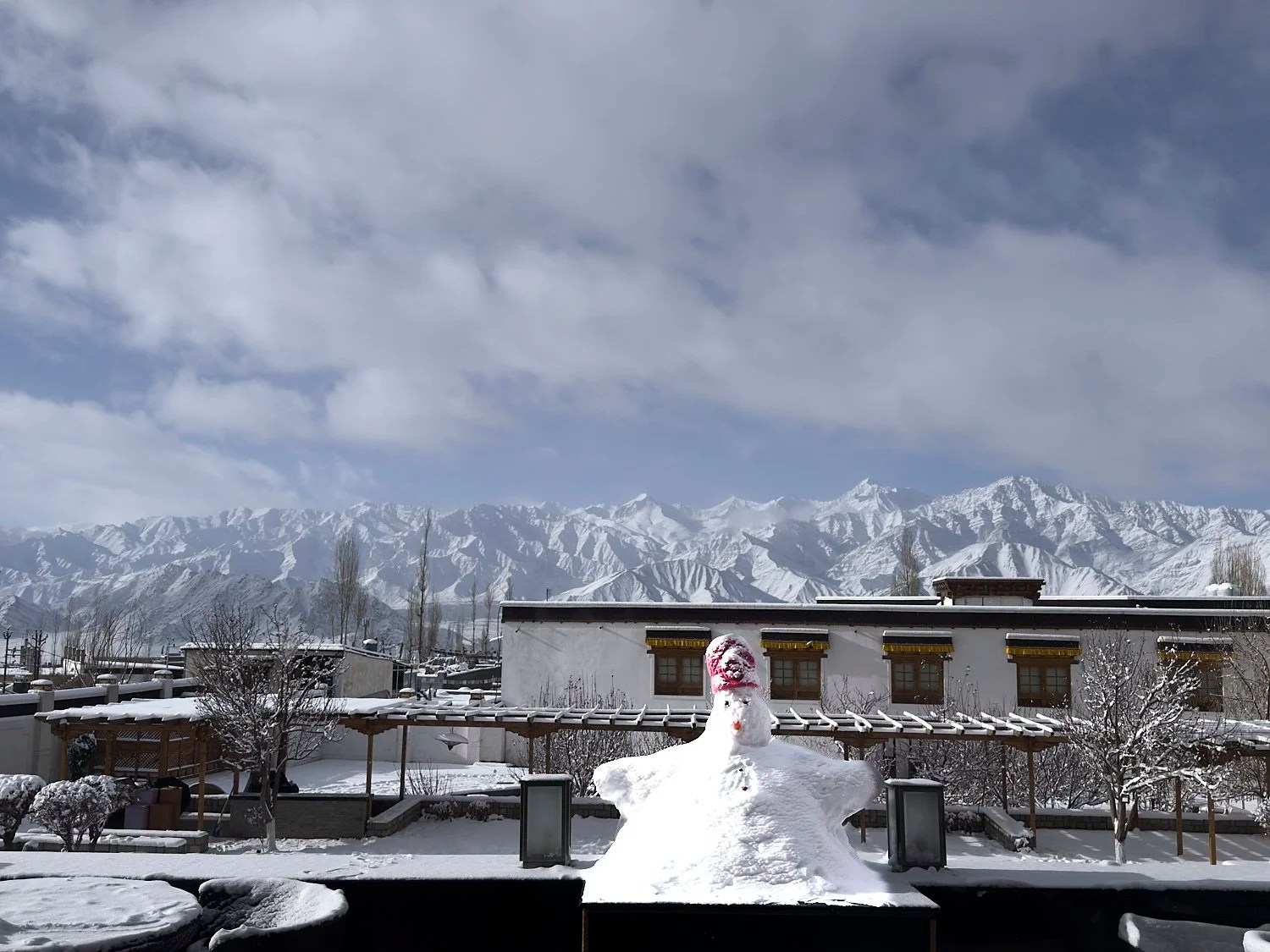
    Wait four. We still had one huge obstacle to overcome, we still had to go through final security, which since Leh airport is technically a military zone was likely to be fraught, as it was. Now the Indians have always, not just in the recent past but for as long as we have travelled there, had a single-minded obsession with batteries in whatever form they take. Not only can they not be included in checked bags, not unusual no airline allows them, but if in hand luggage they must absolutely be seen and minutely examined. I had carefully removed all batteries from my checked bags but as a photographer I have batteries for cameras, battery packs for charging phones etc, batteries for the monitor that I mount on my cameras, batteries for a travel router, the list goes on. In addition I have a laptop, a powered hub, the iPad that I’m writing this on, a bunch of small hard drives to download images and their backups and masses of cables, wires and equipment. I could see their eyes light up when my bags started to go through the scanner, the mother lode! I had three carry-on bags with all my equipment and cameras and lenses and the military had a field day, equipment scattered to the four winds, bits and pieces everywhere while they kept putting various perms and coms of bags with and without various bits through the scanners over and over while seeing how various things looked on the scanners screen and then rummaging some more like busy little pups who have discovered a pile of bones in the park. I suspect I will be the subject of tales in the mess for some time to come.

    While all this was forwarding, the airport manager was trying to haul me by the arm and chivy me to the fully-loaded plane because it had been waiting on the tarmac, now 45 minutes past its departure time. But the military was not to be rushed. Finally the ordeal was over and V and I were shovelling bits and pieces of equipment into whatever bag was handy, desperate to get to our gate until we noticed that our three companions who had been due to leave on a 7:30am flight were still in the waiting room waiting for their flight! We were literally thrown onto a bus and trundled to the plane and as soon as we climbed the steps and clambered aboard the captain announced that now that boarding was completed, the plane would be leaving directly. We finally left at 2:30. It took us fully half of the 90 minutes flight to catch our collective breath and begin to relax, we were on our way! However, one of the chief solaces that sustained us through out our stress-filled afternoon at the airport was the thought that at the other end awaited the Oberoi hotel and a welcome G&T, a good dinner and a glass of wine. I think you can imagine our feelings when having arrived at the hotel and wandering down to the bar we were told that since there were local elections being held on Sunday, both Saturday and Sunday were dry days and no alcohol was allowed to be served, to the point that all alcohol had been removed from the mini bars in all the rooms! A quiet dinner and an early bed.

    I had meant to write in this post a follow-on to my previous one and explain my reactions to our snow leopard experiences but events of the last day intruded. I will complete my snow leopard narrative in my next post.

    More to come!
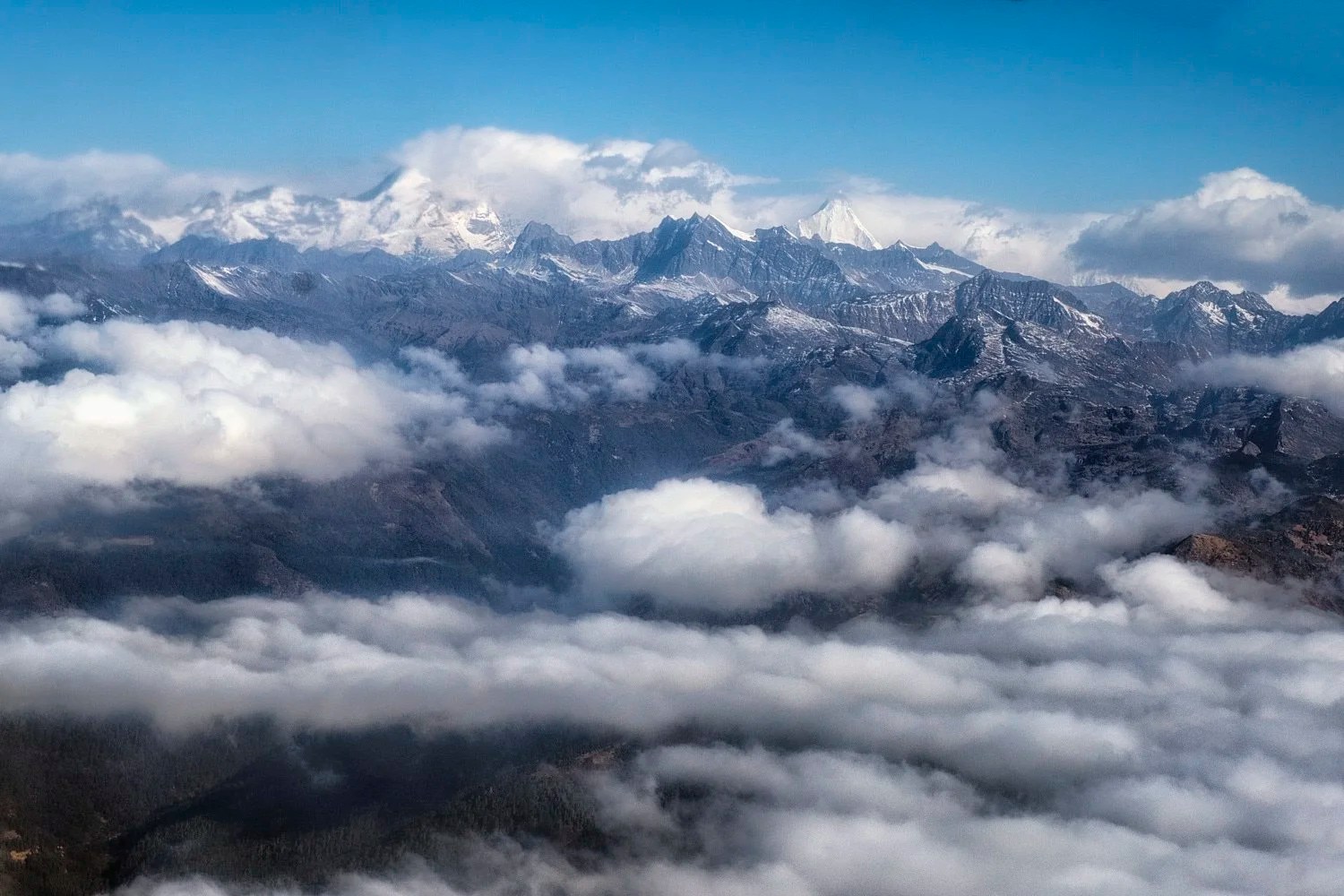
     Flying over the Himalayas
    Flying over the Himalayas
  • Leh, Ladakh – Feb 28, 2025
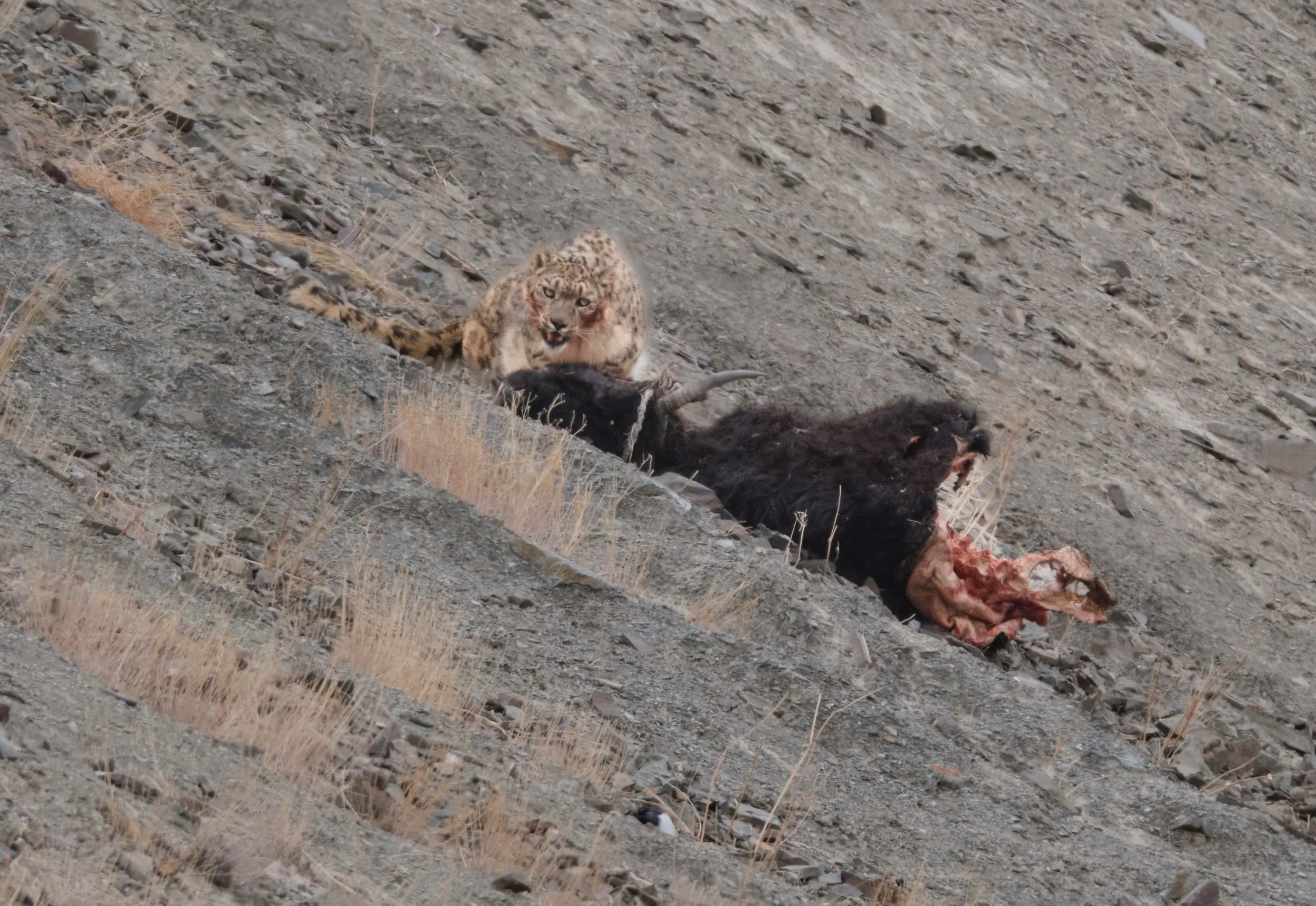
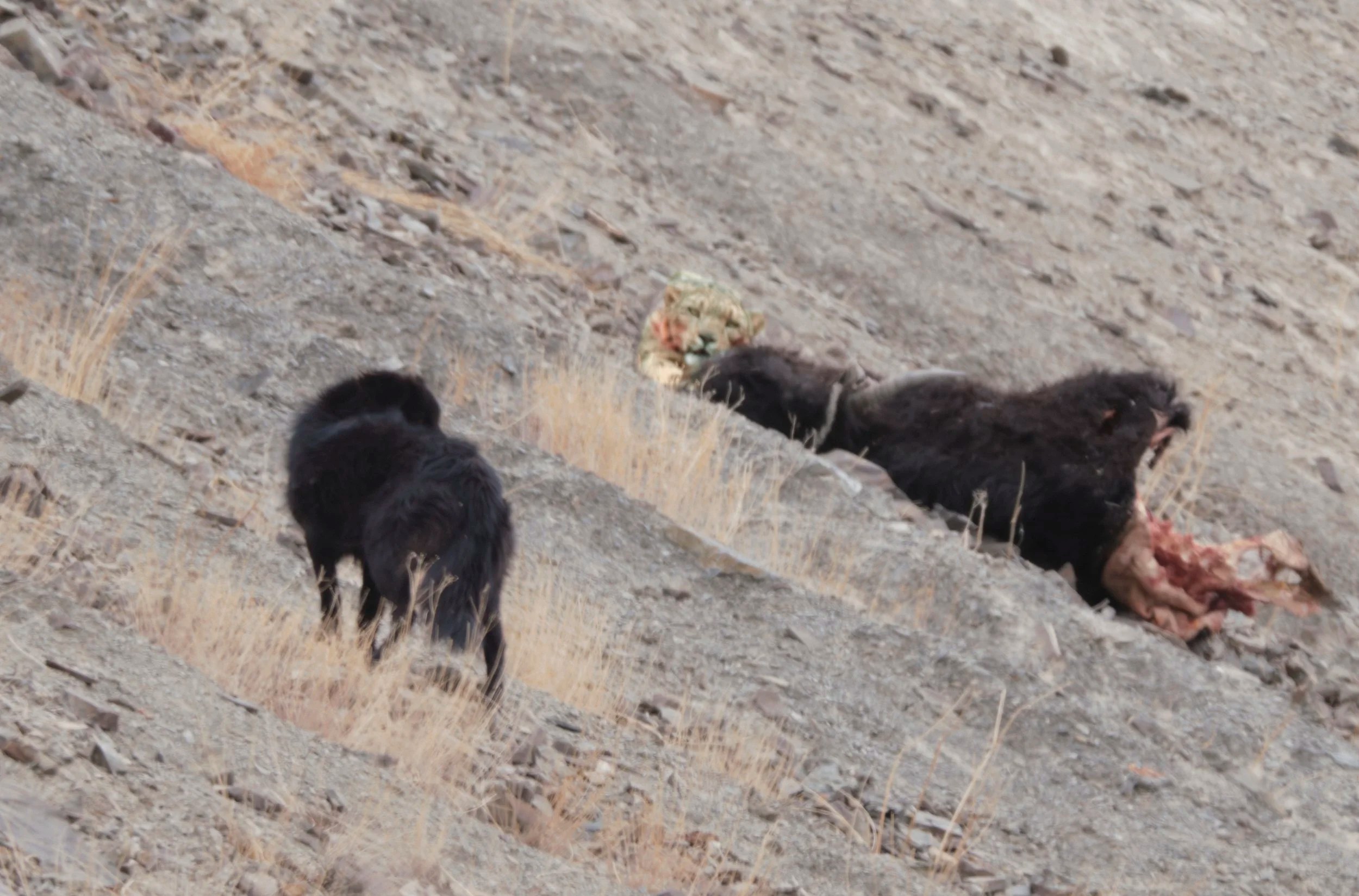
     Snow Leopard with yak
    Snow Leopard with yak

    This is a long-overdue post but for the last 8 days we have been in the Rumbak Valley about 3 or 400 metres higher than Leh and about 90 minutes drive away, further up in the mountains and completely off-grid without access to cell coverage or internet. We returned to Leh yesterday and I write this in our hotel, snow-bound as our flight to Delhi has been cancelled by a blizzard until, with luck, tomorrow.

    As I mentioned in my last post, our first two days in Leh were meant to be ‘rest’ days. The altitude protocol requires that we spend those days inactive and resting so as to acclimate to the altitude. However, we spent our first two days doing everything but resting. On arrival at our hotel, the Leh Grand Dragon, we received word that a snow leopard on a kill had been spotted about 90 minutes outside of town. Accordingly we tore through our lunch, grabbed our equipment and headed for the sighting.

    There are 7 of us in the group, 4 Americans, V and I and a charming Australian woman travelling on her own. There are 4 cars for our use so each couple has their own car and driver. The vehicles are quite roomy and comfortable but they need to be, the roads, such as they are, can be brutal.

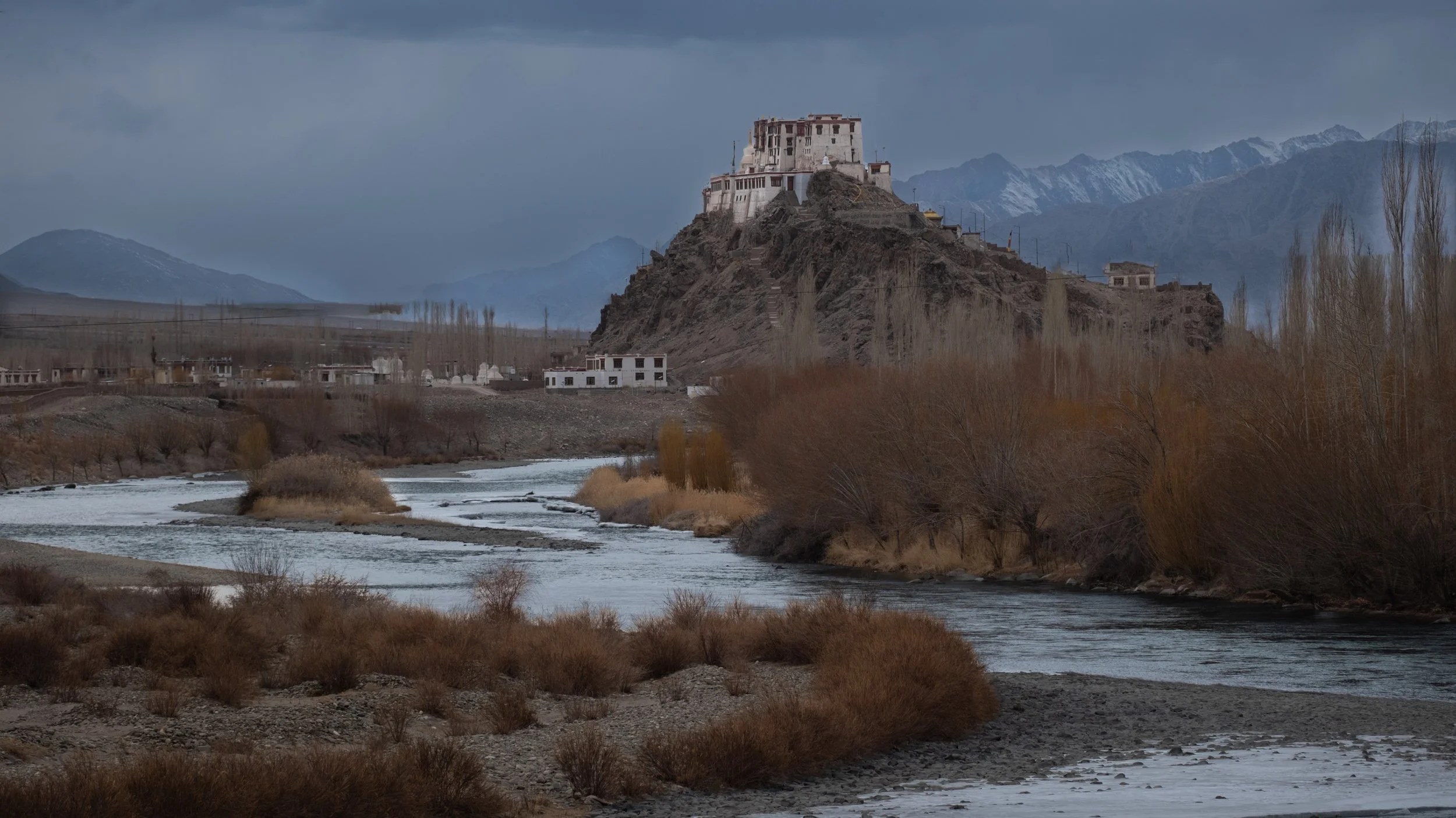
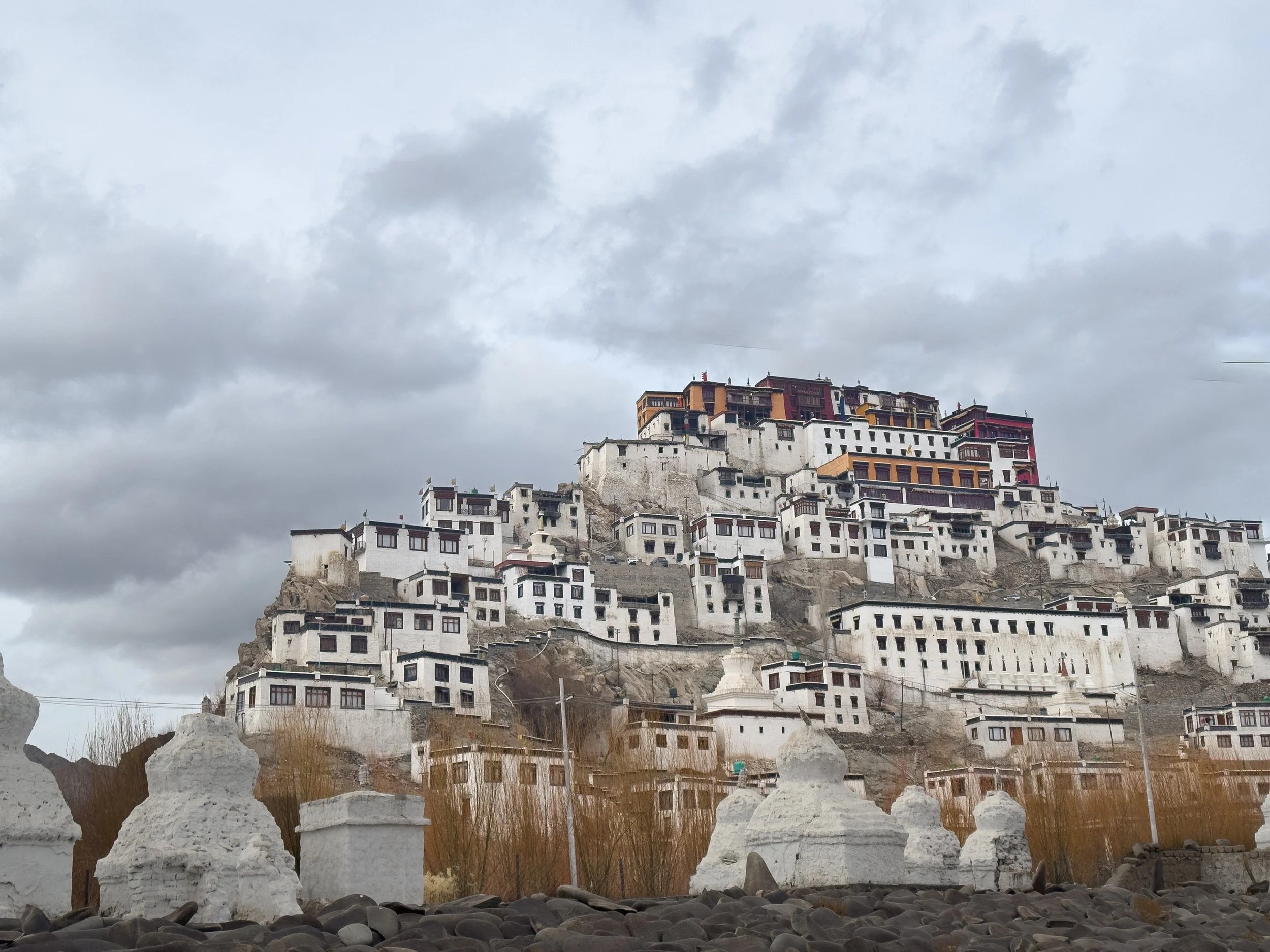
     Hilltop monastery, Leh
    Hilltop monastery, Leh

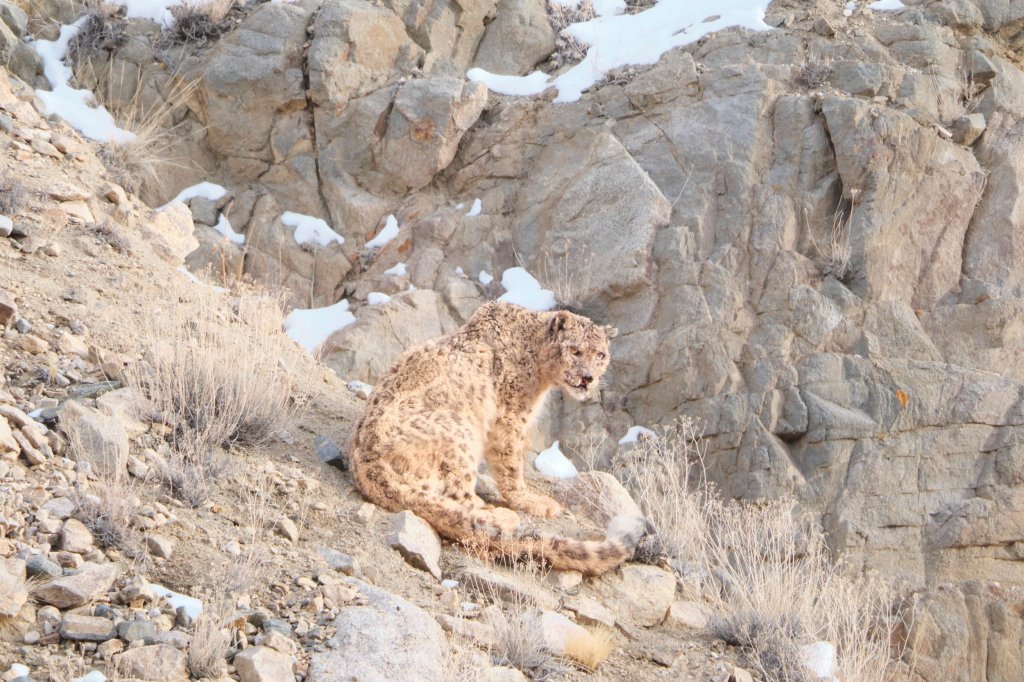
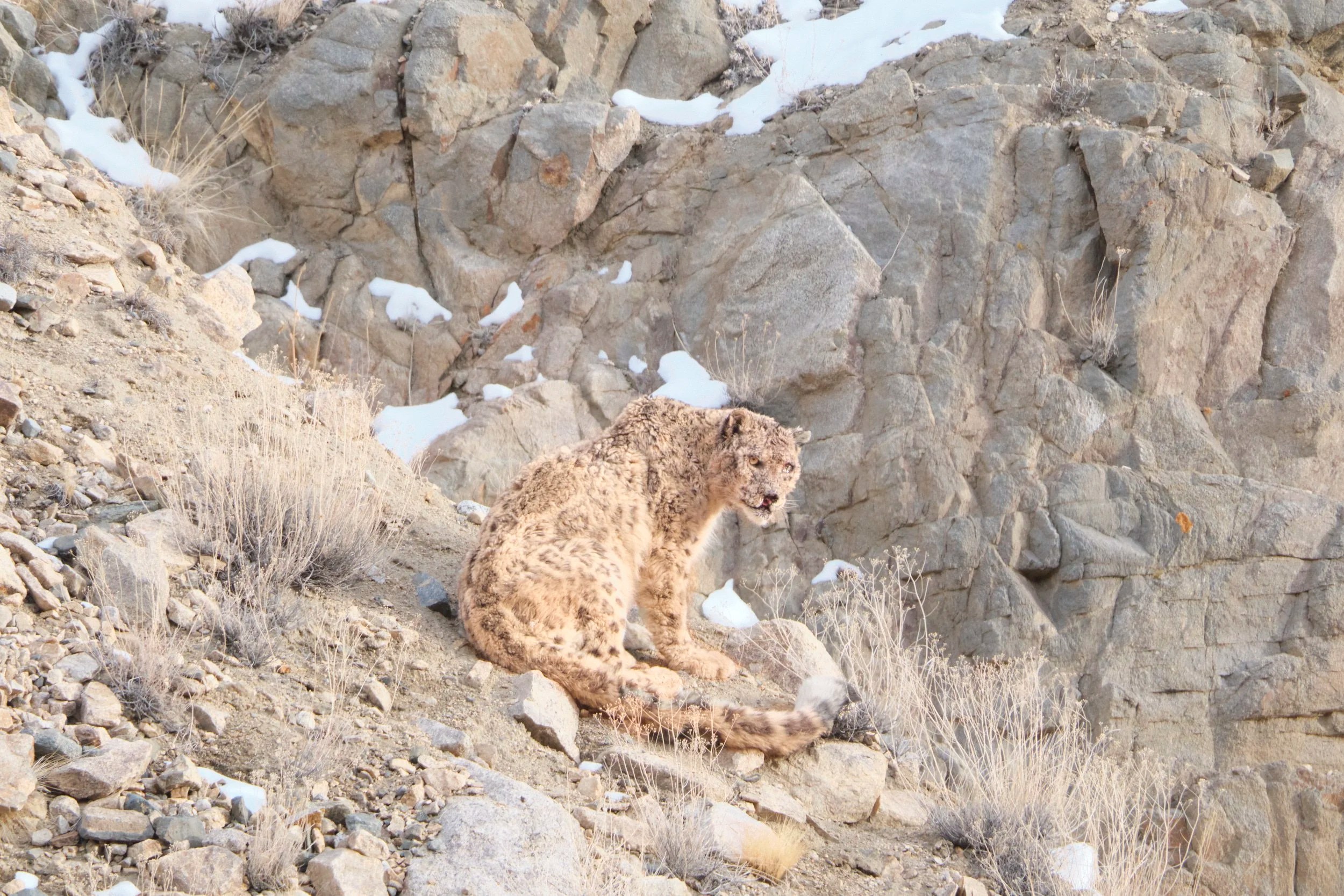
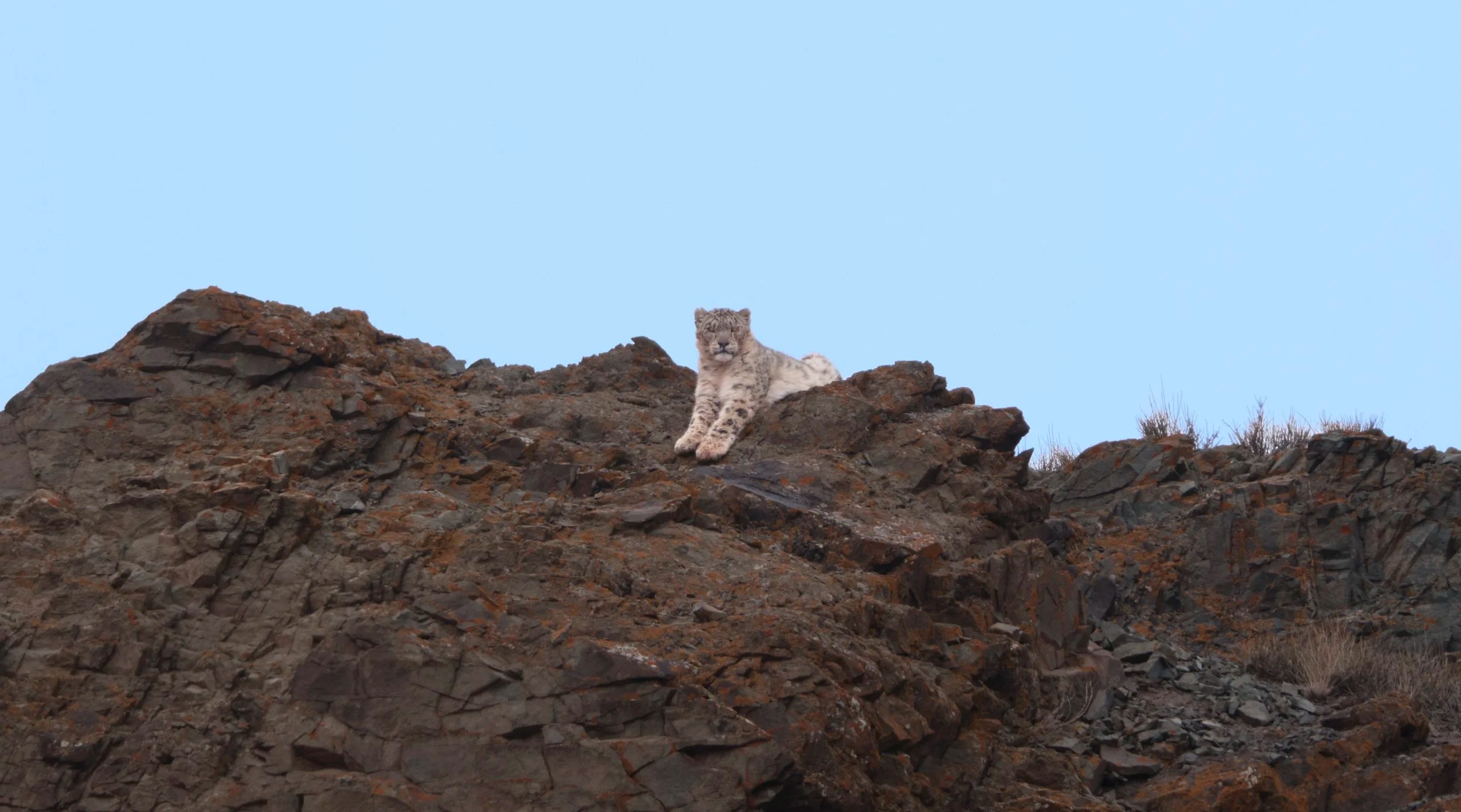
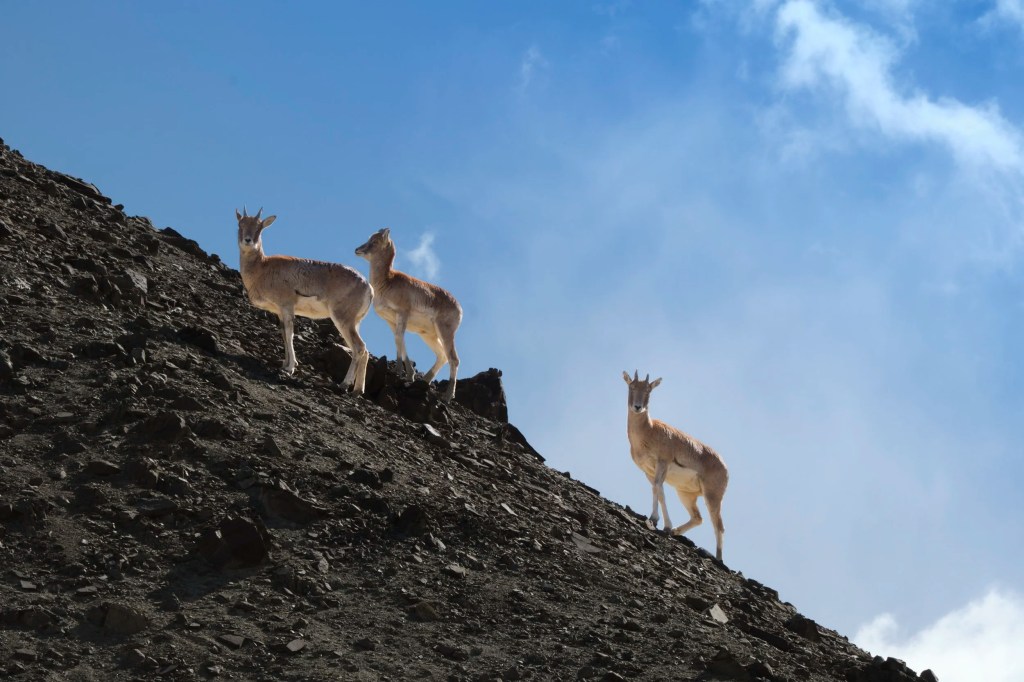
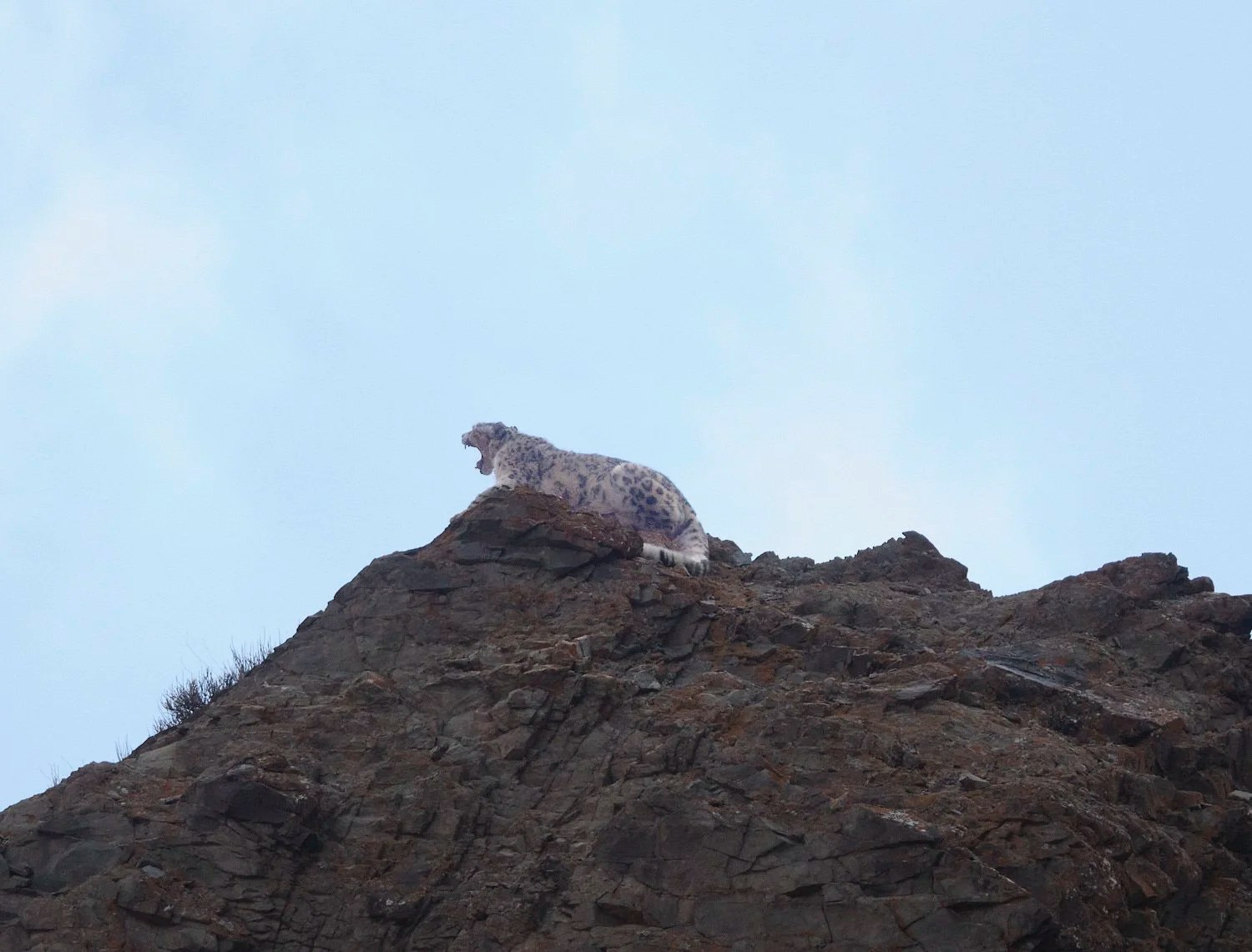
    We all piled into our cars and after a bumpy run up the valley reached a small village up the rocky mountainside perched astride a small stream. Outside the village and 3 or 400 metres up the mountain we could barely see a snow leopard camouflaged in the rocks looking down at his kill, a domestic yak, lying at the side of the stream.

    Let me describe the scene because it represents our experiences for the rest of the trip.

    By the way, do not be surprised when you see my images that the landscape is barren, rocky and virtually without snow. This region is a high-altitude desert which rarely experiences snow in winter. The snow falls begin in late February and essentially mark the very early beginnings of spring. The first heavy snowfall of the season occurred yesterday and that is why we are snow-bound with all flights cancelled.

     Snow Leopard are actually genetically more closely related to tigers rather than to leopards. Their faces and heads are much bigger and heavier than is the case for leopards.
    Snow Leopard are actually genetically more closely related to tigers rather than to leopards. Their faces and heads are much bigger and heavier than is the case for leopards.

    Now, let me tell you about snow leopard photography. You first need to know that at any one time, there are somewhere between 60-80 people in this area who have come in expressly to see and photograph snow leopards. Those 60-80 people are supported by spotters, drivers and support people. The spotters and support people arrive in their own cars. At a rough estimate there is at least one support person/ spotter per photographer. That means that if even half of the photographers come to a sighting, and I can assure you that at all of our sightings there were well more than 50%, then there are at least 60-80 people and 20+vehicles and usually more.

     Scavenger standoff from 400+ metres. My lens is at 1200mm but really difficult to get a good clean shot from almost half a kilometre away.
    Scavenger standoff from 400+ metres. My lens is at 1200mm but really difficult to get a good clean shot from almost half a kilometre away.

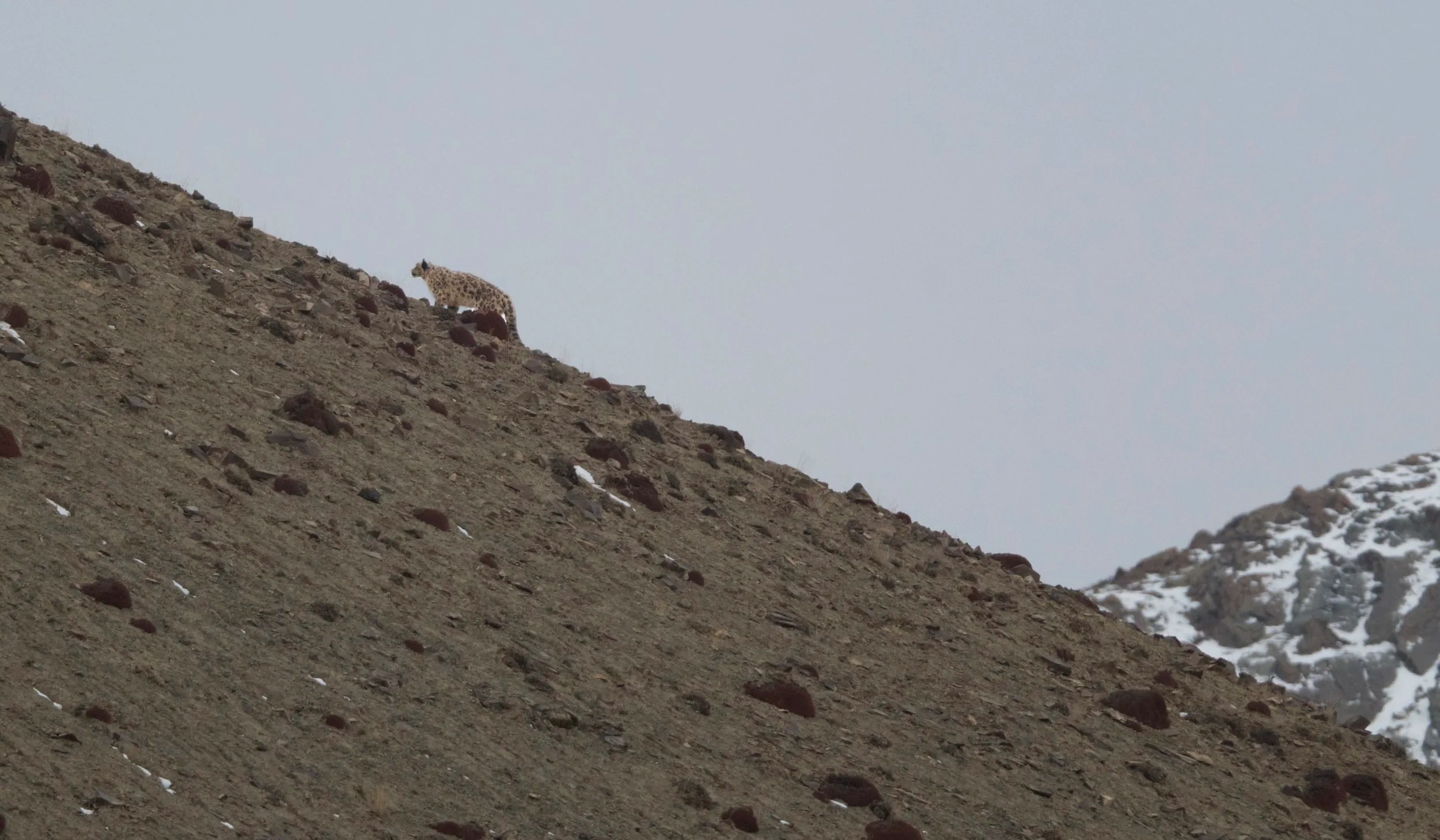
    Let me continue. Unlike Africa where game can be mere metres from a vehicle, in all instances in Ladakh the snow leopards are at least 200 metres from the photographer and more often than not significantly farther away. Effectively this means that virtually every photographer is on a tripod since at a minimum you need a 900mm lens or ideally much longer, you just cannot reliably hand-hold these brutes at full extension. So we now have 30-40+ cameras mounted on tripods and at least that number of spotter scopes on tripods. It’s not hard to get the picture. A forest of tripods and photographers and spotters all jockeying for prime position, a sea of cars filling the track and dozens of people all trying to make the most of the moment…wildlife paparazzi.

    And to answer your question, why are the leopards at least 200+ metres away? Well partly due to protocol, maintaining a safe distance for the safety of the animal, but largely for the same reason that celebrities live in gated communities. Neither celebrities nor snow leopards want to be intimately surrounded by a huge ring of people, cameras, tripods and cars.

    Standard practice for a day on a sighting. The animal has fed overnight and removed itself from its kill and moved to a higher position on the mountain to keep an eye on the landscape. We arrive early and get a good position so as to be well sited when the cat comes back down at some point to continue eating. By 9 or 10 in the morning the full entourage of photographers and supporters is in place and the wait begins. The temperature has been between -10 and -20 during the day but no one leaves, all waiting for the cat to move. During the course of the day support people keep hot coffee and tea coming and hot food distributed from thermoses while we all wait next to our cameras. A community is built over the course of the day as people, most of whom you have seen on previous days chats and gets to know one another. But for all the reasons above the cat, hungry as it increasingly becomes over the day, just will not approach the kill. So as we begin to lose the light after 5pm, cars begin to move away to start the process all over again tomorrow while the cat waits for all the cars to leave so that she can continue her meal. We and the cat have all been out-waiting each other in the cold for 8 or 9 hours seeing who would break first.

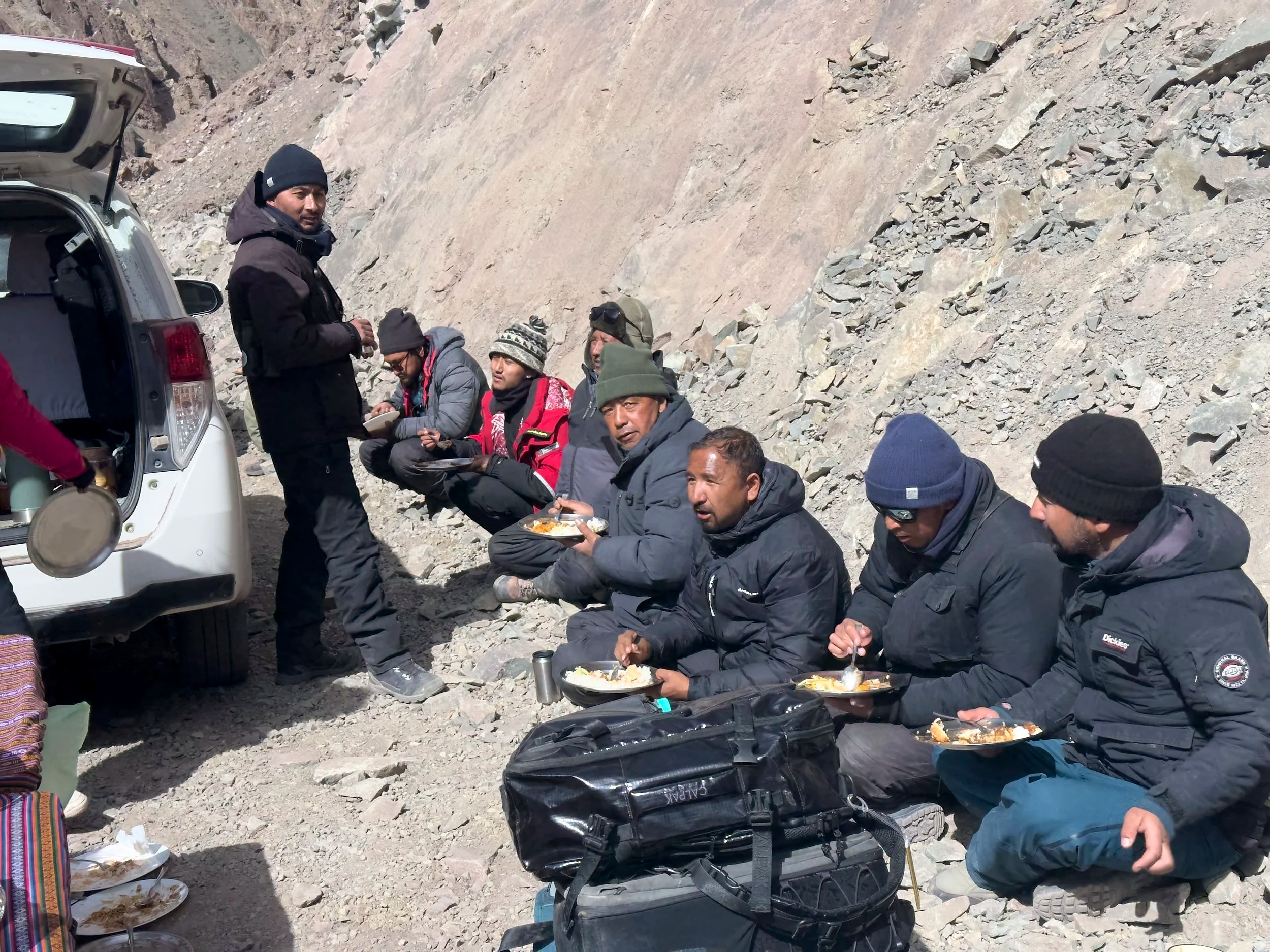
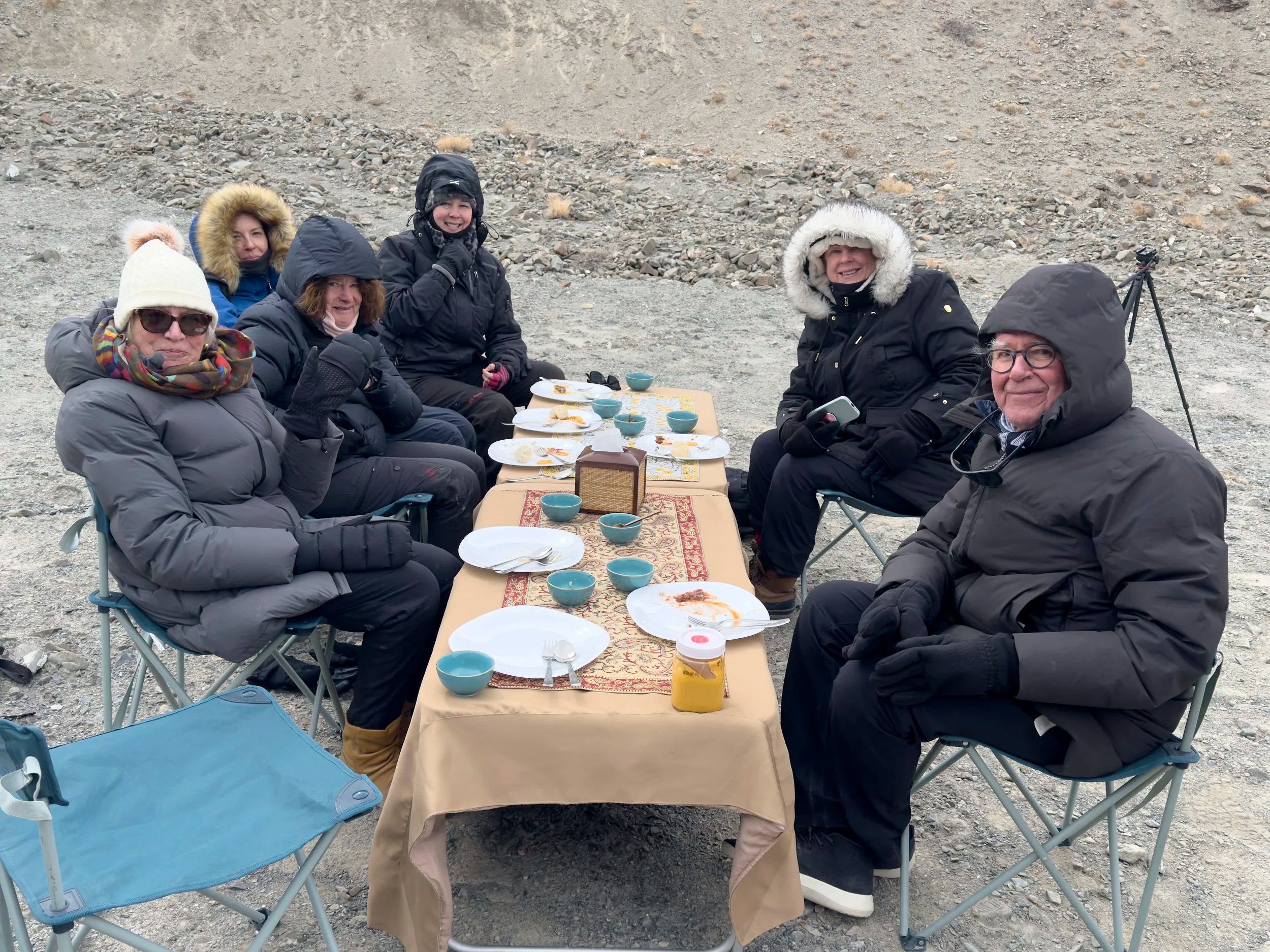
     Lunch at -19C
    Lunch at -19C
     Some of our support team lunching
    Some of our support team lunching

    That description covers our first sighting and all the ones that followed, nonetheless I did manage to get some good shots on day one and I was pleased. Day two, our second ‘rest’ day followed the same pattern but in an entirely different area with a different leopard and again I did manage to get some shots. However if it sounds like cognitive dissonance to be pleased with my shots after describing the circumstances in which they were taken, I have some thoughts and I will share these with you in my next post.

    More to come!
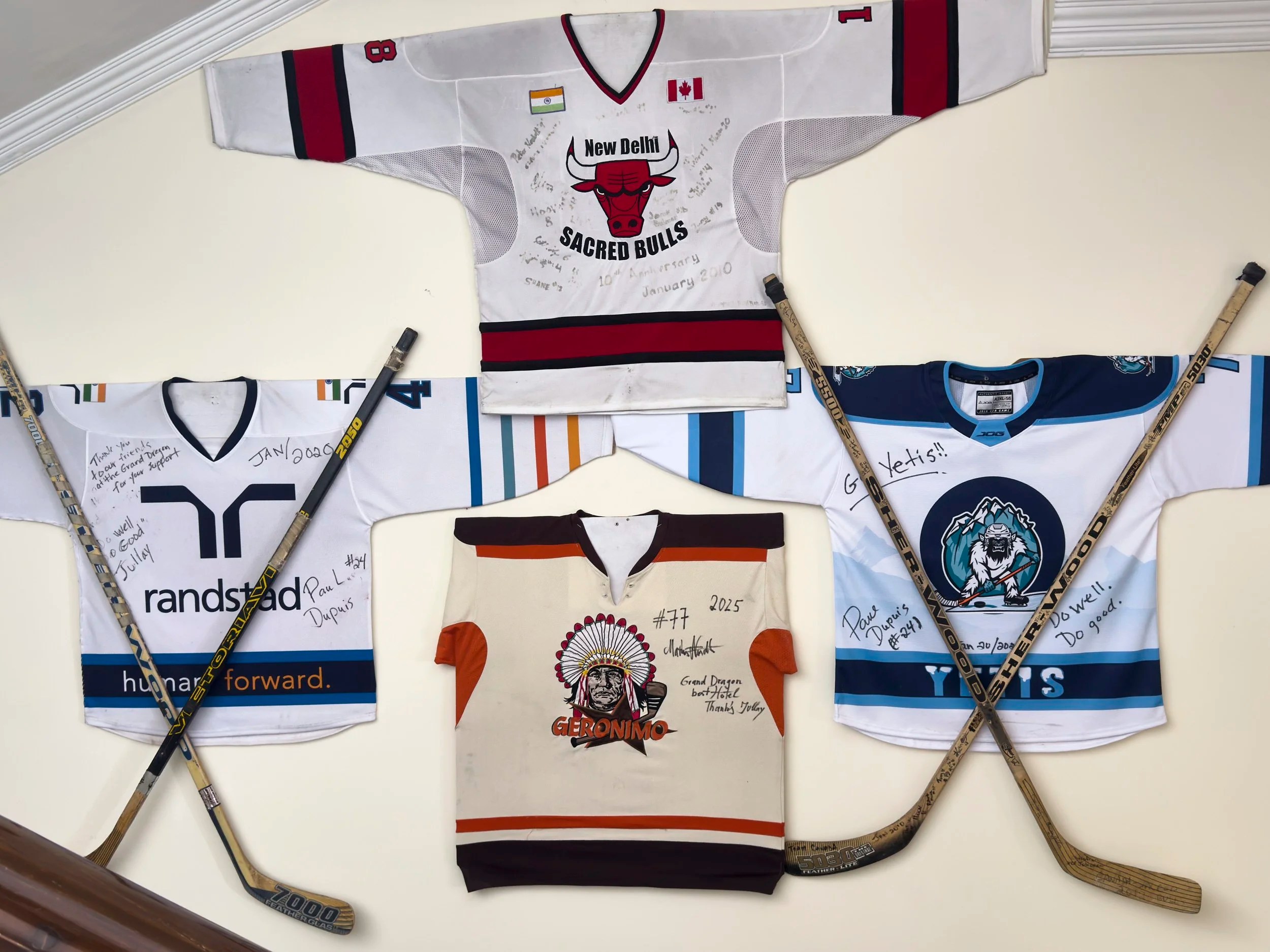
     On the wall of our Leh hotel where the championship hockey winners are celebrated. There is a thriving hockey scene in Ladakh with teams from local communities as well as from various of the military bases and from as far away as Delhi. Up to 10,000 people turn up to watch games in the Leh outdoor hockey arena and the games are broadcast on local media. The two prime sports in Ladakh are cricket and hockey!
    On the wall of our Leh hotel where the championship hockey winners are celebrated. There is a thriving hockey scene in Ladakh with teams from local communities as well as from various of the military bases and from as far away as Delhi. Up to 10,000 people turn up to watch games in the Leh outdoor hockey arena and the games are broadcast on local media. The two prime sports in Ladakh are cricket and hockey!
  • Leh, Ladakh – Feb 20, 2025
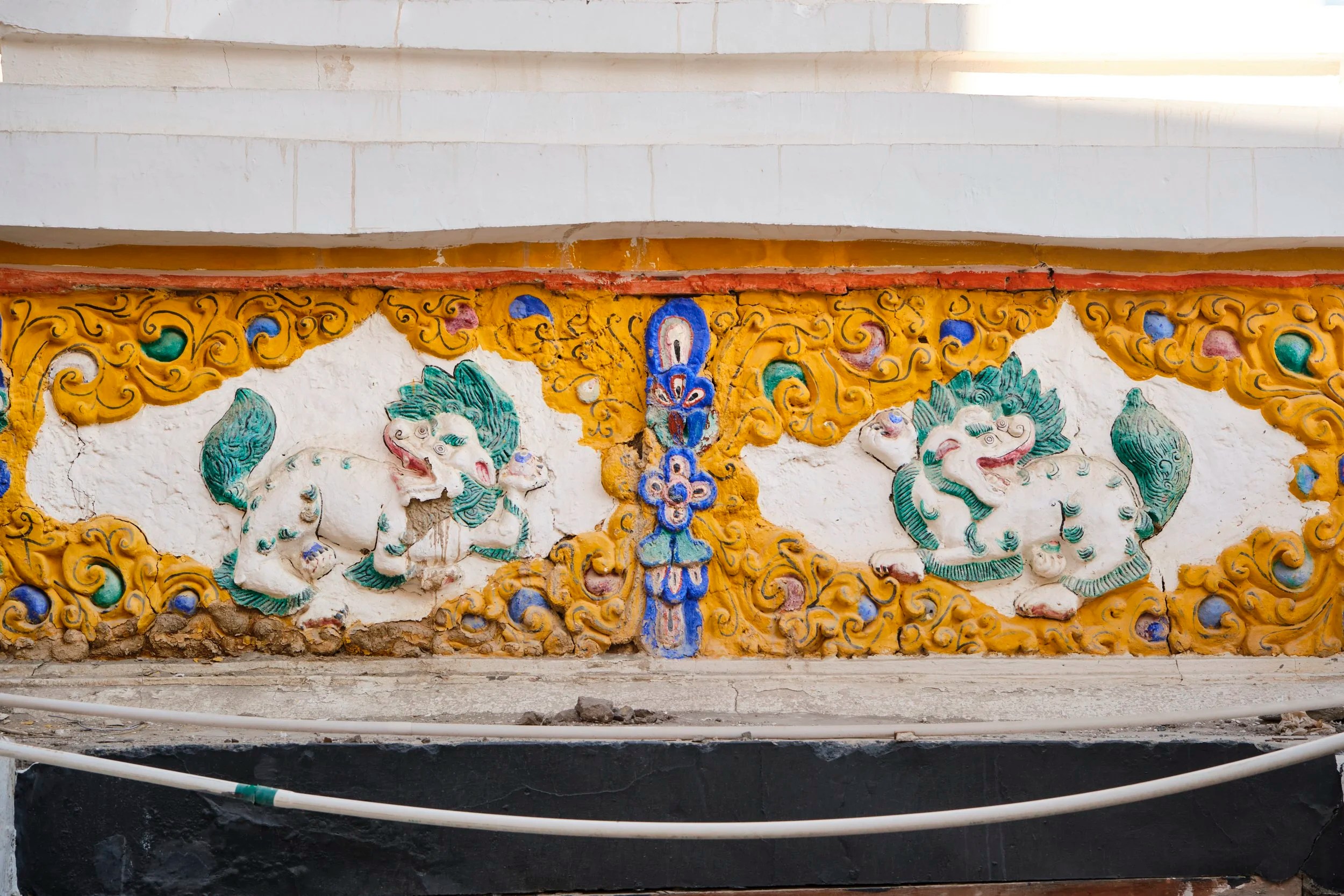
     Tibetan Buddhist influence, 50% of the population is Buddhist.
    Tibetan Buddhist influence, 50% of the population is Buddhist.

    This post and the ones following in the next few days have all been written retrospectively since for most of the time since our arrival we have been off-grid, with no cell or internet service.

    We arrived in Delhi late in the evening of Sunday February 16 after a lucky escape from the weather in Toronto, a snowstorm that had begun in the early afternoon of February 15 and which was piling up heavy snow on roads and runways.

    We have not been in Delhi for about 12 years and so had forgotten the insanity of Delhi traffic. Let me not be judgmental…Indian drivers are a very creative lot. They add one more lane to the designated design of any road, so an eastbound stretch of road that was designed with 2 lanes magically contains 3 lanes of cars, as well as buses and motorcycles. It’s not that there is room for 3 lanes but rather that every inch of road is utilised as drivers squeeze in and out of lanes, slide by each other and tuck into any slight opening. Delhi drivers default position on any road or highway is straddling the lane markers, thus doubling their options and magically creating one more lane than the road was designed for. The net effect is of a giant mobile jigsaw, mosaic or Tetris game moving at speed and all the pieces in the design being constantly shifted and re-arranged, not for the faint of heart. Seen from above it would appear to be a perfectly packed array with cars in every available inch of space and with mere inches between cars. All of this moving at 30/40 kph while being serenaded by the continual braying of car horns. Delhi divers do not use their brakes, they use their horns.

    Spent the next two days getting over our 16 hour flight and preparing for the journey ahead. Delhi temperatures were in the mid 20’s during the day so very pleasant and will be in stark contrast to the minus teens that we will be dealing with once at our destination.

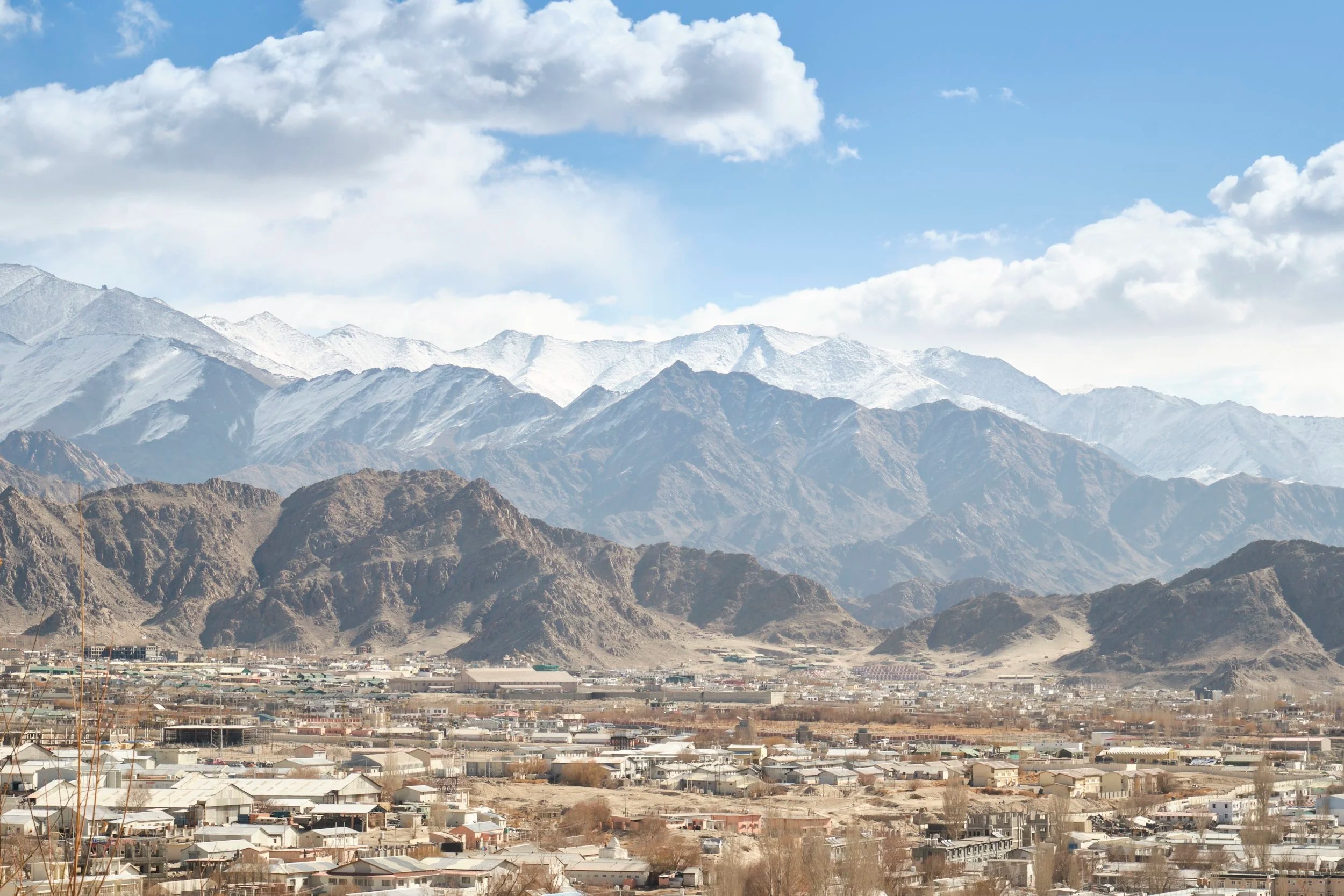
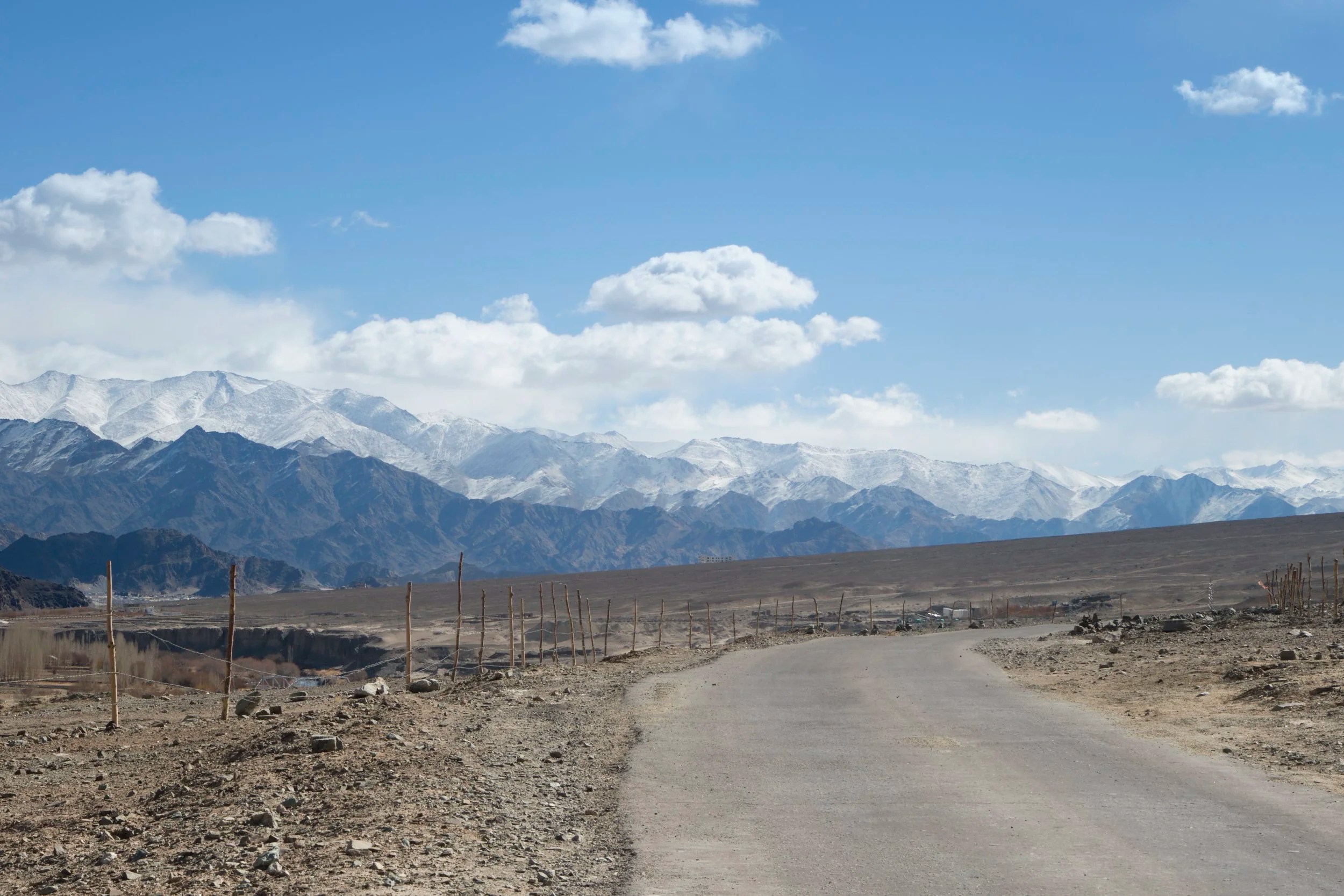
     Leh (3800 metres) with the Himalayan Zanskar Range (6000 metres) in the far background
    Leh (3800 metres) with the Himalayan Zanskar Range (6000 metres) in the far background

    We departed from Delhi in the early morning hours of Wednesday Feb 19 and flew to Leh, the capital of Ladakh for the start of our snow leopard journey. Ladakh, formerly the Kingdom of Ladakh is now and has been since 2019 a state of India. Until the recent past it was part of Kashmir and Jammu, both now belonging to Pakistan. The new state is bordered on the west by Pakistan and on the north and east by Tibet and China. Arising from this, one of the most striking features of the area around Leh are the large number of military camps that surround the city and penetrate into the valleys leading up to the borders. Paratroop regiments, various army regiments, military police, military hospitals and air force bases. In fact the airport that services Leh is an air force base and security is very tight. For instance, owning or carrying a drone or a satellite phone is a jailable offence.

    As is the case for all the countries in this region, there is a very long, rich and complex history, the area having been overrun at various times going back to the time of Alexander the Great and continuing through the Mongol hordes, the Moghul invasions, Russian incursions as they sought access to an ocean port in India, the British Raj and in more recent times threats from China and Pakistan. Overlaying all these were centuries of more local cultural, religious, political and territorial wars and conflicts.

     Leh countryside
    Leh countryside

    Leh is situated between two Himalayan ranges on the banks of the Indus River, one of the world’s great rivers, the river also lending its name to the country of India. It’s mind-boggling to think that Alexander the Great crossed the Indus River in 325 BC after having marched his army from Macedonia and conquered his way across Asia into present day Pakistan. In fact, tradition has it and now borne out by genetics, that one of the settler groups in this region were remnants of Alexander’s army who preferred to stay and settle rather than fight their way back to the Aegean. The north-west of Ladakh is populated by a lighter-skinned, blue-eyed peoples.

    Interestingly, Leh was also a key cross road on the Silk Road and Ladakh has very close ties of culture, religion and tradition to Tibet. In fact the Dali Lama maintains a summer residence in Leh, as close to Tibet as he is able to get.

    Our biggest obstacle to date has been acclimatizing to the altitude. Leh is at roughly 4,000 metres and the protocol requires that we spend two nights in Leh before we travel to our final destination, the Rumbak Valley at about 4,500m. The intent of the protocol is to insure that one does not over-exert and so bring on altitude problems but rather remains quiet and at rest. This theory was quickly cast aside on the afternoon of the day we arrived. But that’s a story for another day….

    More to come !

     Leh Monastery
    Leh Monastery
  • Leaving for Ladakh – February 15, 2025
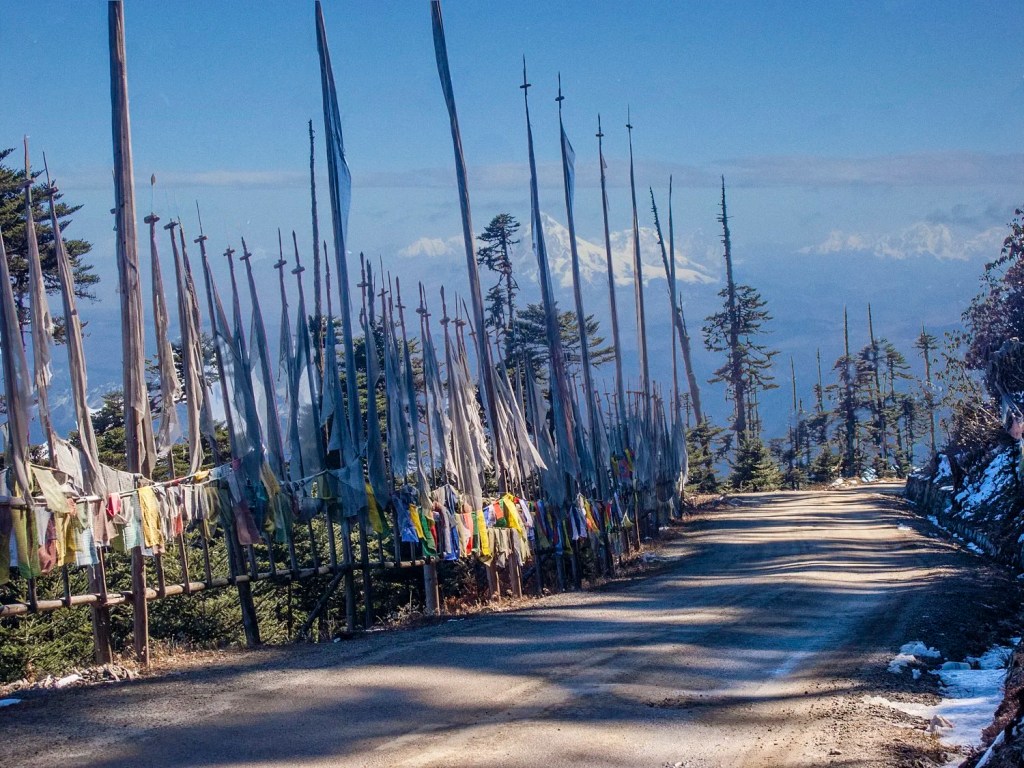
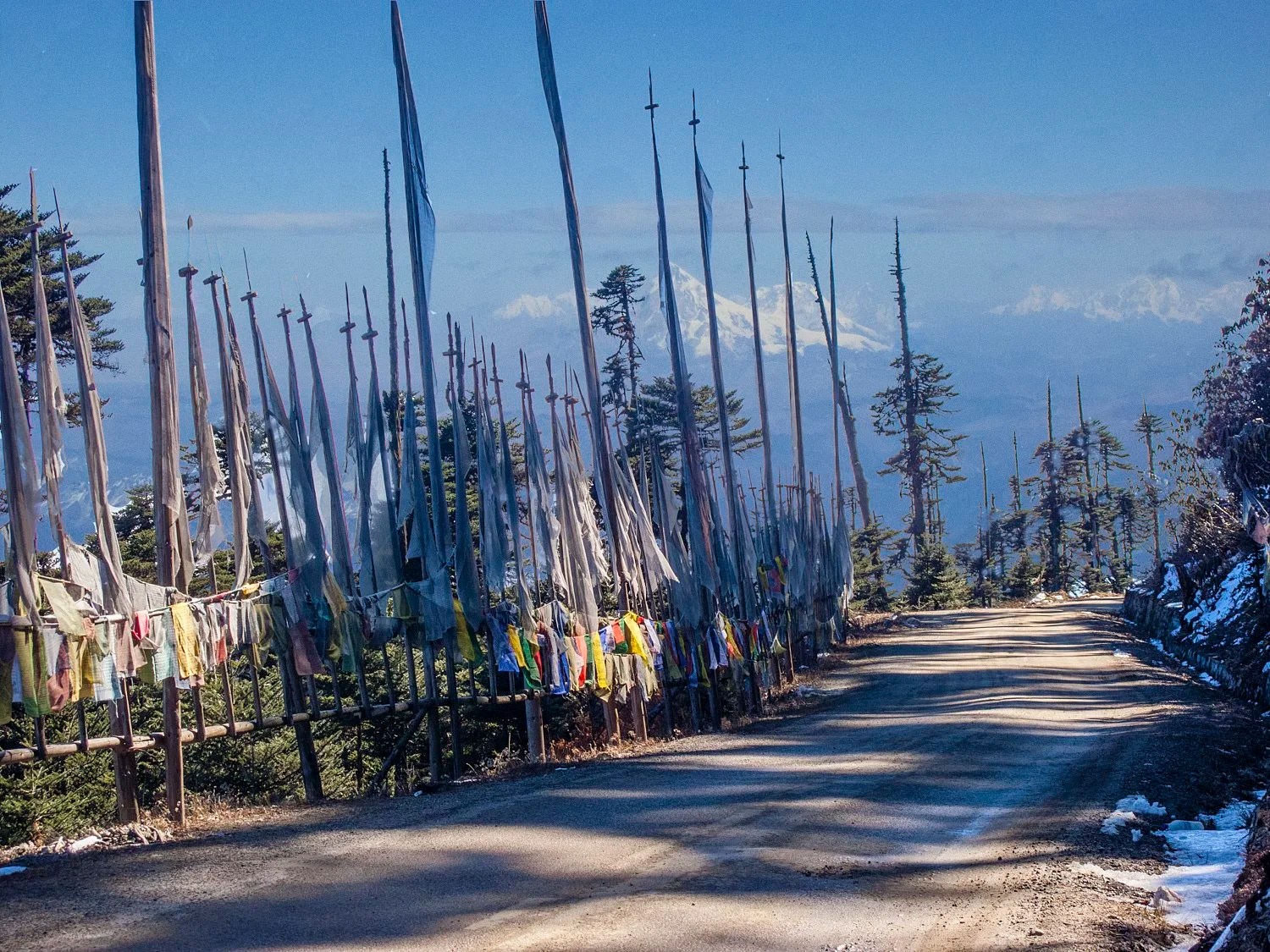
     Himalayas from Bhutan on our 2017 journey
    Himalayas from Bhutan on our 2017 journey

    I write this as we get ready to leave for the airport on our way to Ladakh in the Himalayan section of northern India. Our goal is to track and photograph snow leopards, an endangered species who are only found at high altitudes in this region.   

    Weather for the Toronto area is calling for significant amounts of snow overnight tonight and through Sunday and, as our flight leaves at 20:00 I worry that we may not get away before the flight interruptions begin. I’ve firmly latched on to this particular worry since it’s a very nice replacement for the more permanent worry that most of us have been living with since January 26. If we do get away, it will be a real relief to park our more permanent concerns for a couple of weeks and deal with issues over which we actually have some control.

    As I look back over the timescape of the last couple of weeks I’m jolted by the knowledge that Trump’s greatest social and political damage is being done by making the unthinkable normal. There are many who will succeed him who may be happy to take advantage of this and the consequences then become truly frightening.

    I’m reminded of Zadie Smith’s writings in On Optimism and Despair in her brilliant collection of essays, Feel Free;

    “All the goodness and the heroisms will rise up again, then be cut down again and rise up,” John Steinbeck wrote to his best friend at the peak of WWII. “It isn’t that the evil thing wins — it never will — but that it doesn’t die.”

    “Caught in the maelstrom of the moment, we forget this cyclical nature of history — history being merely the rosary of moments the future strings of its pasts. We forget that the present always looks different from the inside than it does from the outside — something James Baldwin knew when, in considering why Shakespeare endures, he observed: “It is said that his time was easier than ours, but I doubt it — no time can be easy if one is living through it.” We forget that our particular moment, with all its tribulations and triumphs, is not neatly islanded in the river of time but swept afloat by massive cultural currents that have raged long before it and will rage long after.”

    Well worth a read…but I can’t wait to leave.

    More to come!
  • Los Alerces National Park and the end of 2024 – January 3, 2025
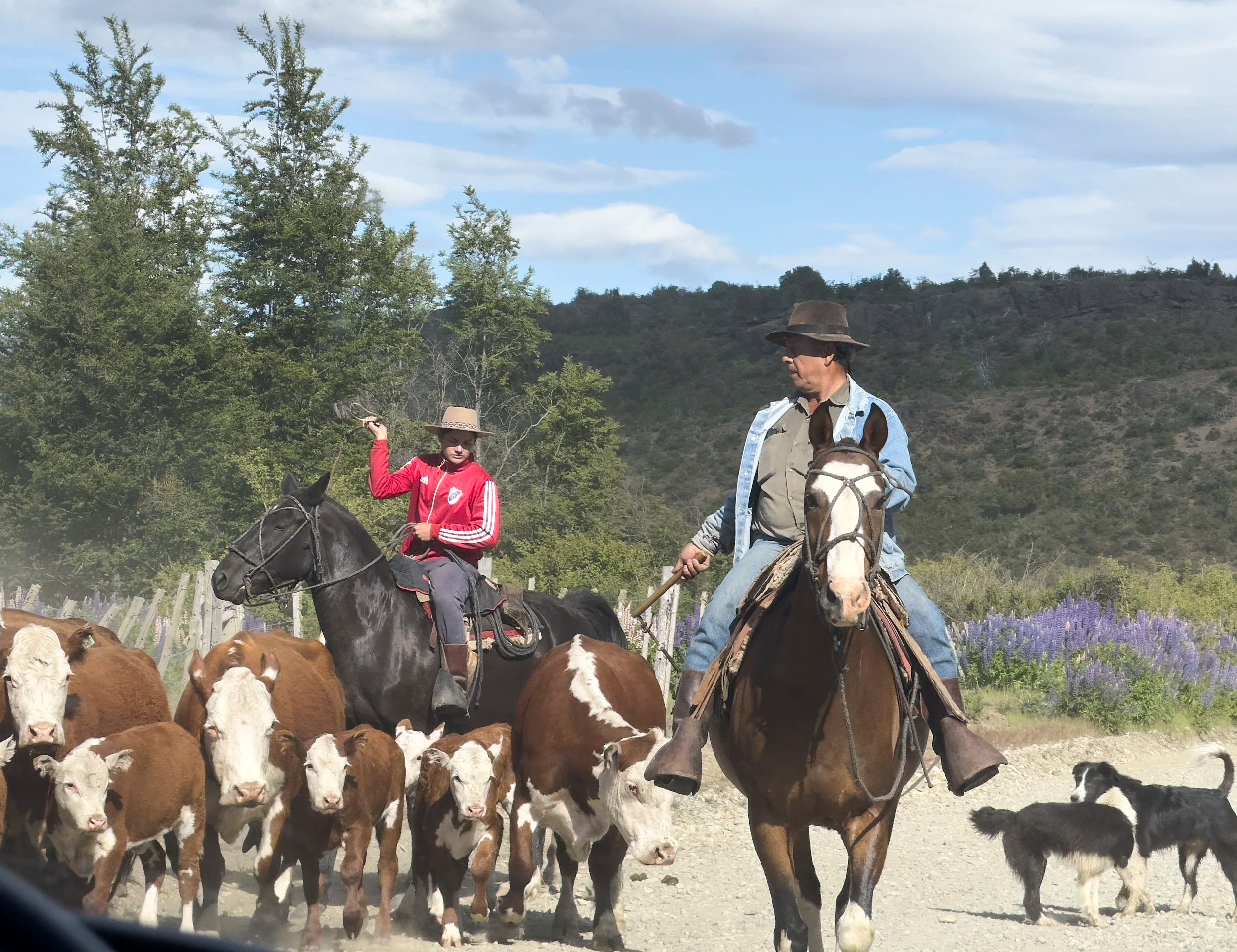
     Gauchos, Los Alerces
    Gauchos, Los Alerces

    I have received a number of sharp email nudges from readers who wondered why I left everyone suspended mid-journey on my recent Patagonia trip. Not the first time I have done this I know, but in this instance returning from Argentina and right into the midst of the holiday scramble, my journal writing priorities were turned on their heads. So let me close out the trip and the year as we all launch ourselves into 2025.

    When last heard from we had completed a 4 day stint in an eco-camp in La Posta de Los Toldos in the ReWilding Argentina nature reserve. After another long day’s 12 hour drive we reached our destination for our last four days on the road, Los Alerces National Park. As an aside and since I’m writing this well after the fact, when I returned to Toronto Hugh emailed us to let us know that we covered 3700 kilometres of driving on our trip…didn’t come as as even a slight surprise!

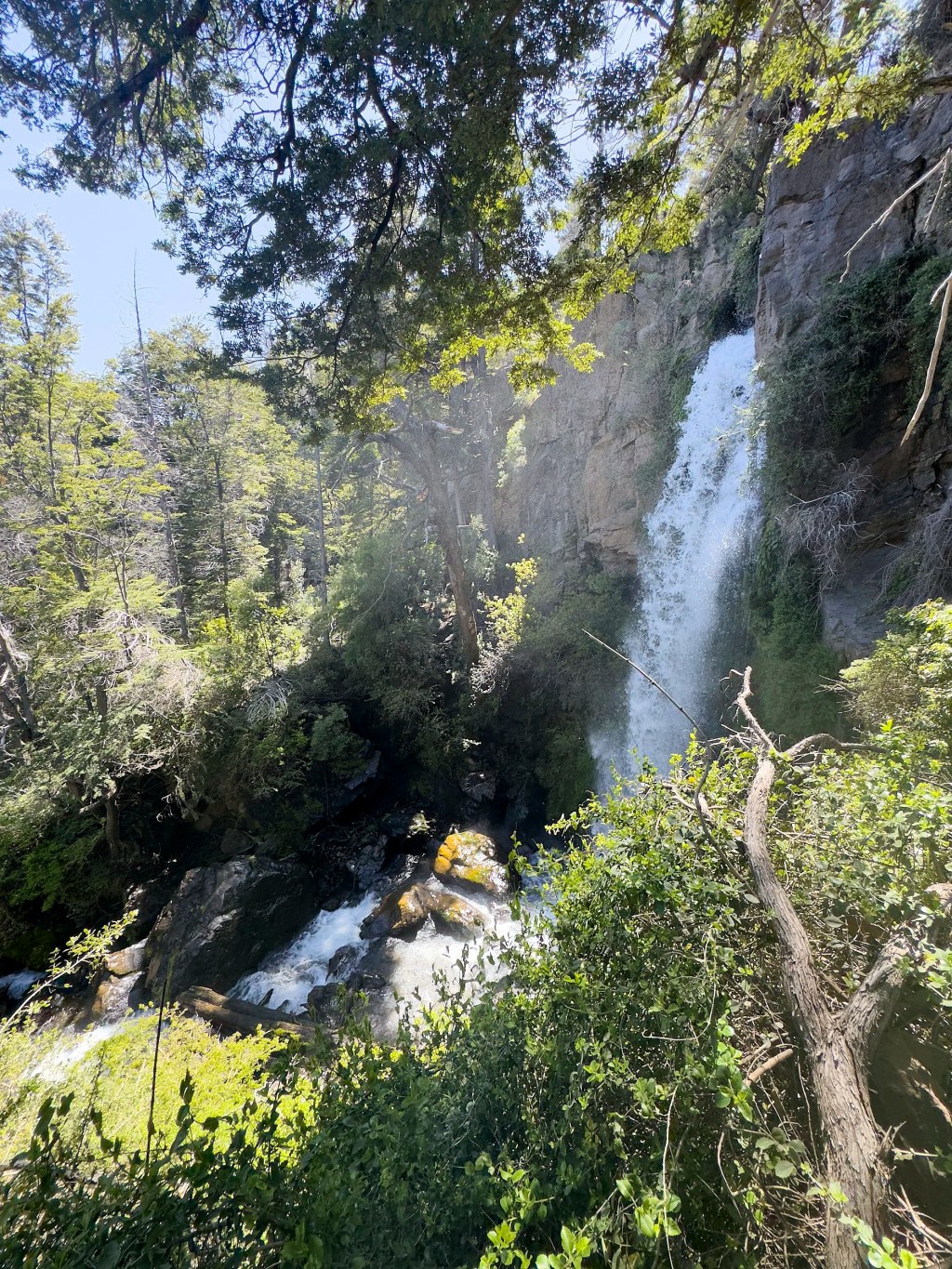
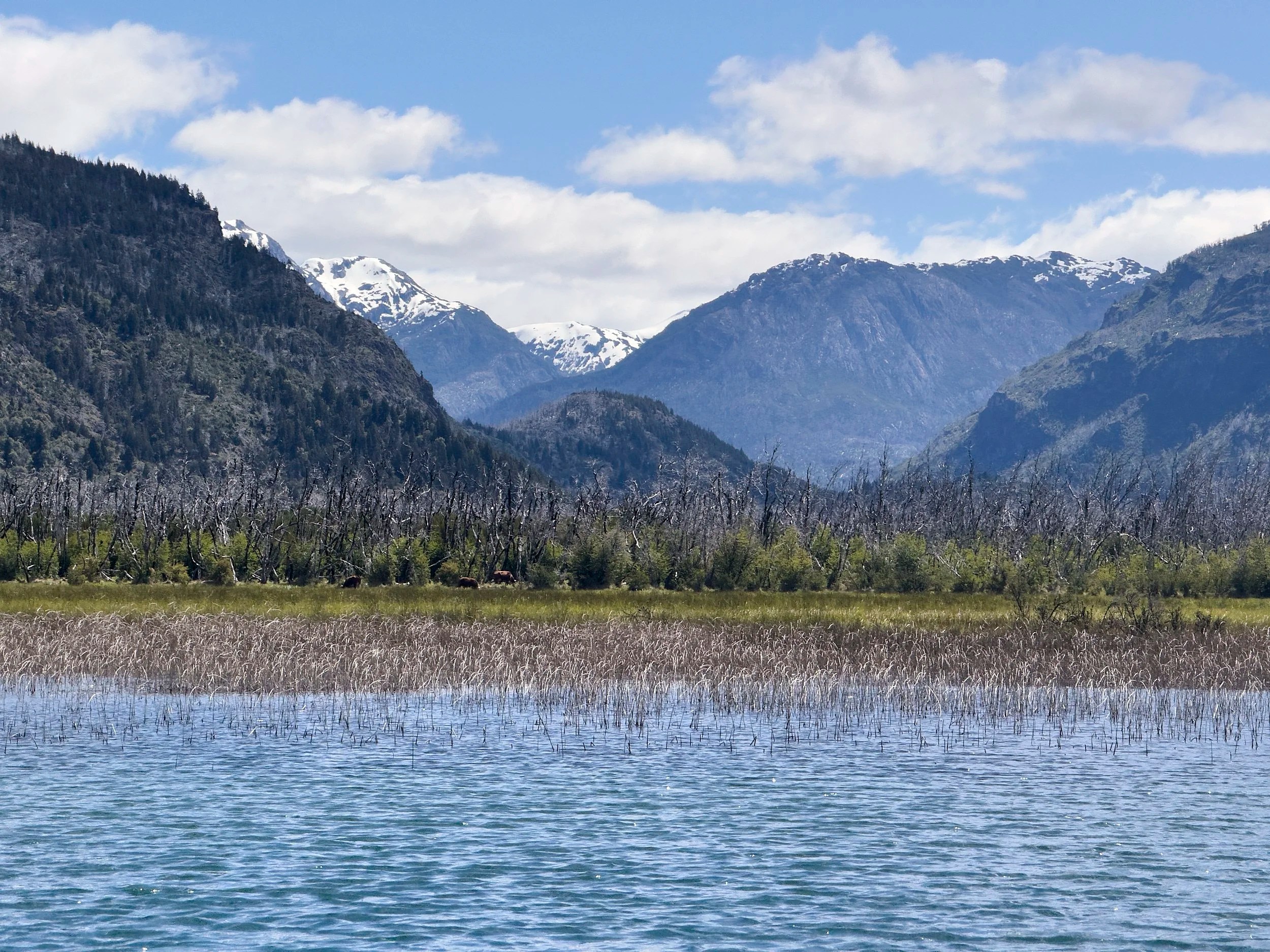
     Lake in Los Alerces
    Lake in Los Alerces

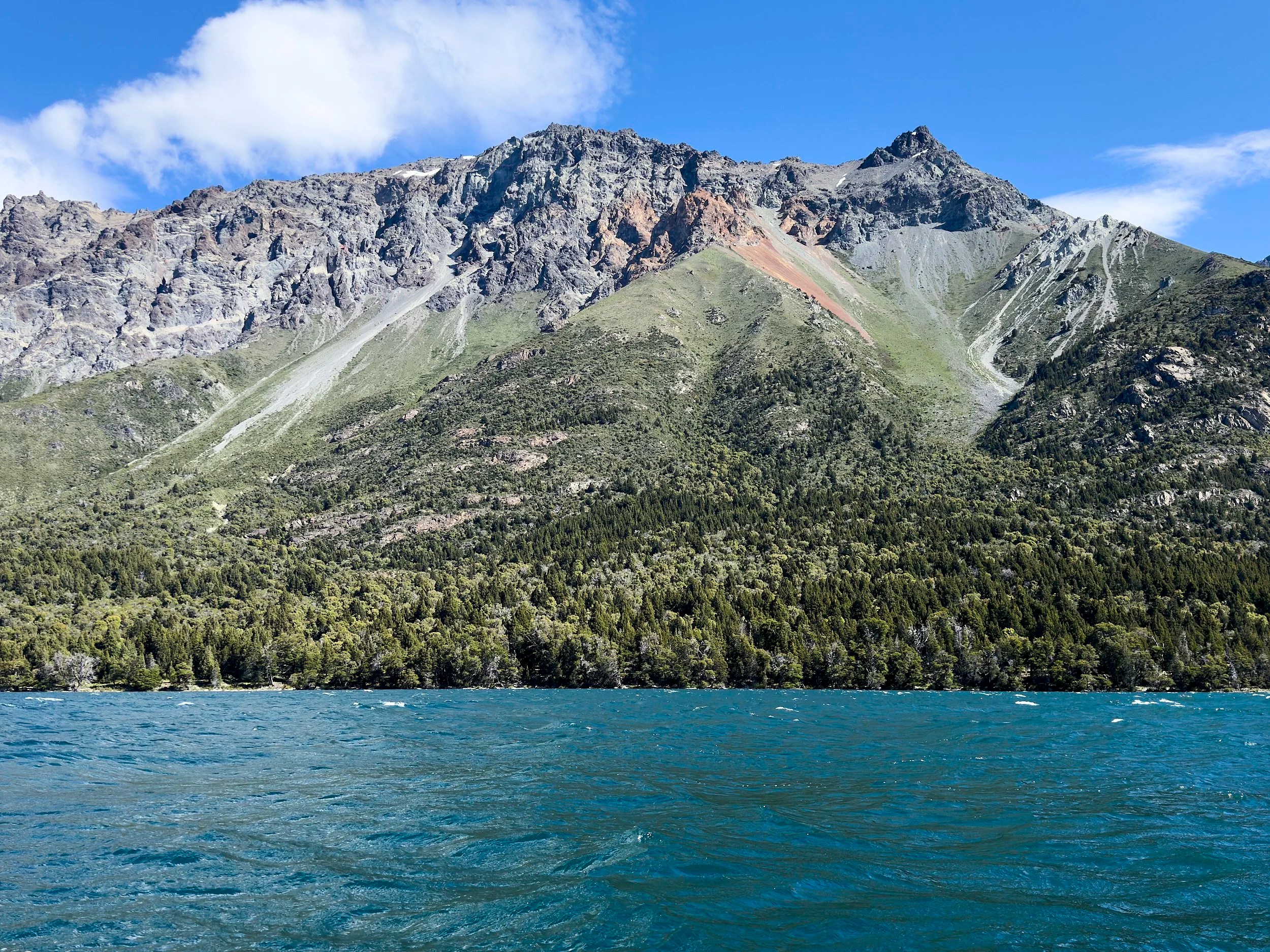
    Los Alerces National Park while still in Patagonia, is in the northern portion of the region and couldn’t be less like the landscapes through which we had been travelling for the previous two and a half weeks. Whereas in the south the landscape was bleak and arid and and the climate was dry and perpetually windy, in the north the landscape replicated the Rockies and the look and feel of Banff or British Columbia. The Andes are higher here and their mountainsides are covered with rich forests while the region is filled with deep clear glacial lakes and foaming rivers coming down from the high Andes glaciers. Stunning country, postcard perfect and yet…the barren south still has a compelling attraction for me.

    We spent 4 nights at El Aura Lodge on a wide blue lake which, for my Canadian readers, could have been lifted directly from Muskoka cottage country. Our days were spent exploring the local countryside led by our guide, a retired forestry professor who knew the habitat, the birds and the wildlife remarkably well. However the highlight was our final day when the four of us, Robert, Hugh, our forestry guide and I set out on a boat safari along the waterways of Los Alerces National Park. Along with the captain we were the only occupants of the boat as we crossed a huge sapphire-blue lake resting at the foot of the Andes. The most striking impression was the vast, stunningly beautiful setting with virtually no noticeable human presence, except for the very occasional cottage or country house. Our own Canadian north country must have looked very much like that 100+ years ago before every metre of lakeside real estate had been claimed for vacation properties.

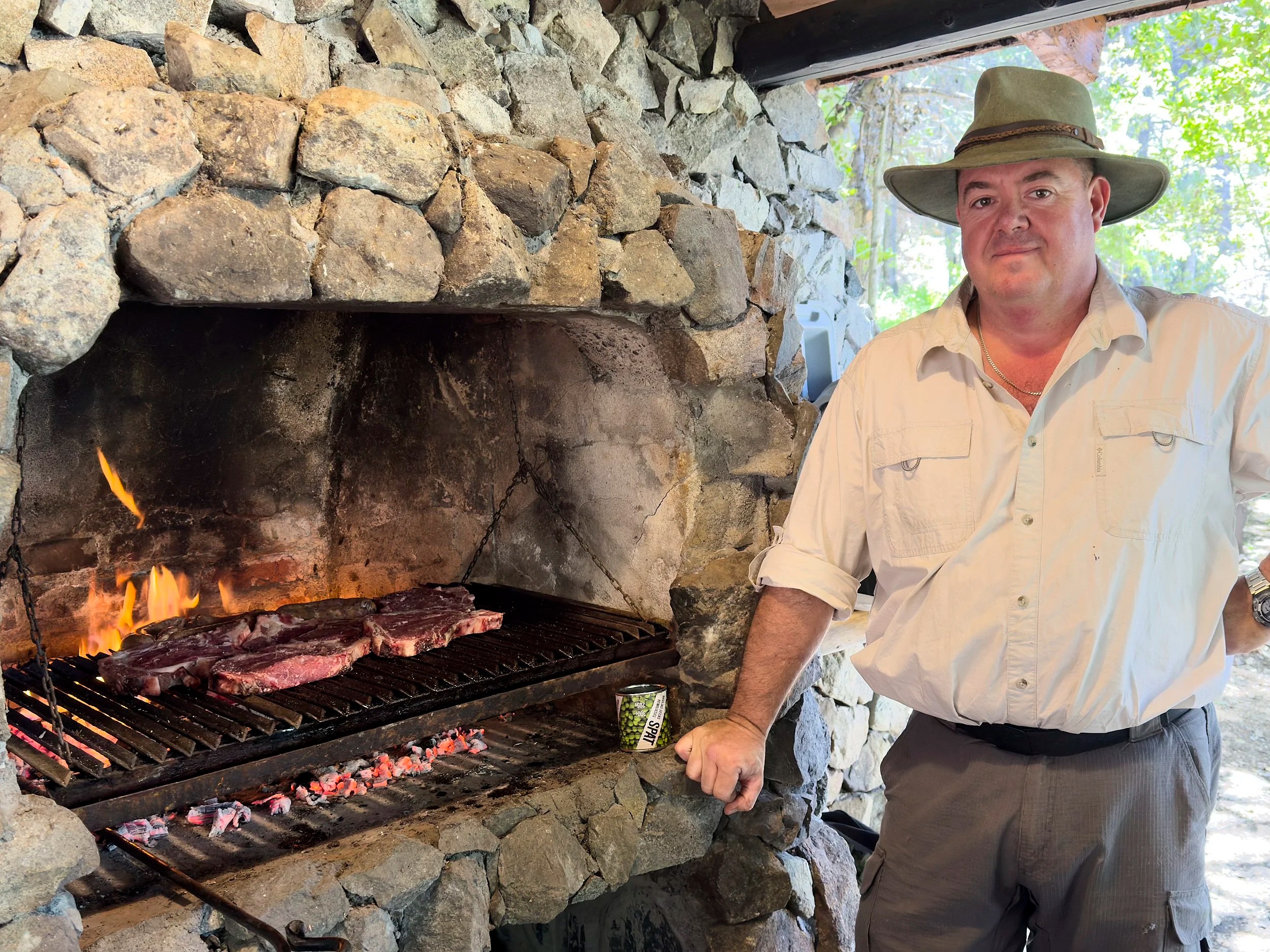
     Our boat captain
    Our boat captain

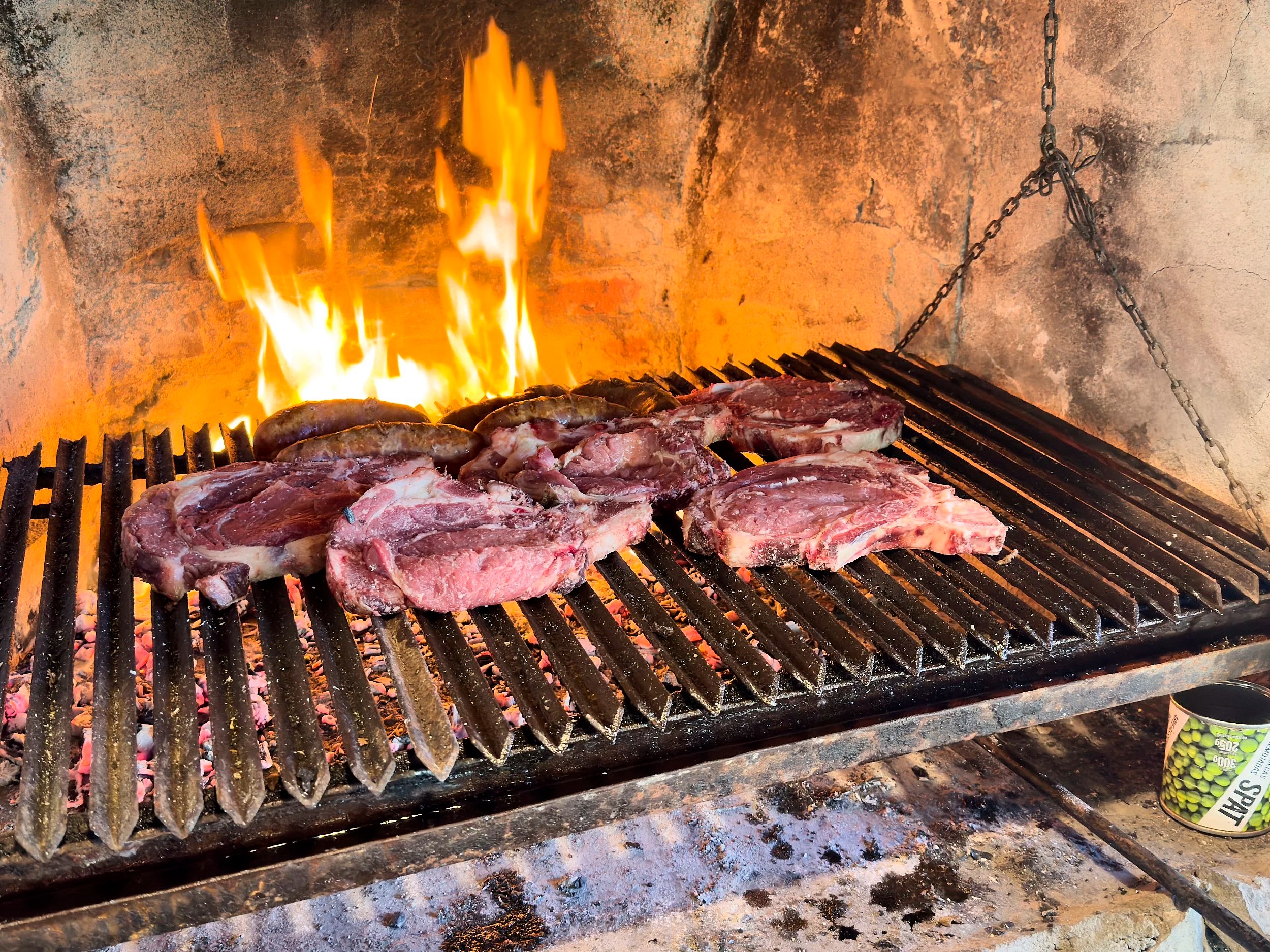
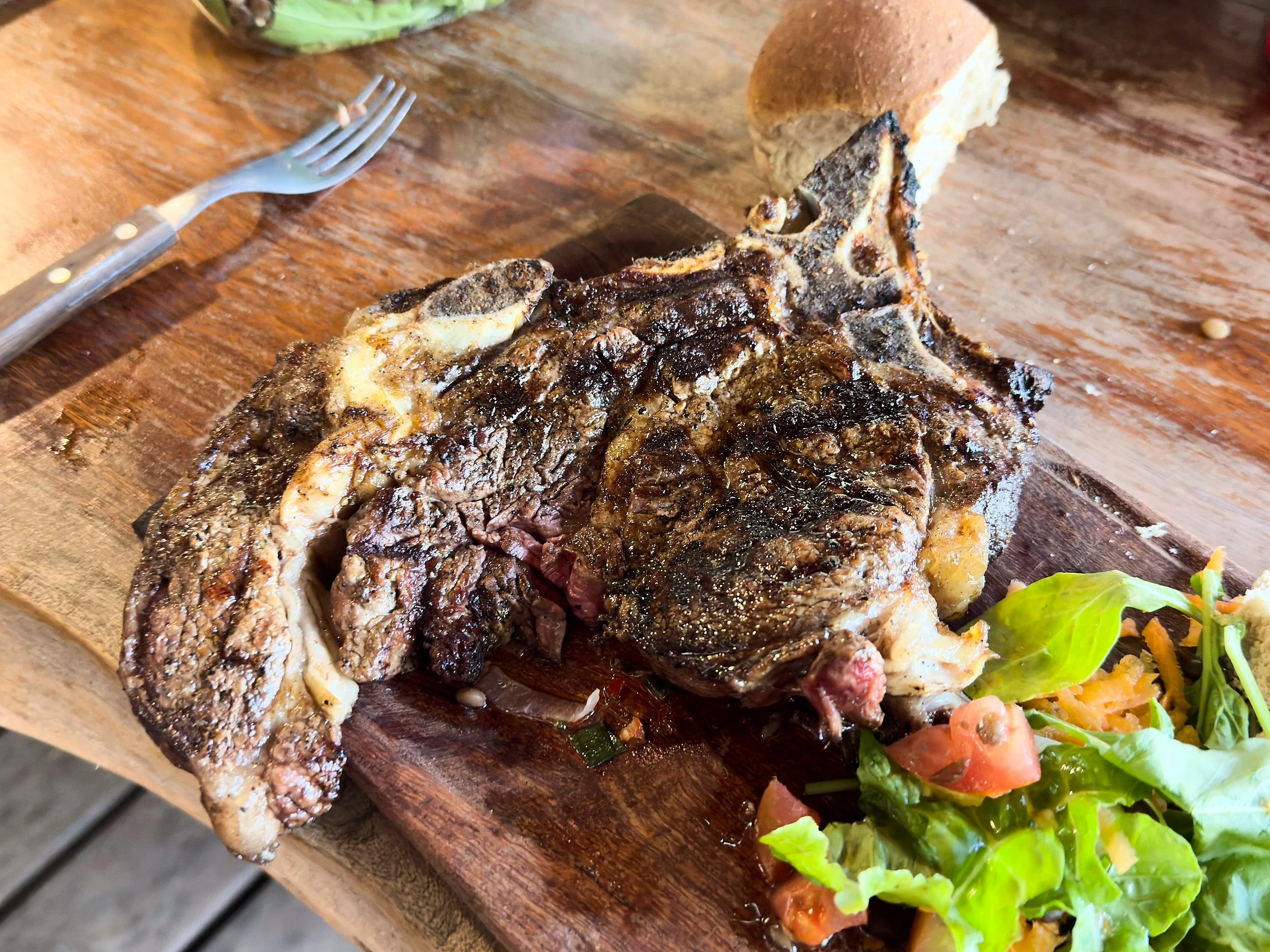
    Our boat captain took us to a barbecue pit on the other side of the lake where he prepared a fabulous lunch of massive T-bone steaks from his own cattle and country sausages, again from his own pigs. During the course of a long carnivorous lunch he told us the story of how his family arrived in the region. His great grandfather, he said, had came from Montana. He was the sheriff of a town in that state who was sent, along with a number of deputies and Pinkerton police to Argentina to arrest Butch Cassidy and the Sundance Kid both of whom had fled to Patagonia in 1901 after a string of robberies in the south-west US. They had purchased a cattle farm in Patagonia but learning that the authorities were on their trail in 1905, they quickly sold it and fled to Bolivia. There is a complete mystery about their fate after that. There are claims that they were killed in a shootout in Bolivia while there seems to be conflicting evidence that suggests that they managed to return to the US under alias and lived there until 1937 when Cassidy died. Our boat captain’s great grandfather, the sheriff, had come to Argentina in 1905 on the hunt for Cassidy and Sundance and when they eluded capture, decided that he loved the Patagonian landscape, bought a farm and never left! Is there any truth to the story or were we merely gullible gringos who were being fed stories from the same bull who had supplied our lunch? I’ll never know but I’m prepared to believe it, wouldn’t you?

    After leaving Argentina I had a two weeks crash reintroduction to real life. I returned home only to collapse in bed with flu for a couple of days, overtired I’m sure. That was brought to a swift end by the necessity for me to prepare for and Chair a Year-end corporate Board Meeting, as well as having a friends and family pre-Christmas dinner to plan and execute. In short, diving headlong into all the activities and events arising from the holiday season and then on Dec 23 we left for 17 days on Bequia, an island in the Caribbean Grenadines, where, with great pleasure, I now write this.

     Lake in Los Alerces
    Lake in Los Alerces

    I’m not sorry to see the end of 2024. As I mentioned in an earlier post the year was book-ended by the loss of our two companion cats, a heavy blow in both cases. 2024 was also the year that I hit the 80 year mark, a milestone that, at an earlier time seemed impossibly distant, and now it too has come and gone. It has felt like a year that demanded time for reflection and a year to put things right. I now feel like a new journey has begun and I’m very happy and eager to begin my next lap of the track.

    I’ll be back with you all in the middle of February when V and I leave for Ladakh and the Himalayan top of India where I’m on a photo hunt for Snow Leopards.

    Best wishes to everyone for a safe and healthy 2025!

    More to come…

  • Los Alerces National Park, Patagonia – December 4, 2024
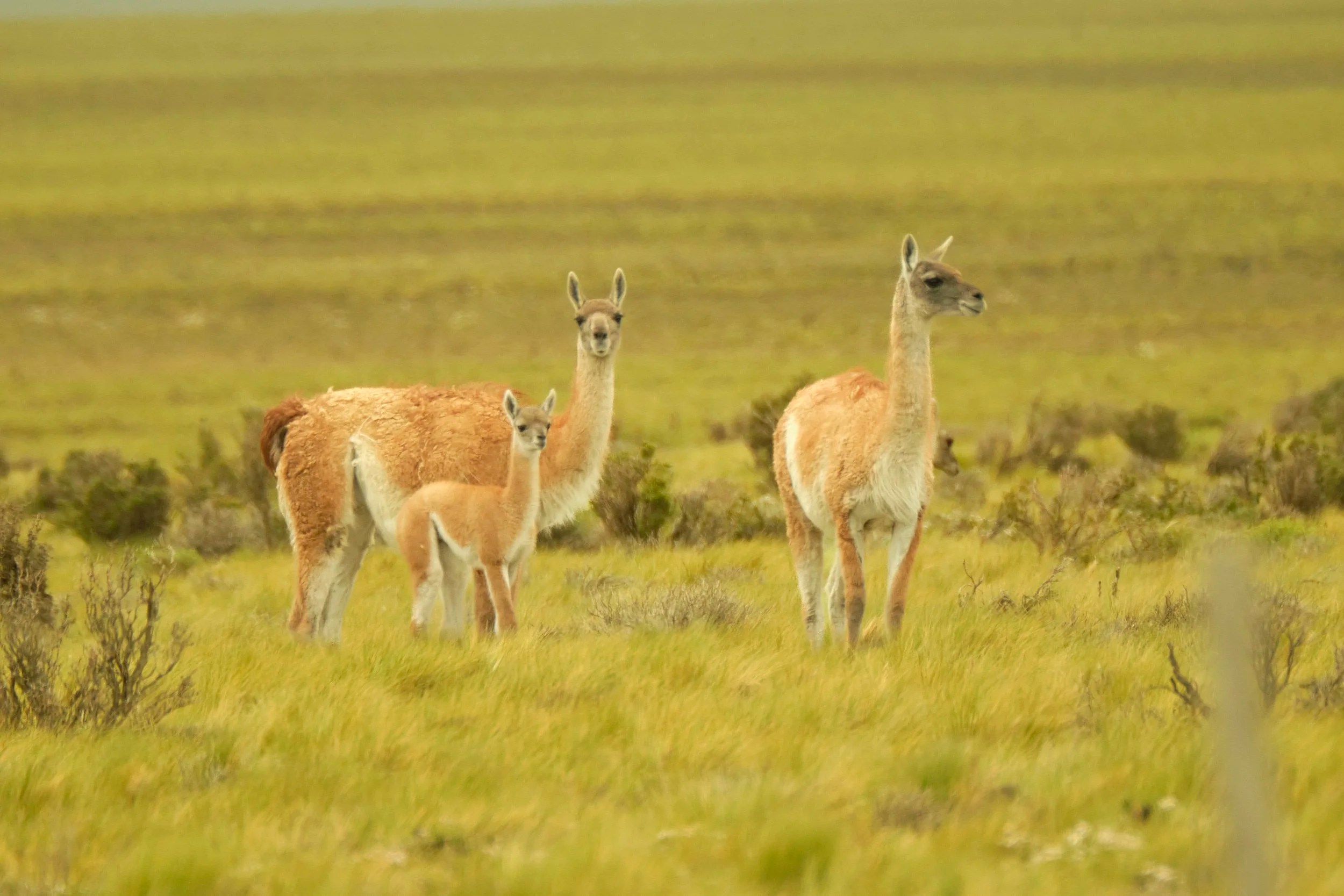
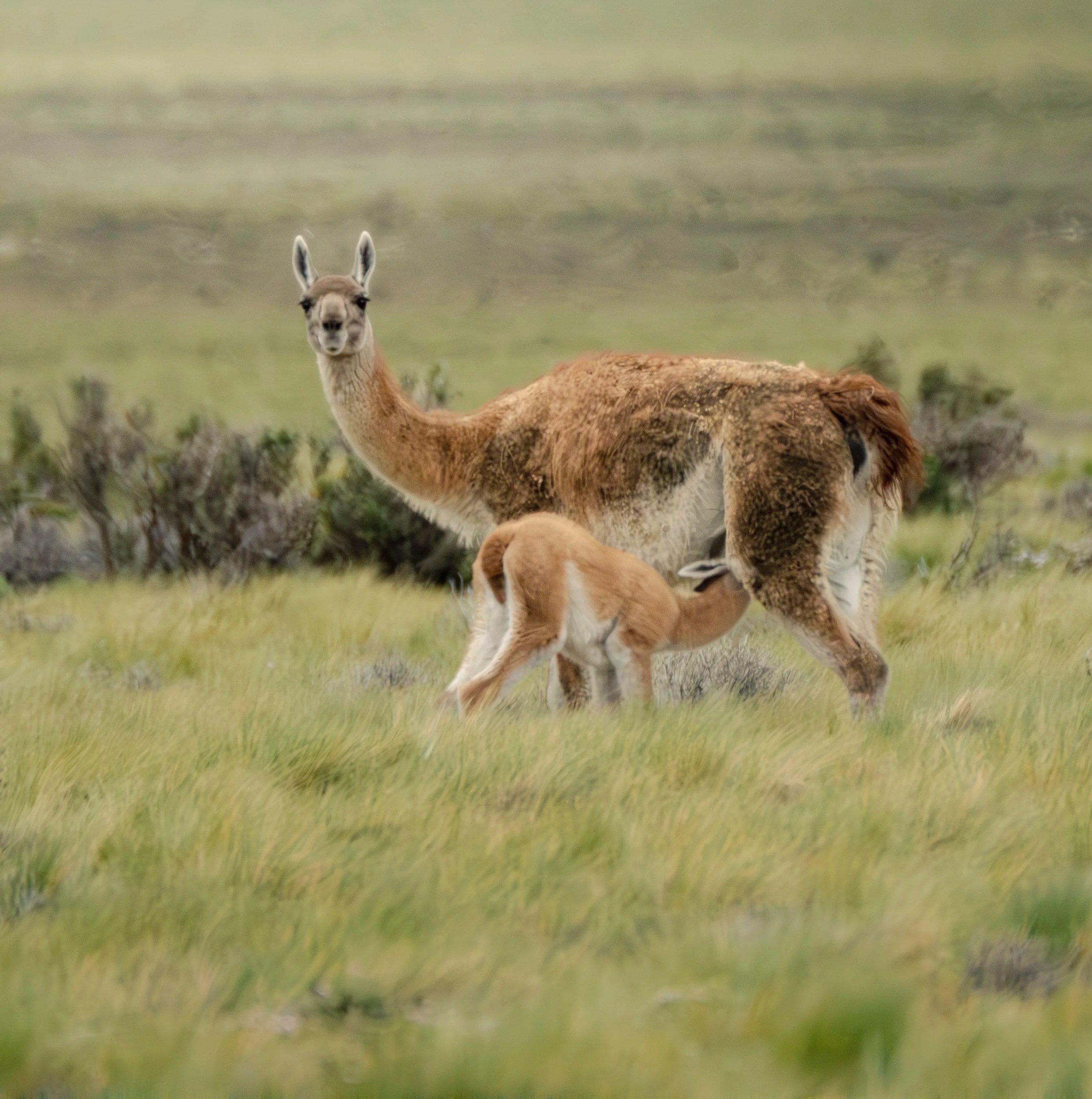
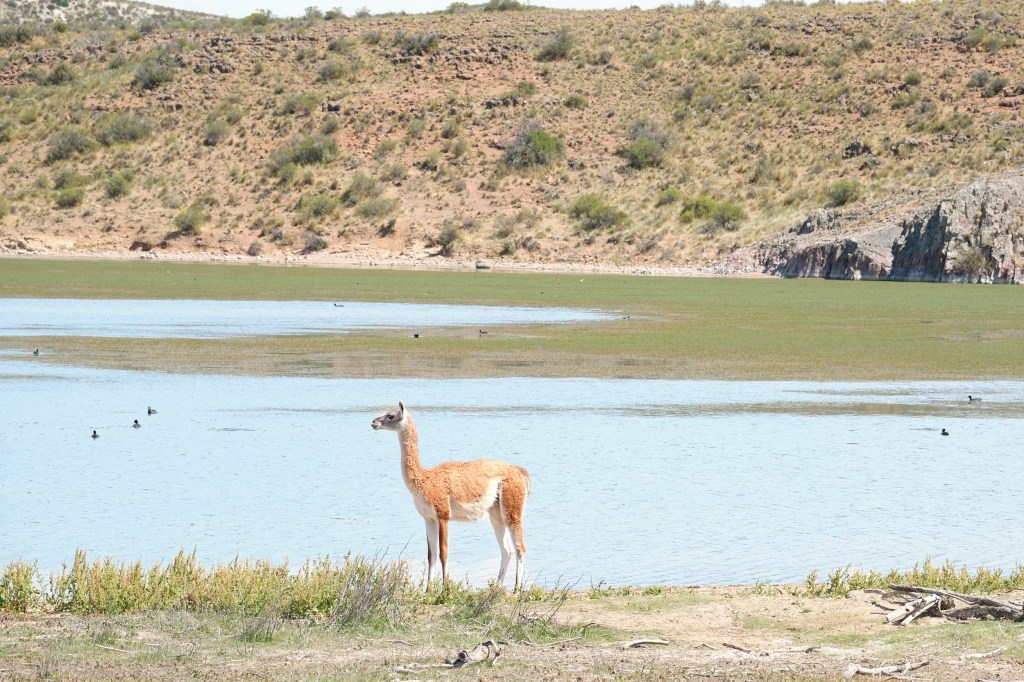
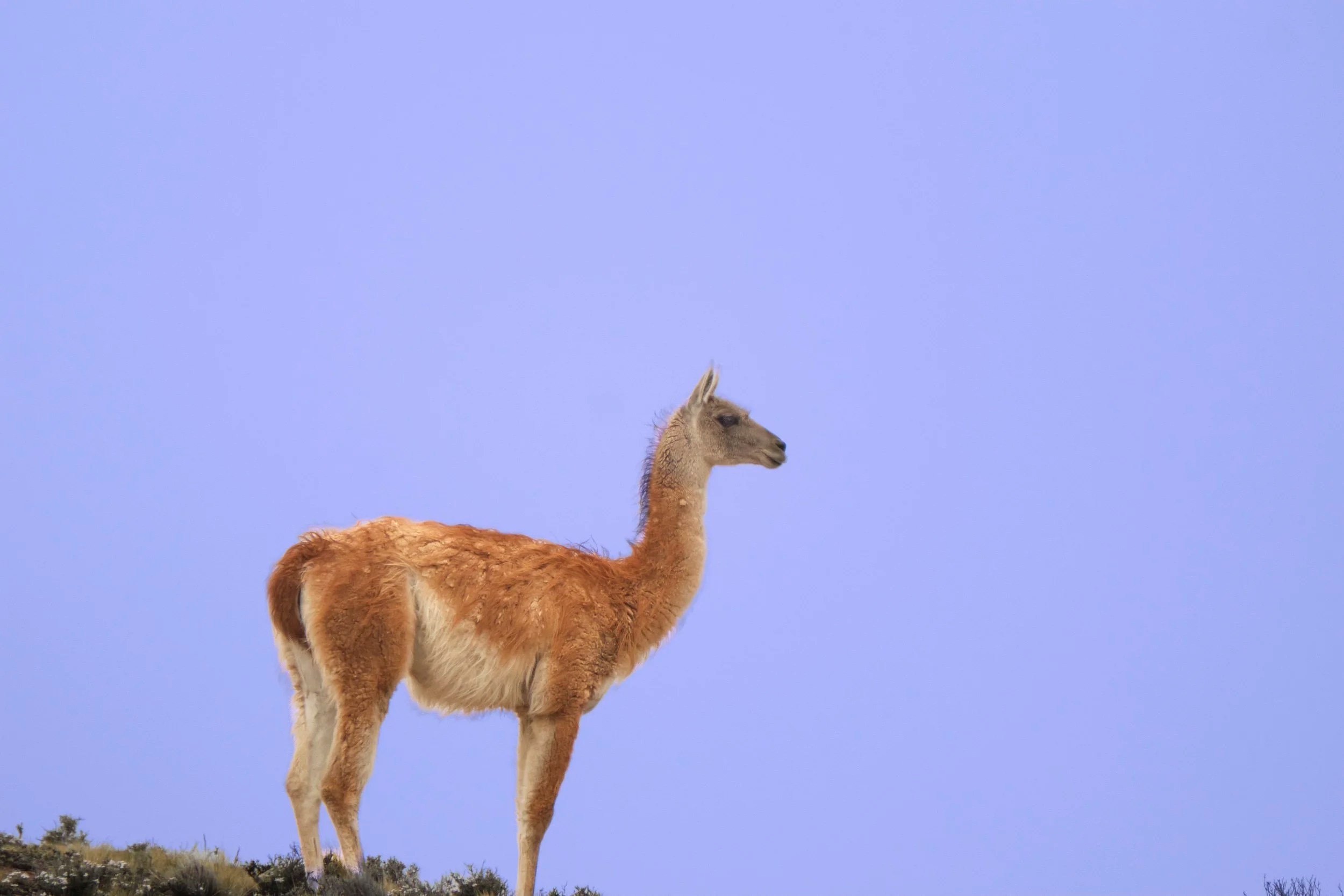
     Guanaco
    Guanaco

    It’s been a long time since my last post, not for the want of trying however. From Lagos del Furioso onwards we have been in the mountains at eco lodges where wifi has been sporadic at best and laundry non-existent. I’m writing this in haste in a cafe in a little town on the way to the airport for our flight to Buenos Aires, wifi still not the best so hope this post is in reasonable shape when I upload it.

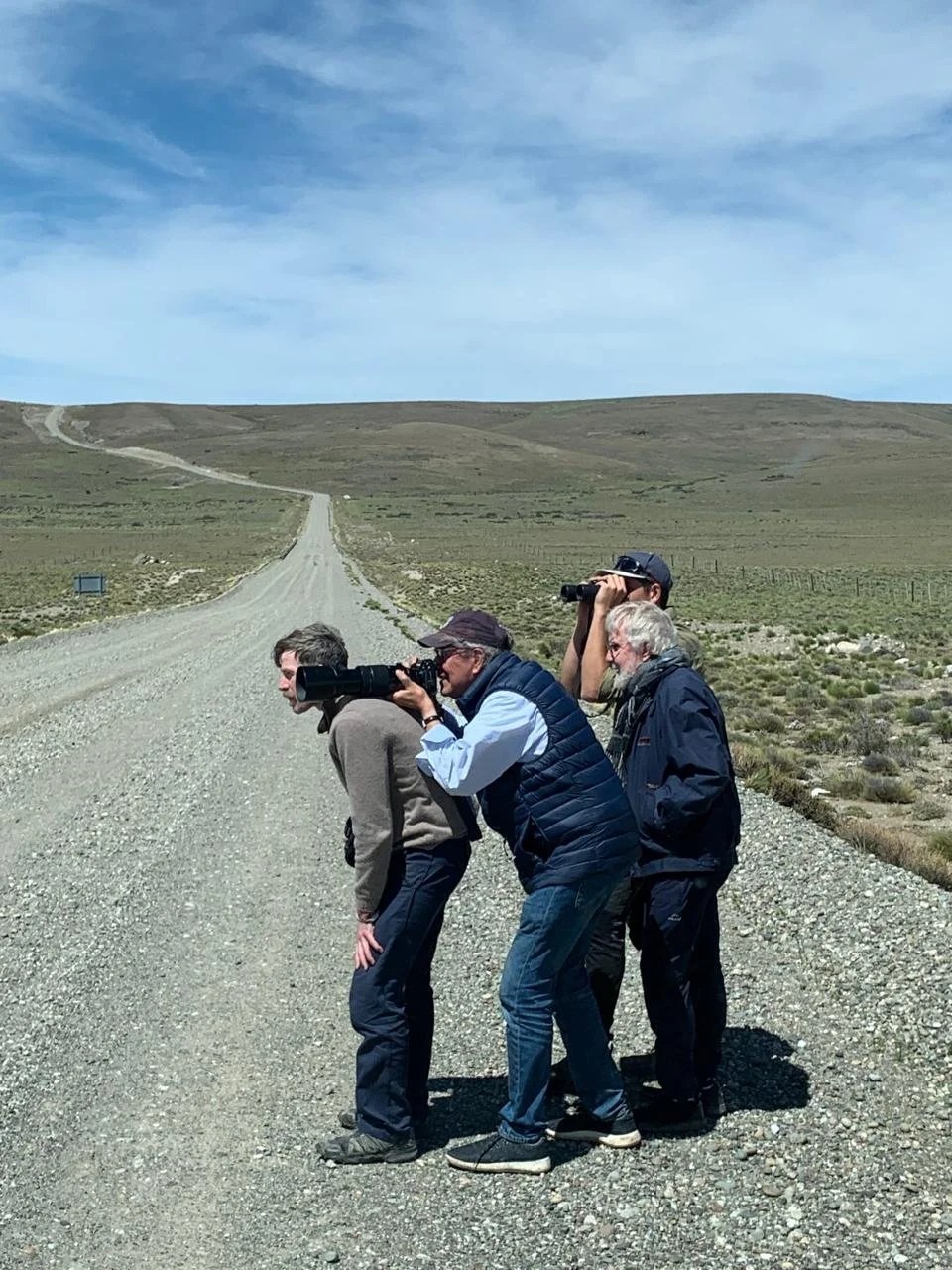
    Rather than a blow-by-blow description of the last 10 days I’ll pick a couple of highlights and let the images speak for themselves. One interesting note, this has been a trip characterized by immersion in new experiences, challenges to long-held ideas and assumptions and a growing awareness of ourselves and our own trajectories of aging and experience. Not least of these for me is the knowledge that my career as a photographer, particularly of wildlife, needs to be re-calibrated. For quite some time, years rather than months, my ability to use a pen or pencil has been severely compromised, I can barely write legibly due to age-related hand tremors. I’ve never been particularly troubled by this since virtually all written communication can be accomplished by email or at least electronic keyboards so not a major inhibitor. In contrast, I have been pleased that when I picked up a camera, my hands seemed to return to my former facility and my tremors seemed to disappear as long as I held the camera. I’m now very aware from examining my shots on this trip that I can no longer depend on this. My only steady shots on this trip were the ones taken of the parrots early on, when I used a tripod or landscape shots with light, wide-angled, short focal length lenses. My handheld wildlife shots are not crisp and in tight focus as they have always been. In fact, I simply can’t hold the camera steady enough to keep the subject in the frame with long lenses, really the only ones that can be used for wildlife, far less achieve acceptable focus. As a creative solution on occasion on this trip, Hugh volunteered to be my tripod, as you’ll see from the image below. A great option but I think that Hugh will agree, not the long-term answer.

    I could sense the beginning of this on our recent African trip in June but have now accepted that this is my new reality. I will need to find solutions since wildlife shooting and tripods are an oxymoron but I have some ideas for solutions and Hugh will be pleased to know that they do not include him!

    So, apologies in advance for the soft shots. Travel is broadening!

     Hugh as a tripod
    Hugh as a tripod
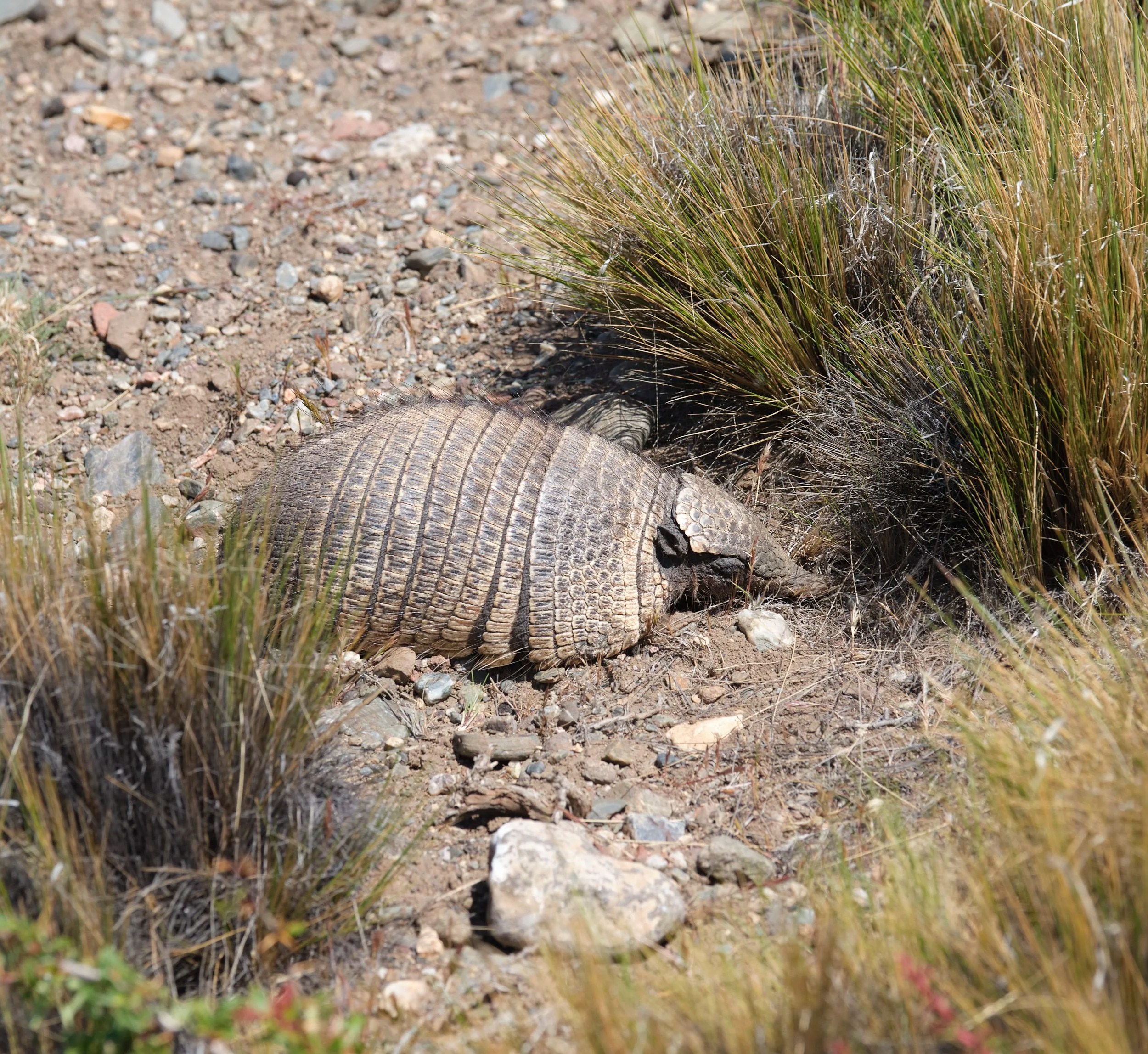
     Armadillo
    Armadillo

    Back to our little armadillo from an earlier post. I have had some questions about him and why he had a picture but no explanatory text, so to rectify this oversight, he/she was about the size of a small chubby cat with very short legs. He was spotted along the side of a dusty dirt track, and when we approached he huddled down, tucked his legs under himself, and closed his eyes. I suppose he believed that if he couldn’t see us, we couldn’t see him!

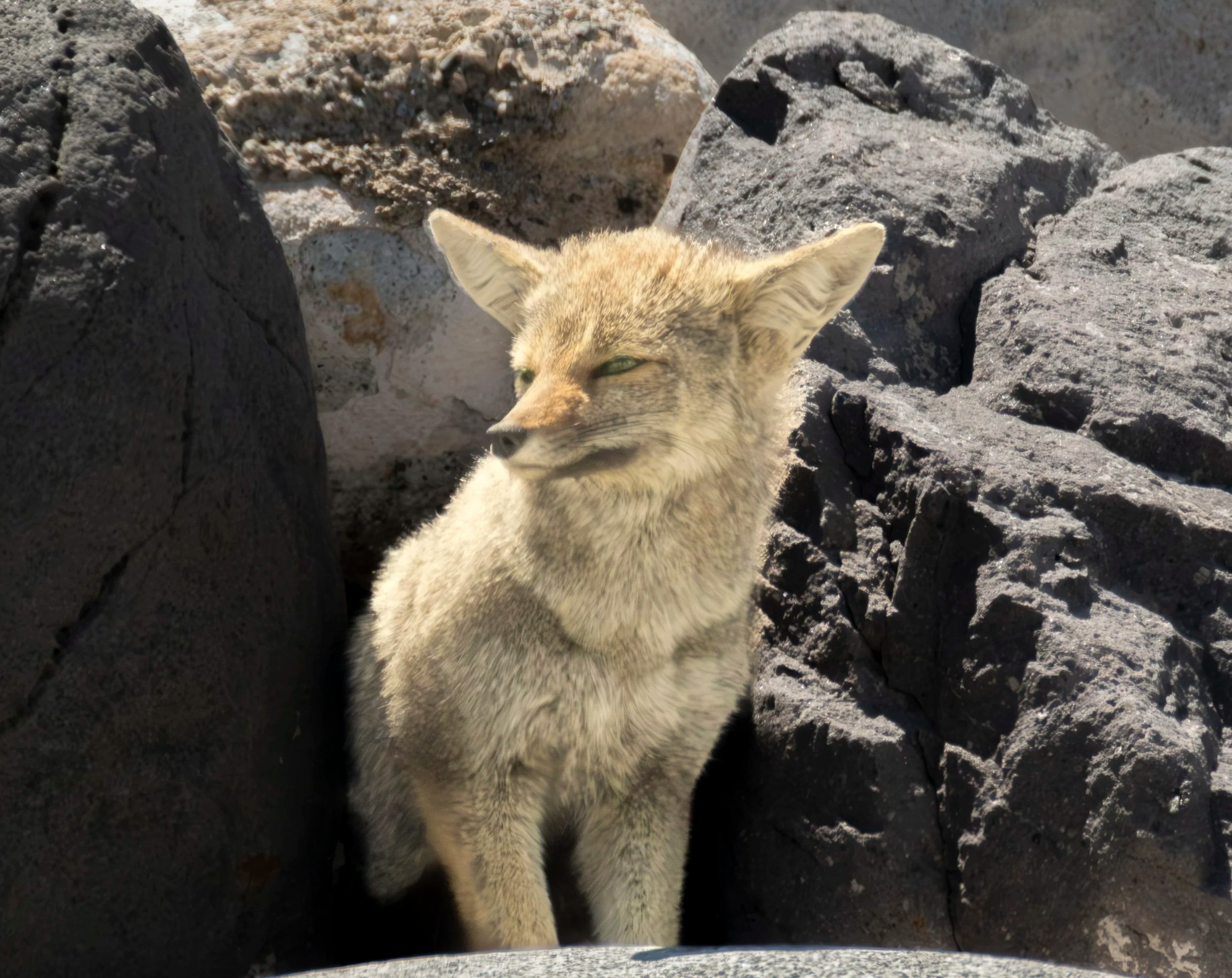
    We saw evidence of their presence at various times, holes dug in the ground and in the case of the parrots, holes dug down from the top of the cliffs to access the parrots’ nests but this was the only one we saw.

    Very cute little guy.

    When we left Lagos del Furioso we spent 4 or 5 hours driving to our next stop, La Posta de Los Toldos, in Patagonia Park (Argentina). Our way was hampered by the intense rain of the previous night and the mountain pass that we had planned to cross was impassable, washed out. This pass is the highest in the region and we had laboured up the muddy track up to the top of the pass but when we looked at our road down, a narrow dirt path carved into and zigzagging down the mountain,  we could see that it was much muddier and wetter than our road up and was simply too hazardous for us to attempt. Our tires were caked with mud so that we had little traction and trying to make downhill hairpin curves at 2000 metres altitude with no guardrail was a recipe for disaster. We turned around and crawled our way to a safer road.

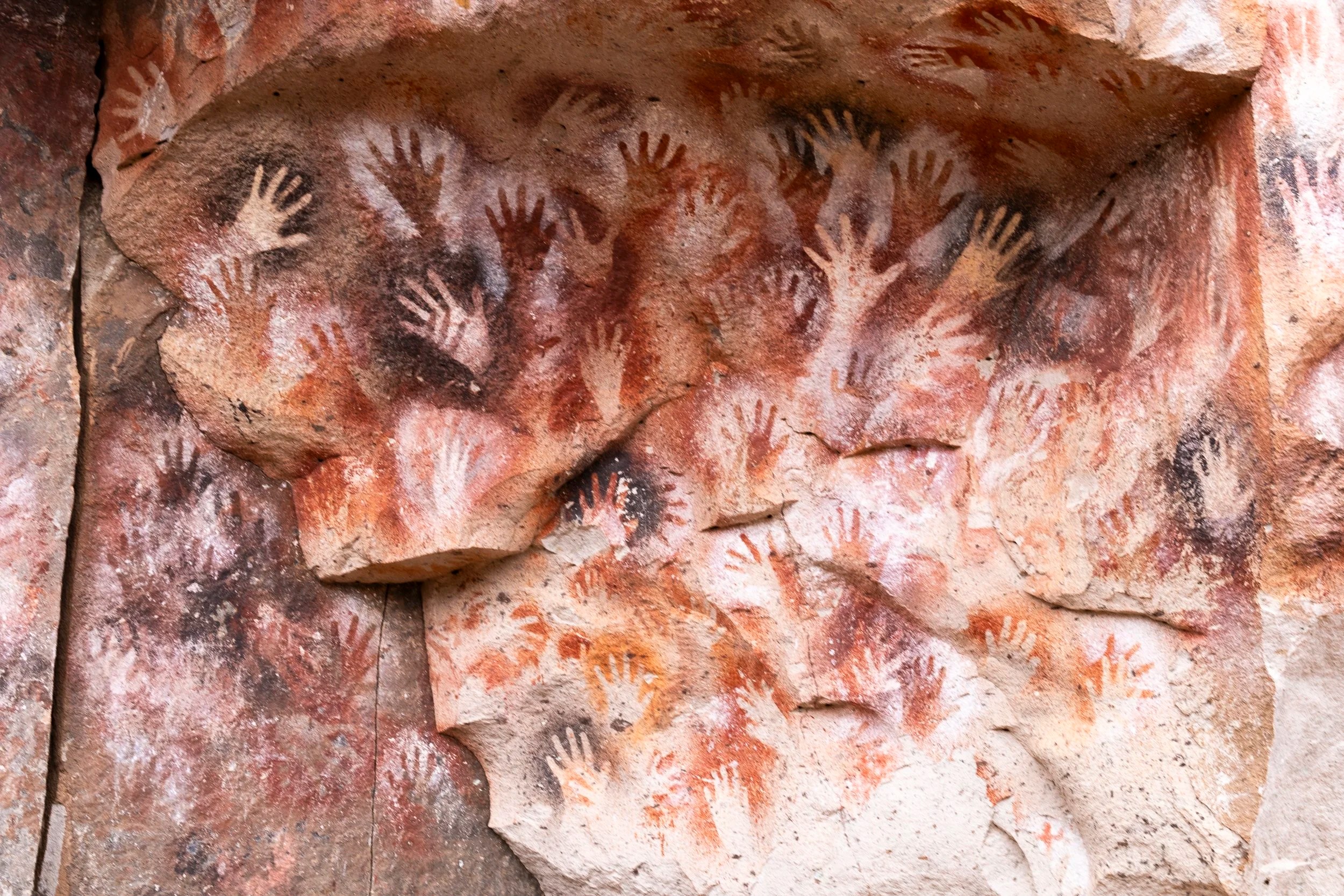
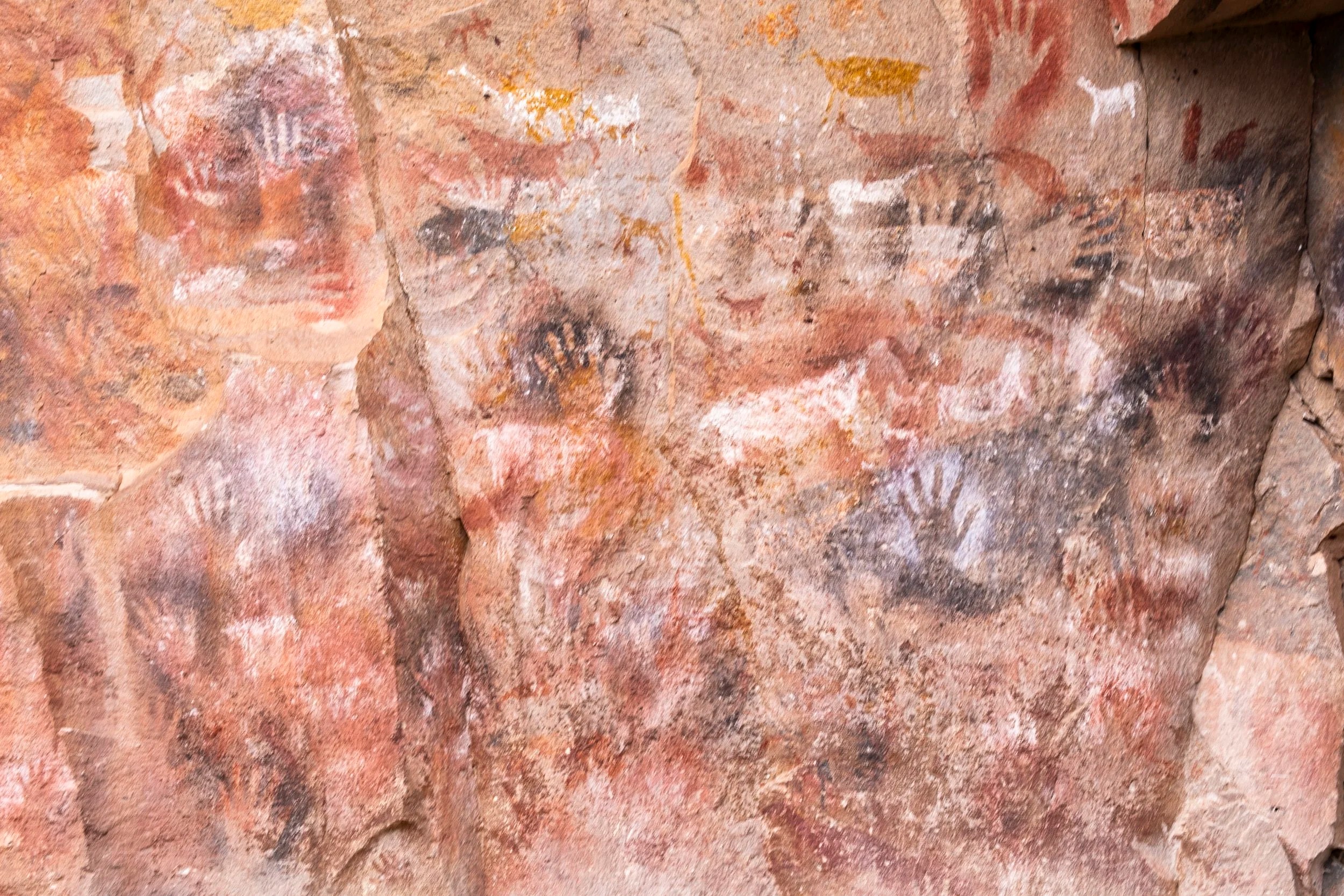
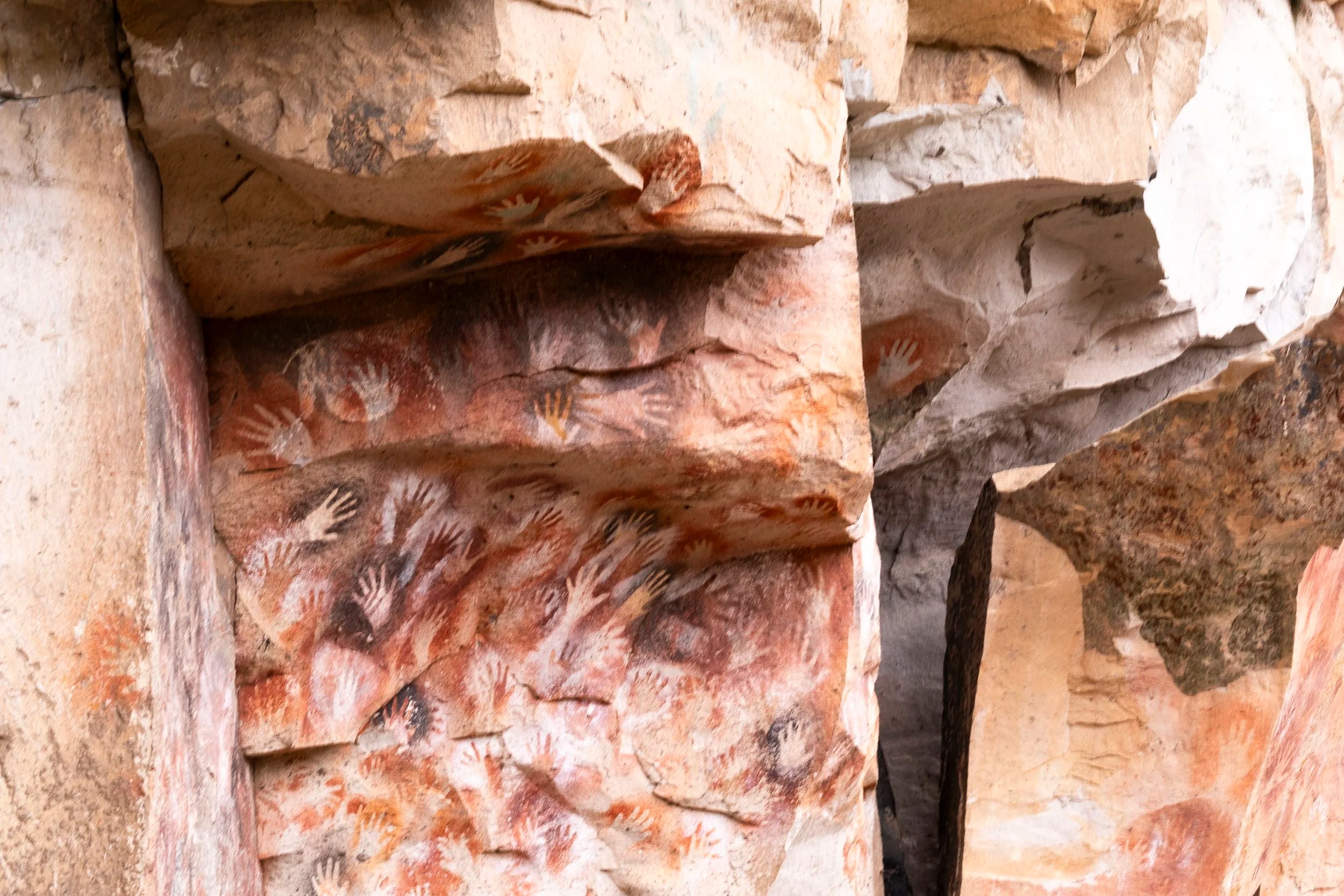
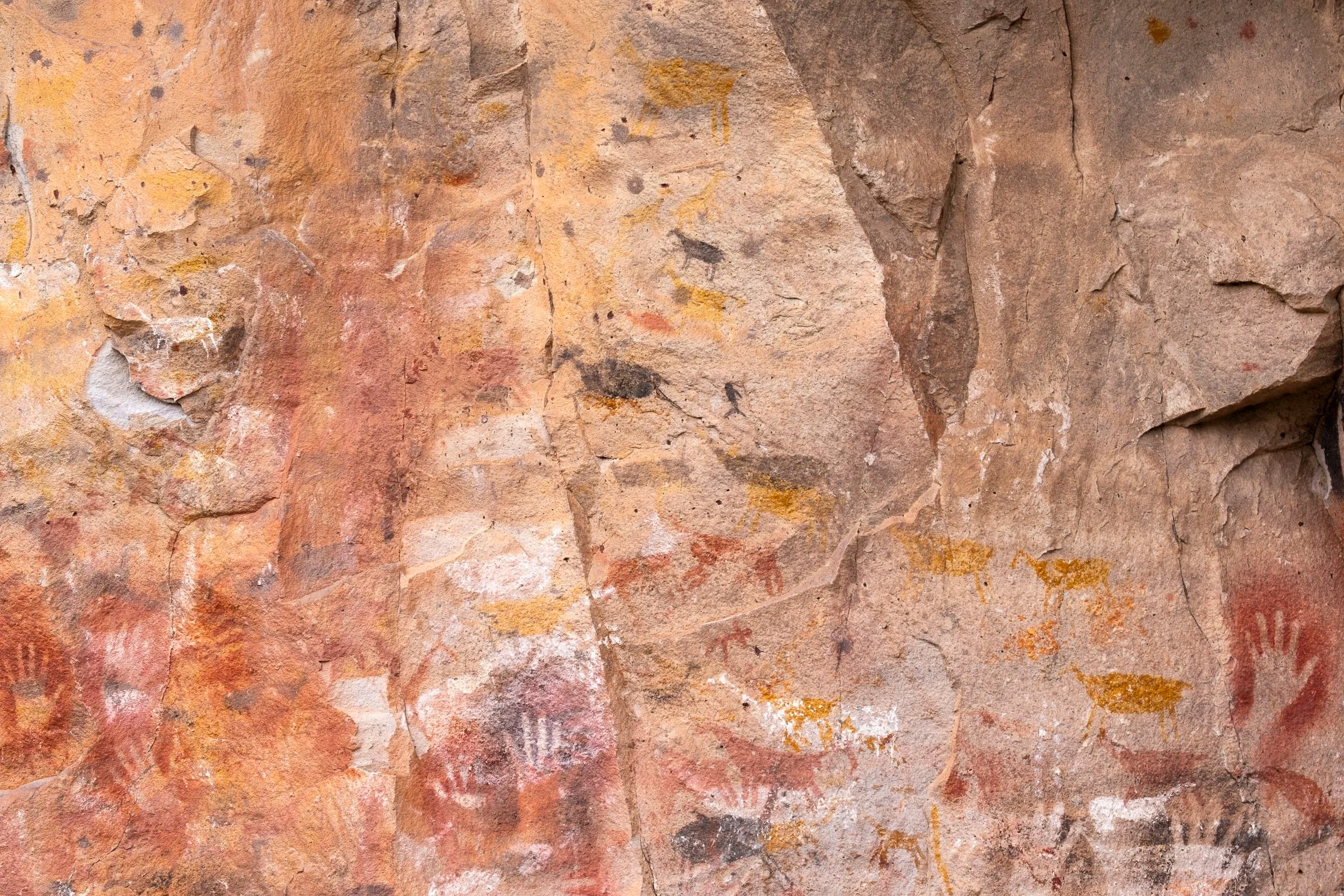
    While in Posta de Los Toldos two major highlights were visiting La Cava de las Manos and the research station of Parque Patagonia.

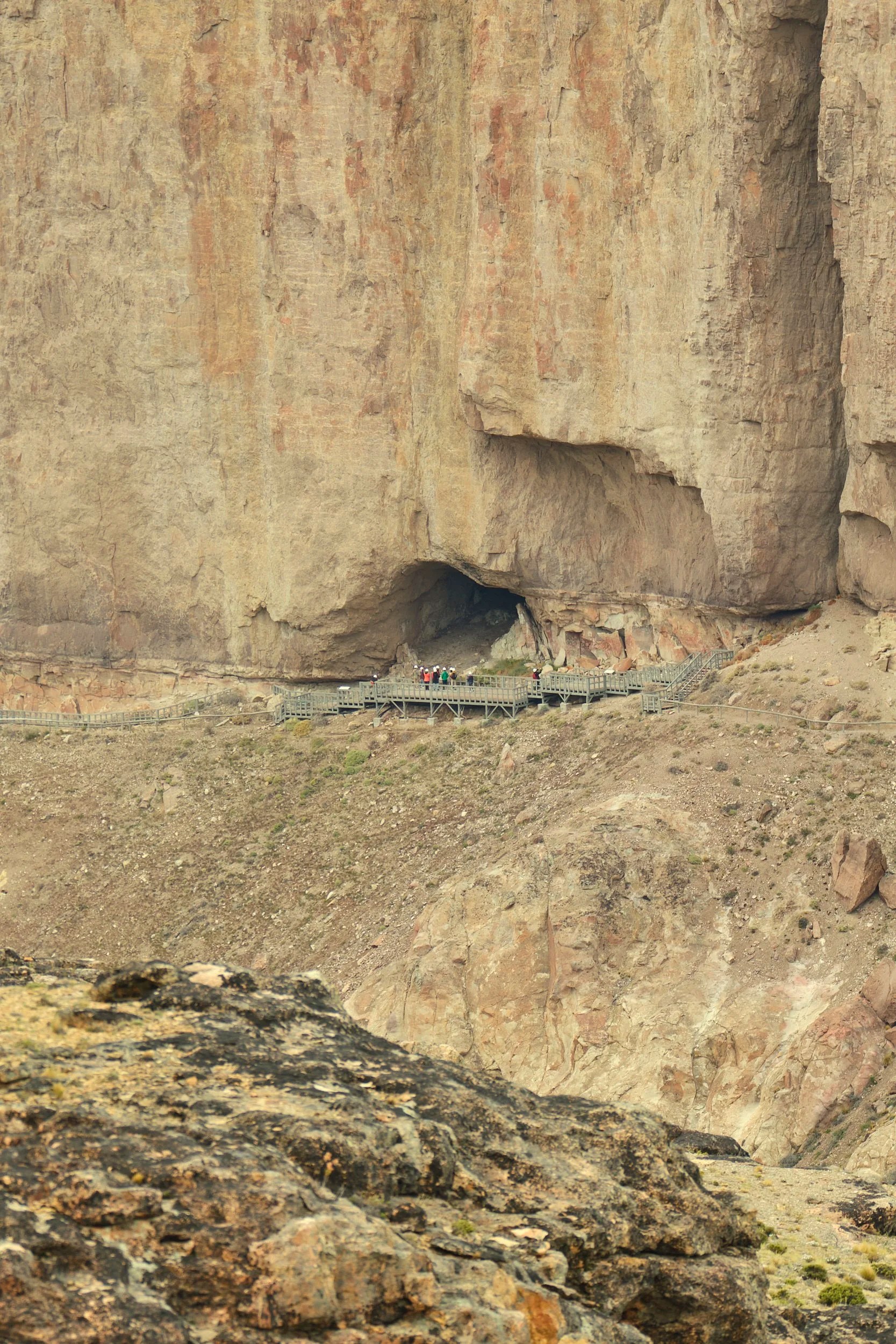
    As you will see from the pictures, La Cava de Las Manos, the archaeological jewel in the crown of the park hidden beneath an overhang on steep cliff walls above the Pinturas River Canyon, are more than 800 stencilled hand-prints and painted images of animals. These handprints encompass all ages and genders and are by a very high percentage, left hands. One speculates that the owner of each hand-print would have used their right hand to hold the paint applicator and would have then have been constrained to stencil their left hand.

    Interestingly, when photographed with infra-red or ultra-violet filters many more prints and drawings can be seen which are too faint to be seen with the unaided eye.

     La Cava de Las Manos from the top of the cliff on the other side of Pinturas River Canyon
    La Cava de Las Manos from the top of the cliff on the other side of Pinturas River Canyon

    Nobody fully understands why Patagonia’s nomadic hunter-gatherers crafted the graffiti, but we do know that the earliest images were created around 9,300 years ago using mineral pigments mixed with blood and fat, and that they continued to be added to for the next 8,000 years. They provide a glimpse of early life in the glacier-carved province of Santa Cruz and were overwhelming and compelling to examine and study.

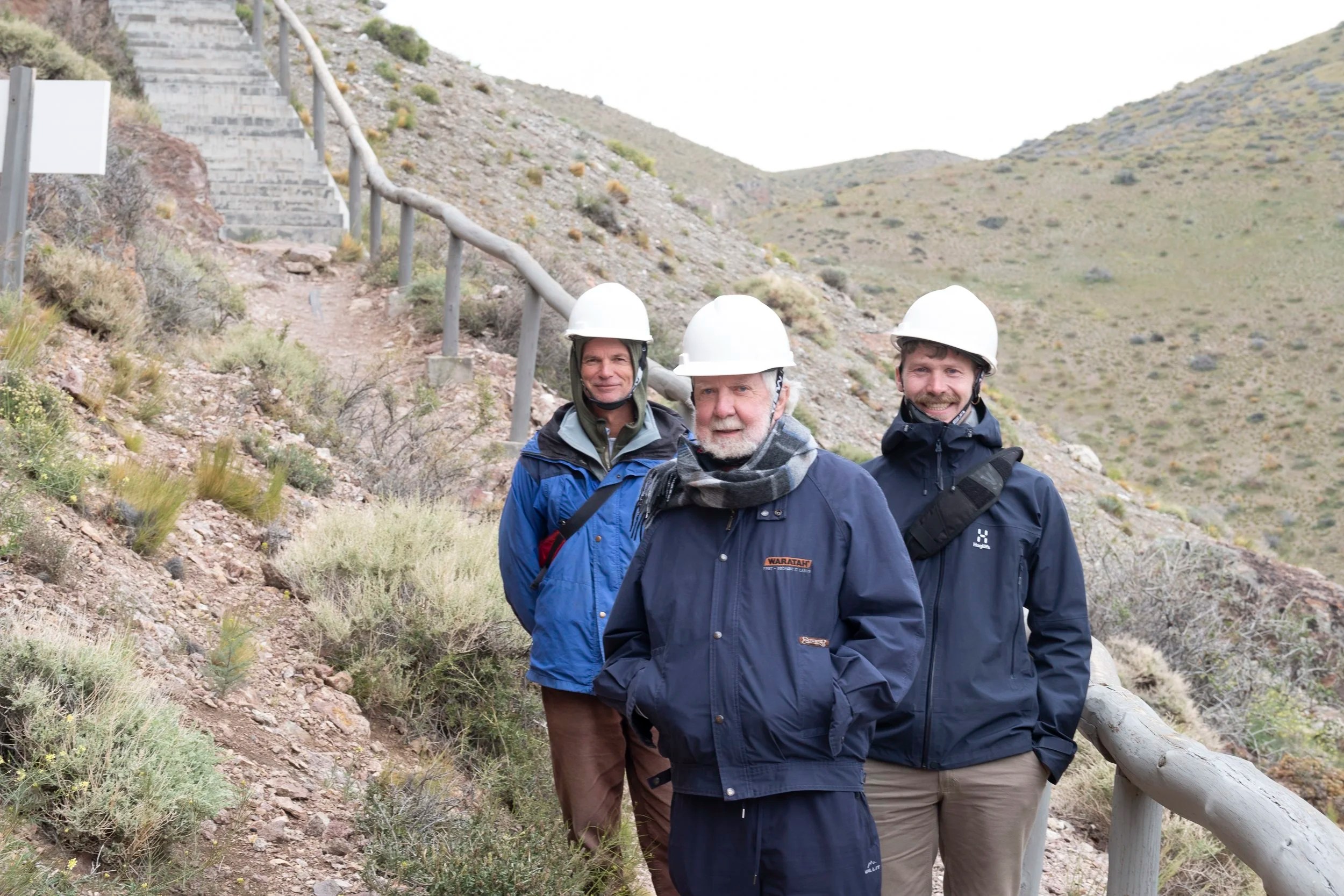
     Guido, Hugh and Rob on the way to the cave
    Guido, Hugh and Rob on the way to the cave
     La Cava de las Manos
    La Cava de las Manos

    As an aside, one of the funnier incidents of our time in this area, was coming across a very large red two-decker bus whose signage indicated that it was from Rotel Tours, filled with Germans preparing to enter La Cava as we were leaving the cave parking lot. We wondered how anyone could survive being cooped up in a two decker bus on the rough mountain roads but left and thought no more about it.  As we left the  5k dirt road leading into the cave area we spotted a very large, red trailer parked by the side of the road and also signed Rotel Tours which contained 3 rows of small windows with 13 windows in each row. When we chatted with some fellow German guests at dinner that evening at our refugio’s common dining table we learned that Rotel means a rolling hotel and the trailer was towed by the two-decker bus we had seen in the La Cava parking lot . Seemingly the 34 guests on the bus each slept in one of the little capsules behind each of the windows that we had counted in the trailer and that and the two-decker bus was their accommodations for the trip. Apparently, with couples, the divider between compartments is removed to allow for a double bed…

    When the weather is fine they eat outdoors on folding tables and chairs and when it’s was not I guess they eat in the bus. We tried to figure out to where they stored their belongings, where the bus cooked their food and whether they changed their clothes lying on their backs on their little capsule bunks, but when it came to the question of personal hygiene and the calls of nature we refused to speculate!  One of our fellow diners said that he had checked out the tour on the web and thought that it was quite expensive. He claimed that it cost 5,500 euro a person which included an 18 day trip, all meals in, and includes the transatlantic return flights!  The mind boggles.

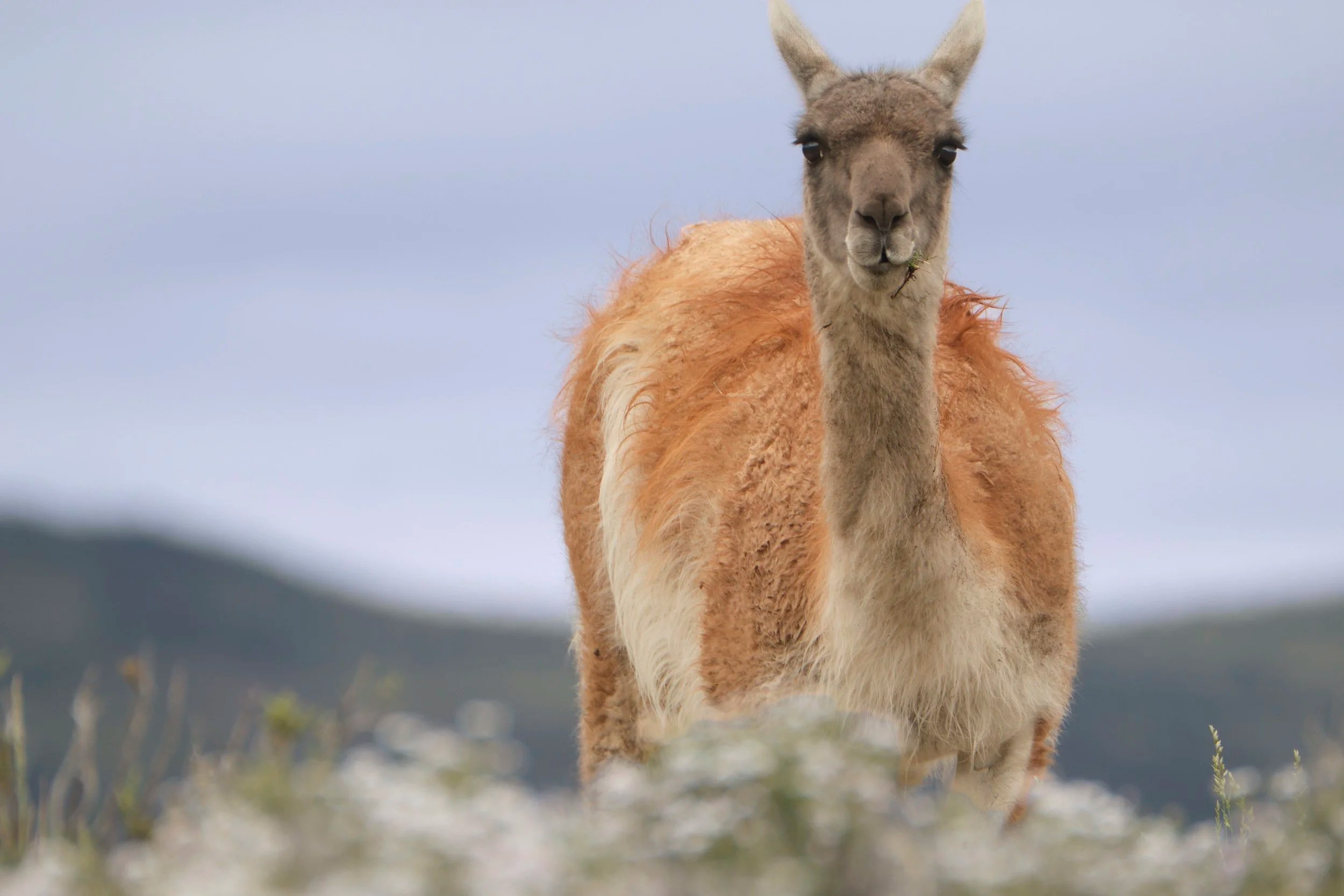
     Guanaco close-up
    Guanaco close-up

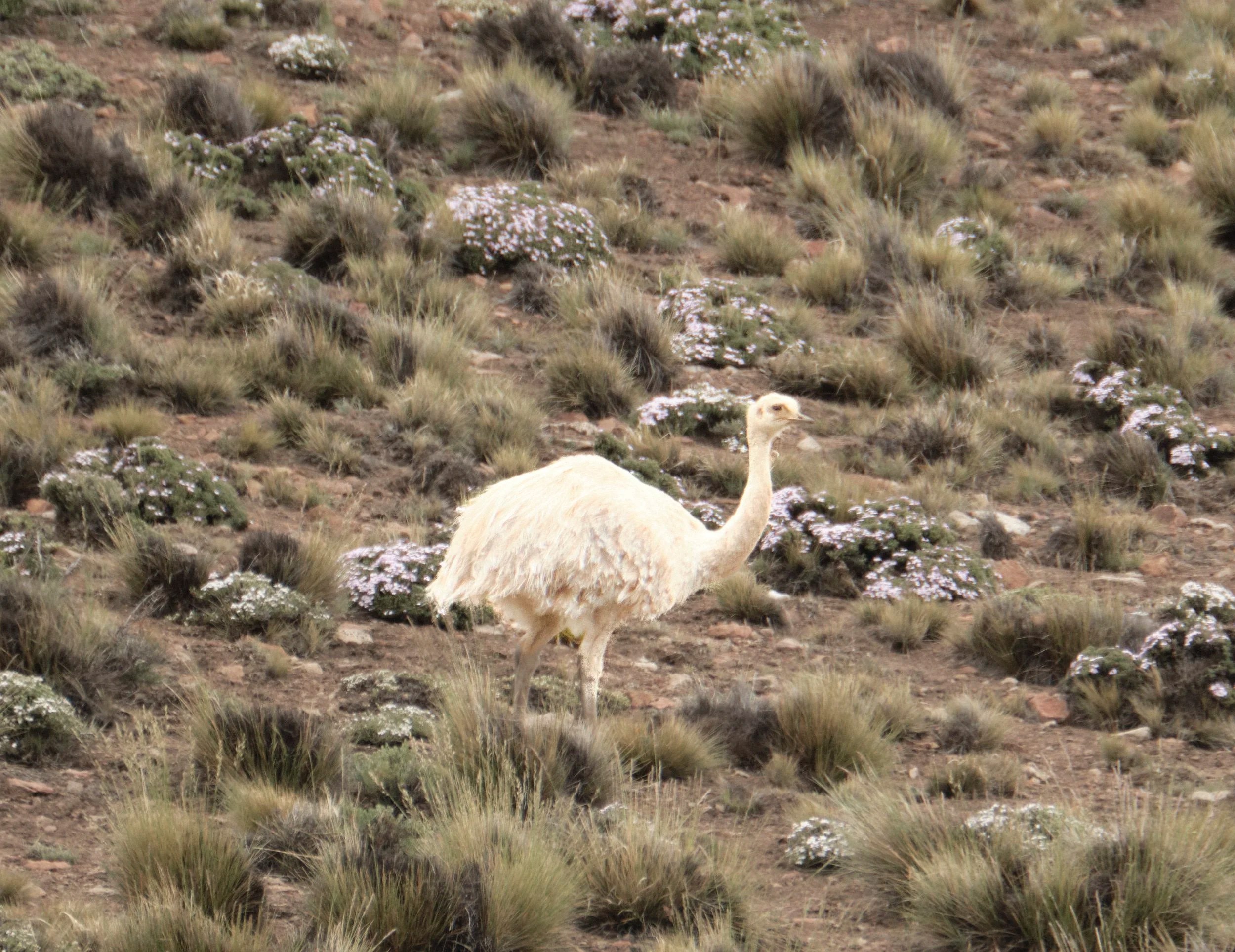
    Our other interesting highlight in Patagonia Park was a day spent with 3 young guides and researchers from Rewilding Argentina, the NGO that owns the park. As I mentioned in earlier posts Rewilding Australia is an arm of the Tompkins Foundation who assembled the huge parcel of land that makes up Patagonia Park and purchased it privately. Their intent is to re-establish native flora and fauna, set up a sustainable economic base and then turn it over to the Argentinian government and people, much as they did in Chile. Most of our stops along the way on this trip have been in areas in which Rewilding Argentina have been working on projects along this line and we have been enormously lucky to have spent time with the scientists, researchers and guides who are all passionate and committed to this vision.

    We were lucky enough to be invited to spend a day with these 3 young people at the research centre and out in the field. This is the first time that the organization has extended such a welcome and opened their doors to outsiders not officially involved in research or conservation with any national or international organization and all through Hugh’s long-time association with the NGO. Needless we were thrilled and honoured.

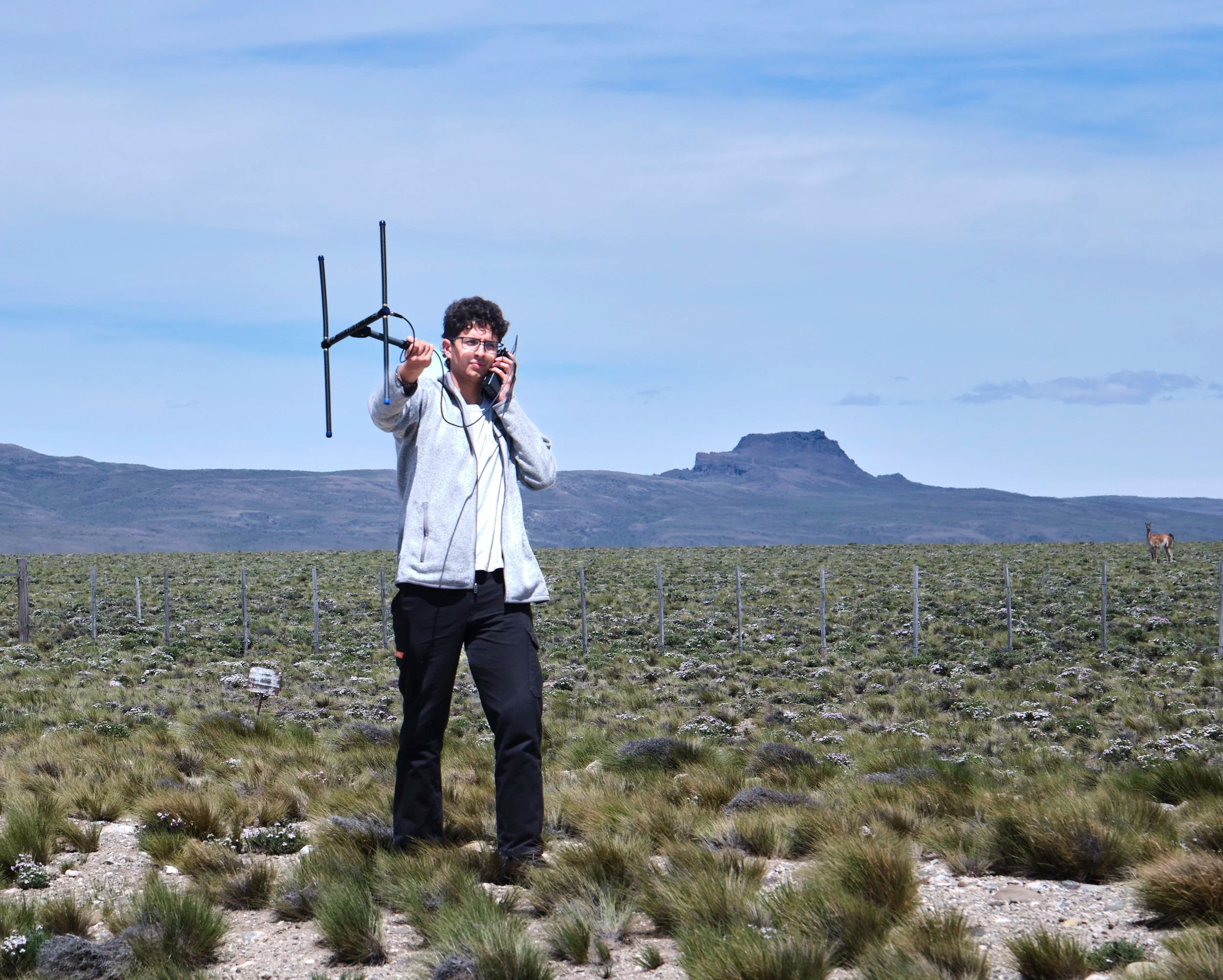
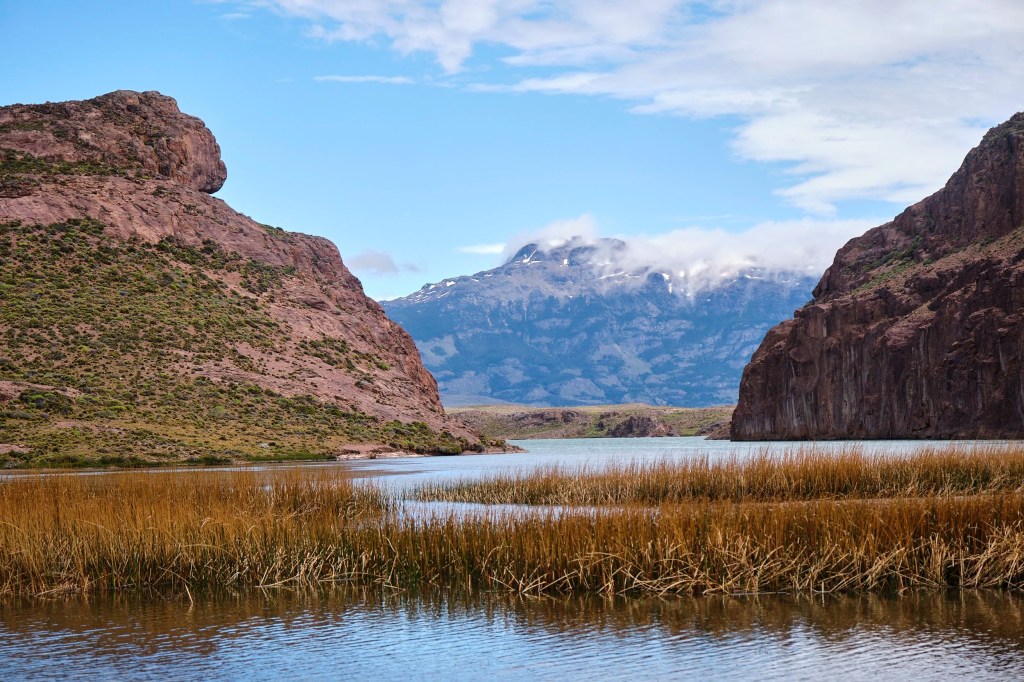
    One of the purposes of the day was to try and get me in a position to get some shots of a puma. Rewilding has radio collars on the 13 pumas in the park and it was hoped that via satellite tracking and the VHF signal that each collar sends out we might be able to track and photograph one of the puma. We spent a fascinating day getting a first-hand look at the work of the organization in rewilding the region and spent considerable time bouncing around the countryside with an antenna trying to locate a puma. The park covers an area of 528 square kilometres so it was always going to be tricky to locate a puma in an area where we would be able to access it and so it proved. We did pick up a signal late in the afternoon but unfortunately it proved to be in an area that could not be reached by 4×4 and the hike would have been a test so we reluctantly have had to postpone it until our next adventure.

     Jorge searching for puma with his VFH antenna
    Jorge searching for puma with his VFH antenna

    More to come!
    [ {
    “type”: “highlight”,
    “id”: “56c34348-a68a-4501-83f6-c2b210134ec4”,
    “shape”: “underline”,
    “isFront”: false,
    “isAnimationEnabled”: false,
    “animation”: “draw”,
    “duration”: 0.5,
    “direction”: “right”,
    “color”: {
    “type”: “THEME_COLOR”
    },
    “thickness”: {
    “unit”: “em”,
    “value”: 0.1
    },
    “linecap”: “square”
    } ]

    Click on the map to to follow my route

  • Lagos del Furioso, Patagonia – November 25, 2024
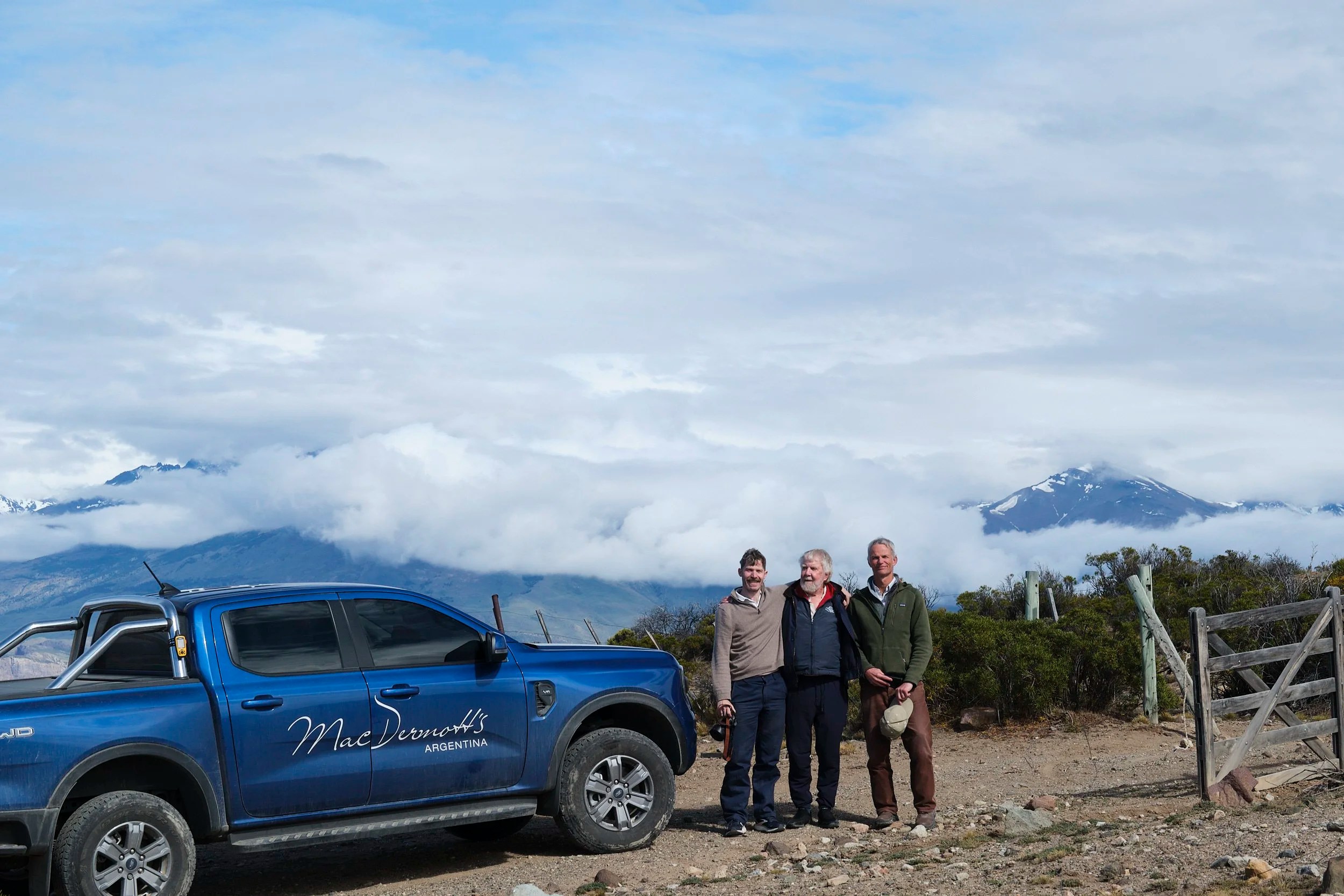
     From L to R, our truck, Hugh, Robert, Guido, the Andes
    From L to R, our truck, Hugh, Robert, Guido, the Andes

    Sunday, November 24 – Long day’s drive on Sunday, longest of our trip, approximately 800k’s. Left Islas Leones at about 7:30 and arrived in Lagos del Furioso at about 19:30, straight run of 12 hours with brief pit stops for gas and bio breaks, snacking in the car as we drove. A mix of tarmac and dirt highways, so on balance we made very good time, original ETA was between 20:00 and 20:30.

    Fascinating changes of landscape as we drove from the Atlantic coast to the foot of the Andes, flat coastal plains turning into rolling hills, back to a flat dry plateau and then into hilly country leading up to the mountains. Only characteristic shared by all terrains was dry, low shrubby ground cover, clumps of dry grasses and no trees. In fact the only trees to be seen are those that mark a settlement or the outbuildings of an estancia, (farm and very large, open land and used for grazing cattle or sheep), and the trees to be seen there are invariably poplars, planted as windbreaks to shelter building from the incessant wind. Pleasantly, the shrubby bushes and grasses covering the landscape are bright and green with spring. In a month or two when summer arrives everything will be back to their normal dry and dusty look.

     Armadillo
    Armadillo

    Our lodge at Lagos del Furioso was built about 30 years ago as a way of attracting tourists to the region and is now run by the original owner’s son. Guest rooms are huts built among the poplar trees surrounding the property and the whole operation is reminiscent, for my local Ontario readers, of a 1950’s cottage-country lodge. Food however is significantly better than it would have been at its suggested precursor.

    On our drive, at a little town about 3 hours drive from our destination, we stopped to pick up Guido, our local guide who will spend the next 5 days with us.

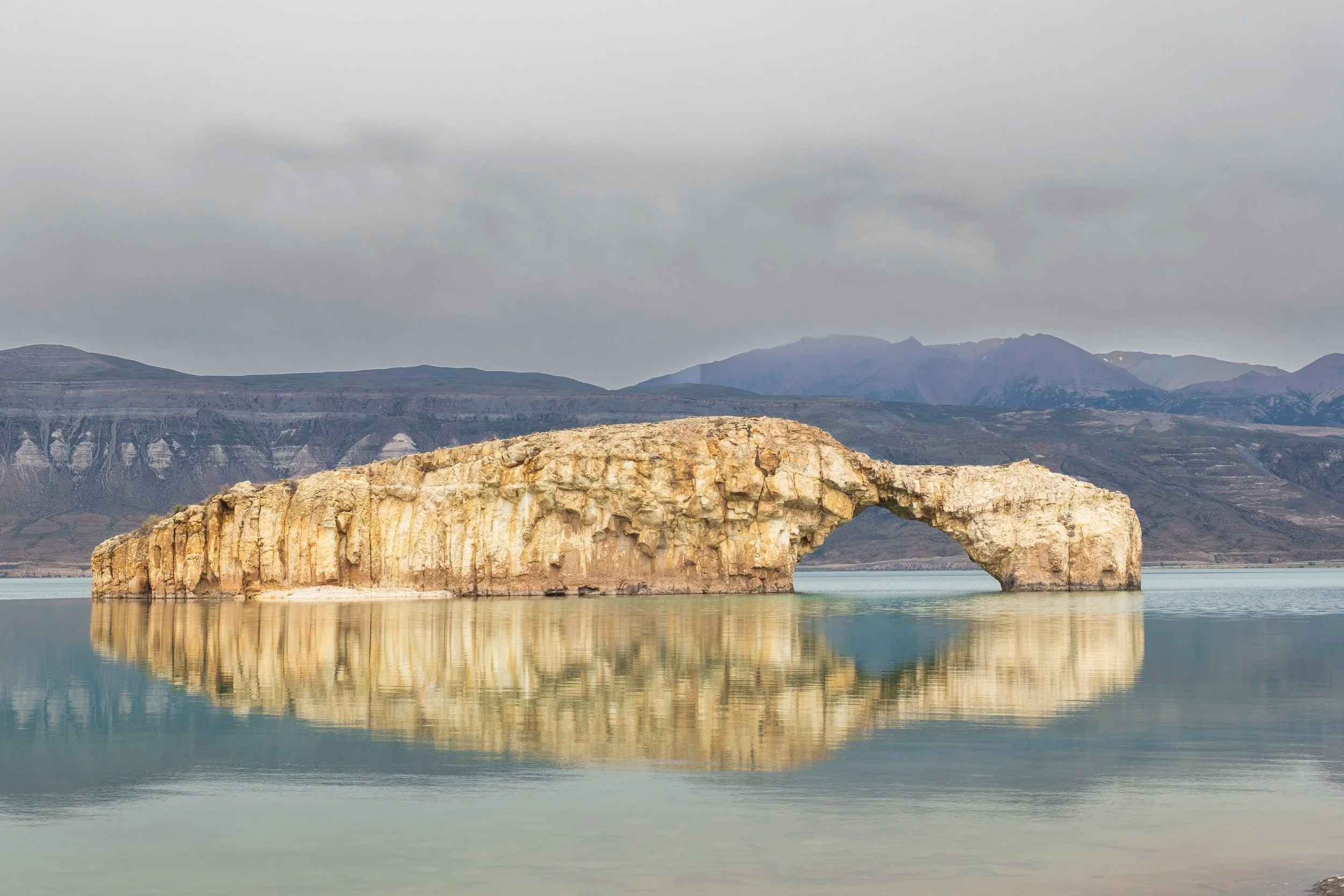
     Reflected arch, very rare, still day
    Reflected arch, very rare, still day

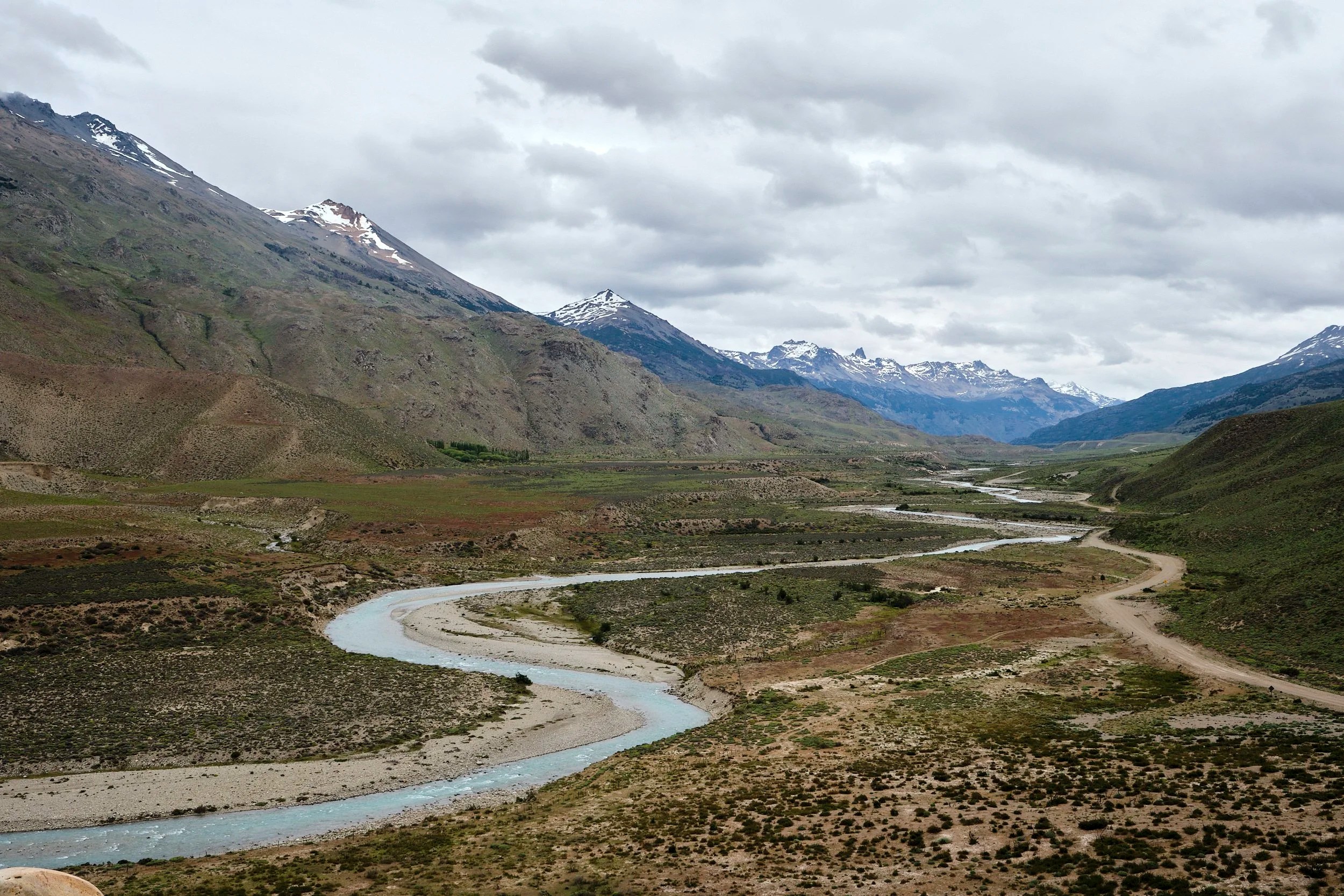
    Monday November 25 – Off after breakfast for an exploratory driving tour of the area. The first thing to know about Patagonia and one of the most important things that helps shape the landscape is the weather. There is really only one weather pattern in western Patagonia, where we are located, and that is a strong, persistent west wind that blows from the Pacific, hits the Chilean side of the Andes, is forced up and over the mountains and in the process dumps most of its moisture as rain in Chile. It is much drier when it descends into Argentina and that continuing, strong dry west wind means that the landscape is shrubby and grassy rather than covered with forests as in Chile. The other two major landscape sculptors are vulcanization and glaciation. The Andes are young mountains, still being formed and the landscape is very volcanic, so not a soft weathered terrain except in those areas adjacent to the mountains that were heavily glaciated during the 4 ice ages that have covered the land in the last million years, the last of which receded only about 10,000 years ago. So a harsh, dry, windy land, torn by great canyons and featuring residual lakes and extensive dried lake beds created by melting glaciers, everything scoured and shaped by the persistent, abrasive wind that is continually blowing.

    What’s particularly fascinating about Patagonia is the fact that since there is so little vegetative cover on the landscape, no forests or wide expanses of heavy tree cover, everything in the terrain is laid open to be read like a book. Easily visible are great tracts of ageless lava flow, basalt cliffs and peaks, sweeping rifts of glacial moraine and beautifully articulated cake-like layers of ocean-bottom sediment going back millennia. An earth scientist’s dream landscape. What is even more amazing is that so much of it has not been studied, indeed many peaks that have never been climbed, many areas never visited or barely explored.

    A captivating, interesting and stunningly beautiful country that I find utterly compelling.

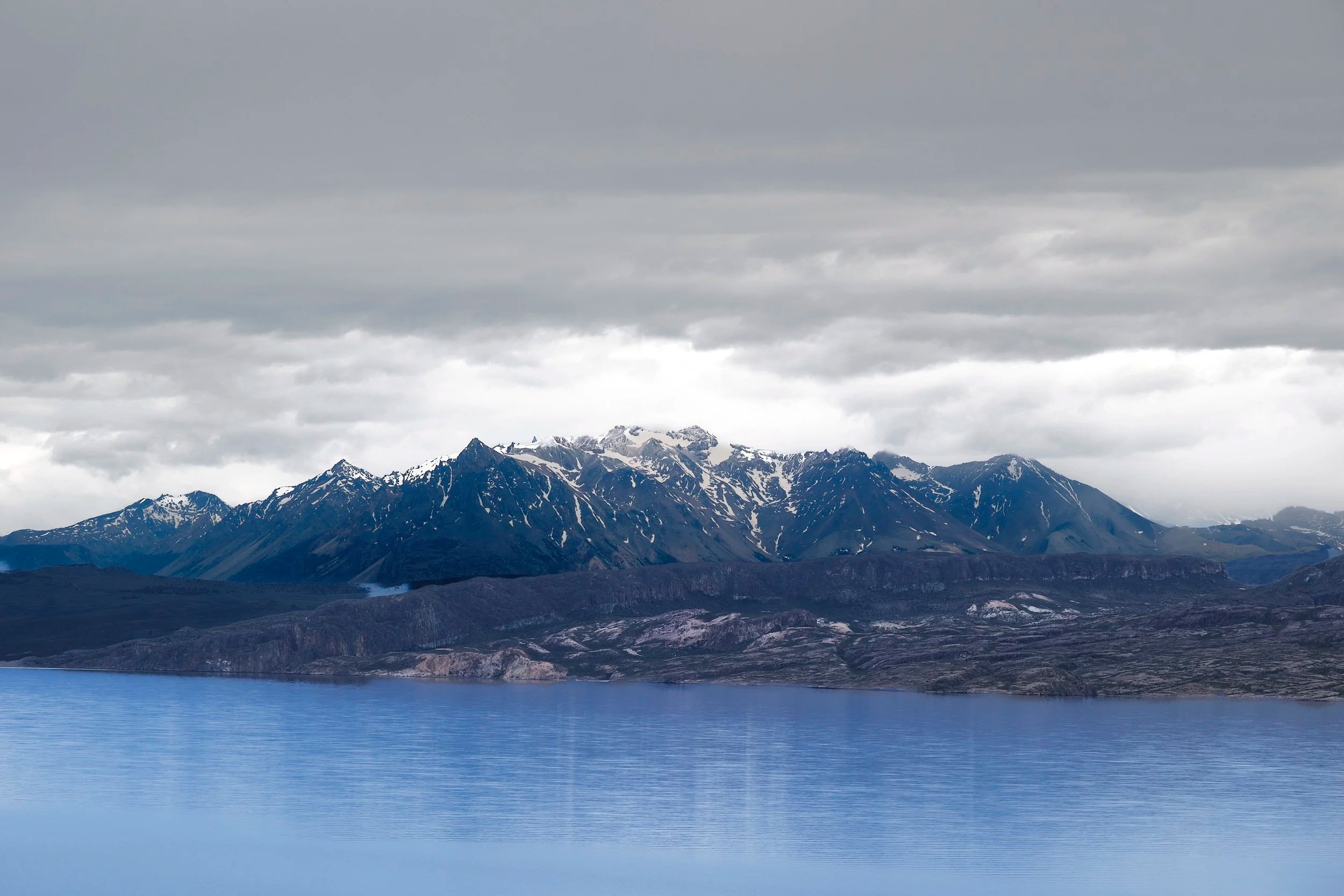
     Andes
    Andes

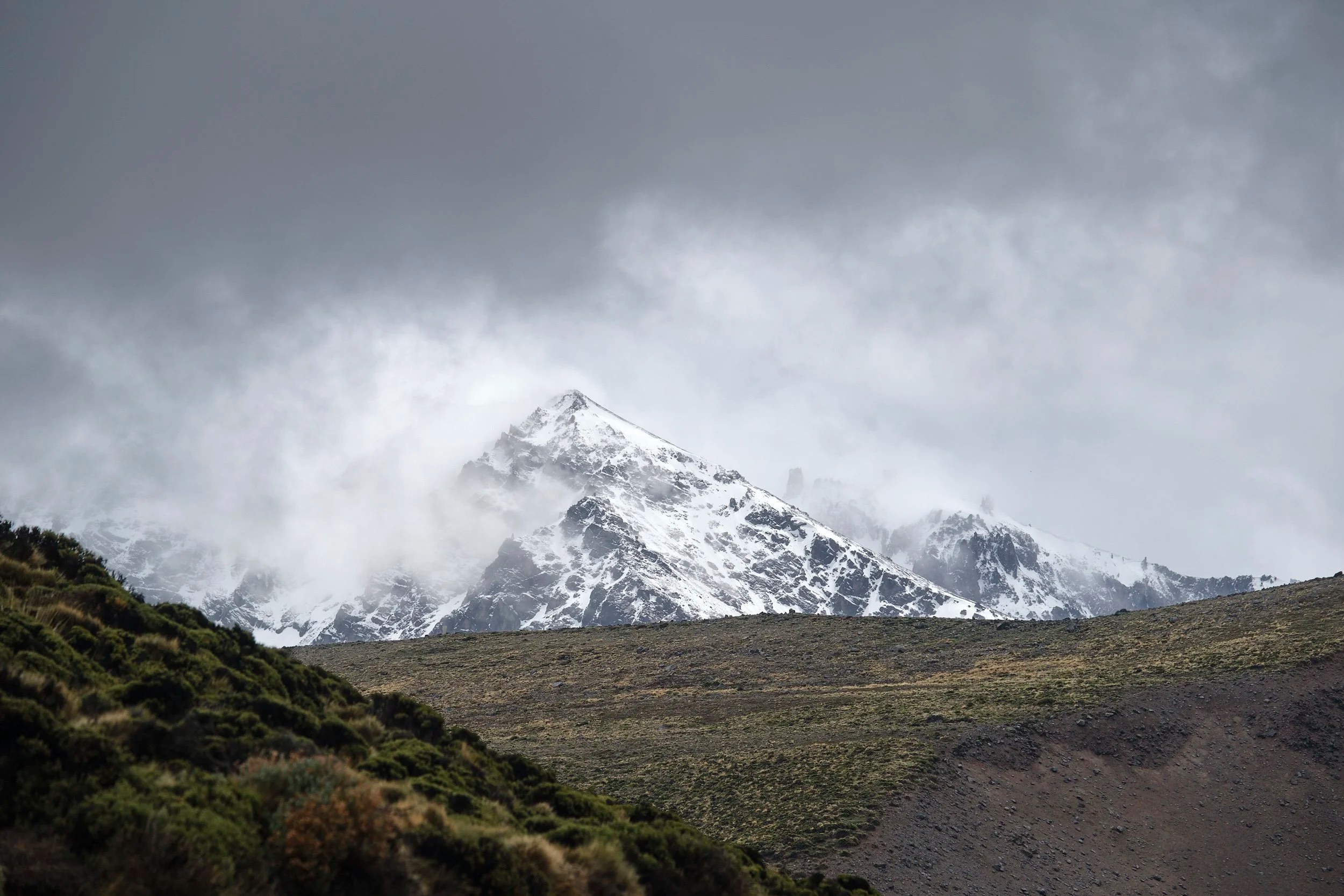
    I also learn that we are here at a highly unusual time. When we arrived on Sunday evening and all through Monday the air was absolutely still and I was able to take some interesting landscape shots which included the mountains with their reflections caught in a still lake. Guido says that he has never experienced this in the 30 years that he has lived in the area; maybe a guide’s little exaggeration, but certainly very unusual. Additionally, the weather at this time of year is normally very dry and nothing more than a brief shower is the rule. In fact Guido tells us that lightning and thunder are unheard of here (pardon the pun), since there are no competing air masses in collision that cause lightning and thunder, instead there is only the dominating west wind always moving in one direction. And yet overnight we had a continuing intense rain that lasted for a couple of hours accompanied by peals of thunder.

     Andes
    Andes

    In fact that intense rain had consequences which I’ll cover when I tell you about the following day’s activities.

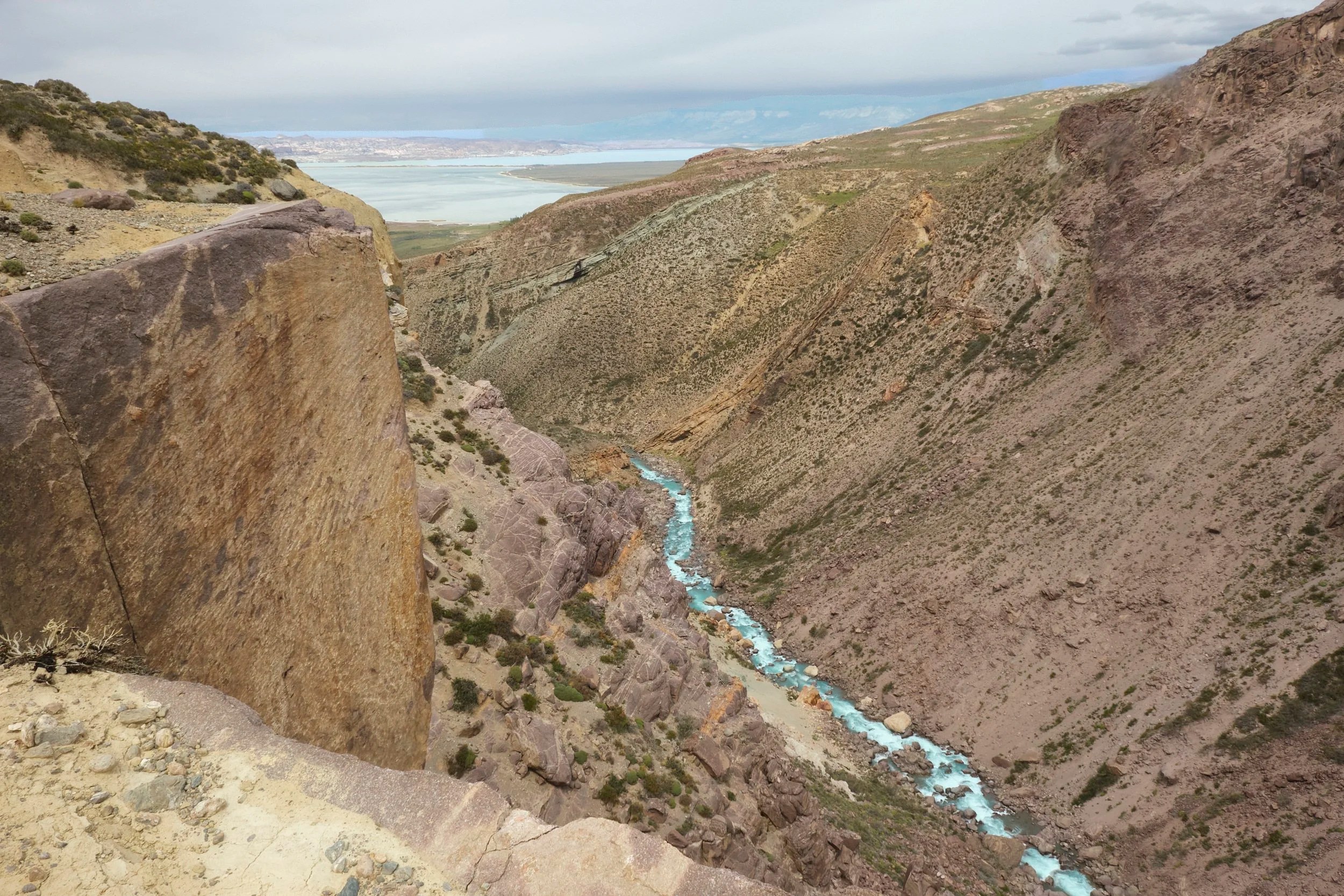
    We spent the day driving, walking and clambering over trails, fabulous vistas and terrifying cliff-edge drops. Heights are always very nervous-making for me and R shares my aversion to heights but sometimes you need to get the shot. The image above was taken after scrambling down a hillside to the ledge whose edge can be seen bottom left and shooting straight down to the bottom of the 200 metre drop to the river.

    More to come!
    [ {
    “type”: “highlight”,
    “id”: “56c34348-a68a-4501-83f6-c2b210134ec4”,
    “shape”: “underline”,
    “isFront”: false,
    “isAnimationEnabled”: false,
    “animation”: “draw”,
    “duration”: 0.5,
    “direction”: “right”,
    “color”: {
    “type”: “THEME_COLOR”
    },
    “thickness”: {
    “unit”: “em”,
    “value”: 0.1
    },
    “linecap”: “square”
    } ]

    Click on the map to to follow my route

  • Isla Leones, Patagonia – November 23, 2024
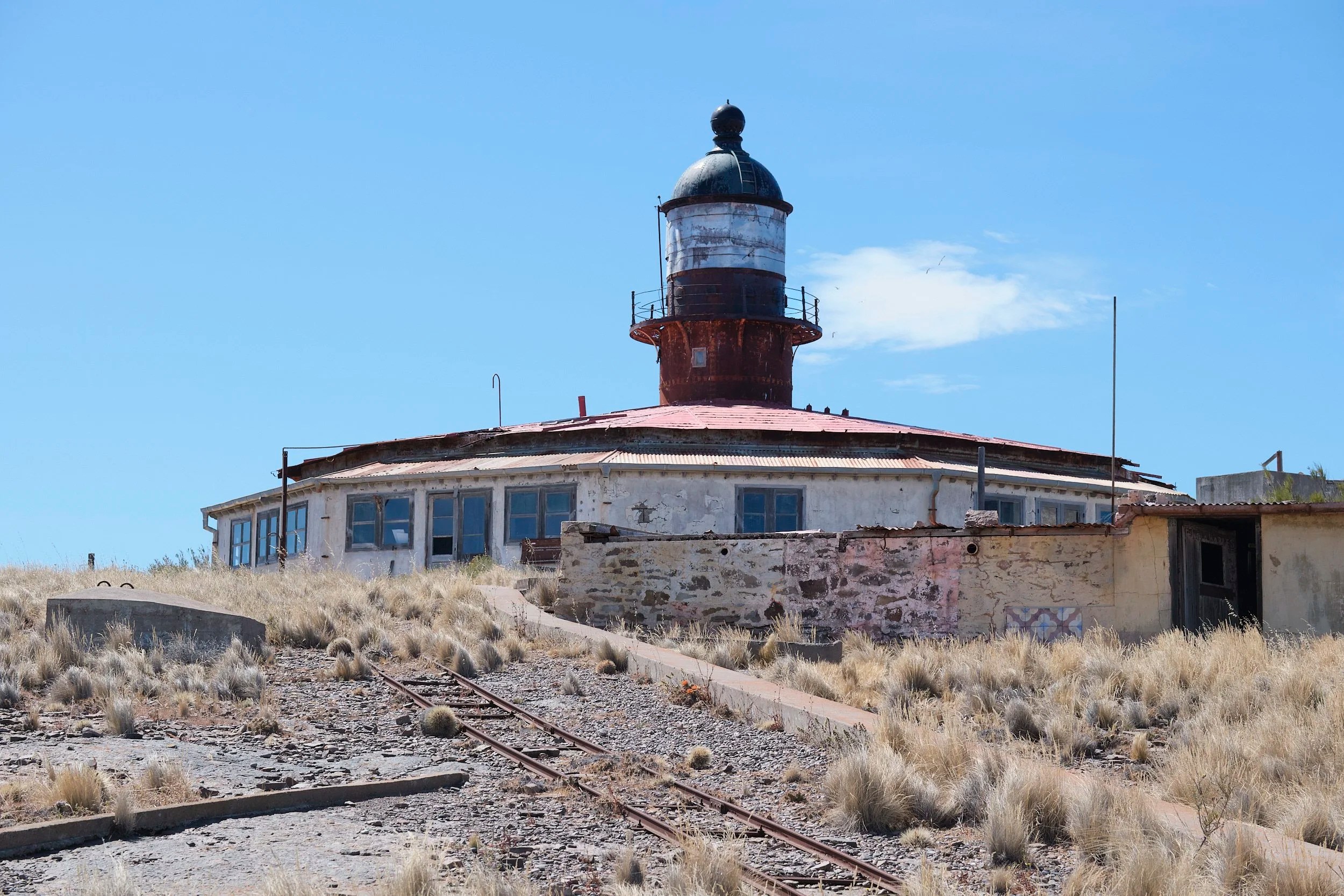
     Abandoned lighthouse
    Abandoned lighthouse

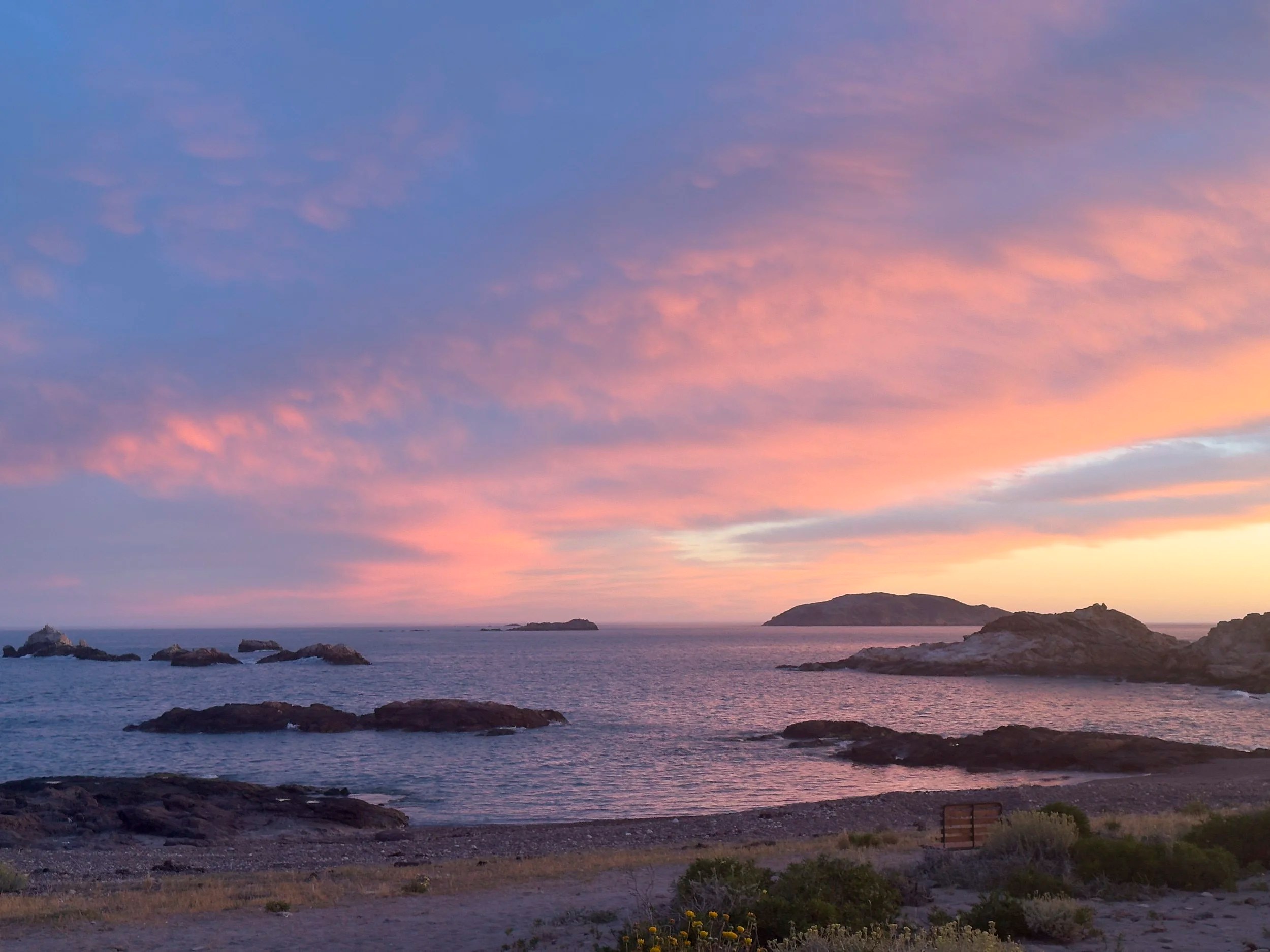
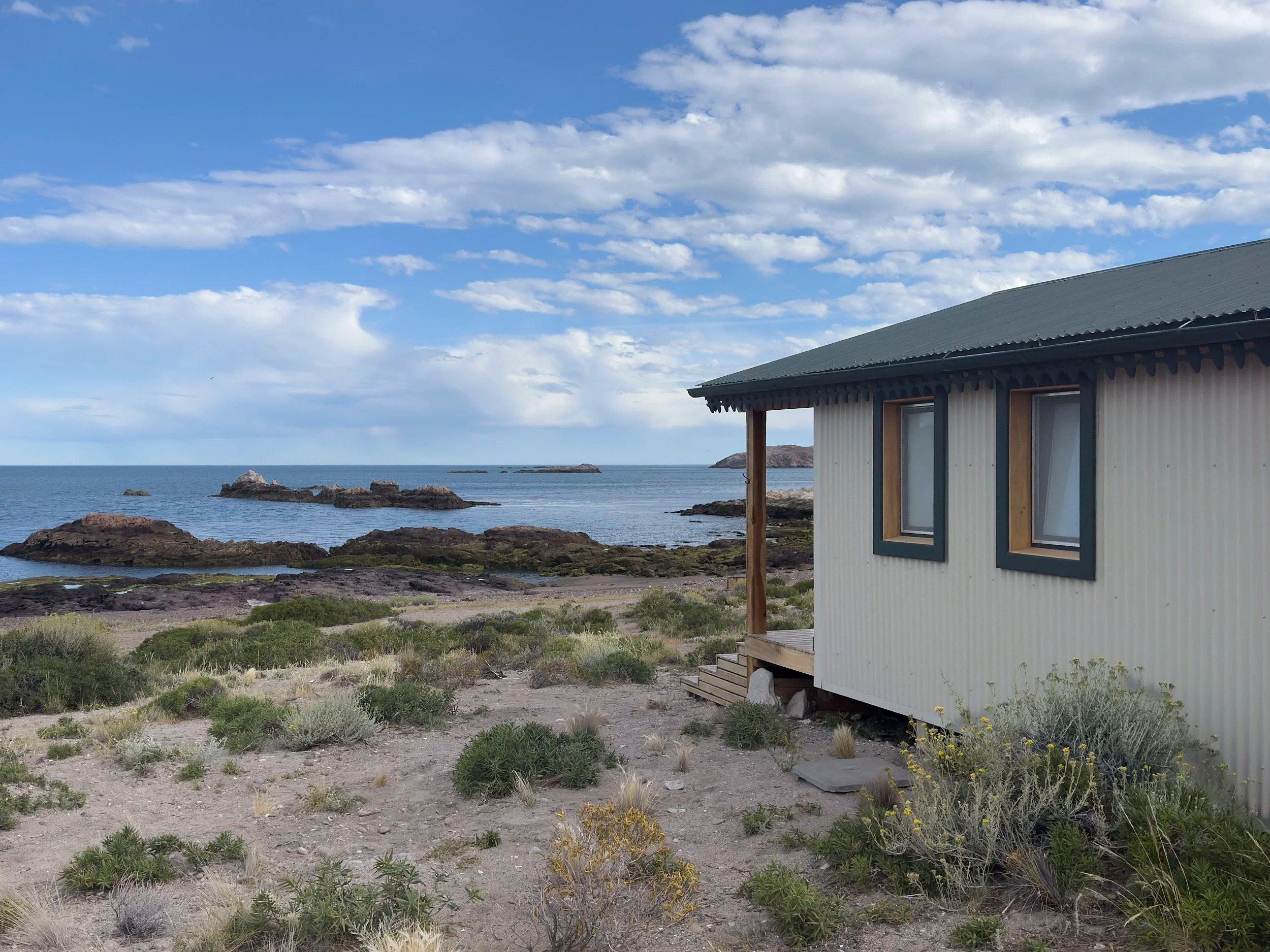
    Saturday, November 23 – Yesterday we drove from the little fishing town of Camarones where we saw the whales and seals, to our present location, Isla Leones eco-camp. Our very new camp, I’ll explain that in a minute, consists of 6 small huts about 30 metres above high water mark on the beach. The only power is provided by solar panels so each hut, like a very clean and comfortable monk’s cell has one small bedside reading lamp, a pair of single beds and no heating. The wind blows ceaselessly and at this time of year the temperature is in the mid-teens C during the day so not warm when the sun goes down or indeed behind a cloud, but I can attest to the fact that the duvet is very warm and my night’s sleep was most pleasant despite the lack of heating.

     Sunrise from our eco huts, Isla Leones camp
    Sunrise from our eco huts, Isla Leones camp

    This new camp has been open for only four months and is the latest addition to a very ambitious program that R and I are learning about called Patagonia Azul which is a part of a large national NGO called Rewilding Argentina, started by Tompkinks Conservation, the foundation created by Douglas and Kristine Tompkins in the early 1990’s. Douglas was the founder of the North Face outdoor clothing and recreational equipment retailer and Douglas, now deceased, and his wife Kristine dedicated their lives to conserving the beauty and biodiversity of Chilean Patagonia. They have been enormously successful in their efforts and in fact when R and I made our road-trip to Chile last year we visited the huge park that they developed, purchasing all the land themselves, and then donated to the Chilean government. as a national park.

    They have now carried the model over to Argentina and are focused on purchasing huge tracts of land formerly used for sheep and cattle farming and creating protected areas in order to re-introduce species that have been driven to the edge of extinction by the agriculture that replaced them. Where we are now and have been for the last couple of days is part of Patagonia Azul, a very large protected area that I’ll tell you more of in future posts, and part of Rewilding Argentina.

     Isla Leones Camp eco hut
    Isla Leones Camp eco hut

    Today was a boat day and the boat and captain from our whale sighting expedition day before yesterday brought his boat down to our camp and we spent a pleasant morning on the water. No excitement today however, our only sightings were a beach full of seals that all dove into the water en masse when we arrived, snorting and grunting, in a melee of lithe bodies. It was like rush hour in the Tokyo subway. Great fun while it lasted but by the time I found my iPhone to try and video it, they had settled into a much more sedate pace.

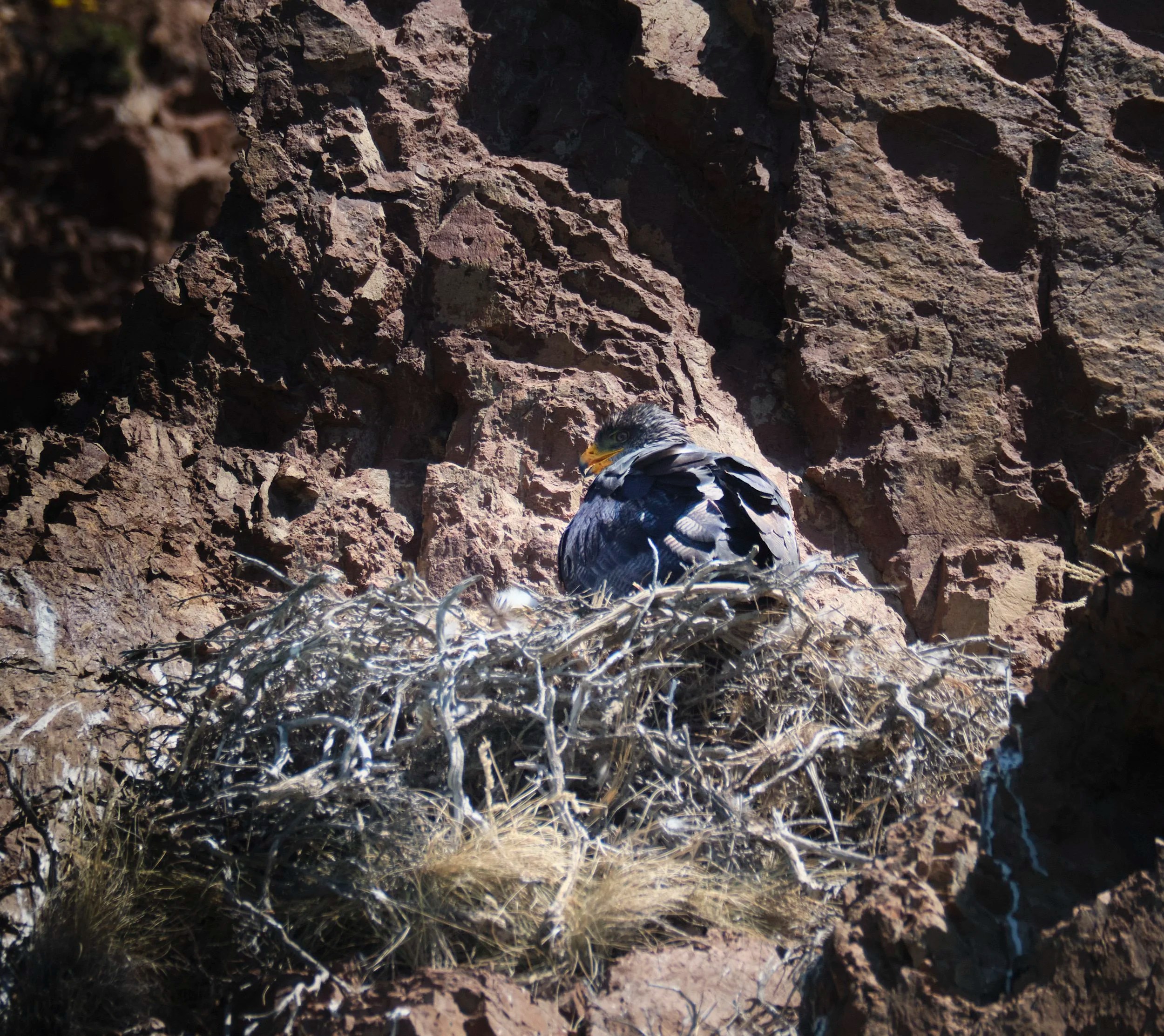
    We did have some bird sightings, a black-chested buzzard eagle in its nest with a tiny chick. However he/she kept its back resolutely turned to us and the chick was only visible by its fuzzy little white top knot. Some days are better than others.

     Black-chested buzzard eagle in its nest with a tiny chick
    Black-chested buzzard eagle in its nest with a tiny chick

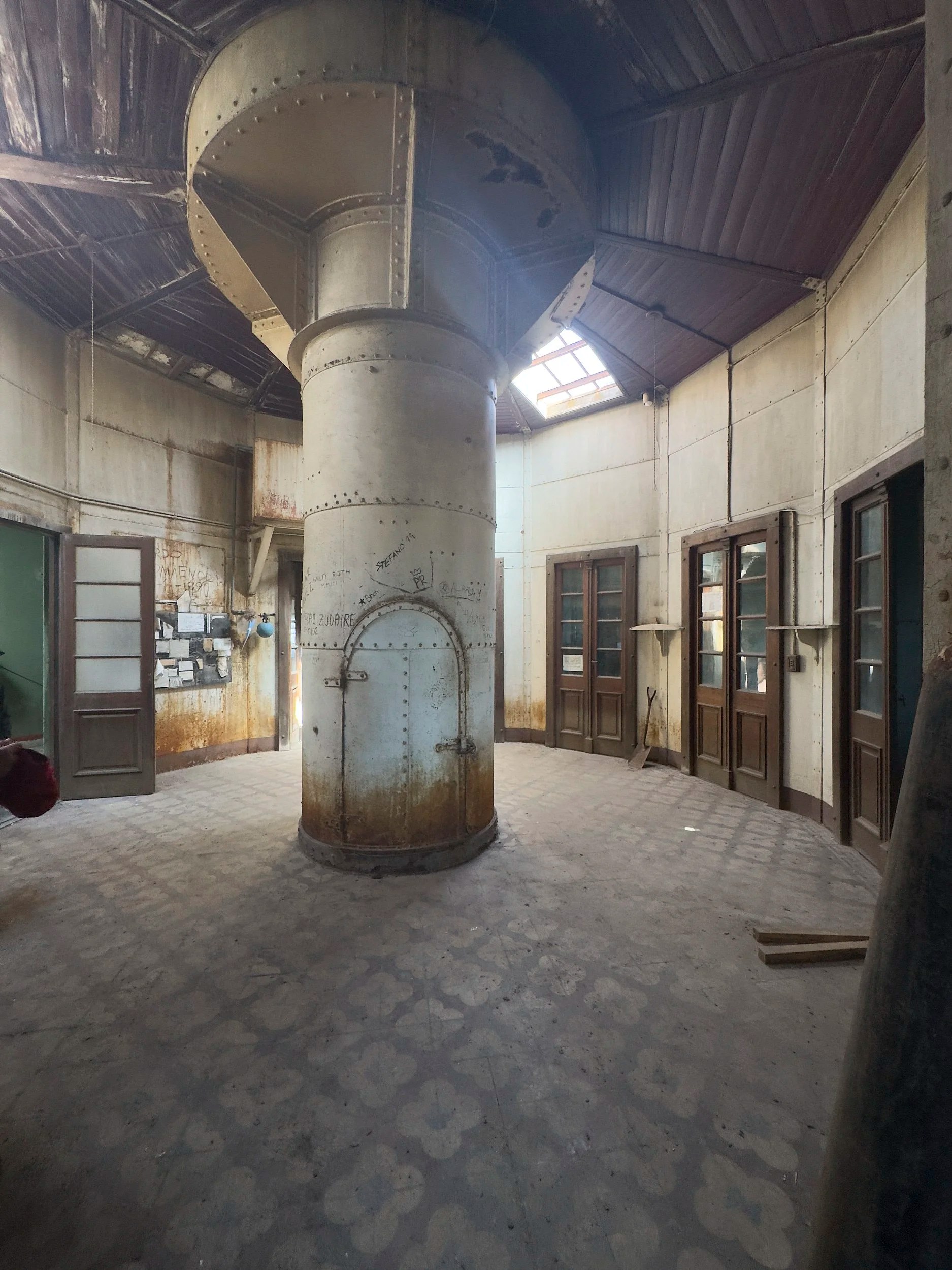
    The most interesting part of the day was the visit to Isla Leones after which this camp is named. Its claim to fame is a lighthouse built in 1915 and de-commissioned in 1968. The derelict structure remains and like all abandoned buildings, it now has much more capacity to invoke feelings and emotions that it ever did in its active prime. It is situated in the middle of the island, at the top of an 80 metre hill and is reached by a stiff uphill 30 minute walk through knee high grasses and shrubs while being besieged by hundreds of tiny non-biting but annoying flys. It was a pleasure to reach the top where the wind was strong enough to blow them away. We spent some time exploring the buildings but the lighthouse was the most interesting with rooms whose lighting was evocative of a Caravaggio painting.

     Abandoned lighthouse room
    Abandoned lighthouse room

    For background, the lighthouse is situated on the Isla Leones after which our camp is named. However the island, translation Island of Lions, is itself well named. As we stood on the summit of the hill on which the lighthouse is located and listened, the sound that the sea made as it crashed and tumbled into the rocks below did indeed sound like lions roaring. Onomatopoeia at its best.

    Another interesting fact that came as a huge surprise to me. I blithely said, looking out to sea from the lighthouse, that if sailing due east there was nothing to bump into until you hit Africa. As I later learned, at our current latitude we are in fact south of all continental land masses except Antartica. We are south of Africa and Australia so that if we sailed due east we would continue in a great circle in the Southern Ocean until we bumped into the coast of Chile. Look at a map!

     Abandoned lighthouse, central pillar is circular staircase leading to the light
    Abandoned lighthouse, central pillar is circular staircase leading to the light

    The most striking aspects of this trip so far has been two-fold, the solitude and the quiet, vast landscapes barren of trees and no sound, no sound to be heard but the ever-present wind soughing its way through the grasses. The second and most noticeable is the absolute lack of tourists and outsiders. At no time, in no hotel nor in any of the places we have visited have we seen another tourist, another person. Only birds, animals and landscapes. Quite amazing.

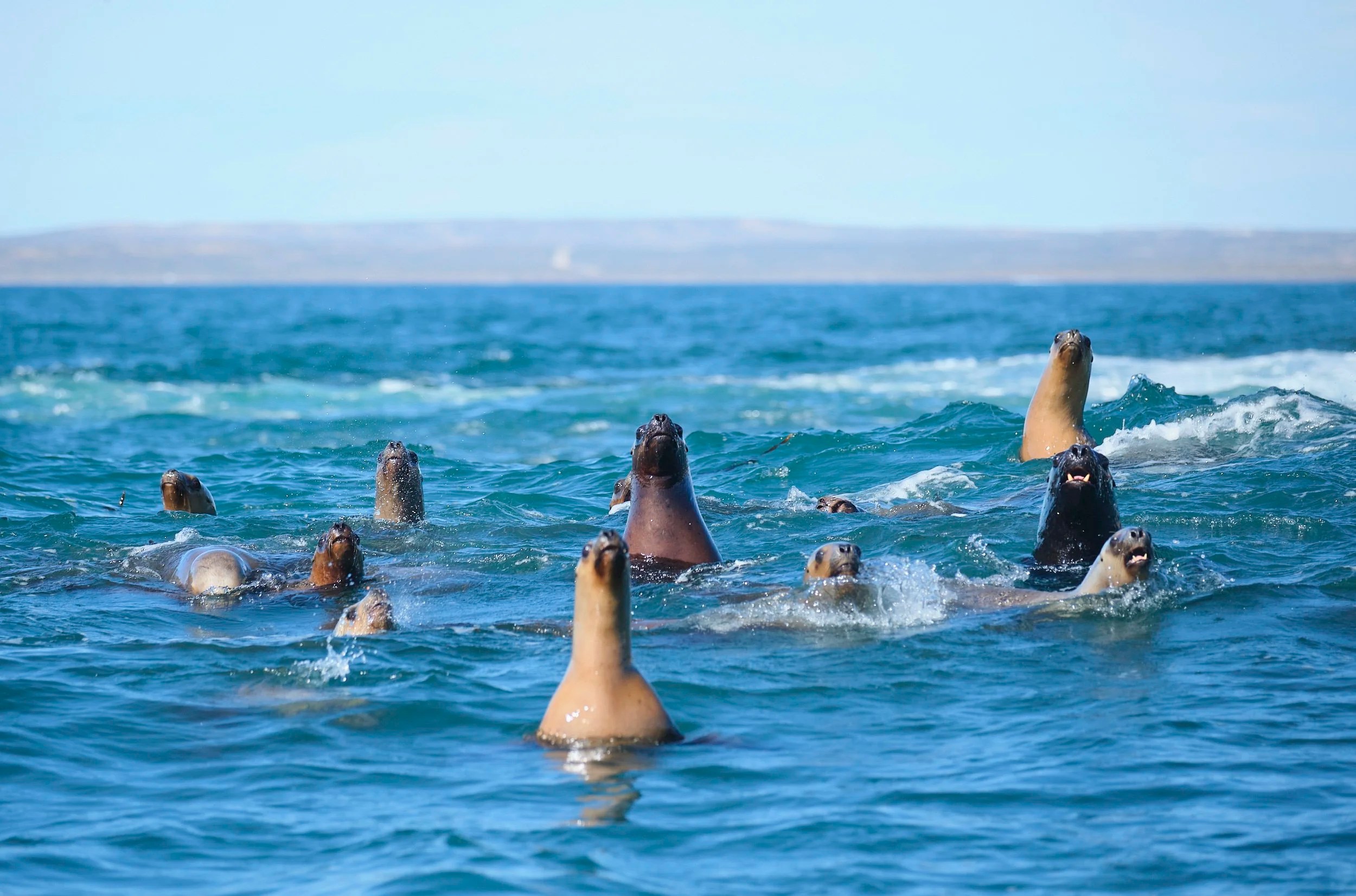
     Back by popular demand, yet more curious seals
    Back by popular demand, yet more curious seals

    Tomorrow we leave for a very long cross-country drive to the Patagonian Andes.

    More to come!
    [ {
    “type”: “highlight”,
    “id”: “56c34348-a68a-4501-83f6-c2b210134ec4”,
    “shape”: “underline”,
    “isFront”: false,
    “isAnimationEnabled”: false,
    “animation”: “draw”,
    “duration”: 0.5,
    “direction”: “right”,
    “color”: {
    “type”: “THEME_COLOR”
    },
    “thickness”: {
    “unit”: “em”,
    “value”: 0.1
    },
    “linecap”: “square”
    } ]

    Click on the map to to follow my route

  • Patagonia – November 22, 2024
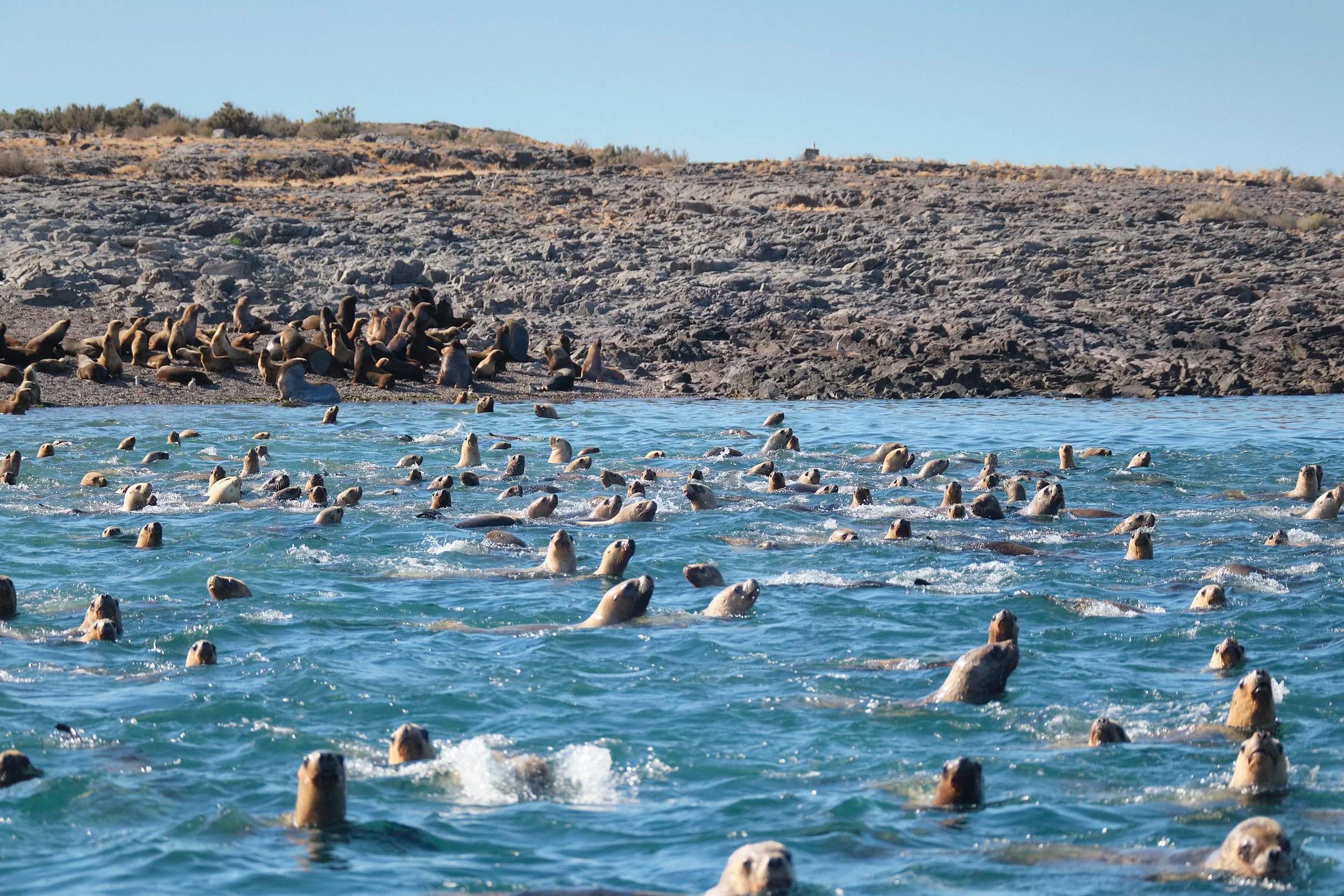
     Curious seals
    Curious seals

    Another long drive yesterday from our parrot beach location to a little fishing village, Camarones, 8 hour’s drive south. We are here for two nights and today we were out in boat seeking out marine animal and bird life. Spectacular day, high blue sky with the ever-present ocean wind taking the heat out of the air. The sea was turquoise and as flat as it ever gets, no white caps but a pleasant little swell, a fabulous day to be out on the water. Coated ourselves with sunblock and headed out in a 16 foot RIB, with two 115hp Yamaha outboards. There were 5 of us aboard, the boat captain, Leo, , a helper/guide and the three of us.

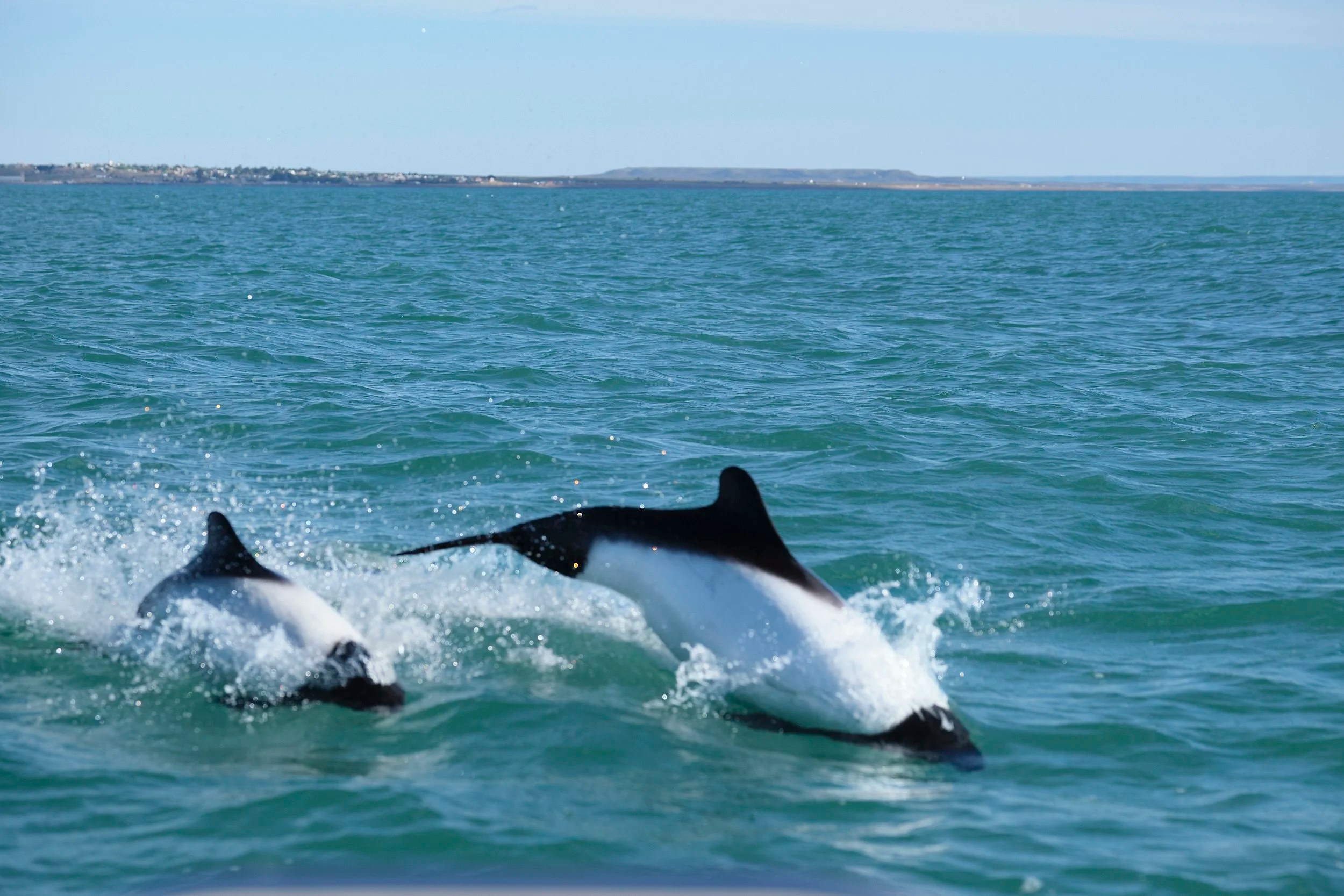
    Some spectacular sightings, most notably a small group of Commerson’s dolphins which look like scaled down Orca, similar colour scheme but smaller in size. As dolphins do they raced ahead of the boat, circled around it and swam like living torpedoes along our side, periodically popping out of the water. Utterly charming.

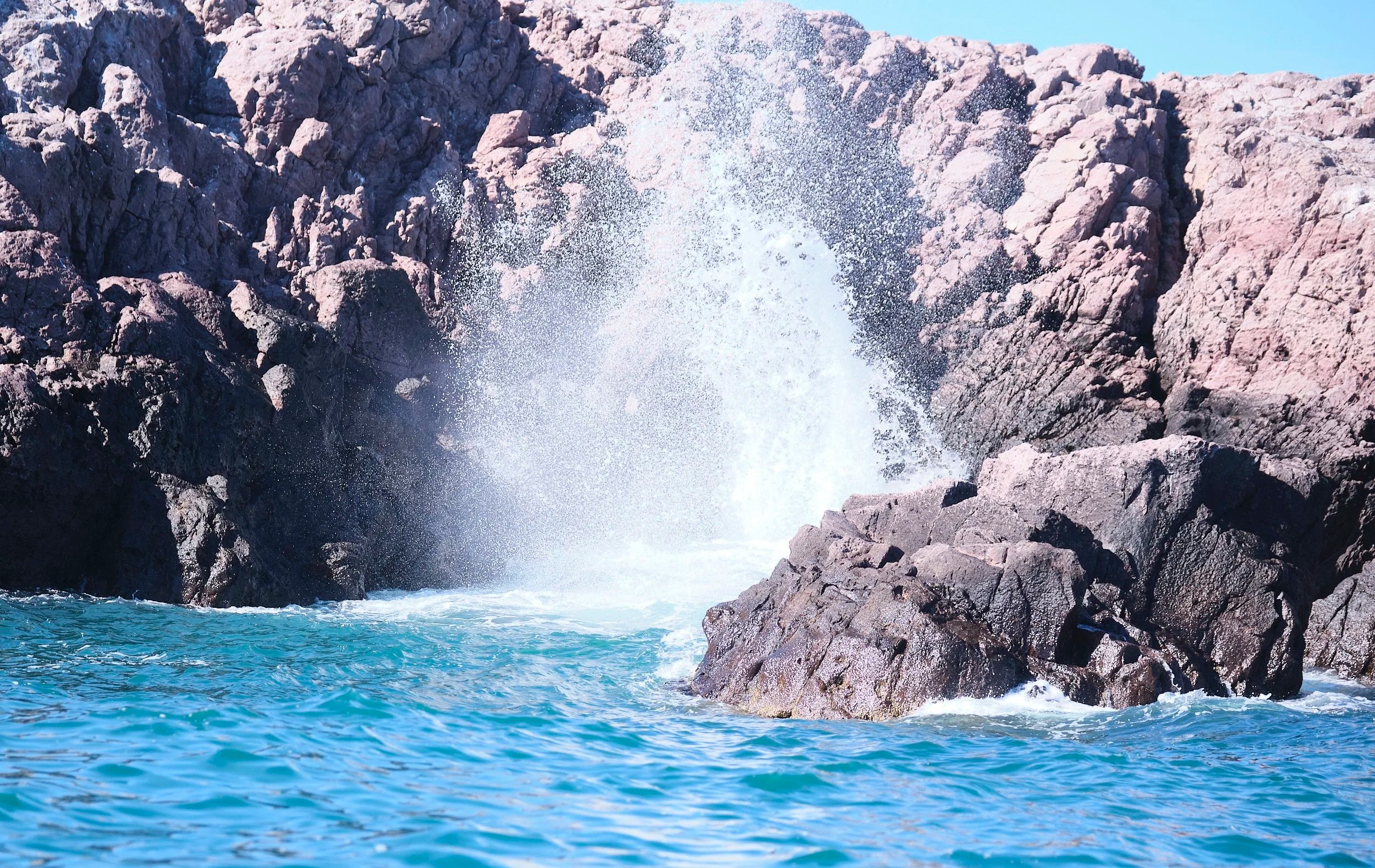
     El Sifón
    El Sifón

    We came across an unusual water feature called El Sifón, the syphon. It consisted of a small cleft in the rocky side of one of the islands which contains a rock in which a hole has worn through over time. When a wave enters the cleft, the force of the wave drives the water through the hole with a whistling roar and a spray fountains out of the hole high in the air. The process is repeated with every wave. Unusual and beautiful.

    A couple of kilometres off-shore are three very low, barren islands populated by the expected checklist of marine mammals and birds. The list is long but many of the usual suspects, seals, sea lions, one gigantic elephant seal and colonies of sea birds, Imperial cormorants, skua, and interestingly, steamer ducks who are flightless. A fabulous display.

     Commerson’s Dolphins
    Commerson’s Dolphins

    We spent a couple of hours just slowly cruising through the area watching and enjoying the spectacle as they in turn watched and enjoyed our antics.

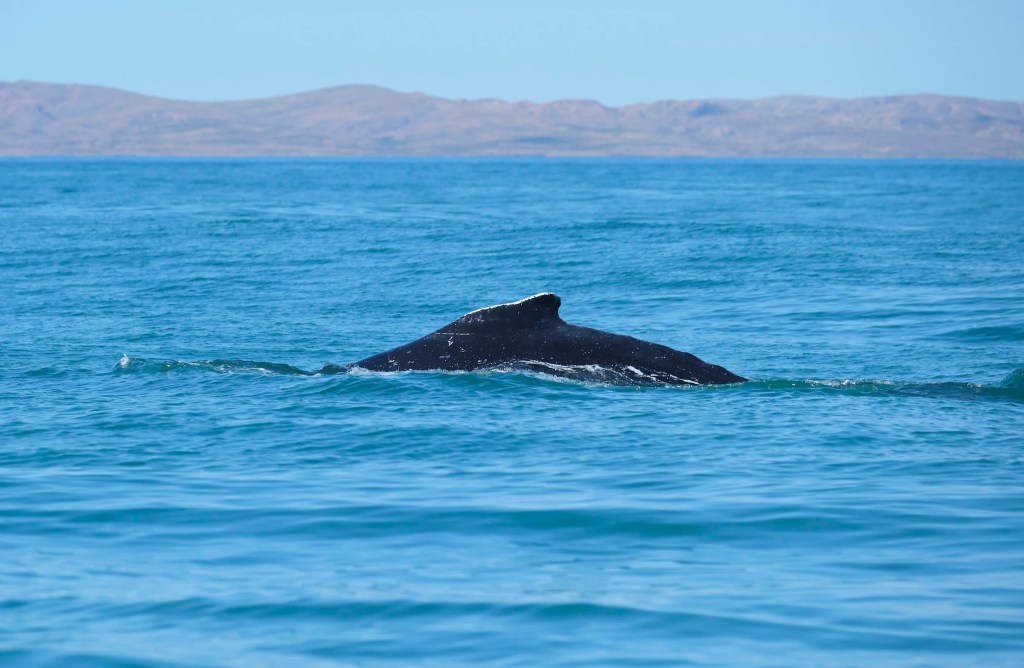
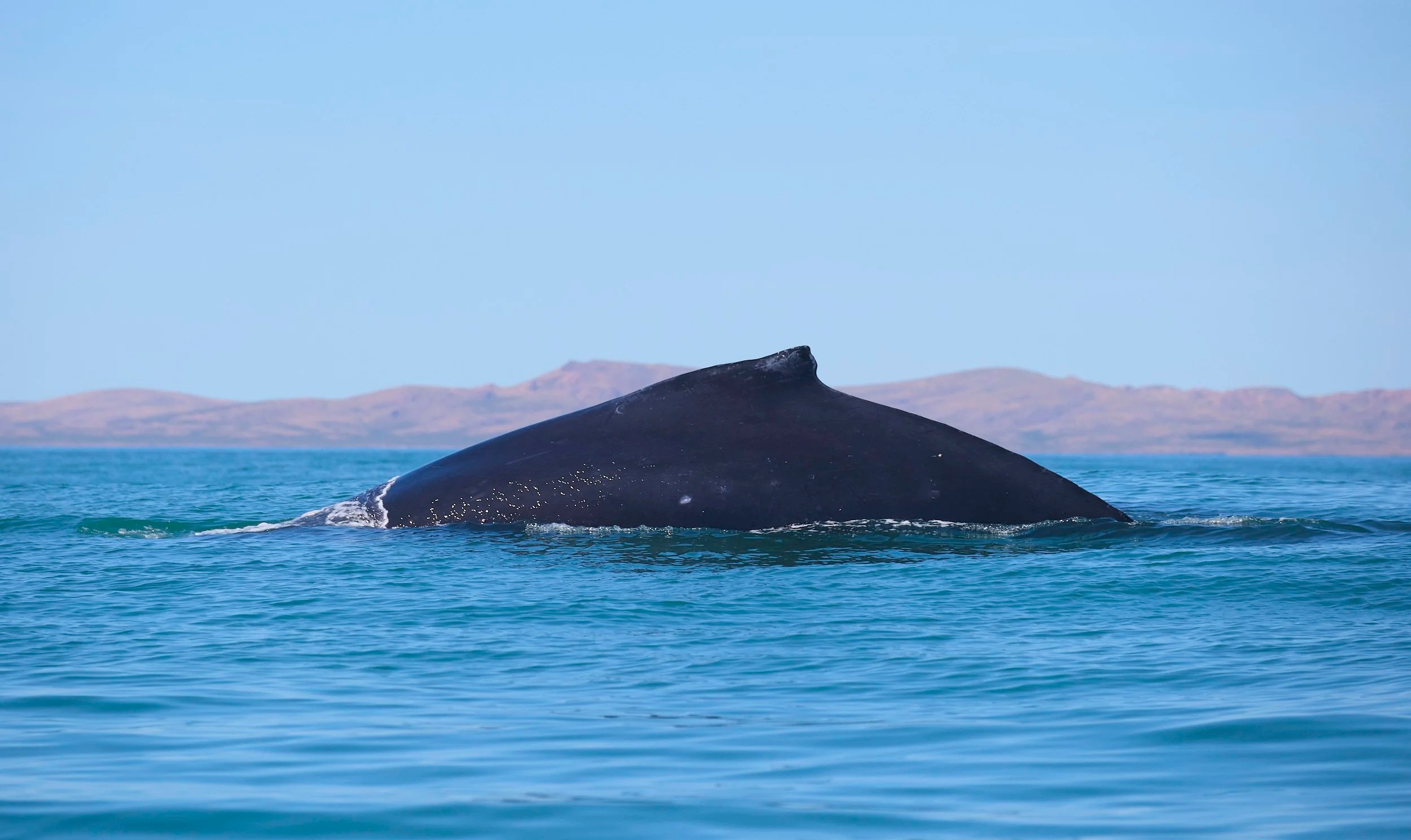
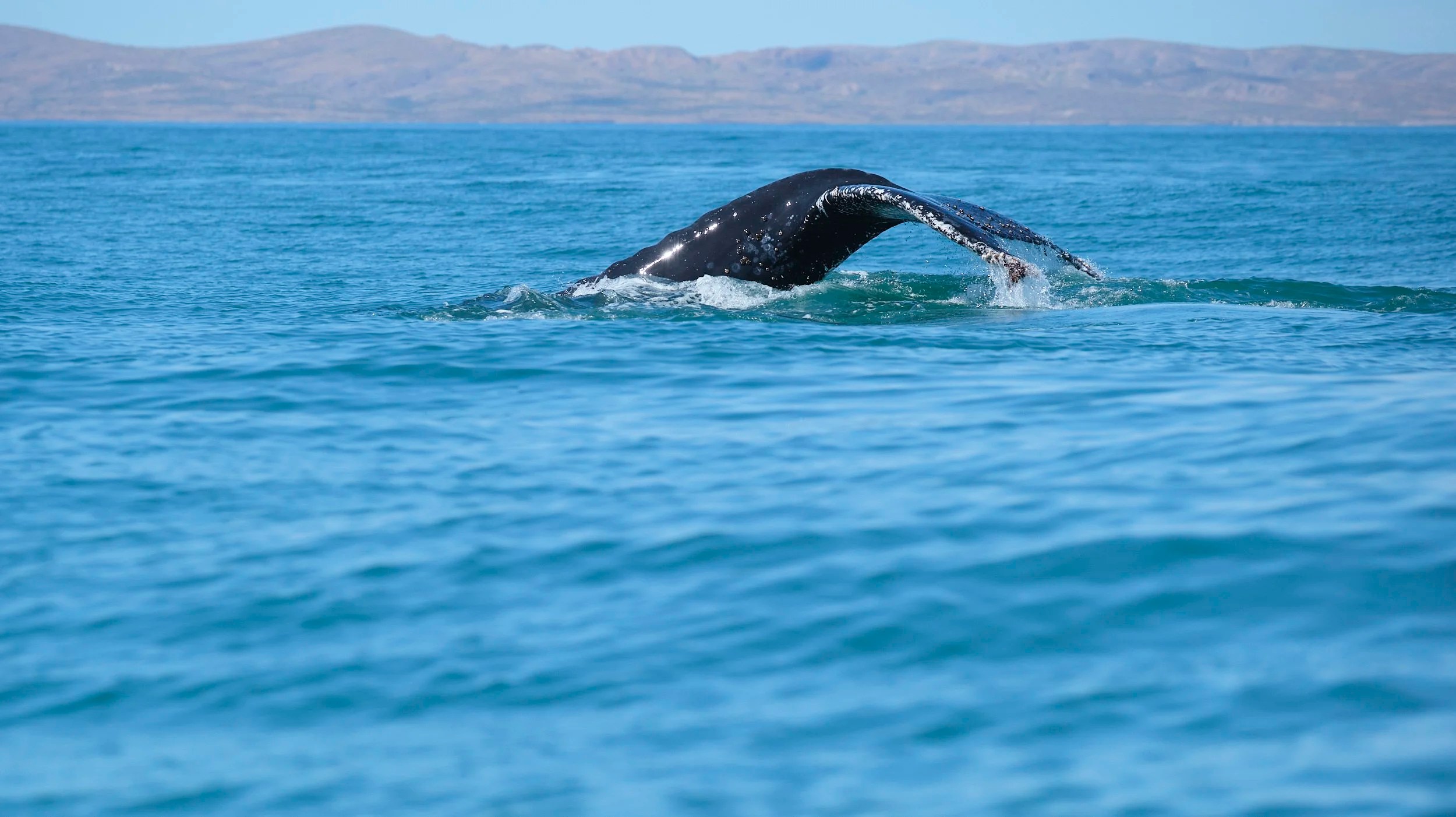
    Our boat captain took us to some open sea where he hoped that we would find more Commerson’s dolphins, watch and enjoy and then put the boat into idle and have some lunch. To set some context, while the itinerary was being developed I asked if we would have a chance to see any whales on this trip. I was told no, the chances were slim to none because of the season and the location. Imagine our surprise when we saw, arising from the sea a huge creature and the captain shouted, whale. There were in fact two humpback whales who circled the boat, periodically coming to the surface, blowing and then up tail into a dive.

     Humpback Whale
    Humpback Whale

    While we ate empanadas made by the captain’s mother we watched the whales slowly swim out to sea, having made our day.

    Fabulous day at sea!

     Humpback Whale
    Humpback Whale

    More to come!
    [ {
    “type”: “highlight”,
    “id”: “56c34348-a68a-4501-83f6-c2b210134ec4”,
    “shape”: “underline”,
    “isFront”: false,
    “isAnimationEnabled”: false,
    “animation”: “draw”,
    “duration”: 0.5,
    “direction”: “right”,
    “color”: {
    “type”: “THEME_COLOR”
    },
    “thickness”: {
    “unit”: “em”,
    “value”: 0.1
    },
    “linecap”: “square”
    } ]

    Click on the map to to follow my route

  • Patagonia – November 21, 2024
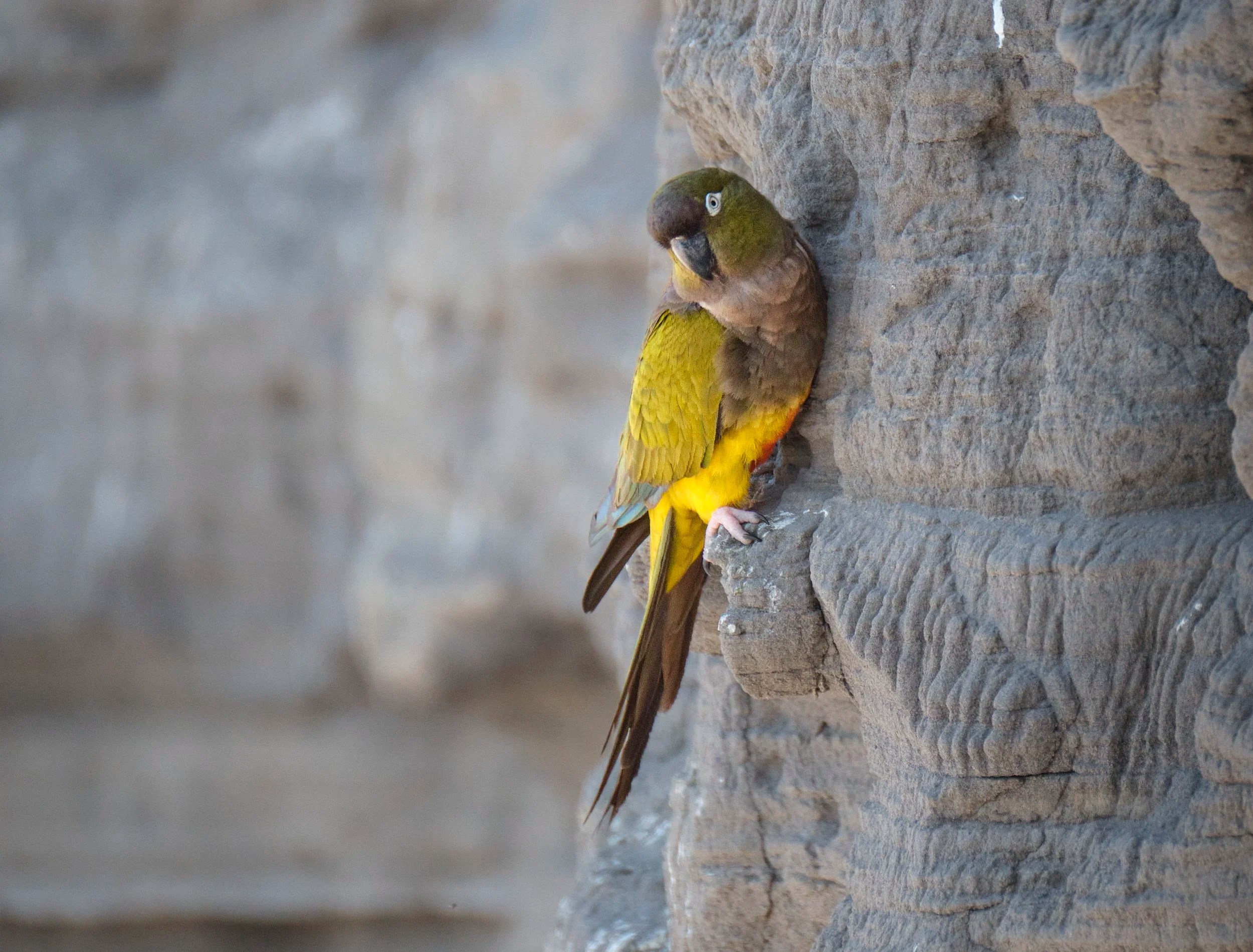
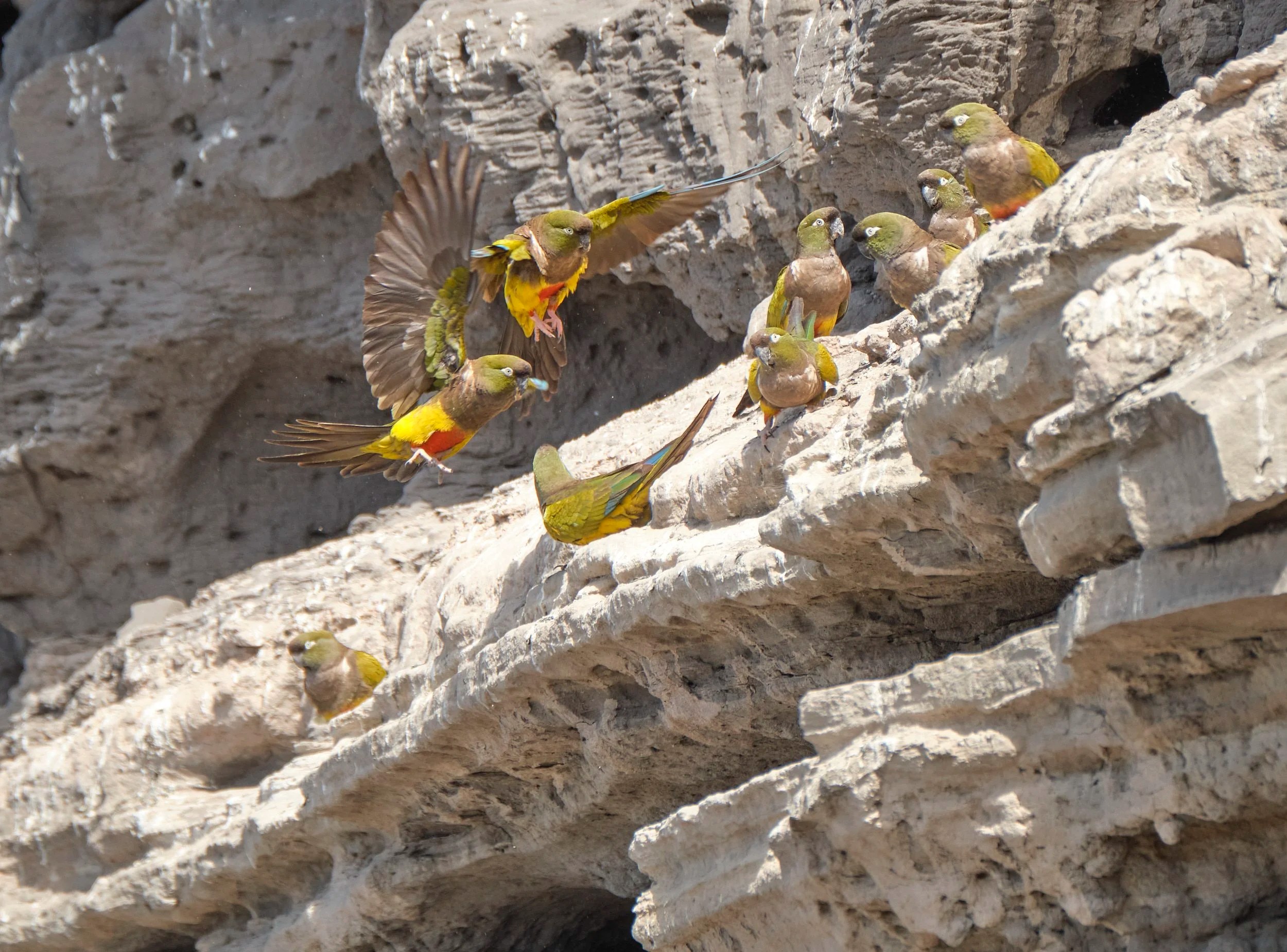
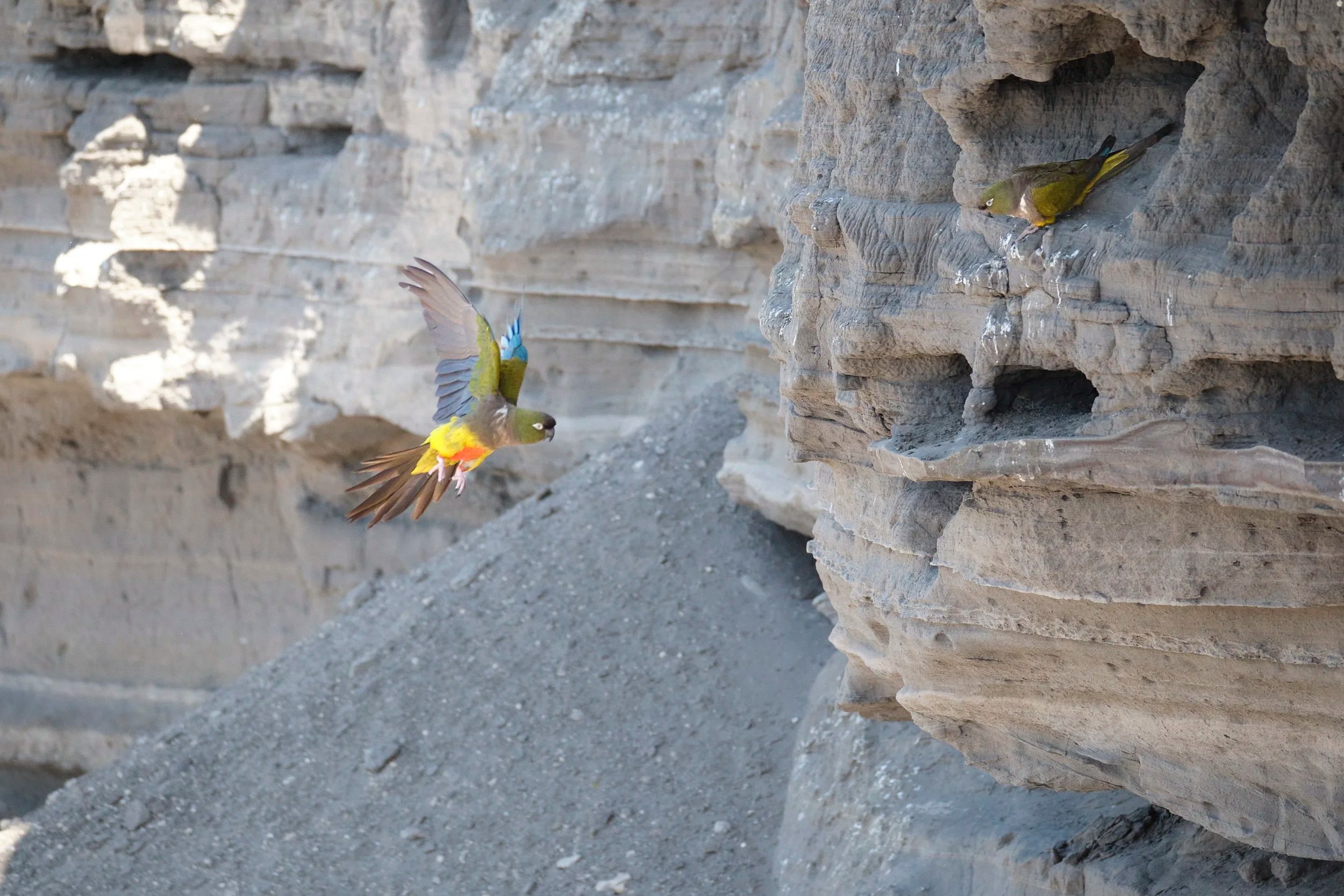
     Burrowing Parrot, cliffside
    Burrowing Parrot, cliffside

    Arrived in BA on Saturday Nov 16. Met up with Robert, shared dinner and then I collapsed in bed at 9:30, having had vey little sleep the previous couple of nights, Toby and then an overnight flight. Awake at 9am and although a solid 11+ hours of sleep, still not feeling very rested.

    I always love coming to BA, a city I really enjoy, but there was steady drizzle all day so R and I passed the afternoon away chatting in the coffee shop awaiting our pickup from Hugh, the owner of MacDermott’s Argentina. Hugh has prepared trips for me/us in the past, most recently in 2023, when he organized the trip that R and I took to Chile when we drove the Carretera Austral. I cannot recommend Hugh and his company highly enough. He is a very interesting man, has lived a truly adventurous life, is a fascinating conversationalist, well-read and a great planner and organizer. For R and I one of the highlights of the trip is the fact that Hugh has decided that he will personally guide us rather than arrange for someone to do it for us, so it should be a particularly special adventure.

    This trip has had many iterations, we had originally planned to travel in April or May and drive from the tip of South America up through Patagonia and the Andes. However we had to change the timing, now in November, and we are now travelling in the southern hemisphere spring rather than the fall. As a result we now need to start in the warmest part of the country and drive south as Patagonia begins to emerge from winter and warm up.

    Hugh has found some very interesting places, well off the normal itinerary so rather than a straight run down the country we will be working our way over to and down the Atlantic coast to some newly developed eco-parks and re-wilding areas. Then over to the Patagonian highlands where, amongst other things, we will be tracking wildlife and, in particular, puma.

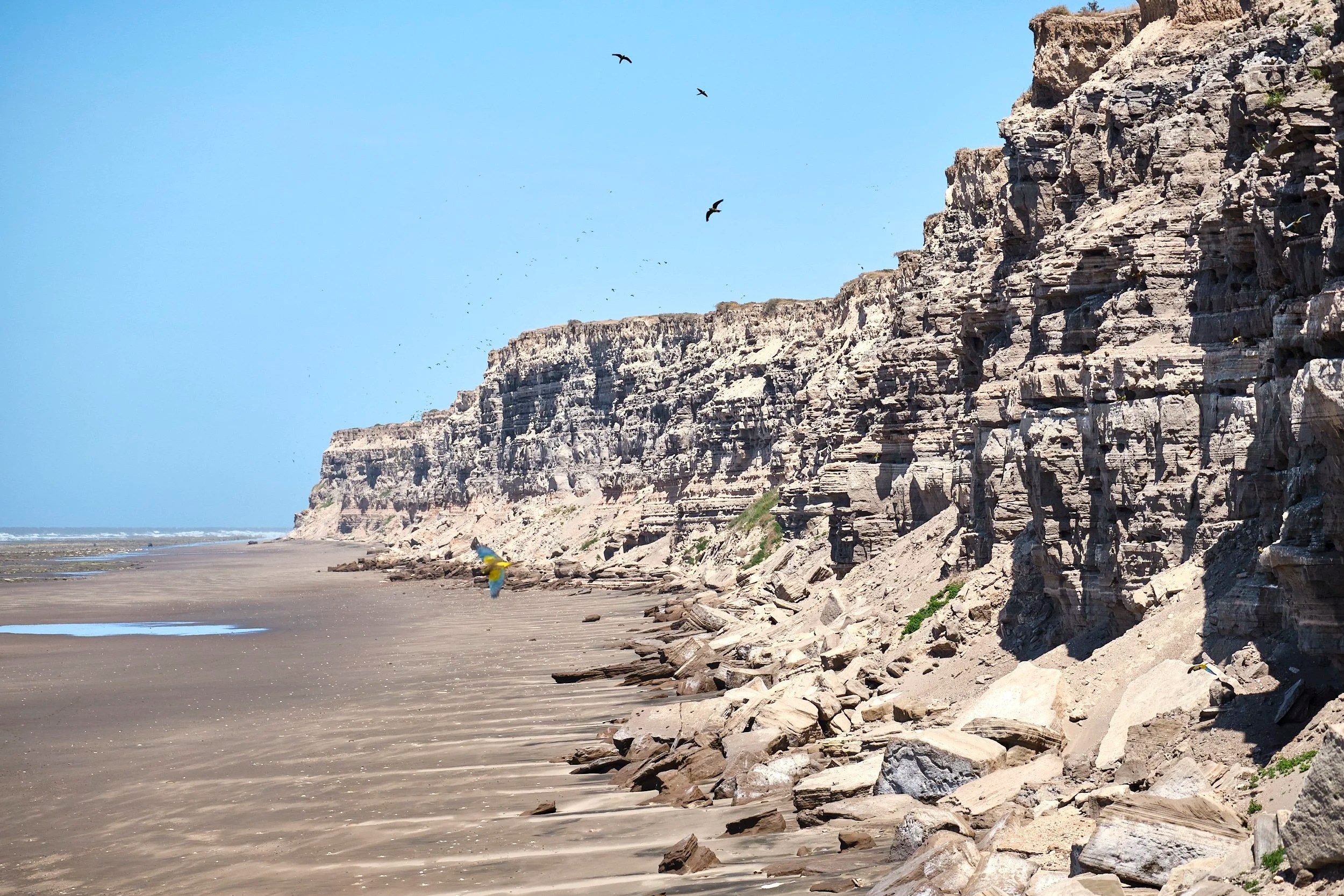
     Parrot Beach Coastline
    Parrot Beach Coastline

    Sunday Nov 17 – To begin our trip Hugh has invited us to spend our departure night at his house so that we can get an early start and be off at 6am on Monday morning. Great dinner and an early bed.

    Monday Nov 18 – a long 12+ hour’s drive south to an interesting section of the Atlantic coast of Patagonia. Arrived at our very pleasant hotel, Casa Crespo, in the little town of Carmen de Patagonia, at 7pm. Good dinner and in the evergreen phrase of Samuel Pepys ‘and so to bed’.

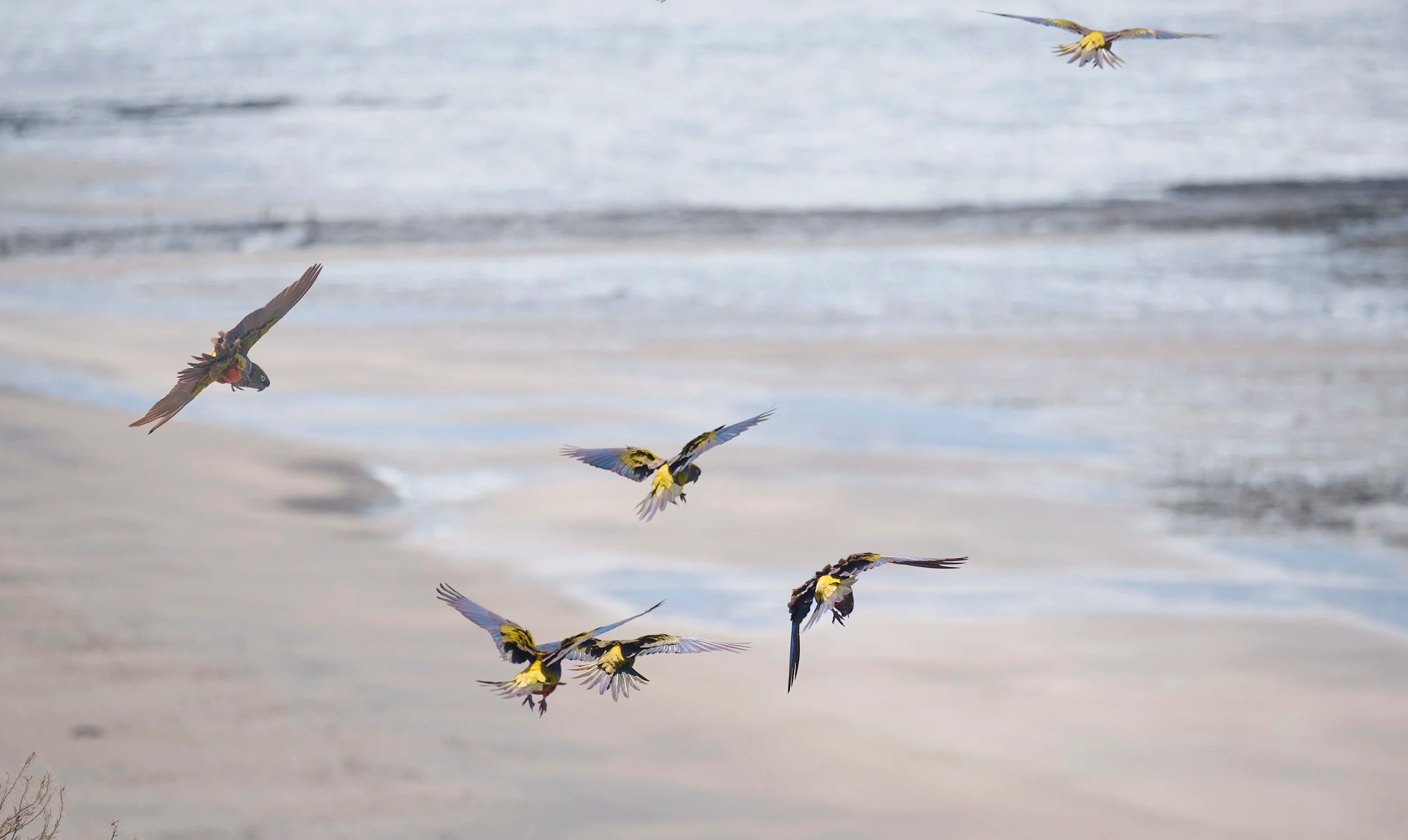
     Burrowing Parrots in flight
    Burrowing Parrots in flight

    Tuesday Nov 19 – Today the trip really kicked off. After breakfast we drove to the little town of Balneario el Condor about half an hour from our hotel. It is situated on the ocean and extending from the edge of the town there are 18 kilometres of high sandstone cliffs filled with thousands of holes pecked and scratched into the crumbling sandstone by thousands of burrowing parrots. Barranquero parrots are a genetically distinct species of parrot once widespread throughout South America but now sadly in decline. These cliffs are the largest breeding ground of these parrots left in the world. It is estimated that there are currently over 37,000 active nests along the 18 kilometres of cliff-side. Since each nest contains 2 parents and 3 chicks on average, the number of birds is staggering.

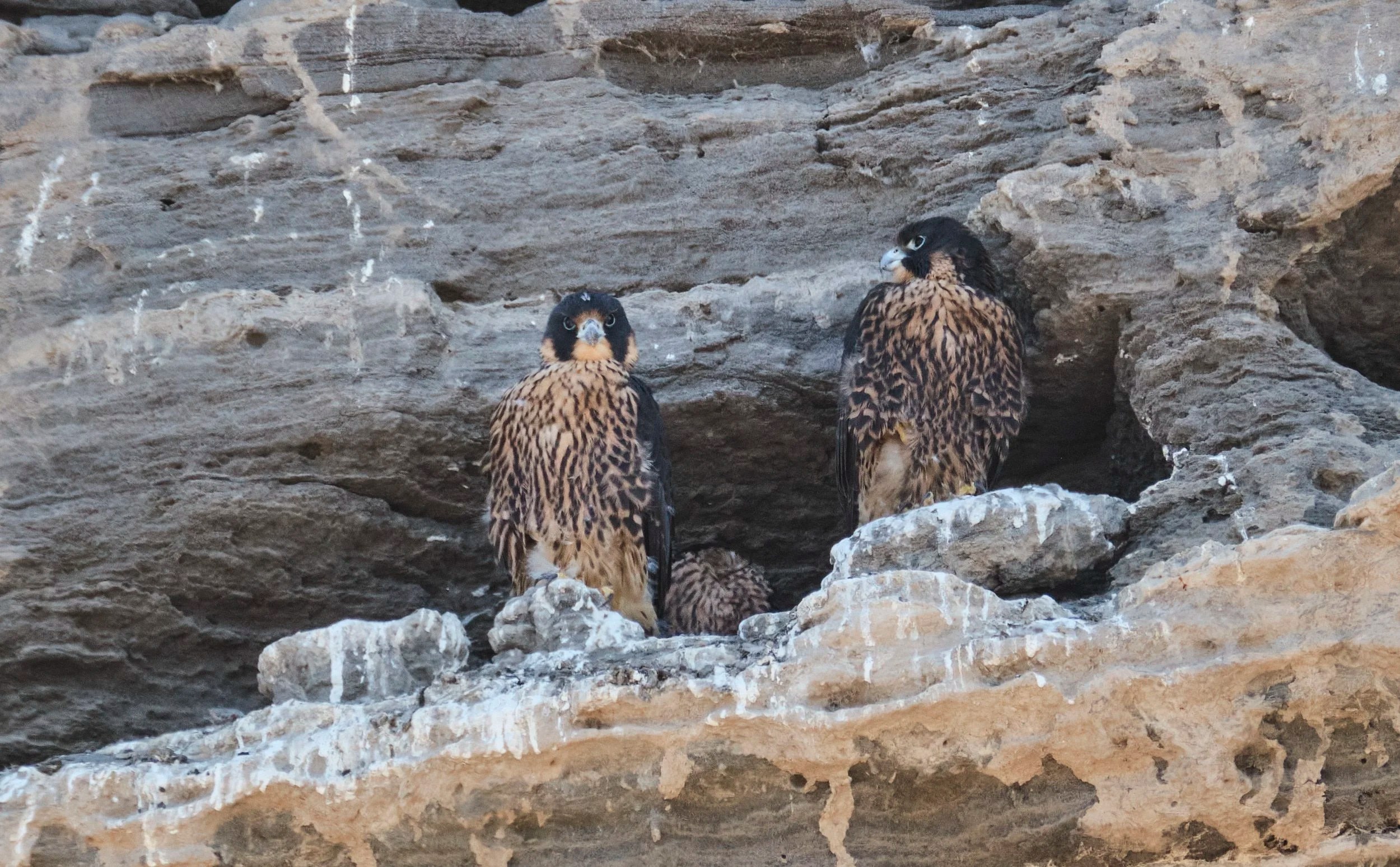
    We were met by Mauritsio, a scientist and educator, who has worked with the birds for many years and has been part of a group of research scientists who have published many books and scientific papers on the unique qualities of the breed. Mauritsio spent the morning and early afternoon with us as we walked the beach watching and learning about these birds. Our time was limited as the tide was beginning to make and it can create a very powerful sea when driven by a south wind, which it was that day. After a walk of about 1k along the beach studying the parrots and some of their predators, including a nest with 3 peregrine falcon chicks, we returned and reached the steps up the cliff side just as the water was beginning to wet our shoes.

    The parrots are beautiful, noisy and fascinating to watch. While great flocks of them can lift into the air at once, you immediately notice that the flock is composed of hundreds of distinct pairs of birds. They are socially monogamous as are many other species but almost unique among life on our planet, they are genetically monogamous as well, so pair bonds are never broken. If one partner dies, the other survives as a widow or widower. Since their expected life in the wild is about 20 years, and their pair relationship is so strong it can be very difficult for the surviving partner, sound familiar? They are touchingly intimate with each other, touching beaks and continually watching and looking for each other.

    Their diet is seeds and small fruit but much of their natural habitat is rapidly disappearing, as not surprisingly, they are not well-loved by local farmers. In many cases large flocks of birds have been tracked flying total distances of 260 kilometres a day to find food for themselves and their chicks.

    Darwin on his Beagle voyage visited the parrot beach in 1833, although hardly the same beach since it was 2 kilometres further east than its present location. The power of the sea and the very soft sandstone of the local geology means that in the intervening 190 years the coastline has lost thousands of square kilometres of its landmass.

    Because the sandstone cliffs are reasonably soft, there are periodic falls as the front edges of sections of the cliff carry away, no doubt weakened by the burrows, and many birds are killed. However the birds seem genetically predisposed to dig and once their feathers appear the chicks too begin to dig and enlarge their tunnels which can extend a metre or more back into the cliff. Their predators are not limited to flying foes, since, as we walked along the top of the cliffs we found holes dug by armadillos who dig down and enter breeding tunnels from the back to take eggs from the nests.

     Peregrine Falcon chicks ready to fledge
    Peregrine Falcon chicks ready to fledge

    Walking along the beach, masses of fallen cliff face are evident as piles of rubble along the foot of the cliffs. Interestingly, one of the benefits of the continually decaying sandstone cliffs is that with each cliff fall new sheets of fallen sandstone reveal clear tracks of pre-historic birds and animals which quickly weather away over the course of months to be replaced by new rock falls and new sets of tracks. Scientists have come from around the world to study these tracks which have been determined to be slightly older than 2 million years.

    R and I were both captivated by the beach and cliffs and these fascinating birds and by their unusual adaptations. A fabulous day!
    [ {
    “type”: “highlight”,
    “id”: “56c34348-a68a-4501-83f6-c2b210134ec4”,
    “shape”: “underline”,
    “isFront”: false,
    “isAnimationEnabled”: false,
    “animation”: “draw”,
    “duration”: 0.5,
    “direction”: “right”,
    “color”: {
    “type”: “THEME_COLOR”
    },
    “thickness”: {
    “unit”: “em”,
    “value”: 0.1
    },
    “linecap”: “square”
    } ]

    Click on the map to to follow my route