• Ethiopia – Days 14 & 15
    Bottle flowers
    Bottle flowers
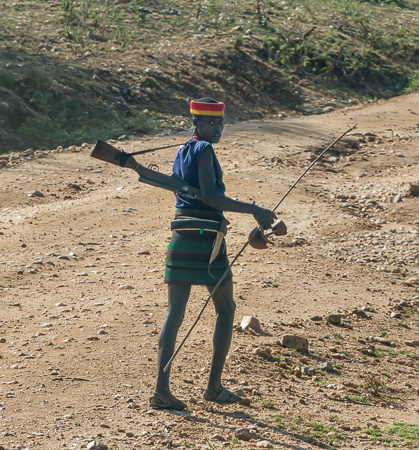
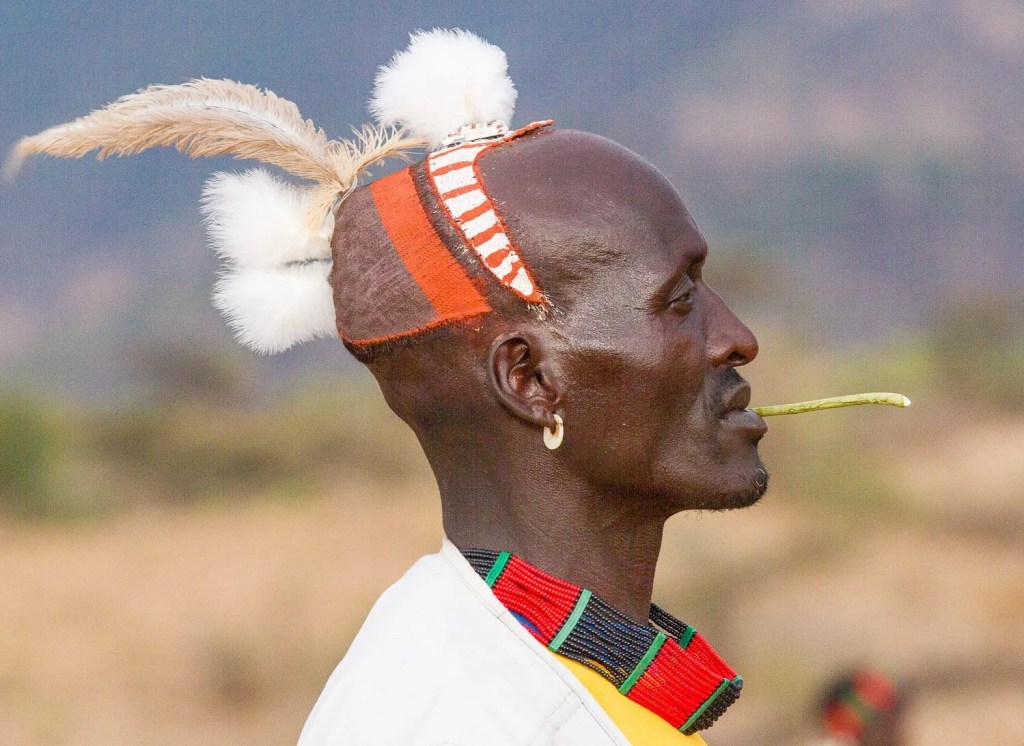
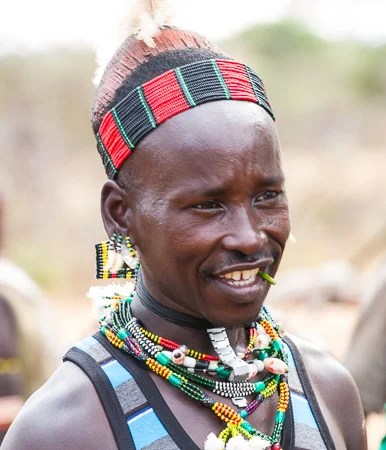
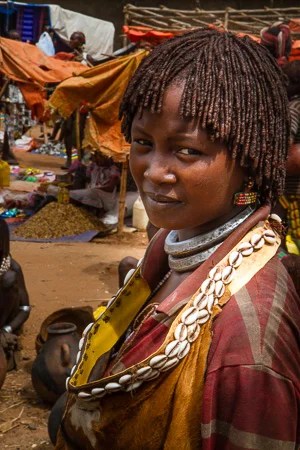
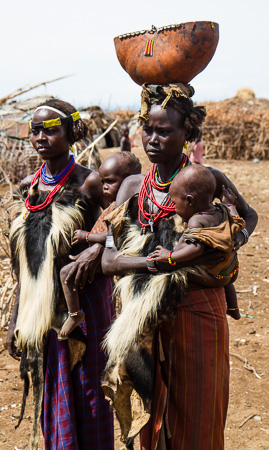
     Dasanach people
    Dasanach people

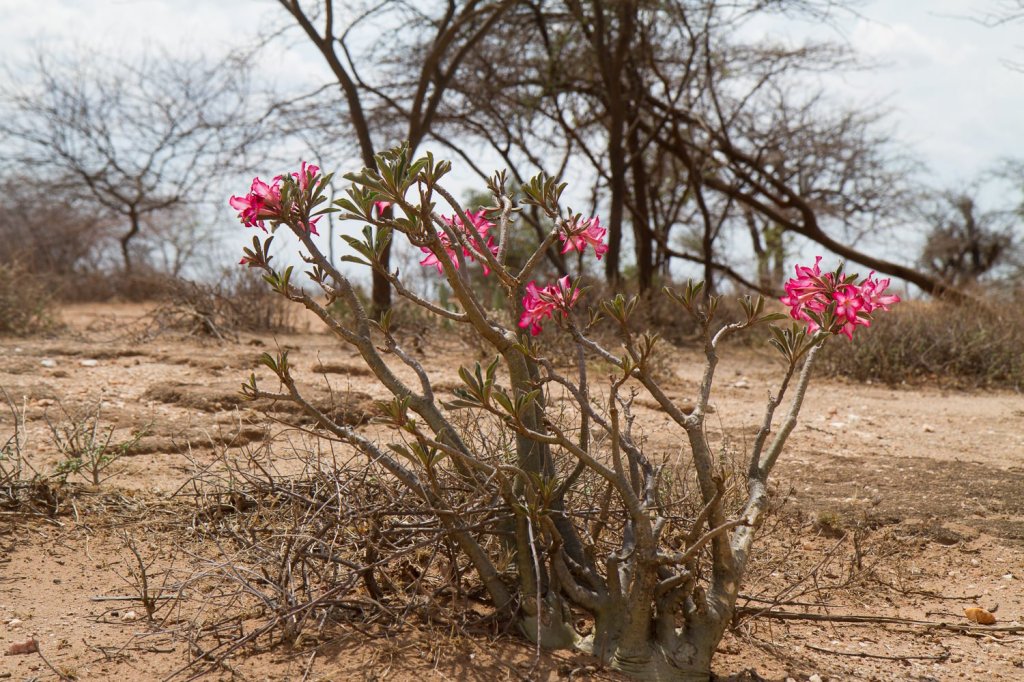
    Early out of Murelle and back up to Paradise Lodge on our way back north to Addis. Retraced our route through the trackless, well barely, rough, dry, scrubby desert country. This is a region of termite mounds which are scattered in surprisingly large numbers across the countryside in addition to something else that fascinated me. This was the presence of a flower called by the locals a bottle flower, blooming in large numbers on a plant whose stem was smooth and gray and somewhat bottle-shaped, which like the termite mounds, were scattered throughout the dry scrub. It was wonderful to chug through the scrubby desert landscape and then be confronted by a 2 or 3 metre high termite mound or even more surprisingly, a burst of beautiful waxy flowers covering a virtually leafless small tree, carmine at their petal edges shading through pinks to a brilliant white in the heart of the flower. I drove our poor driver crazy as I continually asked him to stop whenever we found a fresh specimen for me to photograph, temperature in the 40’s and no-one wanted to stop, but…. Stunning.
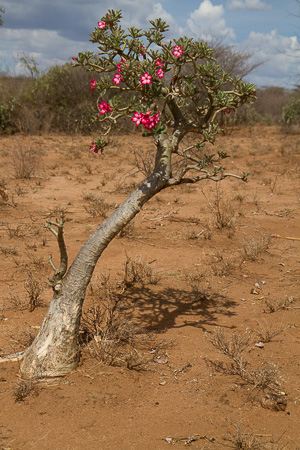
    Bottle flowers
    Bottle flowers

    Arrived at Paradise Lodge late in the day, and fortunately had remembered that instead of asking for a double bed we should ask for twin beds as standard practice. This almost guarantees a larger room and more space to manoeuvre and to put suitcases and cameras. Worked like a charm again and our room at the Paradise was substantially larger and more comfortable than on our previous visit.

    The hotel’s restaurant is built on the edge of a highland plateau looking towards the Bridge of God and the two rift valley lakes stretching out across the horizon about 500 metres below. At the back of the restaurant is a terrace with a railing that stretches to the very edge of the plateau and a couple of steps down from it are two little private terraces, big enough for only a table and a couple of chairs with a stunning and unobstructed view across to the lakes and mountains. After check-in and on our way to our rooms I stopped in the restaurant and asked them to reserve one of the little terraces for V and I, so we drifted up there as the sun was setting to find a freshly laid table and two comfortable chairs waiting for us. We have been restricted to beer for the most part of the trip since wine is both vile and expensive and imported wines are prohibitive and yes, Ethiopia does produce its own wines. This evening there were some South African wines available and the view and the evening were so stunning that we decided to pull out all the stops. Wines were not available by the glass but if you selected the bottle they would sell you a glass by charging 1/5 of the cost of the bottle and then filling the glass to the brim. We ate a pleasant, not particularly memorable meal helped along its way by 3 glasses each of very drinkable white for V and red for me.

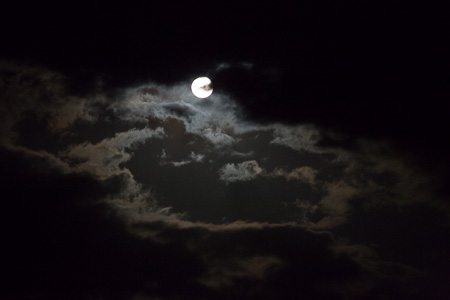
    Full moon rising over the mountains and so back to our room where we sat on our veranda and tried to handhold some 1/2 second moon shots, not successful but with the wine couldn’t have mattered less. Forgot to mention that yesterday we visited a village of the Karo people, a tribe that I’m sure most readers of National Geographic will recognize as they decorate their faces and bodies with white painted designs, the paint being made from white limestone that the women grind to a powder and mix with water. A large village of many very neat tukuls surrounded by a thorn enclosure to keep out predators. The village is situated on a bluff about 150 metres above a bend in the Omo River and stretching out for a great distance towards the mountains on the other side of the Rift Valley was a lush, flat delta, perfect for agriculture. The land is jealously guarded from incursions by neighbouring tribes who raid cattle and I was told by our village guide, a very articulate young guy who was going to be jumping his bulls at the next festival, that AK47’s are involved and shots are fired in anger.
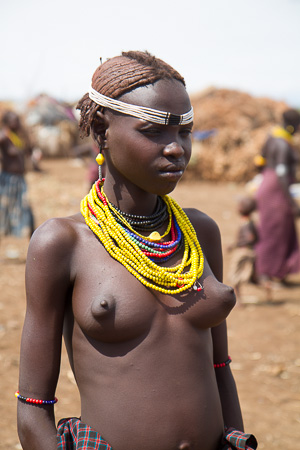
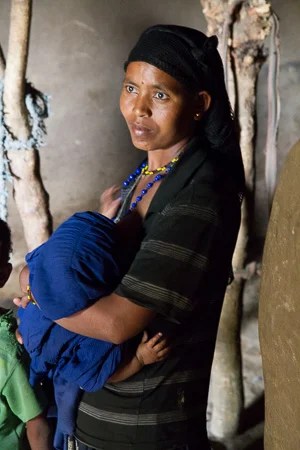
    Dasanach woman
    Dasanach woman

    More surprisingly, we learned that the rich delta land that the tribe used to grow their crops was being leased to Turkish investors to grow tobacco. When I asked why they would do that, was it for the rents that the tribal community would receive, I was told that they will receive no rents as the monies will go to the local government but that the Turkish firm would provide employment to the tribespeople as farm workers. I could have wept; from independent pastoralists with their own land to day labourers, at minimum wages on their own tribal lands.

    Off at dawn for our last long drive, 340K, the last 20k into the Bishingari Lodge grounds very bad. But before we got under way Eskadar announced that we would be going for a boat ride on one of the two rift valley lakes that we could see from our hotel. Purpose was to see a crocodile farm on the lake. We announced that a crocodile farm had less than no attraction for us and in fact neither did a boat ride but a boat ride we were going to have since it was on the itinerary and the boat and captain had already been engaged. Much time spent driving to the park gates, as the lake is in a national park, along another of the numberless unmade roads that we have traveled, back again to a 2 lane paved highway and a 20 minute drive to the boat dock on the edge of a reedy sore line. Since we were not going to see crocodiles we chugged dutifully up the lake for 1/2 hour, took some pictures, chugged back to the dock and loaded into the car no wiser than we were before we started.
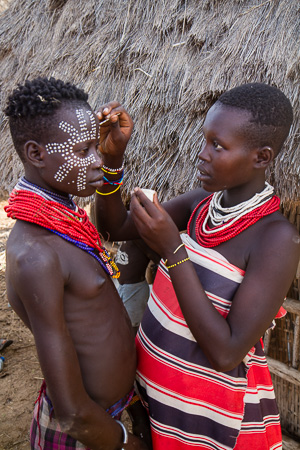
    Karo women
    Karo women

    We had left the hotel at 7:00 and it was now 10:30 and we had 320k to go, the last 20 over very bad roads to the Bishingari Lodge. The early part of the drive was on relatively good roads albeit with people and flocks wandering on and off the road without warning so that even though it was a relatively smooth surface, speed was reduced considerably since there was a constant need to slow down to avoid mass murder of flocks and pedestrians.

    After about an hour we moved off the paved section to a stretch of about 80k which was a road in name only with massive road building going on. Dusty, hot and slow.
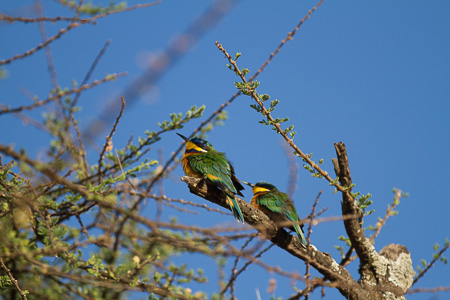
    Green Bee-eaters, Bishingari
    Green Bee-eaters, Bishingari

    Arrived at Bishingari late in the afternoon and met by a horse drawn buggy which took our bags to reception and on to our rooms all of which was a walk of about 500 metre through the property. Built on the side of a large lake with a main open-sided dining building and individual cabins in the woods along the side of the lake. All are built of varnished wood and are quite attractive but pretty basic, as the idea of eco-lodge suggests. Candles and lamps in the dining room at dinner and one fluorescent to each cabin. Walked back to the cabin in the dark, aided by a flashlight, about 300 metres, and V almost jumped out of her skin as a family of warthogs, parents and squealing youngsters suddenly dashed across our path, more than a little unsettling. No wifi at the Lodge and V is working on a proposal with colleagues in Toronto which needed to be completed on the following day so we cancelled our second night at Bishingari, and booked at the Sheraton in Addis, our home away from home.
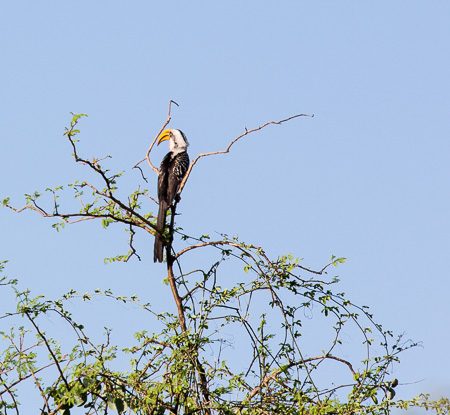
    Toucan, Bishingari
    Toucan, Bishingari

    Went on a bird walk with one of the camp naturalists at 7:00 pm; fascinating and a large variety of land and water birds to be seen. Breakfast and in our car at 9:00 for the drive to Addis.

  • Ethiopia Day 12 & 13 Turmi
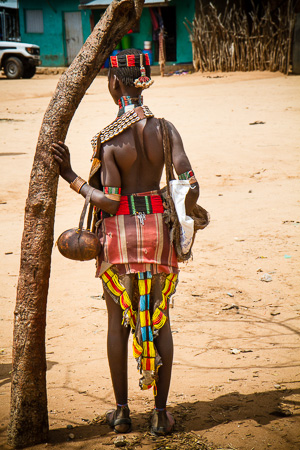
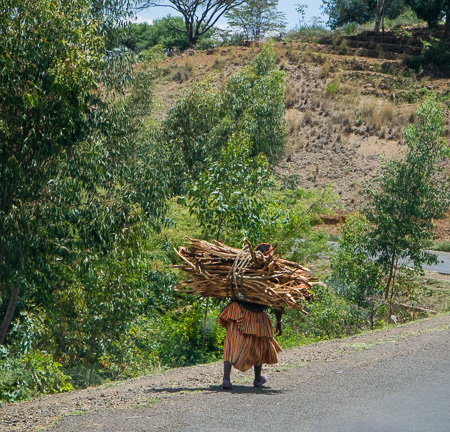
    Hamar woman carrying
    Hamar woman carrying

    Arrived at the Buska Lodge in Turmi after our bull-jumping adventure, a place that is in the middle of the desert that characterizes the southern part of the country. TripAdvisor had said of our hotel that one should bring their own food but we discovered when we were checked in that we should have brought our own room as well. We arrived at the hotel at about 8:30 to find that it was full and the room that we were given after 12 hours driving over broken tracks was a reject from a BBC production of Oliver Twist, tiny, dirty, with space only for a bed, a mosquito net and a fluorescent light. The lodge consists of about 6 0r 8 huts constructed like tukuls and a couple of rooms for overflow guests one of which we were given. We had been advised in advance to book a hut but by the time we arrived these had all been given out to a party of about a dozen French people in a minibus who had also cleaned out the buffet, the only food on offer. We asked for some pasta and a sticky, gummy bowl was produced but the beer was cold so we took our nourishment that way and stumbled to bed.

     Moonrise over the Turmi Desert
    Moonrise over the Turmi Desert

    Off next morning for a visit to Omorate, a town on the Omo River about 25k north of the Kenyan border and a 90 minute drive away from our hotel. Omorate has nothing to recommend it, a shabby riverside settlement out of a Joseph Conrad novel with no apparent reason for its existence. We reached it driving along on a track beside a massive highway being constructed by the Chinese to carry tanker trucks of oil away from newly-opened Ethiopian oil fields to Kenya for trans=shipment. Since Ethiopia does not have a sea-port it is severely limited in its ability to export and the Chinese are building massive amounts of infrastructure to allow the country to turn itself into a more developed economy. This does not come without a price, as the Ethiopians will soon discover.

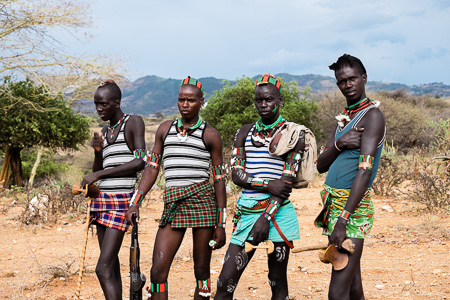
    Bona tribeguys
    Bona tribeguys
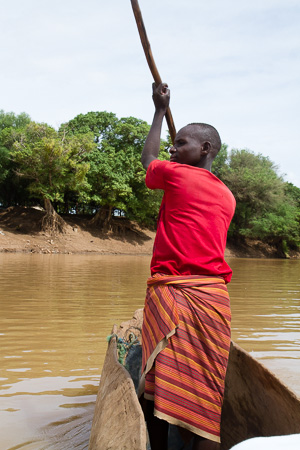
     Dugout across the Omo River
    Dugout across the Omo River

    Once arrived in Omarate we crossed the Omo in a dugout canoe carved from a single log, kneeling on the damp muddy bottom and trying not to move too much. The village on the other side was depressing, Hamar people in an enclosure about a 20 minute walk away from the river in high 30’s heat. Tukuls were made of scrap metal and wood and there was a definite feel of trailer park about it, not at all like the other more prosperous Hamar villages that we have visited. Left as soon as it was decently possible.

    The highway being built by the Chinese will cut the region in half and totally disrupt local tribal culture and economy as the small towns and villages that support it are bypassed by these massive direct links between cities and the local tribal lands are leased to Chinese and other foreign agricultural multi-nationals. This is the primary reason that we chose to visit Ethiopia now as the country is undergoing enormous change and this is a last chance to see some of these cultures before they are gone forever.

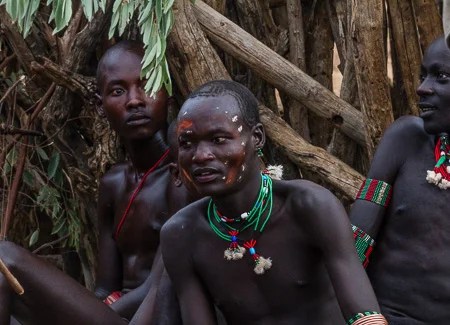
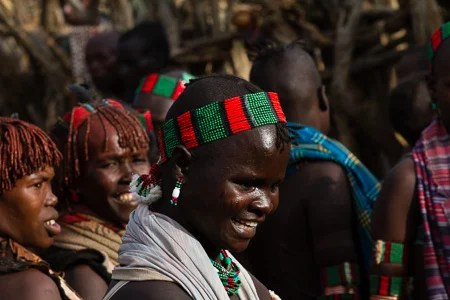
    I certainly have problems with some the tribal traditions and these continued to be reinforced over the next two days of tribal visits, the Dasenach people, the Bona people and some more Hamar people, but its hard to think of the way of life of whole cultures being wiped out with little trace.

    Left Turmi for the Murelle Lodge in the middle of another vast tract of the desert and we descended from the floor of the desert down a 10 metre high river bank into a treed flood plain next to the Omo River. We had been looking forward to this since a description that we had read, (heed the warning, the ONLY description that we could find!) described a camp where people flew in specifically to stay, a high-end destination, where we though that we’d relax before our run back to Addis.
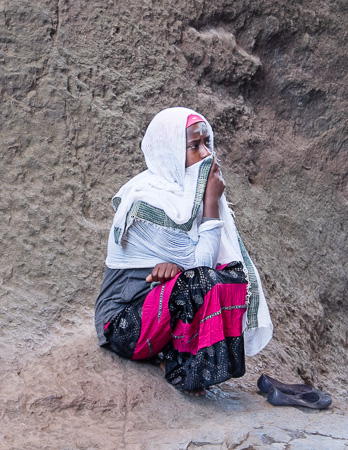
    Bona tribeswoman
    Bona tribeswoman

    It came as a surprise therefore to discover that the camp was composed a series of small, originally white but now very dingy, stone huts with A-frame thatched roofs scattered among the trees. No electricity, a bathroom that we have not seen since Asia with the shower head in the middle of the room making the whole bathroom into the shower stall, and with the temperature in the 30’s and no fan. We were told that they had not had guests for some time so there was no food but that they could make us pasta for dinner and that there was a small cooler on a generator so that there was some cold beer. Things suddenly looked right up!

    There was not a soul around, quiet and dark under the trees, extremely hot and with a down-at-heels sense of resignation at the state that it was reduced to, but with a certain underlying malevolence. I could almost sense Marlon Brando in his own heart of darkness, watching us out of the fire-lit dark of one of the huts, implacable and evil incarnate, cooking heroin and plotting our demise. Shook myself and went for a beer.

    Bona tribesman
    Bona tribesman

    A surprisingly good bowl of pasta, possibly the result of the beer and since it was very hot, we sat on chairs by the river, had another beer and waiting for the air to cool a little before bed. We were joined by our guide and we had a rambling, relaxed chat although he was very curious about my occupation. When I told him that I was retired but was involved in publishing during my working life he jumped on this and wanted to know if I was a journalist. When I asked him if this had anything with the cameras he said yes. Customs believed that I was a journalist traveling undercover since normal tourists don’t need 4 cameras and 6 lenses. They didn’t believe for a minute that I was innocently touring the countryside. Had V and I arrived together it would have been ok but on my own with all the cameras it was never going to sell.

    Our travel agent had had to provide a surety that guaranteed my behaviour and he was on the limb if I was not what I said. The guide was very interested because the travel agency owner was concerned, and rightly so, since his tail was in the wringer if he was wrong. While it may be a democratic republic I gather from the camera situation and a few other incidents in the last few days, that you still have to be very careful about what you say and who you say it to. Infinitely glad that the puzzle has finally been solved.

    Leaving tomorrow for Paradise Lodge on our return trip to Addis.
  • Ethiopia – Days 10 & 11 Turmi

    Paradise Lodge where we spent last night was supposed to be one of the highlights of our Ethiopian hotel experiences but we missed its charm. The rooms are built as stone replicas of the round tukul huts that are the usual form of housing in rural Ethiopia and are built on the edge of a highland looking across a wide, forested valley floor to the Bridge of God. This is a mountainous spur of land separating two rift valley lakes, both of which can bee seen from the hotel’s rooms stretching far to the left and right of God’s Bridge.

    Ethiopia-33
    Ethiopia-33

    Room was small, mosquitoes were biting and there was no support frame for the mosquito net so it draped over our faces and feet all night so that any self-respecting mosquito could use it as a feeding grid, poking through the net’s mesh and into its waiting banquet, us. View was pretty spectacular but we’re driving 300+ kilometres a day over very bad roads, getting up early to start our drives and arriving between 5 and 6, ready for bed. Things need to be pretty spectacular to make a dent in our dulled senses.

    Bona tribesman
    Bona tribesman

    Leaving Paradise we drove towards Turmi, our destination for the night stopping in mid-afternoon to attend the Dimeka Market, a weekly market in a small town whose name escapes me, possibly Dimeka! It is attended by the Hamar and Bona peoples and is much like the Lalibela market that we attended in the North except that everyone is in tribal dress. Another important difference is the distribution of labour, whereas in the Northern part of the country everyone, aided by donkeys, seems to share the hard work of carrying stuff, in the Omo River region where we are spending the rest of our time in Ethiopia, the men do not carry anything except their little portable stools and a critical fashion accessory, an AK47. It was made very plain to me when I asked a local market guide why the women carried everything, he said that the men’s responsibilities are for their flocks of sheep and goats and that they do not carry anything, although they do seem to carry a very large load of masculine self-worth and general superiority.

    Additionally, in the North donkeys are a part of every household and between the shared labour amongst genders and ages and the work of the long-suffering little beasts of burden, stuff gets moved around. In the South, in the Omo River valley, it’s too hot for donkeys to survive so everything is moved by people and that means by the women. So it’s normal to see women strapped to massive amounts of wood or large plastic jugs of water and walking many kilometres with their loads while the men sit in the shade, chatting with their mates, watching their flocks and the rest of the world go by.

    Hamar woman
    Hamar woman

    Lots of photo ops at the market but in addition to their sense of privilege, the men actively do not like their photos taken and leave such menial chores to the women who charge for photos and so use it as an addition to their family income. Not a fan of these guys and while I’m sure any first year Anthropology student could give me chapter and verse supporting the utility of the social model, doesn’t work for me and frankly I think that the only thing between these guys continued free ride and the women’s tossing them out on their collective ears is the presence of all those AK47’s. In fact, the men’s dress, at least among the Bona people, is a brightly-coloured, skin-tight little kilt that extends only to the top of their thighs, a tight sleeveless top, usually black, a beaded head band and the fashion-forward Kalashnikov. They also run to little round pink plastic mirrors that they check frequently and carry tucked in their headbands and little hair clips that they constantly adjust. It’s my belief that if they landed in a New York leather bar they would be greeted like old friends.

    Selecting date of next ceremony
    Selecting date of next ceremony

    One of the very good things that came out of our market visit was a rumour that Eskadar tracked down, that a bull-jumping contest was being held that afternoon at a family compound in the hills about 15k away and if we could get there and would pay the family for our attendance, we would be welcome to come. It was a very hot afternoon and Eskadar had some doubts since 15k can turn into 50k and we would be driving on a broken track not a road. V was very keen however so we picked up a local to guide us and headed out.

    Bull jumper
    Bull jumper

    Bull-jumping is the ceremony and the trial that a young male 18 or 19 years old must undergo in order to be accepted into adulthood and therefore be allowed to marry. There are parts of the process that we were very hesitant about particularly a step in the proceedings when some of the young women are beaten with sufficient force that they carry enlarged scars on their backs which are evident on many of the women in the markets that we have attended. I’d love the help of my helpful first-year Anthropology student here since when I asked what the rationale for the beating was, I was told that it was a way for the women to show their pride and love for the young man undergoing the bull-jumping trial. I’m pretty sure that rationale was never one that the women decided on.

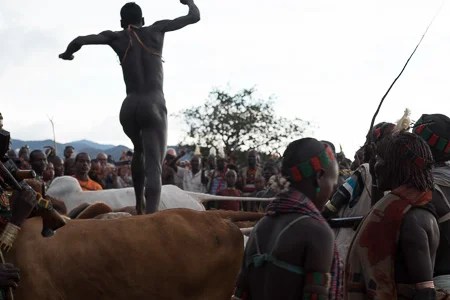
    The trial itself consists of a number of bulls, 6 or 8, being rounded up and somehow being made to stand side by side in a row while the young guy leaps up on the back of the first bull then runs across their backs using them as stepping stones while trying not to fall under their hooves. He must do this 6 times, 3 times in each direction and if he is successful he is considered to have entered adulthood and be an eligible bachelor.

    Ethiopia-39
    Ethiopia-39

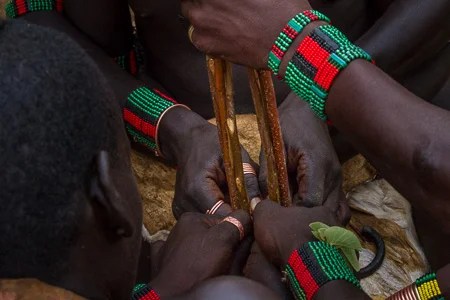
    A very big deal for the family, First Communion or Bar Mitzvah, and large amounts of money is spent on feeding and entertaining and family comes for miles around. We arrived after a lot of the various ceremonies had already taken place, including the beating of the young women which we were happy to have missed but the main event was still to come. In the lead up to the bull-jumping there was singing and dancing by the women and a series of conclaves in the family compound during which elders worked out when the next bull-jumping event would take place and which involved a complex series of rites with sticks and various objects.

    As we discovered when we visited some other tribes, bull-jumping is a wide=spread ceremony throughout the Omo River region but the Hamar people have individual rites paid for and hosted by a family for their son while other tribes treat it as a community exercise with all eligible young men jumping in a large joint exercise which takes place every two years. Failure to make the jump, couldn’t the pun, means that a young man brings shame on the family and essentially lives in their basement and cannot marry. He can try a second time but failure then condemns him to wearing his bath robe for days on end, never washing or shaving and playing video games for days at a stretch.

    Hamar Bull jumper
    Hamar Bull jumper

    Finally as the day was fading into twilight the bulls, about 8 or 10 of them were herded into a circle made up of all the assembled crowd of family and friends. A number of family volunteers tried to get them to line up but they were young and very skittish, surrounded by noisy people who were yelling and singing and crowding in on them. A number of them kept breaking loose and charging the crowd who broke away and took cover while volunteers tried to catch them and get them back in line; an Omo River version of Pamplona. Finally, by dint of someone holding their horns on one end and someone else pulling their tail with all their strength on the other end 6 or 7 of them were lined up while the loose ones charged around for general effect.

    Suddenly the young man who had been patiently waiting while the melee went on, held by one of successful friends who kept talking quietly to him, he gathered himself, leapt up on top of the nearest bull and began to run across them like leaping from stone to stone while crossing a stream. He managed the crossing 5 times and just as he reached the last bull on his 6’th run he fell but was caught and congratulated, having passed his trial.

    A race for cars and a long and extremely bumpy 90 minute drive to our hotel in the dark.

  • Ethiopia – Days 8 & 9 Hawassa and Arba Minch

    Uneventful flight last night and in fact it left 1/2 hour early as by then all passengers had checked in. It appears that we were the only flight from the airport that evening, so I think that everyone wanted to shut down and go home for dinner.

    Very nice to be back in the Addis Sheraton, which seems to be the major hotel in the city for foreign dignitaries and business people, and in fact, we arrived on the eve of a meeting of the African Union which is headquartered in Addis and our hotel is apparently where many of the delegates are staying. As usual massive amounts of security, in the streets around the hotel and all the way to the airport there are armed military every 50 metres or so on both sides of the road and the luggage and personal checks at the hotel entrance were unusually thorough, turning up stuff in our luggage that airport security had not found or did not care about. Surprisingly for a Sheraton the hotel is large, marbled, impressive and expensive. However it has come to feel like home.

    Good dinner and V managed a bowl of soup and so off to an early night since we are heading to the south of the country on our drive tomorrow. Even more excitingly, we are stopping at the airport on our drive out of Addis tomorrow since our travel agency has been working with the appropriate government departments and has a document authorizing customs to release my cameras, with the travel agency being required to take responsibility for their release in the event of any later problems. Lord knows what that means, but it was part of the process so that i is dotted. Because of the intricacies of bureaucracies and govt departments it was not a sure thing but I was very hopeful.

    Our car was scheduled to pick us up at 8:30 but delayed because no cars were being allowed into the Sheraton grounds as the Prime Minister of Ethiopia was arriving at the hotel from his official residence next door to the Sheraton at that time and the whole area was battened down. We waited on the hotel porch, saw him arrive and be greeted, great fun, and then when things cooled down a little our car arrived. Off to the airport through cordons of military. This is not intended to give a sense that Ethiopia is a particularly repressive or militaristic state, as far as we can determine, it is far from it. It is a democratic republic, stable for an emerging African nation, and while it has no shortage of problems, they seem to be working hard to move themselves forward. For the most part we have been vey impressed with what we have seen of local authority and with the way things work, and if they could only deal with cameras at customs……..

    Not surprisingly, layers of bureaucracy at the airport and it took us over an hour as our piles of paper grew. We had our letter from the ministry as well as the receipt and inventory that I was given by customs on the night that I arrived. These were added to by additional forms each of which had to be stamped and counter-signed by the appropriate person and we shuttled from office to office getting signatures and stamps. At one point I thought all was lost since I had a carbon copy of the original customs inventory but nothing could be done without the original. Given that one was a carbon of the other with all the vital information I had assumed that it would work, but not so. Could not even remember what I had done with the original to safeguard it; this whole experience has been a series of self-inflicted wounds. Dug into my travel wallet and found it, much battered and folded, tucked into a corner of the wallet and hard stares were replaced by wide smiles, all was once again good. One last hiccup as the final customs gatekeeper refused to approve the cameras’ release since an earlier official had signed on the wrong place on a form, on the left side rather than the right, but we found the erring officer and had him sign properly.

    After an interminable discussion which fortunately I could not contribute to since it was all carried out in swift Amharic, I was reunited with my cameras and charged about the equivalent of $10 for warehousing and storage. At that point 10x as much would have been a small price to pay. Relief all round!

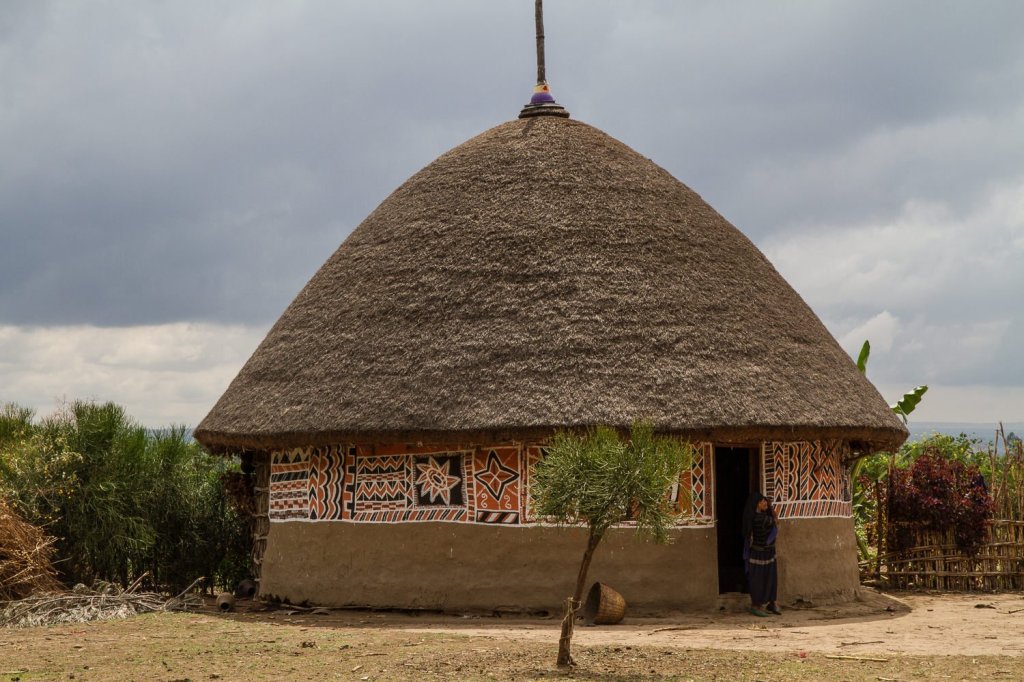
    Decorated tukul on the way to Arba Minch
    Decorated tukul on the way to Arba Minch

    Into our car and off for our drive to Awassa, our first stop. Leaving Addis was a long process because all of the roads seem to be being built or re-built and are rough gravel with the lanes expanding to 2 in either direction and suddenly compressing to 1 without warning and people and animals darting between cars. Shoulders of the road are filled with people and animals, people selling things from blankets spread out on the ground and directly behind them and feet from traffic are rough wooden stalls and sheds selling anything that can be imagined. Great volumes of cars and trucks, weaving and jockeying for position but no signs of road rage, very calm and even-tempered while still being very assertive and dodging the streams of people and animals.

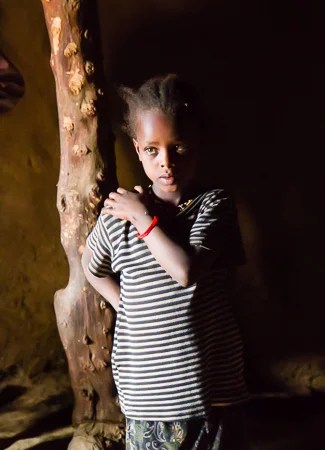
    Tukul owner's child
    Tukul owner’s child

    Country changed as we drove south and as we crossed over a series of mountains into the Great Rift Valley. I have capitalized the name because that is how I think of it from my high school geography lessons. In fact I had an utterly unrealistic mental image of the landscape. I knew rationally that it could not be as I imagined it, but the mental image overpowered the rational. In my imagination I saw, as in my geography diagrams, two straight-sided cliffs and between them a flat and even stretch of land that had suddenly dropped a thousand metres below the level of the two side land masses as if descending in an elevator. I imagined driving down the middle of the valley and seeing the two sheer cliffs, on one either hand, rising straight up into the sky. Of course nothing like that and once I got over my disappointment, really enjoyed the change in scenery.

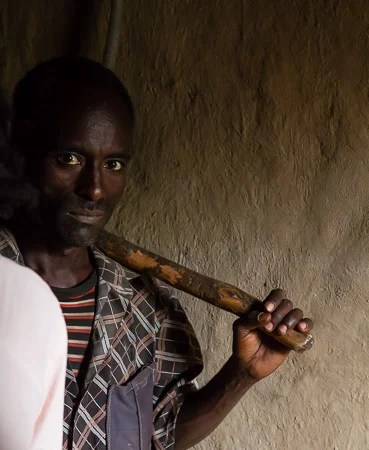
    Farm worker
    Farm worker

    Toward the middle of the day we began to see tukuls which seemed much neater than any we had noticed earlier in the day and characterized by painted designs around their outside walls. Eskadar told us that while we had entered a Muslim part of the region, there was no special significance to the nature or types of design, they were simply decorative and a way for householders to show off their homes.

    We stopped the car at a very neat tukul set in surrounding farmed fields and he asked the homeowner if we could visit. A very stoic and prosperous farmer with a charming wife and 5 kids who proudly showed us around their home, their granary complete with cat to deal with the rats, and his fields.

    Tukul owner's wife
    Tukul owner’s wife

    We drove by one of the large rift valley lakes and as we approached Hawassa at the end of the day we drove through the town of Shashamane which is a settlement of the Rastafarian sect, built on land gifted to them by Haile Selassie in the 1940’s. Rastafarianism incorporates sociopolitical views and teachings of Jamaican publicist, organizer, and black nationalist Marcus Garvey who was a keen proponent of the “back to Africa” movement in the 1920’s, advocating that all people of the black races should return to their ancestral homeland of Africa, and worship the Creator “through the spectacles of Ethiopia”. About 2,000 Jamaican Rastafarian followers took Haile Selassie up on his offer and immigrated but their number has dwindled to about 300. Drugs, including ganja, are illegal in Ethiopia but in the Shashamane area ganja is freely and legally grown and consumed as part of the religious practices of the Rastafarian residents of the town. We would have been interested in a walk through the town but Eskadar was reluctant since he felt that the area had become heavily populated with ganja hustlers and touts and not an easy walk for outsiders.

    On to out hotel, the Haile Resort, built by a very well-know Ethiopian long distance runner named confusingly enough Haile Selassie, who has set world records and is using his prize money to invest in his country, this hotel being one of his projects. One of the nicer places we have stayed and the restaurant, very good. We did not want a buffet and ordered from the menu and all the dishes were western, usually the downfall of Ethiopian kitchens, and were very well prepared and showed a knowing and light hand at the stove.

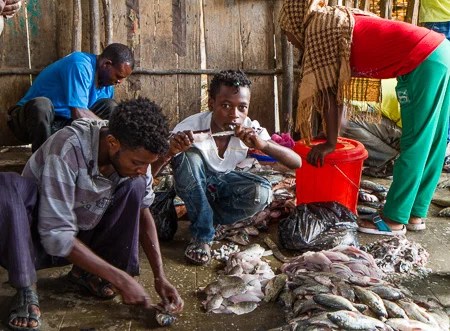
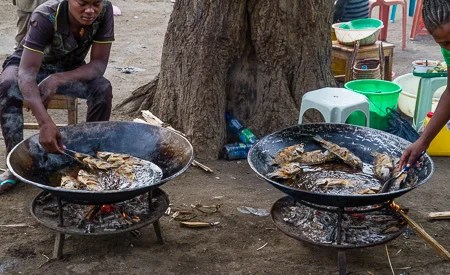
    Hawassa fish market
    Hawassa fish market

    Our experience of the Ethiopian people, as I have said before, is that they are a quiet and very gracious group and thus was really brought home to me at the Haile Resort. I was sitting in the very large and high-ceilinged lobby/bar surrounded by couples and groups of Ethiopians who made up the largest percentage of guests, and the only distinct voices to be heard were from scattered nasal, grating and penetrating North American conversations, carried on in the self-centred expectation that everyone in the room was interested in what they had to say. Or they just didn’t give a damn, take your pick. The locals were chatting and there were lots of discussions but all were conducted with a sense of intimacy and quiet. That alone would be enough to make me want to move here.

    Hawassa fish market
    Hawassa fish market

    Long drive today, from Hawassa to Arba Minch about 300k farther south. Our first stop before we left the city was to the fish market, never a favourite place but this was not as richly-scented as some and was therefore much more bearable.

    Dorze woman kneading fermented banana pulp
    Dorze woman kneading fermented banana pulp

    Stopped in the afternoon to visit a village of the Dorze people who are very well known for their weaving tradition but disappointingly while there were a number of men at looms in the village weaving centre, the finished materials that were available for sale bore no resemblance to the fabric on the looms and had a very Chinese mass-produced feel to them. Possibly a very unfair view of the village, but it did feel somewhat like a stage set. The Dorze’s main traditional food is produced from the false banana plant, which looks very much like a regular banana except that it bears no fruit. They scrape the flesh from cuttings from the concentric circle of fleshy leaf stems that form the central stem of the tree, it smells and looks like fibrous chopped cucumber, and then they wrap it in leaves and bury it for 3 months. After that time it smells exactly as you would imagine after sitting underground in the heat for that period of time. They then knead the resulting paste with water to make a kind of ripe-smelling dough and bake it as bread. We saw and tried it at the various stages, and while interesting, happy that I’m not a Dorze.

    Arrived late at the Paradise Lodge in Arba Minch and a hasty dinner as an early start again tomorrow.

  • Ethiopia – Days 6 & 7 Bahir Dar & Addis

    Staying at Kiriftu Lodge on the southern shore of Lake Tana, one of the two candidates for the source of the Blue Nile, the other is a small spring bubbling out of the ground about 16k away. Can’t quite fathom how this can still be a mystery but since we’re on Lake Tana then I’m voting for it.

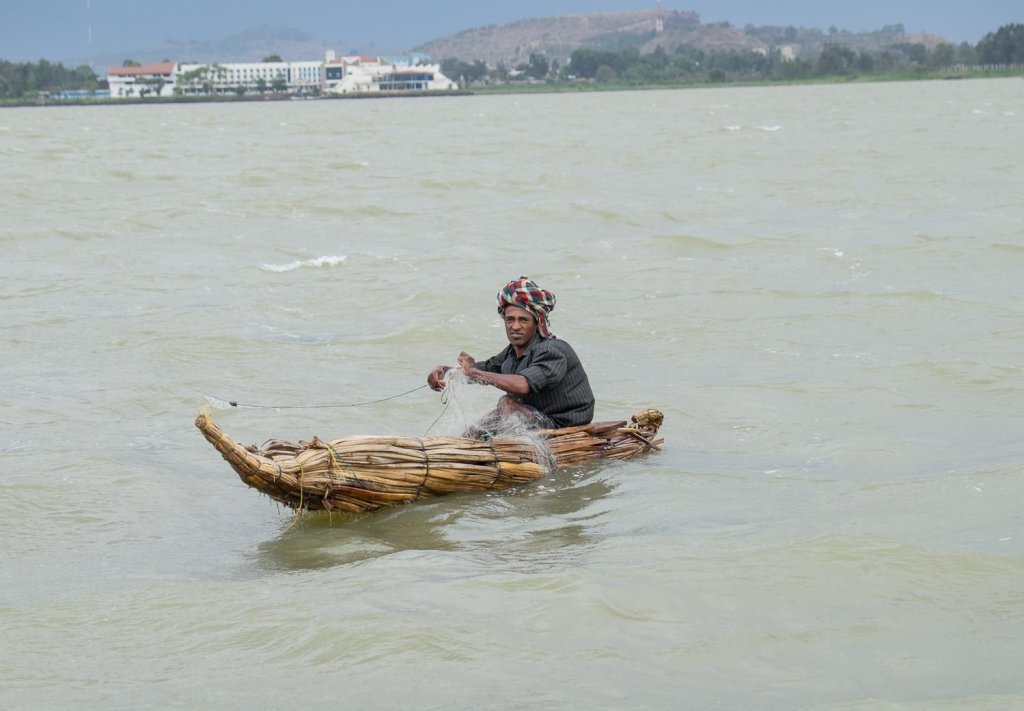
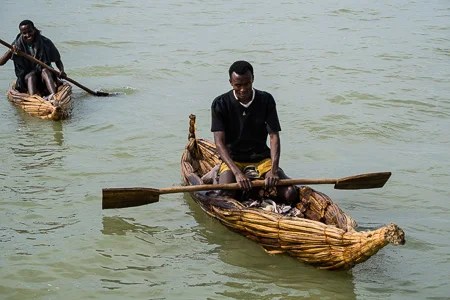
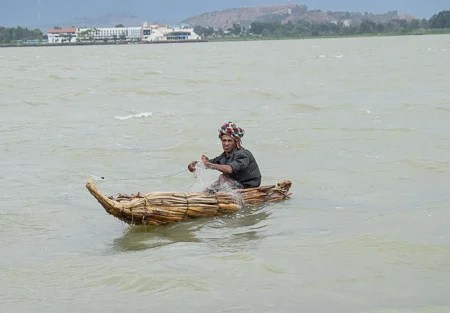
    Lake Tana fisherman
    Lake Tana fisherman

    We were scheduled to spend the day on the lake so at 8:30 we presented ourselves on the hotel’s dock to be met by Eskadar and our boatman who helped us on to a very clean and neat little fibreglass craft about 6 metres long with a sunshade and with enough comfortable seating on cushioned side benches for about a dozen people. Today however the boat is chartered for us alone and we have a picnic lunch prepared by the hotel so should be a fun day. Our mission is to visit two monasteries, one on island about 35k away and the other on our return trip home, about 10k from our hotel. There was a hazy feel to the air and a bit of a breeze blowing suggesting weather at some point during the day but the sky was clearing and the sun was shining and all was right with the world.

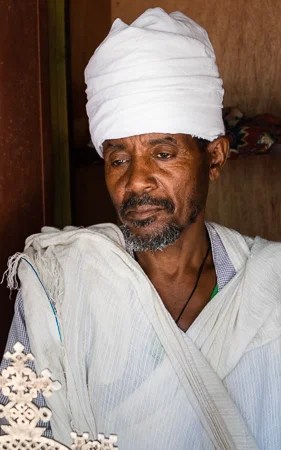
    Lake Tana monastery abbot
    Lake Tana monastery abbot

    The trip took about 2 1/2 hours and we chugged down the middle of the lake which is about 3,600 square kilometres in size and the largest lake in Ethiopia. Weather held and the day began to get warm but we were well protected by the sunshade and we were fascinated to periodically pass boats that seemed more appropriate for Lake Titicaca than Lake Tana in Ethiopia. They were single-person craft and made of bunches of papyrus tied together in long bundles which were in turn tied together to form the boat which had a shallow dugout interior with the ends of the bundles tied together to form an uplifted prow and stern. The boats were probably about 3 or 4 metres long and very low in the water so the fishermen who paddled them were right at water level and were casting nets, hauling them in and filling the bottoms of their boats with mounds of flapping fish, tilapia and catfish for the most part. Very impressive particularly since we were sufficiently far out in the lake that the shore was hazy in the distance.

    Lake Tana monastery abbot
    Lake Tana monastery abbot

    Arrived at our destination which was an island sufficiently large that a couple of thousand people live on it and farm it. The monastery however was at a secluded end of the island surrounded by trees and very secluded and quiet. As far as we could gather only one priest/monk lived there and he was our conductor as he showed us around his church which was built in the 15’th century and many of the paintings it contained were apparently originally painted at the time of its construction while others are clearly more recent. To call them paintings suggests framed and stand-alone works which these are not. First it’s important to know that the church, made of wood, is like a tukul writ large. A round building of one story and about 10 metres high and 20 metres in diameter with a conical roof and windowless walls. In the interior of the church there is a large central four-sided construction which goes from floor to ceiling and which houses the holy of holies. It is like a giant block which fills the centre of the building and leaves an open space around it and between it and the walls which is only about 3 metres wide. The church contains three doors situated around the building and these are the only sources of natural light. The paintings are on gessoed canvas that was stretched and mounted on each of the four sides of the central block and extend from floor to ceiling and each covers an entire side of the four square walls of the holy of holies. Each side is a series of painted panels and the whole surface of a side is a mass of panels telling biblical stories as well as moments from Ethiopia’s past when the saints and angels who protect the country came to assist and performed miracles that are still remembered so that make it is hard to detect where historical fact stops and historical myths begin. They are very stylized but are stunning and the colours are bright and bold and while some portions have suffered the overall effect is staggering.

    Our priest/monk, aided by a very long pole spent about 45 minutes going around the interior of the building and pointing to and explaining the stories on each of the panels. He was amazed that we knew the greatest percentage of the stories but most of them are from the old testament as well as the new. We fared less well when panels represented scenes involving Ethiopia’s own religious myths and while the central characters were biblical, Raphael and Gabriel for example, they were involved in matters not covered in either the old or the new testament since the Ethiopian Orthodox has four additional books that do not form part of the European bible. Our monk was very surprised that we knew as much as we did and continued to express amazement when we were able to tell him what scenes represented. He shouldn’t have been surprised as these stories form such a large part of western literary tradition that religious or not we are all aware of them and they are the stories that underpin much of our literary and cultural history.

    We left the church building and wandered around the compound that surrounded it, all enclosed in a crumbling wall which surrounded it and included a number of falling-down towers and gates. Grass and trees grew untended except for a circular area around the church itself whose grass is kept in check by worshipers who gather there for services and whose many feet keep the grass trodden and in check. Nonetheless it had a lonely and deserted feel even in the bright sunshine.

    Back in our boat and another 2 1/2 hour trip to a peninsula where a second monastery awaited. Vey pleasant trip; we ate our lunch and watched the boats and the fisherman but as we got close to our destination the air began to feel heavy and the wind began to pick up. I am sure that the second monastery was equally interesting but unlike our first stop where there was a quiet and melancholy feel, this one had a hike of about 20 minutes to reach it through an open forested area, both sides of which were covered by rough wooden stalls and tables set up by locals to sell various handicrafts and souvenirs. The church when arrived at was exactly the same design as the first since this is the pattern of Ethiopian churches but the paintings didn’t seem as captivating, the weather was becoming threatening and we were so pleased with the first monastery that we just did not want to stay, so we quickly left. Returning to our boat we were again being sold stuff on every side, very politely and un-aggressively, but annoying nonetheless.

    Lake Tana fisherman
    Lake Tana fisherman

    As we began the last leg home, the wind picked up, great black clouds with bright flashes of lightning built up in the direction in which we were headed and the waves began to rise and give us a good rocking horse ride. No rain fortunately but we had our rain jackets zipped up and cameras under cover. The boatman was working very hard to keep our nose to the waves as he worked crabwise to work his way to our landing point as the wind picked up. I was therefore amazed to see about 100 metres off our course a couple of the little papyrus fishing boats casting nets and carrying on their business. I was sure earlier in the day that if the weather became problematic they would be the first ones headed for shore, but here they were calmly carrying on their trade while bobbing like corks. Almost impossible to sink I guess.

    Not a very interesting dinner and so to bed as we are being picked up at 7:30 for our flight to Addis and on to the south. Was awakened at about 3:30 by the pitiful sound of someone being sick and begging for a swift and early death. V had clearly eaten something that hadn’t passed muster and was having a very sad time of it. The worst of these things is that after a bout you feel better and think/hope that the worst is over, only to begin to feel that clammy sense about 20 or 30 minutes later that the price has still not been paid. I called Eskadar at about 6:30 to see if there was a later flight and he worked to get us on a 13:30 flight as we all hoped that it was a short nasty bout that would clear by mid-morning and allow her to at least fly and collapse at the other end. At about 10:00 it was obvious that this was a fond hope so we managed to get tickets on the 19:30 flight that would give V until late in the afternoon to sleep it off. By noon the worst was over and she managed some weak tea and slept. So we are staying in the Sheraton Addis tonight which is very good news, a very clean bed in a 5 star hotel, crisp clean sheets and a shower with endless hot water will cure many things and it was the promise of this that allowed her to rally and make the flight. All once again good.

  • Ethiopia – Days 4 & 5 Lalibela & Bahir Dar
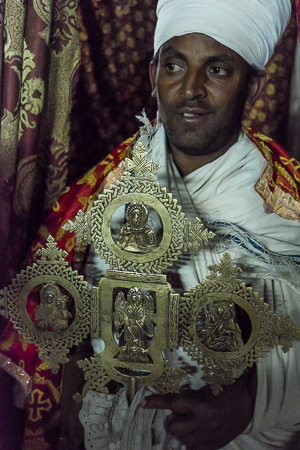
    Young celebrant, Lalibela
    Young celebrant, Lalibela

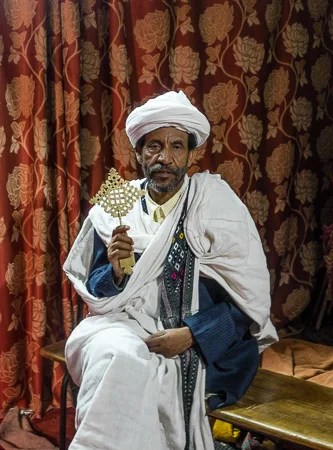
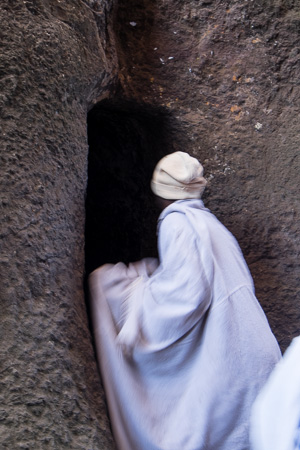
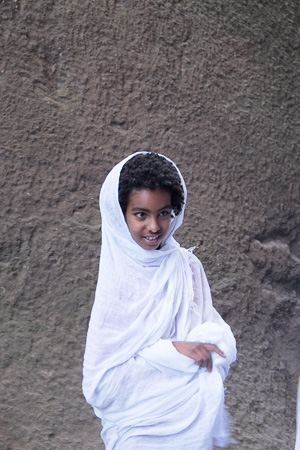
    Sunday morning was bright, clear and cool. We were picked up at about 7:30 to go to the largest of the in-ground churches where a service was being conducted and where a very special cross made of solid gold, and weighing about 7.5 kilos is housed as part of the church’s religious treasury. It is claimed to be concurrent with the time of the churches construction and is taken out of the church only at times of grave local or national emergency when it used to in services to pray for heavenly intercession However for most of the time it is housed in the church and is used in Sunday services or on holy days. Eskadar wanted us to attend the service and see the cross because it is a national treasure but more than this, V wanted to take part in the blessing service.

    Tunnel between churches, Lalibela
    Tunnel between churches, Lalibela

    The courtyard area on the level ground surrounding the edges of the hollowed out pit where the church is located was filled with people, men, women and children all draped in white while a priest preached a sermon in a very loud carrying voice from a rise of higher ground. Everyone was quiet and very politely moved out of the way as we threaded our way towards the set of steps that led down to the church. Since the insides of the churches are spaces hollowed out of the central block of rock with few windows they are very dark and very little can be seen without some form of illumination. Therefore when we reached the door to the church at the bottom of the dugout, nothing could be seen inside the church but vague shapes and the crowd inside was sensed more than seen.

    Young celebrant, Lalibela
    Young celebrant, Lalibela

    We all removed our shoes and V and Eskadar, our guide, went into the church and took their place in the large group waiting to be blessed by the cross. I was not enthusiastic about being in a crowded space in the dark and decided to stay outside the church steps and watch the people coming and going but V was very keen and the two of them disappeared into the dark. I took some shots that I hope will turn out and just enjoyed the air and the morning light filtering down to the bottom of the dugout trench where I was sitting. After about 1/2 hour V emerged, thrilled that she had been blessed and touched by the cross, and full of praise for the crowd that she had been a part of, as there was no pushing or shoving in that tightly packed, dark space, everyone just patiently and graciously allowing each other their turn to take part in the ceremony.

    Guard at the hilltop monastery, Lalibela
    Guard at the hilltop monastery, Lalibela
    Priest at hilltop monastery, Lalibela
    Priest at hilltop monastery, Lalibela

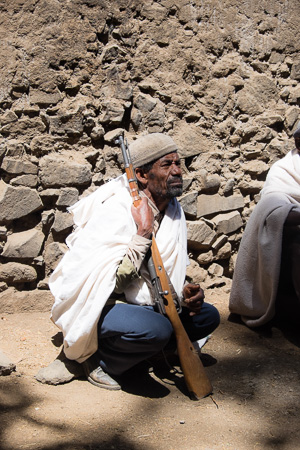
    To our car and an hour’s drive over very rough gravel roads to a small village in the hills where we left the car and climbed, zig-zagging our way up a path several hundred metres high up the side of the hill we were climbing. Neither V nor I had realized the length of the track or the height that we were going to climb and so she had left her asthma puffer in the car. She was struggling to breathe and I tried several times to cancel the trek but she insisted so we stopped every 50 metres or so for her to catch up her breathing and finally made it to our destination, a very large cave in whose interior a monastery had been built. Charming and graciousI priest/guardian who showed us around and we wandered around the interior of a massive cave inside of which were two buildings dating from the 11’th century, one the monastery and the other supposedly the house of the king who had built the monastery. The floor of the cavern was completely carpeted with split bamboo strips tied side by side to make an enormous wooden carpet and since we were the only people there, a quiet and very peaceful scene.

    Hilltop monastery, Lalibela
    Hilltop monastery, Lalibela

    Back to our car for the jolting ride back into Lalibela and our trek to the second group of churches culminating with a visit to St George’s church as the evening began to draw in. Long day.

    Out for dinner at Ben Abeba a very quirky restaurant built on the edge of a cliff outside Lalibela with sweeping views towards the mountains away in the distance on the other side of a valley above whose floor, 1000 metres below, we perched. The restaurant is built in the vague shape of an orb but there are no walls to define the space but a series of 4 or 5 levels some enclosed in glass, some open air with interior steps and runways connecting the various levels. If anyone can remember that far back, it looked as if it was designed by the authors of the 1960’s Whole Earth Catalog and constructed with the aid of inspirational amounts of ganja. There are interesting and odd spaces throughout the building, gardens, dining areas and a flat section on the edge of the cliff with circular benches surrounding a fire pit, perched on the edge of the abyss. It is rated as either the first or second best restaurant in the country, which if that is true does not speak well for our next two weeks in the country; we enjoyed our dinner but it will be quite a while before it’s worth Michelin’s time to send an inspector. The restaurant is run by a Scots woman in her late middle age who opened it 2 years ago and who has been in the country for about 6 years. There is clearly a rich story behind her presence but not enough time to talk with her and find out more. We ate by the pit in front of a roaring fire, watched the stars blazing in an inky black sky and drank quantities of very bad wine.

    Petra-like underground church, Lalibela
    Petra-like underground church, Lalibela

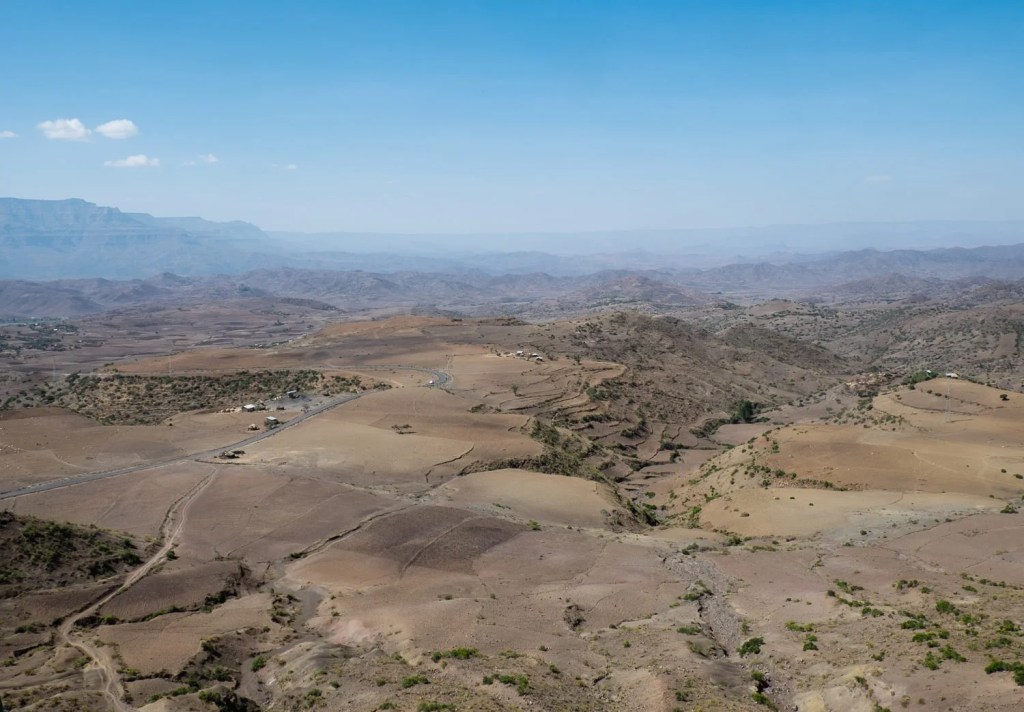
    Monday morning off to a very early start and drove to Bahir Dar, a very large town with a university, built on the southern shore of Lake Tana. Not much top say about the drive; bad roads for about 25k and then hit the main highway, a well built asphalt two lane road built by the Chinese, which took us down from the high country around Lalibela through a series of mountainous passes down to lower country and eventually into Bahir Dar. One of the most interesting aspects of the drive was watching farmers all along the way preparing their fields for spring planting by ploughing (or pluffing as Eskadar calls it, the inconsistencies of the English language!) with a brace of oxen and a wooden plough as has been done for thousands of years. The other was the massive amounts of eucalyptus that are planted all along the way wherever there is space to grow them. One of the 19’th century Ethiopian kings had brought them in from Australia and they have taken over from native species. However they are put to good use as they grow quickly and if cut while young provide quantities of very long and straight stems about an inch or two in diameter which are used as the material of which all houses seem to be made. A framework of eucalyptus stems lashed together and then covered by mud mixed with straw and finally for the wealthier, an outside layer of brick.

    Roof of St. George's church, Lalibela
    Roof of St. George’s church, Lalibela

    As we drove along Eskadar watched for smoke coming from the isolated tukuls or houses that we passed because he wanted us to see injeera being made or beer being brewed, in both cases for household consumption as most family groups weave their own baskets, make their own beer and bread and grow their own food. After a couple of false starts, when he was sent packing by large dogs he found a charming family who welcomed us into their compound, composed of 3 mud covered, round tukuls, and who showed us their home and let us see how they carried out their family chores, grinding and fermenting grain for injeera and brewing beer. We met the grandmother and the mother as well as two very handsome boys and a daughter with her baby. The men were in the fields and as we left, they arrived with the cattle that they had taken to pasture. Everyone lives in shared domesticity, sheep and cattle sharing space in two of the tukuls with their owners while one building is kept animal-free and is used as the family’s living room. A fascinating visit and the family seemed proud to show off their home and we all shook hands with best wishes all round at parting.

    Arirved in Bahir Dar late in the day and checked into our hotel. Tomorrow we have a boat for our use and will be visiting monasteries on some of the lake’s islands

  • Ethiopia Days – 2 & 3 Addis and Lalibela

    Have been more or less off the grid for the last couple of days so will try and compact a couple of days in this post while I have fleeting and intermittent internet access.

    V arrived on Friday on an Emirates flight from Dubai where she overnighted.

    I had arranged with the driver that he pick me up and take me to the airport when he was scheduled to pick up V, as I wanted another run at Customs and my cameras. At the least I wanted to make sure that there was no problem when I tried to pick them up when we flew out of Ethiopia. Spent the morning reading and at 13:00 not only did the driver arrive, but Eskadar who will be our guide for the next two weeks and whose English will be welcome when dealing with Customs.

    Arrived at the airport, greeted by a level of security that I have not encountered since India. I should have expected this given the level of security at the Sheraton hotel where we’re staying. The hotel and very extensive grounds and gardens are surrounded by a high wall and there is a security checkpoint at the gates to the hotel, at the end of a long drive about 100 metres away from the hotel building. Taxis are not allowed on the property and when I was dropped at the gates at about 12:30 am on the night of my arrival, I had to wait at the entrance gates while a golf cart was sent to pick me up and carry me to the hotel. On the hotel porch there is a full body scanner for guests and visitors and all luggage, hand bags and parcels are x-rayed.

    In keeping with this climate of security, there was no access to the International terminal without a ticket or boarding pass and after some discussion with the military guarding the entrance doors, Eskadar was allowed in to meet V and I with him to see Customs after showing my passport and a copy of the camera papers. In order to enter the terminal building, once again empty all pockets, remove shoes, belts and jewelry and go through a body scanner. If you are flying this process would be repeated when entering the departure lobby and once again at the gate.

    We had about an hour before V got through formalities and picked up her luggage. During this time Eskadar, with me as a bystander, carried on furious discussions, with a variety of officials each of whom referred us to someone else. If the definition of bureaucracy is the fear of making a decision, these guys had it down to an art. The only person who was prepared to release my cameras demanded that we pay “taxes” of 180,000 Birr, the local currency, or about $9,000 US. Was never going to happen so once again at an impasse but clearly picking up the cameras was not going to be a simple process on our departure. At this point V arrived with all her luggage safely in hand so we adjourned the battle until next week when the travel agency is going to have a run. Failing that, the Canadian Embassy.

    Early bed and up at 5:00 to get organized; our pick-up is at 6:00 for our 7:30 flight. I was so stressed at the Customs problems that I literally did not sleep and V got no sleep either as she was plotting and planning solutions to the same problem.

    Lalibela market vendors
    Lalibela market vendors

    Saturday we flew into Lalibela, in the north of the country, the region famous for its underground churches carved into and out of the landscape about, and depending on who is telling the story, either 900 years ago or 1,100 years ago or 500 years ago, but more about them later.

    Lalibela market vendors
    Lalibela market vendors

    Straight from the airport to the Saturday market in Lalibela, a town of about 15,00 people at an altitude of 2,700 metres in the high mountainous region. Long before we arrived in town we could see streams of people walking towards us on the rough gravel road into town, in many cases accompanied by a heavily laded donkey, all clearly returning from the Saturday market. The drive into town was an instant window into the country, its economy and its culture. Ethiopia is still a rural, farming economy and between 80 and 90% of the population is engaged in subsitance farming. Very few vehicles, no power lines and local transport is by foot with the heavy lifting and carrying being done equally by man/woman and beast.

    The rural population live in round buildings called tukuls whose windowless walls are made of wattle, mud and straw mixed plastered over a wooden framework, and topped by a conical roof of straw thatch. Lighting is by candle and cooking is over an open fire in the middle of the house. It’s not hard to imagine that at the most basic level nothing has changed for millennia. And yet they are the heirs to a very rich and technically sophisticated culture that lasted for over a thousand years when the country was known as Abyssinia.The people that we have met and observed are finely featured, quiet and gentle. As a noisy westerner I have to keep reminding myself to slow it down and lower the temperature.

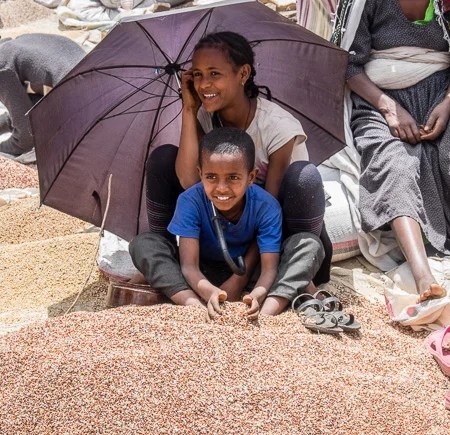
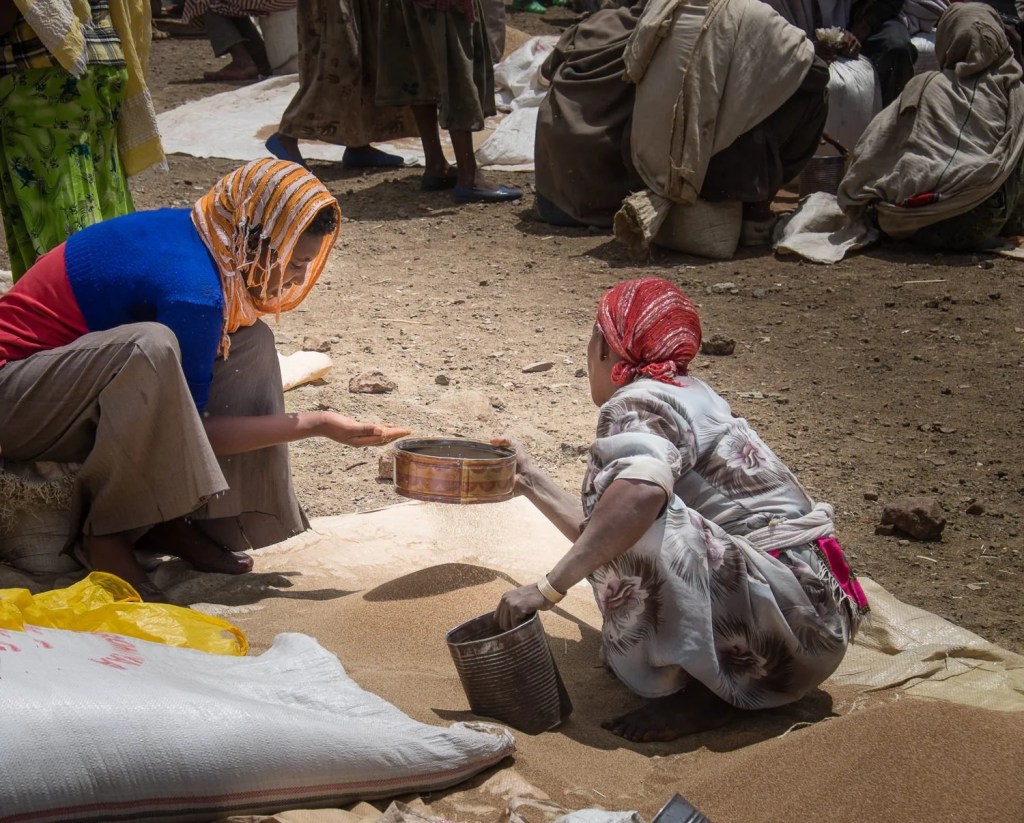
    The market was very large and was a market in the true medieval sense; people trudged in from the country-side with their crops to sell, be it wild honey, grains, cereals or vegetables to name a very small sample, and having sold it, to then buy supplies and finished goods from the same market. Thus everyone, from donkeys to the smallest child walks kilometres from their farms, laden with goods to sell and then returns home, equally laden with their supplies.

    We spent a fascinating couple of hours and filled with people as it was, were continually surprised by how friendly, quiet and amenable everyone was as we stopped at ask questions through our guide and sniff their wares or touch the fabrics. No pushing, shoving and very little raucous market clatter.

    Ethiopia-6
    Ethiopia-6

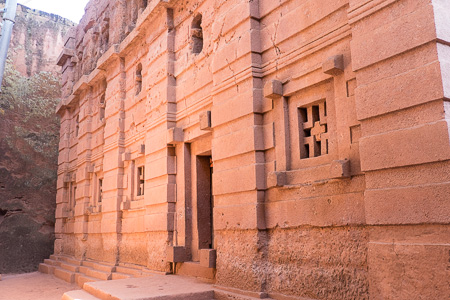
    Lunch and the on to the churches. V says that calling them underground churches is misleading since this term suggests that they are in caves, which they are not. She suggests that they should be called in-ground churches which is a much more accurate description since their roofs are level with the surrounding landscape and they were created by chiseling down from ground level to create a central block of stone surrounded, usually on four sides by a gap about 15 metres deep and 15 metres wide. The central block of stone within the dugout was then hollowed out to create a building whose doors are at the bottom of the 15 metre gap and are reached by rather perilous scrambling down roughly chiseled steps and wildly erratic natural stone ledges.

    The churches are organized into three groups and the whole layout is a fantastic medieval, religious Disneyland. The first group of churches is intended to represent heaven on earth, the second heaven above and the last is a single church, the most well known of all, which was built in honour of Saint George who is the patron saint of Ethiopia. Each church is dedicated to a saint or an angel and St George was angry that none of the churches was named in his honour so the last church was built to keep him happy and retain his patronage. There is a river Jordan connecting the first group of churches to the second and one of the churches is named for Noah and inside its dugout framework, a sloping section of the wall of the surrounding rock is known as Mount Ararat, with olive trees planted at the top of the dugout walls above the Mount Ararat section. Words fail but amazing nonetheless.

    Lalibela church priest & guardian
    Lalibela church priest & guardian

    Long afternoon of scrambling in the heat, up and down treacherous, primitive steps and rough inclines and through pitch black tunnels that connect many of the churches to each other. Collapsed at about 17:30 and rushed for a very cold glass of my new favourite beer, fittingly enough, St George. Tomorrow promises to be even more harrowing as we will be visiting the second group of churches as well as the St George church, attending the service at one of the in-ground churches and driving to a monastery about 40k away over very bad roads out in the country.

  • Ethiopia – Day 1 Addis

    Today was an utterly wasted day. V joins me tomorrow and things will start to get back to travel normal. V and I are on different schedules partly because I had a credit with Air Canada for a trip that I had cancelled some time ago and that needed to be used within a year or be lost. I made my flight bookings with Air Canada and the only flight combination that worked for me was the flight that I described yesterday. As an aside don’t ever make the mistake that I did and book flights with an airline who books all the flight itineraries on other airlines. My ticketing carrier is AC but my flights were with Lufthansa going out and will be with Air Brussels returning. When you need to talk with someone or make any changes AC and the other airline point at each other, wink, and say, Not my problem. You need to be a certified hostage negotiator in order to make any adjustments or get current information.

    V had a couple of commitments at her firm and couldn’t get away until a couple of days after I left and is coming in tomorrow on Emirates through Dubai. Can’t happen too soon.

    Awoke late and managed to grab breakfast just as the hotel restaurant was closing to prepare for lunch. Painful conversation with our travel agency and still in the midst of sorting out issues with them and very tired and dopey. One of those days when you should not be let out on your own without an armed guard and lots of padded clothing.

    Went down to the courtyard area of the hotel to read and doze, spent an hour or so, wandered back to my room and dozed some more. Suddenly realized that I had left my day pack with one of my cameras and my ipad in the courtyard. Rushed down to see if it was still there, and it wasn’t. By now in major panic mode, since Ethiopian customs has all my Canon cameras and at that moment I was sure that I have lost one of my two Fujis with my best lens. Ready to email V, throw up my hands and get the next plane home, this trip is clearly not fated to be easy.

    Fortunately a waiter seeing my distress came over and told me that he had found my bag and kept it for me. I felt like that character in a Christmas Carol who joyfully exclaims, “Reprieved, reprieved, the curfew shall not ring tonight!” or some such. Properly chastened and knowing how lucky I had been, I returned to my room, huddled for safety under the covers where I shall remain until tomorrow, and with luck, a brighter day.

  • Ethiopia in transit

    Long, long day. Lufthansa to Frankfurt in Business and then a flight to Addis with a stop in Khartoum en route, also Lufthansa Business. In the 24 hours leading up to departure I had my usual fit of nostalgia and early homesickness. Weird but I guess it’s good to get it out of the way early so that it doesn’t actually get in the way while on the road. Nevertheless it is inevitable, no matter how many times I travel, that I always get homesick before I leave. Once underway all is good, but the preliminary pre-departure mood always includes a significant component of early homesickness, nostalgia for my cats and a deep sense of wonder about quite why I’m doing this. I find that as I’m getting older this mood comes earlier and is more intense; I suppose that the logical extension is that one day I may just say, enough, I’d rather stay home with the cats and rip up the tickets. Mood always passes but…..

    Plane was due to leave at 18:00 but was late arriving and then because it was snowing, we needed to be de-iced. Finally got under way at 20:00. My connection in Frankfurt leaves 2 1/2 hours after my arrival and we were already 2 hours late. However with tail winds and ruthless Lufthansa timetable efficiency our pilot got us in only about 15 minutes late, so crisis averted.

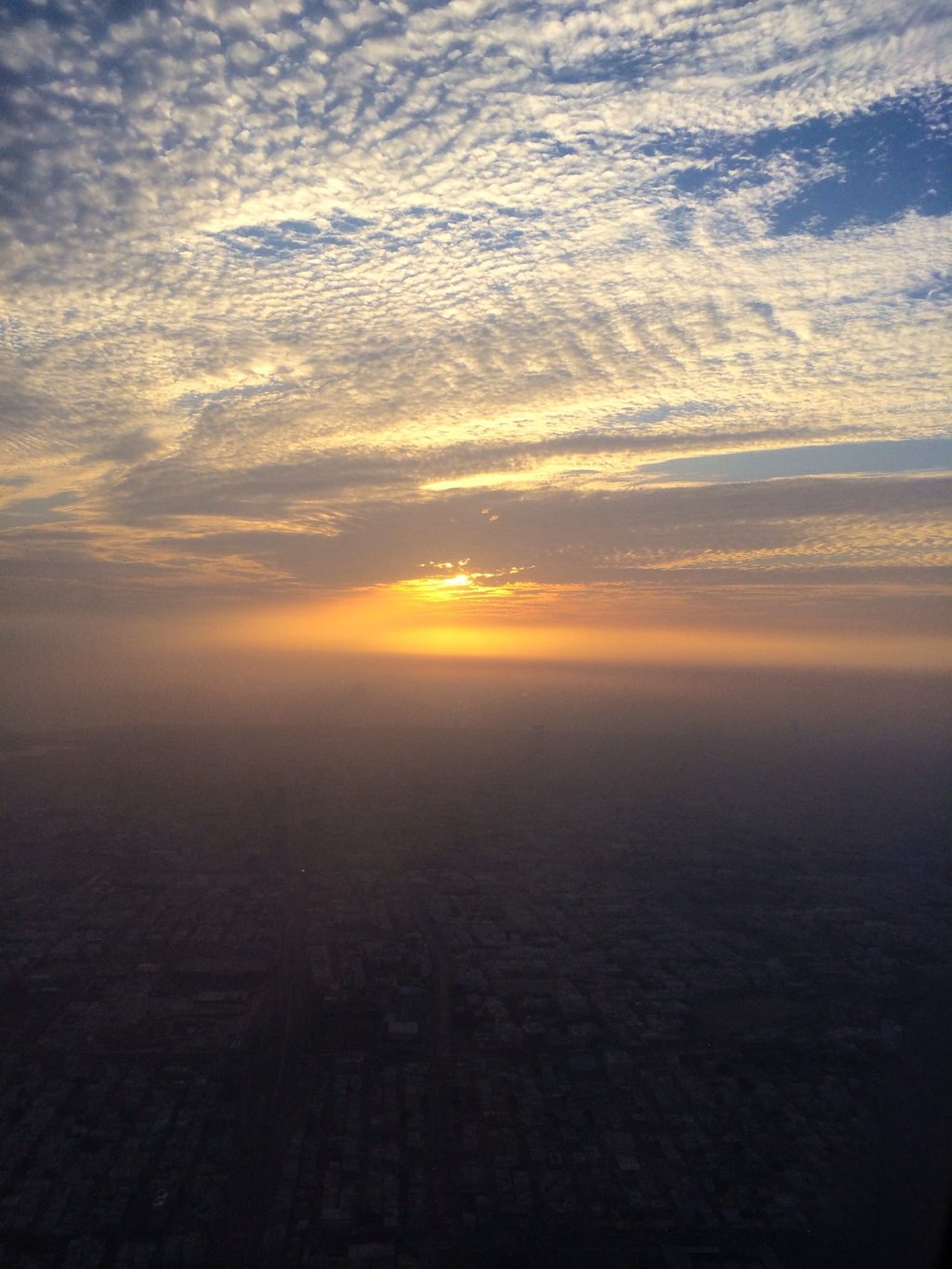
    Sunset over Jeddah
    Sunset over Jeddah

    Turns out that the Frankfurt-Addis leg has recently changed routing, now stopping in Jeddah and then onwards to Addis. Packed flight and as I subsequently learned filled with families going to Jeddah for the hajj in the holy city of Makkah in Saudi Arabia. Over the course of the 5 hour flight I watched a fascinating transformation as dozens of men of all ages, for the most part ordinary and nondescript in running shoes and jeans or street clothes, went to the bathrooms and emerged in what I imagine is hajj dress. All of them variations on a theme of white cotton fabric with white cotton terry or velour geometric designs woven into the fabric, white on white. The clothes consisted of a white wraparound kilt which extended to ankle length, bare feet in sandals and bare above the waist but swathed in a sort of shawl over the shoulders which left midriffs bare. It was like watching butterflies emerge from cocoons; drab, mass-produced western clothing suddenly replaced by a more uniform but powerful form of dress.
    Flight was very interesting; flew directly south over the Adriatic and could see that we were following the coast for its whole length until we crossed Greece and over the Mediterranean to Egypt. We crossed into Egypt just west of Alexandria and followed a long diagonal across Egypt towards the Red Sea which, because the diagonal was closely parallel to the Nile, allowed me see the vast expanse of the red-brown desert, broken by hills and the long, long extent of the Nile which our diagonal finally crossed as we moved towards the Red Sea.

    Arrived in Jeddah as the sun was setting and as we were on our final approach the pilot suddenly kicked the plane into high gear, aborted the landing and accelerated back up to altitude. PA announced that the tower had instructed the pilot to abort for safety reasons but that was all the explanation we got. Circled for a while and then landed without incident.

    Plane was an Airbus 300 so a big plane and after the pilgrims exited there were very few of us left. We were not allowed to deplane but stayed on board while we refuelled and waited to depart, about an hour or so. The purser came around to each seated passenger and explained that there were two brand new and just-qualified stewardesses in the crew who were on their first official flight. She had 2 T-shirts and asked us each to write a little note and sign it in Magic Marker on each shirt and said that she’d be presenting them to the 2 crew before departure and that they would wear them for the flight. Great fun and after everyone signed them there was still room to write so that gives some idea of how few of us there were left. The 2 new stews were thrilled, proudly wore their shirts and were pleased to show them off so a very easy, relaxed and pleasant 2 hour flight into Addis.
    I asked the purser while I was doing my shirt-writing if we were going to be picking up passengers in Jeddah but she said that Lufthansa only had deplaning rights but not pick-rights in Jeddah so I imagine that they had changed the routing from Khartoum to Jeddah in order to take advantage of the opportunity to transport pilgrims to Jeddah. Even though they flew with a virtually empty plane to Addis, I don’t expect that they would have picked up many new passengers had they flown their usual route into Khartoum.

    Once arrived, tired, scruffy and badly in need of a beer and a shower I expected that it would be an easy run through the formalities and on to my hotel. Picked up my bag from the luggage carousel and got onto the tail end of a very long queue waiting to get through customs where all the bags were being x-rayed. However the obvious tourists were plucked out of the line and shown a fast-track gate which seemed to open directly into the arrivals hall and as I was pushing my luggage cart towards the arrivals hall I was stopped by a young couple dressed in street clothes who asked me for my passport. Thinking that they were hotel or taxi touts I simply kept going but just before I entered the arrivals hall they stood in front of the cart and started to push it over to one side while continuing to demand my passport. I noticed the same thing happening to the other 4 or 5 passengers who were also fast-tracked, so following them, I was directed to tables where our accosters collected passports and began to open bags. I can safely say, having been through dozens of customs inspections in dozens of countries in every state of economic and political advancement and failure that I have never been more thoroughly worked over than in the Addis airport.
    Let me also preface this by saying that after Ethiopia we are going on to Kenya and the Masai Mara for a photo safari so I had brought 2 big Canon cameras, a 5DIII and a 7D along with 4 lenses, 2 of them very big indeed and 1 of them a 300mm lens, weighs 2 kilos and takes up one whole section of my travelling camera bag, all intended for Kenya and wildlife photography. One of my chief worries in Ethiopia has been what to do about this kit since I did not want to haul it around and had planned to ask the Sheraton, our hotel for our first and last nights, if I could leave it with them. In addition I had a Fuji X-E1 and an X-E2 with a couple of lenses for them since for the sort of traveling that we will be doing in Ethiopia, I wanted small and unobtrusive equipment for street shooting and people shots. When the various plugs, filter, batteries, chargers other bits and pieces were added in quite frankly it was a massive haul, filled a 30L camera bag and weighed about 16 kilos!

    When my little customs people, as they turned out to be, found all this their joy was unalloyed and I could see bonuses flashing in their eyes as they believed they had single-handedly caught the biggest camera smuggler on their watch. My Amharic being non-existent and their English hardly better I could see that there were problems ahead. We then spent 2 1/2 hours going every way but forwards as we tried to sort this out. I was able to gather that I needed to have a letter from my travel agency stating that I was a tourist and without this letter I could not enter Ethiopia with all this equipment since real tourists did not travel in the way that I was attempting to do. I told them that someone from the tourist agency was waiting for me in the arrivals hall and they would be able to explain who I was and straighten things out. They let me go to the arrivals hall to find my driver but for the first time in all my travels, no driver was in evidence.

    At this point my credibility was non-existent and dropping into negative territory and I still did not know quite what my crime was and they wouldn’t return my passport. Potential smuggler, under-cover journalist? Fortunately I had a printed copy of my itinerary and this I showed them with the name of the travel agency and a list of hotels where we were staying and places we were traveling to. They then indicated that I should call the agency but without a local sim card I was not going to attempt a local call in Ethiopia given Bell’s roaming rates so they called the agency for me but at that time of night, now 22:30, of course there was no one there. We seemed to be at an impasse and during all this time I had gone through all the various methods of dealing with things like this, angry, resigned, cheerful and problem-solving, angry again, friendly and cooperative again but all to no avail. While all this was going on various people came and went, periodically pawing through my bags and cheering when they found a pair of binoculars or an iPad or my laptop, presumably as adding to the evidence that I was not a real tourist. (I know I deserved it, over-privileged western white male!) Lots of chat amongst the various players while I continued to show my itinerary and tell anyone who would listen or could understand that I was simple tourist who was thrilled to be there and couldn’t wait to visit all the fascinating places on my itinerary. After about an hour a couple of the guys started to warm up and talk to me about the Northern part of Ethiopia and the rock churches and the angel Gabriel and Moses and the birth of christianity and the ark of the covenant at great length in marginally understandable english. I agreed wholeheartedly with the sermons, nodded in what I hoped were the right places and looked friendly and pious. They then seemed to accept that I was a misguided tourist and was properly contrite and I could see them trying to sell this to the little firecracker of a woman who kept pointing to the cameras and lenses and clearly was not buying the story.

    The second hour was then spent with my new friends, the two customs guys, trying to convince the customs woman that all was good and I should leave and come back tomorrow with a letter from the Ministry of Communications to support the fact that I was a tourist and all was ok but she was having no part of it. And before I get comments about the situation and my attitude, I do get the irony of it, I really do, and am appropriately contrite!! The two customs guys tried to explain to me that there was a black market in expensive cameras and the law said that without an official letter the cameras and lenses could not enter since I might otherwise sell them for a huge markup. Makes no sense since this problem is not unique to Ethiopia and in other jurisdictions you must declare everything you bring in and then must be able to produce it if requested when exiting the country. There had to have been more to the story since the fear seemed to be centred around my being a professional photographer and if that was the case I presumably needed official sanction if I was going to do a story on the country. However, I digress.

    After 2 1/2 hours we filled in a long official form listing all the equipment that they took exception to, we all signed it, I locked the case, they gave me a receipt and they have kept it until I return with the relevant documentation, or and this is my great hope, or I pick it up when we leave for Kenya. I will confirm this tomorrow and if they will keep it until I pick it up in a couple of weeks, a problem solved since I don’t need the Sheraton to look after it for me. Proving once again that there is always win in there somewhere if you only know where to look. We all had a pretty intense couple of hours, got to know each other a little, had a little fun along the way and all left with our honour intact. Exciting, and I’ve had worse intros to countries.

    Found the last taxi left in the deserted terminal, paid an exorbitant amount in $US for a ride to the hotel and am sitting on the outside of a very cold beer while I write my notes. Tomorrow will phone the agency and try and find why my driver was not in the airport or why I was not told that I needed a letter. Problem for another day.

  • Off to Ethiopia in a couple of days. This trip, 28 days, of which 16 will be spent in Ethiopia and 8 in Kenya’s Masai Mara, was fun to put together and is a wonderful example of changing horses in mid-stream and surviving the swap. When we traveled in South Africa 2 years ago we knew that we wanted to return to africa and left the idea to marinate while we got on with other things. However when Aeroplan issued its misguided policy change that required airline travel points to be used within 7 years of issuance or lose them, we were forced to act. Between us, we had over 400,000 points that were issued more than 7 years prior to the policy start date and they would all have been lost had they not been used by the end of 2013 and so last winter, with some urgency, we began to think about what a trip would look like.

    We knew that we wanted to see the Serengeti and/or the Masai Mara but didn’t know much more than that, so back to Susie and Rich Prangley at African Avenue who had done such a fabulous job of planning our South African trip. Susie, in the final stages of pregnancy with their first babe, put a trial itinerary together which had us renting a car and self-driving through Namibia and then flying to Kenya for some time in the Serengeti. Lots left to be decided and many details to be worked out but it felt as if the skeleton was workable and we were comfortable that with some fine-tuning we could build a good working plan. Our tickets had to be booked by Dec 31 in order to use aeroplan points but when I learned that the trip could be taken after Dec 31 as long as the tickets were booked prior to that date, time pressures ceased to be a problem. Then a monkey wrench in the works.

    We were invited by a very good friend to dinner and a talk by Naomi Duguid, an intrepid traveler, photographer and cookbook author who has written a number of fabulous cookbooks chronicling her travels and built around local recipes. We have collected them all; Hot Sour Salty Sweet: A Culinary Journey Through South-East Asia; Seductions of Rice; Flatbreads and Flavors; Mangoes and Curry Leaves; and Beyond the Great Wall: Recipes and Stories from the Other China. So when we were invited to hear her talk about her latest book,  Burma: Rivers of Flavor, we were very much looking forward to it since we have traveled to Burma a number of times over the last 15 years, loved it  and were keen to hear her talk about her experiences.

    I was fortunate to be seated next to her at dinner and we had an interesting conversation about places that we had been and places that we would still like to get to. I then asked her the fateful question; “Where in Africa are you most attracted to as a place to visit or re-visit?” and her answer naturally was… Ethiopia. She had visited it and was glowing in her praises of the country and the people. She went on to say that she had not spent as much time as she would have liked and would love to get back and spend more time. I gathered that it ticked all her boxes; geographically diverse country; fascinating peoples; long, rich history; very rich cultures; not yet westernized; and in the throes of change. A place to be seen, much like Burma, sooner rather than later. The damage was done and our previous ideas about our trip flew out the window, now replaced by Ethiopia.

    Susie was very gracious about the change of plans and while pleased to try and help, had not worked in that part of the world and so tried to find someone for us who was more knowledgable about the region. This process took some months as we dug around to try and find someone who knew the region well and with whom we felt comfortable. At the same time V found a photographic safari run by David Lloyd, a very well-known wildlife photographer. He was planning to run a couple of week-long safaris out of a small tented camp in the Masai Mara, limited to only 6 people, and intended for photographers. The timing was perfect, March 2014, and he had 2 spots still available which we immediately grabbed. So, we have a week in the Masai Mara for the last week in March and V’s mother’s 101’st birthday on March 3, which we absolutely can’t miss, bracketing the front of the trip. We needed to create an Ethiopian itinerary between the birthday and March 22 when we meet David Lloyd in Nairobi.

    Our research to find a travel planner who knew the region quickly fell into two piles, travel organizers who were located in the UK or North America who were reported to be reliable, with good reputations and who were available for phone chats to discuss plans and itineraries and planners who were resident in Addis Ababa, were not easily available from NA but would be from Ethiopia and who did not have the references and marketing machinery of the UK/NA companies. I put together a trial itinerary with locations and hotels based on TripAdvisor suggestions and asked a couple of UK/NA companies to quote on the cost of booking a car and driver for the trip and reserving rooms in the hotels on my sample itinerary. I also spent some time digging around on TripAdvisor for recent travellers to Ethiopia to get some idea of their experiences and narrowing down the list of Ethiopian-located travel organizers who seemed to get the best reviews and highest ratings. I then submitted my trial itinerary to a short-list of these and asked them to quote on the trip.

    Not surprisingly there was a significant gap between the Ethiopian and the UK/NA quotes but more surprising was the size of the gap. For the exact same hotels and level of service, all with local cars and drivers, the difference between the two sets of quotes was on average between 30% and 40% more to book through UK/NA firms. At that point it was a no-brainer and so we are going with a company called Amazing Ethiopia which seems to be highly thought of by TripAdvisor travellers.

    Here’s our itinerary. The Classic Historic route and the Omo valley

    By coincidence a couple with whom we are friends has recently returned from an Ethiopian trip whose itinerary shared some of the same components as ours. They could not say enough good things about their trip and spoke very highly of their guide who they thought made all the difference in creating a really worthwhile experience which allowed them to feel that they were more involved and closer to the cultures than would have otherwise been the case. I got in touch with the folks at Amazing Ethiopia and since their guide was freelance, they made arrangements to have him be the guide for our trip. So on Tuesday, off on the start of the adventure and really looking forward to it!

    Special thanks to Naomi Duguid for lighting the fire and inspiring the trip and to Eleanor and Diane, the recently returned travellers, for their help and advice.